Foundations of Biological and Cognitive Psychology: Visual Perception
 Call Kai
 Learn
Learn Practice Test
 Spaced Repetition
 Match
Match Flashcards
 Knowt Play
1/42

Earn XP
Description and Tags
These flashcards cover key concepts in visual perception, including sensation, perception, the processes involved in visual information transmission, and details about photoreceptors.
Name | Mastery | Learn | Test | Matching | Spaced | Call with Kai |
|---|
No analytics yet
Send a link to your students to track their progress
43 Terms
Sensation
The starting point of perception; it involves receiving information about the world through our senses.
Perception
The end point of sensation; it is our experience of the world.
Distal Stimulus
The physical object in the environment that is perceived.
Proximal Stimulus
The representation of the distal stimulus received by sensory receptor cells.
Transduction
The transformation of environmental physical energy into electrical energy in the nervous system.
Photoreceptors
Light-sensitive cells in the retina that carry out transduction of light into electrical impulses.
Rods
Type of photoreceptor that is highly sensitive to light and enables vision in low-light conditions, but does not support color vision.
Cones
Photoreceptors responsible for color vision and function best in bright light.
Acuity
The ability to detect fine details of a stimulus.
Top-down processing
Perception processing based on prior knowledge, experience, or assumptions.
Bottom-up processing
Perception processing based on incoming sensory information.
Visual Perception
The process by which the brain interprets visual information received from the eyes.
Fovea
The small central area of the retina that contains only cones, responsible for sharp central vision.
Neural Processing
The process where electrical signals are transmitted and changed as neurons interact.
Retinal Ganglion Cells
Neurons located in the retina that relay information from photoreceptors to the brain.
Neural convergence
The process where multiple photoreceptors send signals to a single ganglion cell, affecting the acuity of vision.
Acuity
The ability to detect fine details of a stimulus; high acuity corresponds to clearer vision.
Illusion of perception
The phenomenon where perception seems effortless, yet is a complex and intricate process.
Practical applications of perception
Understanding changes in perception due to aging, disease, or injury; informing the design of technology and artificial perceptual systems.
Psychophysical approach
A method of studying perception that measures the relationship between physical stimuli and the sensations and perceptions they evoke.
Physiological approach
Study of the biological mechanisms of perception, including brain activity and anatomy.
Retinal distribution
The variance in the distribution of rods and cones across the retina, affecting sensitivity and acuity.
What is the perceptual process
What is the Distal stimulus?
What is the Proximal stimulus?
The information about the distal stimulus that is directly received by our sensory receptors, representing the physical properties of the stimulus in our environment.
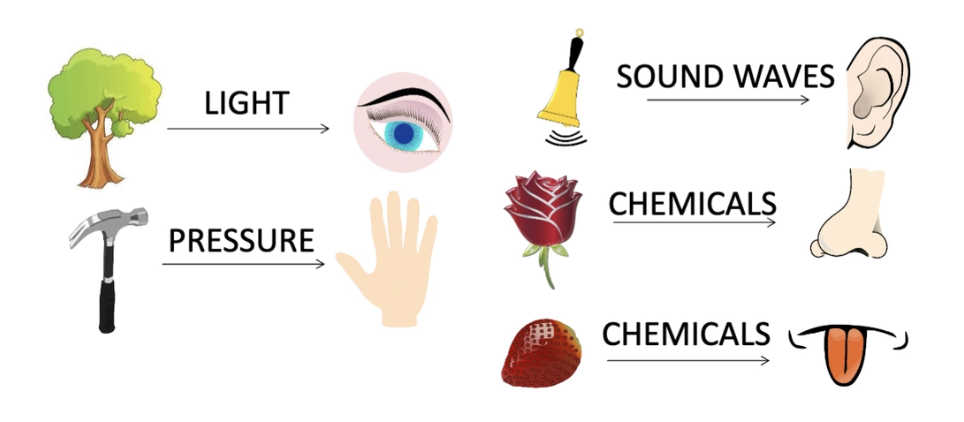
Each sense receives info about distal stimulus via a different type of environmental physical energy.
e.g light via eyes → sound waves via ears → pressure via touch → chemicals via smell → chemicals via taste
What is sensation primarily concerned with?
A) Interpretation of sensory input
B) The detection of physical stimuli
C) The biological mechanisms behind perception
D) The conscious awareness of stimuli
B
Which type of processing begins with the sensory input?
A) Top-down processing
B) Bottom-up processing
C) Neural processing
D) Cognitive processing
B
What role does neural convergence play in vision?
A) It enhances color perception
B) It reduces sensitivity to light
C) It combines signals from multiple photoreceptors
D) It eliminates visual illusions
C
What kind of vision do rods primarily support?
A) Color vision
B) High-acuity vision in bright light
C) Vision in low-light conditions
D) Detailed and sharp vision
C
Which part of the retina contains only cones and provides the highest acuity?
A) Rods area
B) Fovea
C) Periphery
D) Ganglion cell layer
B
In terms of perception, what does the term 'psychophysical approach' refer to?
A) Biological mechanisms of perception
B) Relationship between physical stimuli and sensory reactions
C) Influence of culture on perception
D) Neural pathways in perception
B
What is the significance of understanding the 'illusion of perception'?
A) It simplifies sensory processing
B) It reveals the complexity behind seemingly straightforward experiences
C) It reduces the need for sensory adaptation
D) It demonstrates the limits of sensory information
B
What is the primary goal of sensation and perception?
To find out about and interpret the external world.
Define "Sensation" in the context of the perceptual process.
The starting point; it is the process of receiving information from the environment via our senses.
What are sensory receptor cells?
Specialized neurons sensitive to specific physical properties of the world (e.g., light, sound, pressure).
Define "Perception."
The end point of the process; it is our conscious experience of the world.
Why is perception often called an "illusion" of ease?
Because it feels effortless and instantaneous to us, even though it involves incredibly complex biological and computational processes.
How do artificial perceptual systems compare to human perception?
They have been historically very difficult to develop, highlighting just how complex and "incredible" natural human perceptual systems are.
From an evolutionary standpoint, why is perception vital?
It allows for survival by enabling us to interact correctly with our environment.
What are three practical applications for studying sensation and perception?
1. Understanding changes due to aging, disease, or injury.
2. Analysing the demands of driving or interacting with technology.
3. Designing artificial perceptual systems (AI/Robotics).
Which is more complex: identifying an object (Sensation) or experiencing/interpreting it (Perception)?
Perception. While sensation is the input, perception is the complex processing of that input into a meaningful experience.
What are the three main components of the visual system mentioned in the outline?
1. Light (the stimulus)
2. The Eye (the structure)
3. The Retina (the processing surface)