NES Math Test
 Call Kai
 Learn
Learn Practice Test
 Spaced Repetition
 Match
Match Flashcards
 Knowt Play
1/43

There's no tags or description
Looks like no tags are added yet.
Name | Mastery | Learn | Test | Matching | Spaced | Call with Kai |
|---|
No analytics yet
Send a link to your students to track their progress
44 Terms
Cardinality
understanding that last number counted in a set represents the number of objects
seriation
putting items in order from biggest to smallest
subitizing
knowing number of objects without counting
5 stages of counting
1) count all
2) count on: counting each item once
3) maintain cardinality
4)stable order
5)conservation of numbers
real numbers
any numbers that can be put on a number line
rational numbers
any number that can be written as a fraction
natural numbers
counting numbers including all whole
integers
all whole and negative numbers without a decimal
irrational numbers
numbers that cannot be represented in fraction form
digit
written symbol representing numbers 0-9
expanded form
identifying a number by adding all of the values of each digit
expanded notation
complete view of how we arrived at the value of each digit
period
group of 3 numbers separated by a comma
commutative property
sum will remain the same regardless of order of addend/factors
addition and multiplication
associative property
when 2 or more of the same operation are in an expression the sequence in which you perform them does not affect the outcome
identity element
when a number if multiplied by 1 or 0 is added it remains the same
concrete models
pictorial representations of mathematical operations
prime number
whole number that can only be divided evenly by 1 and itself
composite number
number that can be formed by multiplying 2 smaller integers
combination formula
nCr=(n!/r!(n-r)!)
n=number of items you choose from
r=number of items you choose
factoral
product of all whole numbers from the number down to one
-ex. 7!=7×6×5×4×3×2×1=5040
least common denominator
smallest whole number that is a multiple of both denominators
early elementary tools
10 frame
counters
unifix cubes
base 10 blocks
pattern blocks
elementary age tools
money
rulers
timers
protractors
calculators
measuring containers
inductive reasoning
relies on patterns and trends
deductive reasoning
relies on facts and rules
mode
number that occurs most often in data set
median
number in the middle of a data set when they are listed from least to greatest
mean
average of a data set
range
difference between largest number in data set and smallest number
left skew
left side of distribution is longer
median>mean
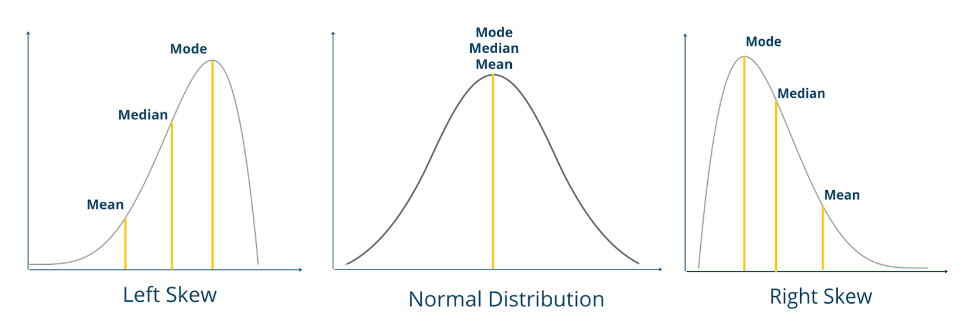
right skew
right side of distribution is longer
mean>median
standard deviation
measurement of spread
variable
quantity that can change
usually represented by a letter
constant
quantity that does not change
algebraic equation
contains an