AH Biology - Unit 1 - KA3(a) - Movement of Molecules Across Membranes
 Call Kai
 Learn
Learn Practice Test
 Spaced Repetition
 Match
Match Flashcards
 Knowt Play
1/19

There's no tags or description
Looks like no tags are added yet.
Name | Mastery | Learn | Test | Matching | Spaced | Call with Kai | Chat |
|---|
No analytics yet
Send a link to your students to track their progress
20 Terms
What are the cell membranes made up of?
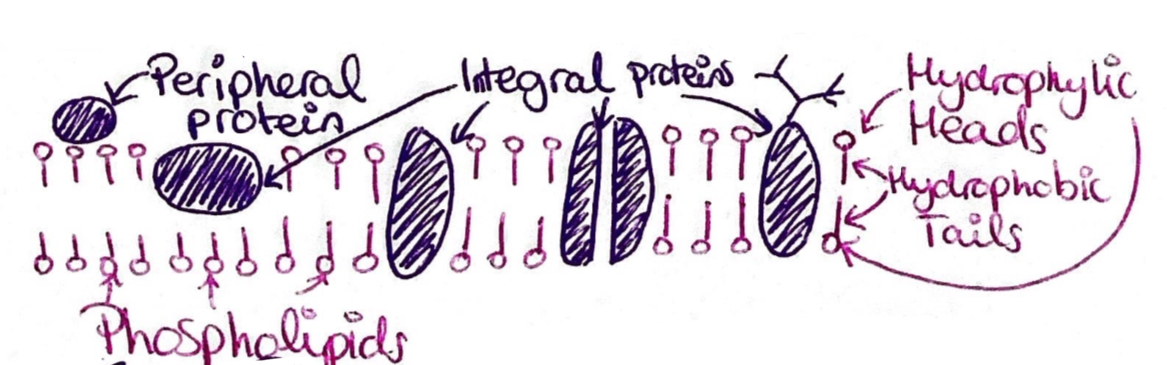
The cell membranes are made up of a phospholipid bilayer and proteins arranged in a fluid mosaic model.
The fluid is moveable phospholipids.
The mosaic is proteins placed through like mosaic pieces.
What are the two types of membrane proteins?
The two types of membrane proteins are:
Integral membrane proteins
Peripheral membrane proteins
What are characteristics of integral membrane proteins?
Integral membrane proteins:
At least part of these proteins are found inside the membrane.
Some integral proteins are transmembrane proteins. This means that they go through the membrane completely from one side to the other.
They contain regions of hydrophobic R groups which allow them to have strong hydrophobic interactions with the hydrophobic tails of the phospholipids. These interactions hold the integral proteins within the phospholipid bilayer.
What are characteristics of peripheral membrane proteins?
Peripheral membrane proteins:
Are found on the surface of the membrane.
Have hydrophilic R groups on their surface.
Are bound to the surface of membranes, mostly through ionic and hydrogen bonding.
Many of these peripheral membrane proteins interact with the surfaces of integral membrane proteins.
What does the phospholipid bilayer act as?
The phospholipid bilayer acts as barrier to ions and most uncharged polar molecules. Some small molecules can pass through the phospholipid bilayer, such as oxygen or carbon dioxide. Other molecules have to diffuse through specific transmembrane proteins by facilitated diffusion.
Which molecules can pass through the phospholipid bilayer and which can’t?
Some small molecules can pass through the phospholipid bilayer, such as oxygen or carbon dioxide. Other molecules have to diffuse through specific transmembrane proteins by facilitated diffusion, such as glucose molecules which move through the GLUT4 transporter.
Where does simple diffusion occur through?
Simple diffusion occurs through phospholipids.
Where does facilitated diffusion occur through?
Facilitated diffusion occurs through transmembrane proteins.
To perform specialised functions, what do different cell types have?
To perform specialised functions, different cell types have different specialised channel and transporter proteins to transport different substances across the membrane.
What are channel proteins?
Most channel proteins in plant and animal cells are highly selective, only specific substances can pass through them. Channel proteins are normally multisubunit proteins and the subunits are arranged to form water-filled pores that extend across the membrane. Channel proteins allow for facilitated diffusion.
What are gated channel proteins?
Gated channel proteins are channel proteins that are gated. They change conformation to allow or prevent diffusion.
What are ligand gated channel proteins controlled by?
Ligand gated channel proteins are controlled by the binding of a signal molecule.
What happens when the signal molecule is not bound to the channel protein of a ligand gated channel protein?
When the signal molecule is not bound to the channel protein of a ligand gated channel protein, the ligand gated channel protein is in the closed formation and molecules cannot diffuse.
What happens when the signal molecule bound to the channel protein of a ligand gated channel protein?
When the signal molecule is bound to the channel protein of a ligand gated channel protein, the ligand gated channel protein is in the open formation and molecules can diffuse.
What are voltage-gated channel proteins controlled by?
Voltage-gated channel proteins are controlled by changes in ion concentrations across the membrane, leading to a change in the membrane potential across the membrane.
What happens to the voltage-gated channel protein, when there is an equal charge across the membrane?
When there is an equal charge across the membrane, the voltage-gated channel protein is in the closed formation.
What happens to the voltage-gated channel protein after there is a build up of positively charged ions on one side of the membrane?
After there is a build up of positively charged ions on one side of the membrane, there is now an overall positive charge on one side of the membrane. This difference in ion concentration triggers the voltage-gated channel proteins to change conformation and open.
How do transporter proteins work?
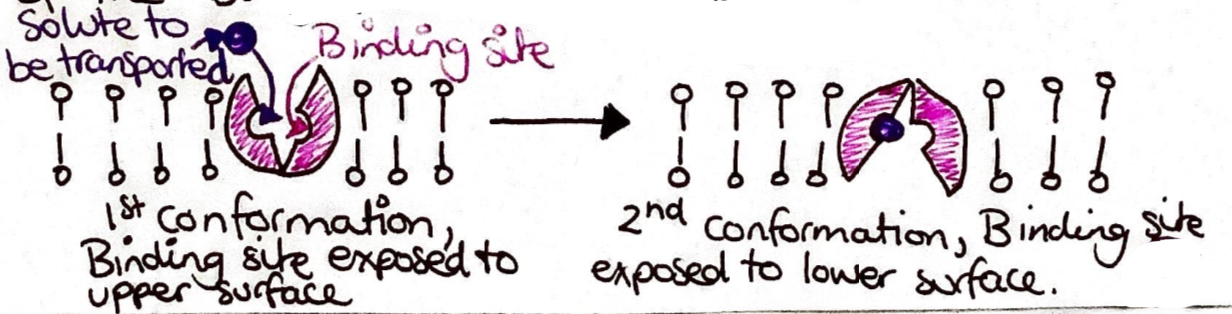
Transporter proteins bind to a specific substance or solute to be transported across the membrane. They undergo a conformational change and this change transfers the solute across the membrane. As they switch from one conformation to the other, the binding site for the solute is exposed on one side of the bilayer, then on the other.
What are pumps?
Pumps are transporter proteins that mediate active transport. They transport substances against their concentration gradient. They are coupled with an energy source and require a source of metabolic energy for active transport to take place.
What do some active transport proteins (pumps) do?
Some active transport proteins (pumps) hydrolyse ATP directly using ATPases directly to provide the energy for the conformational change required to move the substance across the membrane.