BI 451 Inverts Exam 1 (Cnidaria)
 Call Kai
 Learn
Learn Practice Test
 Spaced Repetition
 Match
Match Flashcards
 Knowt Play
1/15

There's no tags or description
Looks like no tags are added yet.
Name | Mastery | Learn | Test | Matching | Spaced | Call with Kai |
|---|
No analytics yet
Send a link to your students to track their progress
16 Terms
Cnidaria (a stinging thread)
Polyp and medusa stage
Radial symmetry
Blind gut (Coelenteron = GVC)
Diploblastic - only 2 distinct germ layers, ectoderm (epidermis) and endoderm (gastrodermis) + mesoglea (non-living gelatinous layer)
Cnidae
Nerve net
Lack of circulatory, respiratory, and excretory systems, but have cilia and gastrovascular canals (radial to ring canals)
Complex life cycle - sexual and asexual reproduction and planula larva
Some w/ colonial polymorphism
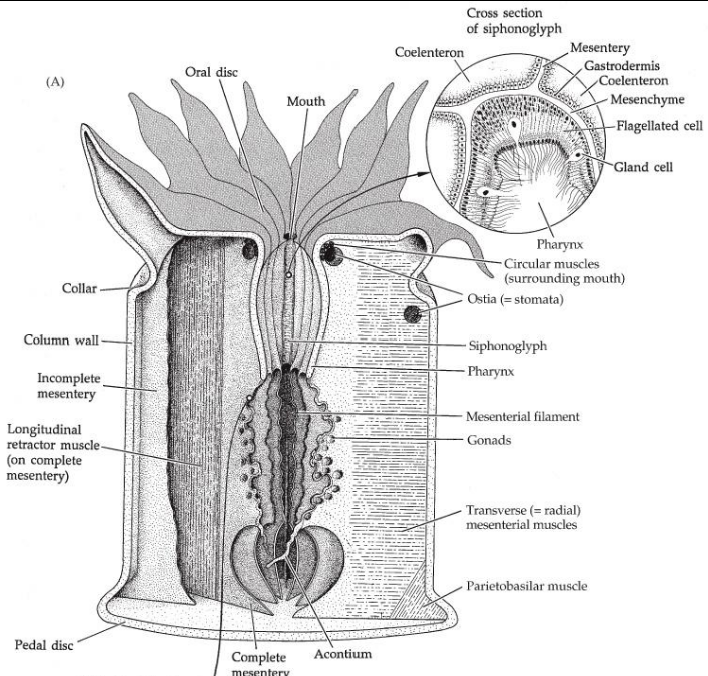
Anthozoa
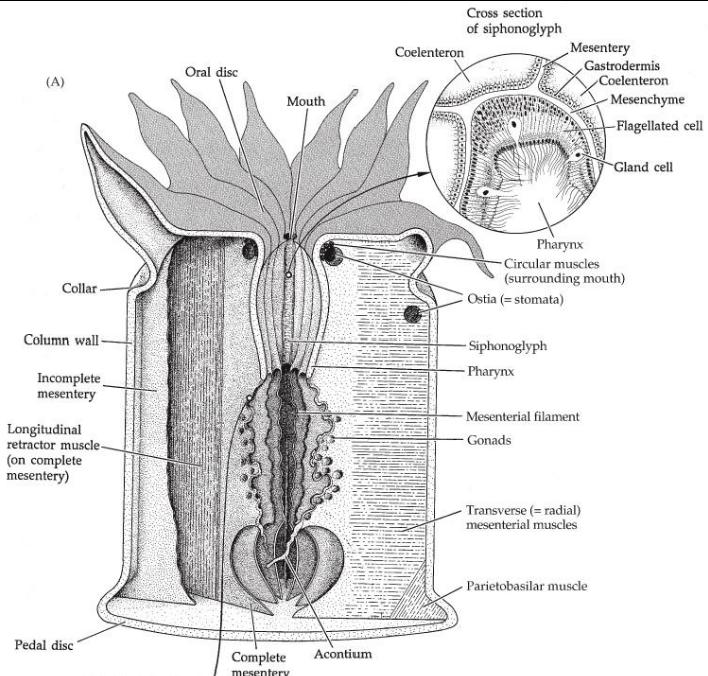
Subphylum of cnidaria, characterized by a lack of a medusa stage, circular mt DNA, presence of pharynx and siphonoglyph, GVC w/ mesentaries/septa
Contains the two subclasses:
Hexacorallia
Octocorallia
Epitheliomuscular Cells
Clone
Genetically identical replicates, can be separate individuals produced asexually
Colony
A collection of repeating units (individuals or zooids) that are interconnected
Each zooid can have its own digestive system, gonad, and behavior; but its interconnected w/ other units permits coordination such as sharing of nutrients, division of labor/specialization of function
Cnidae
Unique organelles in cnidocytes that are used in prey capture
Each cnidocyte contains one of three types of cnidae:
nematocyst - stinging
spirocyst - sticky
ptychocyst - sticky
Requires mechanical or chemical stimulation to fire
Nerve Net
Complex, 2D net of neurons
1 on epidermis
1 in gastrodermis
Joined by neurons that bridge mesoglea
Diffuse conduction
Septa
Anthozoan Sexual Reproduction
Most are dioecious (anemones) some are monoecious (stony corals, synchronized spawning)
Some brooding
Most external fertilization
Anthozoan Asexual Reproduction
Longitudinal or transverse fission
Pedal laceration
fragmentation
Actiniaria
Order of anthozoans containing sea anemones
Characterized by:
Solitary
Lack specialized protective covering
Covered in extra potent nematocysts: Acontia, Acrorhagi, Catch Tentacles
Acontia
Threadlike tissues composed of stinging cells that can be ejected through the mouth or specialized pores of anemones
Acrorhagi
Venomous bulbous structures located at the margins of certain sea anemones, used in defending territories against conspecifics (other genets = non-clones)
Catch Tentacles
Functionally similar to acrorhagi, and develop when genets are present
Functions of a Skeleton
Maintain body shape
Provide support/protection
Serve as attachments for muscles
Transmit the force of muscle contraction to perform work
To extend relaxed muscles
Hydrostatic Skeleton