Quiz 4 Databases
 Call Kai
 Learn
Learn Practice Test
 Spaced Repetition
 Match
Match Flashcards
 Knowt Play
1/19

There's no tags or description
Looks like no tags are added yet.
Name | Mastery | Learn | Test | Matching | Spaced | Call with Kai |
|---|
No analytics yet
Send a link to your students to track their progress
20 Terms
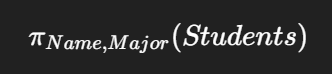
Operation that lets you select cols (Note about what is returned)
Only returns distinct stuff
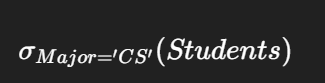
Operation that lets you filter cols
Operation for renaming

Group by operator

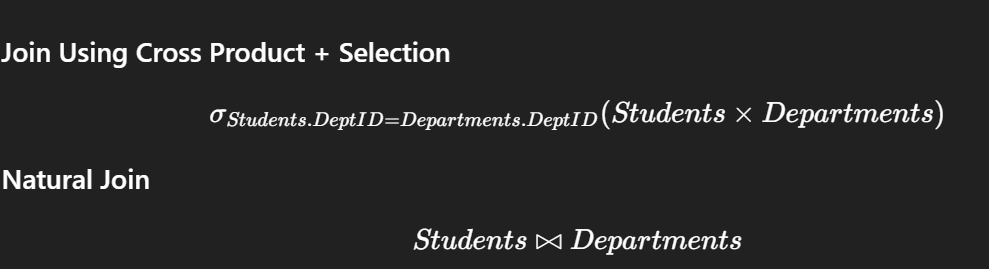
Two ways of joining
Superkey vs key
Superkey: Set of attributes that uniquely identifies a row
Key: Minimal subset of superkey (Can’t remove anything and still have a superkey)
Functional dependency meaning of X → Y
Knowing X means we know what Y is
Closure of X (X+) meaning (Note about trivial thing)
X+ = {…,…,…}
Where everything in that set is stuff that is determined by X
Trivial thing: X is included in the closure. So X+ = {X, …,…}
BCNF Requirement
For all functional dependencies, LHS should be a superkey
Entity in ERD
Square
Attributes in ERD
Circle
Relationships in ERD
Diamond
Derived attribtues in ERD
Dotted circle
Composite
Lines from other attributes connecting to the attribute
How to turn 1:N from ERD into a table
For the table that has the N, put the 1 side in as a FK
How to turn N:N from ERD into a table
Create a cross reference table
Put the PK’s of both sides into it as FK
Also include stuff that might be coming out of the relationship
How to handle recursive
Create a cross reference table
Put the pk and source_pk
How to handle multivalued
Create a cross reference table
Put the PK of the entity as a FK for the table
Put the multivalued attribute in
Basically, each row in the table is the PK of the entity (labeled as a FK), and one value of the multivalue. Repeats for that one PK for each attribute
Remembering which side the 1 and N goes on for ERD
“One ___ can have many ___”
Whatever answers the one gets the 1
BCNF Decomposition Algorithm (Note about result)
Start with one BCNF violating FD. LHS is X
Y = X+ = Closure of X
Z = Everything else
One table becomes Y
The other table becomes X U Z
Gets it closer to BCNF, but not guranteed.