bio 1002 Circulation and gas exchange
 Call Kai
 Learn
Learn Practice Test
 Spaced Repetition
 Match
Match Flashcards
 Knowt Play
1/77

There's no tags or description
Looks like no tags are added yet.
Name | Mastery | Learn | Test | Matching | Spaced | Call with Kai |
|---|
No analytics yet
Send a link to your students to track their progress
78 Terms
Circulatory systems –why have them?
Circulatory systems link exchange surfaces with cells throughout the body
They link exchange surfaces with cells throughout the body
Gases (oxygen, carbon dioxide)
Nutrients
Hormones
Three types of exchange
Three types of exchange systems (ish)
Gastrovascular cavity (not a system)
Open circulatory system
Closed circulatory system
Gas and nutrient exchange in a gastrovascular cavity: Simple form
Diffusion of gasses and nutrients between environment and cells of the body
Mouth opens into a cavity made of radial canals leading to and from a circular canals.
Cilia circulate fluid through the canals
Gas and nutrient exchange in a gastrovascular cavity Complex form
Diffusion of gasses and nutrients between environment and cells of the body
Mouth and pharynx open into a highly branched cavity
why The need for a circulatory system
Larger body size
More complex body plans
Higher metabolic rates
Circulatory systems evolved along with specialized tissues for digestion, and more complex cell-to-cell communication via hormones
Circulatory systems have vessels and a pumping mechanism (organism specific)
Open circulatory system
Fluid is called hemolymph
The heart pumps hemolymph into sinuses (spaces surrounding organs)
Chemical exchanges (gases, nutrients) happens in the sinuses
Relaxation of the heart draws hemolymph back into heart
hemolymph
fluid of an open circulatory system
Closed circulatory system
Fluid is called blood
Blood is contained within vessels and heart (never leaves the system)
Chemical exchanges (gases, nutrients) happens between the blood and interstitial flued and between interstitial fluid and body cells
Blood travels through branched system of blood vessels in one direction
Arteries
carry blood away from the heart
Central cavity lined with endothelium (single layer of flattened epithelial cells
Smooth muscle and connective tissue to aid in support and contraction
Connective tissue is much thicker and stronger, giving arteries elastic walls
No valves
endothelium
skin type cells
(single layer of flattened epithelial cells
Arterioles
branches of the artery within organs
Capillaries
microscopic blood vessels
Venules
branches of the veins within organs
Veins
carry blood back to the heart
Central cavity lined with endothelium (single layer of flattened epithelial cells
Smooth muscle and connective tissue to aid in support and contraction
Wall is about 1/3 size of an artery
Valves to maintain unidirectional blood flow at low pressure
The heart chambers
Atrium/atria
Ventricle(s)
4 types of vertebrate circulatory systems
Single circulation (e.g., fish)
Double circulation
systemic circuit
pulmonary circuit
systemic circuit
One circuit between heart and the rest of the body (systemic circuit)
pulmonary circuit
One circuit between the heart and the gas exchange surface
Three types of double circulation
Pulmocutaneous circuit
Pulmonary circuit – incomplete septum
Pulmonary circuit – complete septum
Single circulation
One circuit from heart to gas exchange surface (gill capillaries), body and back to heart
Heart has a single atrium and single ventricle
Single circulation Disadvantages?
-blockages effect everywhere
-not efficient
-heart is a muscle but only gets oxygen poor blood
Double circulation pulmocutaneous circuit/amphibian circulation
One circuit from heart to gas exchange surface (lung and skin capillaries)
One circuit from heart to rest of body
Heart has two separate atria and a ridge in the ventricle to partially separate oxygen rich/oxygen poor blood
Double circulation pulmonary circuit/reptilian circulation
One circuit from heart to gas exchange surface (lung capillaries)
One circuit from heart to rest of body
Heart has two separate atria and an incomplete septum in the ventricle to partially separate oxygen-rich/oxygen poor blood
Double circulation pulmonary circuit/mammal and bird circulation
One circuit from heart to gas exchange surface (lung capillaries)
One circuit from heart to rest of body
Heart has two separate atria and two separate ventricles (4 chambers)
Muscle walls of the ventricles are much __ than the atria
thicker
__ between the atria and ventricles (atrioventricular valves) and between ventricles and blood vessels (semilunar valves) prevent backflow
Valves
atrioventricular valves
Valves between the atria and ventricles
semilunar valves
valves between ventricles and blood vessels
lub dub sound
The blood recoiling against the AV valves makes a “lub” sound Vibration caused by the closing of the semilunar values makes a “dup” sound
Heart murmur
when blood squirts backwards through a defective valve
Can be born with, or as a result of infection
Does not always impact blood flow efficiency
Can be corrected surgically
the two circuits (pulmonary and systemic) happen , not __ as shown in the diagram!
simultaneously , in sequence
Heart contractions (cardiac cycle)
1. atrial and ventricular diastole
Both A and V are relaxed; blood flows from body into atria and then ventricles
2. atrial systole and ventricular diastole
A contraction forces all blood into ventricles
3. ventricular systole and atrial diastole
A relaxed, V contracts to pump blood into the large arteries (pulmonary artery and aorta
Cardiac output
Amount of blood pumped by each ventricle per minute
Heart rate
rate of contraction (number of beats per minute)
Stroke volume
amount of blood pumped by a ventricle in a single contraction
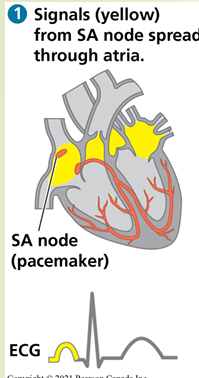
ECG (or EKG) electrocardiogram
measures electrical impulses produced by the SA node and the AV node
: sinoatrial node (aka pacemaker) atrioventricular node
why does blood flow slower in capillaries
Surface area of capillaries is MUCH bigger than arteries and veins
How many capillaries in a human body?
b.7 billion
blood pressure movement
Pressure drops from heart through to veins
Blood moves 500 times slower in the capillaries than aorta (0.1 cm/sec vs 48 cm/s; this allows exchange of materials between blood and interstitial fluid
Measuring blood pressure
The cuff is inflated until the pressure closes the artery
The pressure on the gauge exceed that in the artery
The cuff deflates gradually. As it reaches a pressure just below the pressure in the artery, the sounds of blood flowing can be heard in the stethoscope.
The pressure in the gauge is the systolic pressure
The cuff deflates until the blood flows freely and the sounds disappear..
The pressure in the gauge is the diastolic pressure.
What percentage of your capillaries have blood flowing through them right now?
a. 5-10%
movement through capillaries
Capillaries have no smooth muscle so blood flow is regulated with either
Smooth muscle contraction in the arteriole
Precapillary sphincters
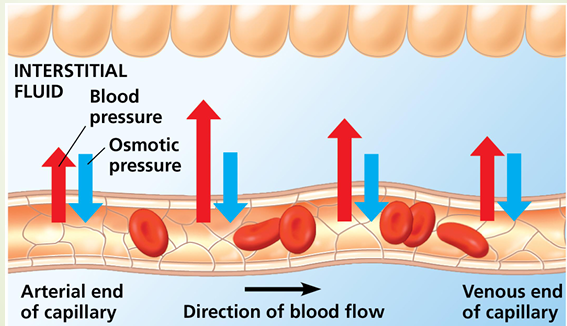
Movement of fluids between capillaries and surrounding tissues is via
Endocytosis and exocytosis of the endothelium
Diffusion
Via pores
Movement of fluid out of the capillaries is via blood pressure
Movement of fluid into the capillaries is via blood proteins
You body has about _ L of blood
5
Human blood is made up of two components:
Plasma (55%) Cellular elements (45%)
Blood plasma
Plasma is 90% water
Serum
plasma from which the clotting factors have been removed
Cellular elements of blood
Erythrocytes (red blood cells) are the most numerous
There are 25 trillion erythrocytes in your body
There are 5 types of leukocytes (white blood cells)
Platelets are pinched-off cytoplasmic fragments of bone marrow cells
Erythrocytes
red blood cell
Lack nuclei
Lack mitochondria
Small biconcave disks
Lack of nucleus means more room for hemoglobin proteins
Hemoglobin is an iron containing protein that transports O2
Leucocytes
5 types
neutrophils
basophils
eosinophils
monocytes
lymphocytes
Their main function is to fight infections.
They travel outside the circulatory system and can be found in interstitial fluid and the lymphatic system
Platelets
• Pinched off cytoplasm of specialized bone marrow cells
• 2-3 μm
• Aid in blood clotting
What happens when cut – blood cell level
1. Damaged blood vessel endothelium exposes connective tissue in the vessel wall to blood. Platelets in the blood attach to collagen fibres in the connective tissue. This makes nearby platelets sticky
2. Platelets form a plug to prevent blood loss
3. In larger breaks, the plug is reinforced by fibrin threads
gas exchange vs respiration
gas exchange:
Uptake of molecular O2 from the environment and discharge of CO2 to the environment
Happens in nostrils/tracheal lungs (human) Happens in gills (fish
respiration:
Cellular process referring to the energy transformation of sugars to ATP
Happens in the mitochondria (all organisms)
Important concept – partial pressure
Partial pressure: the pressure exerted by a gas or mixture of gasses.
Gasses always diffuse from regions of higher partial pressure to regions of lower partial pressure.
Gas exchange in water
When in equilibrium, the partial pressure of gasses in air equal that in water
However, concentrations differ because gases are less soluble in water than in air
More difficult to extract oxygen from water than air
Cells that carry out gas exchange have a __ that must be in contact with a solution; therefore all respiratory surfaces are always __
plasma membrane , moist
Gas exchange always takes place via __
diffusion
Diffusion is __when the area for diffusion is large and the path is short, because __
fastest
This influences morphology of respiratory surfaces They tend to be large and thin
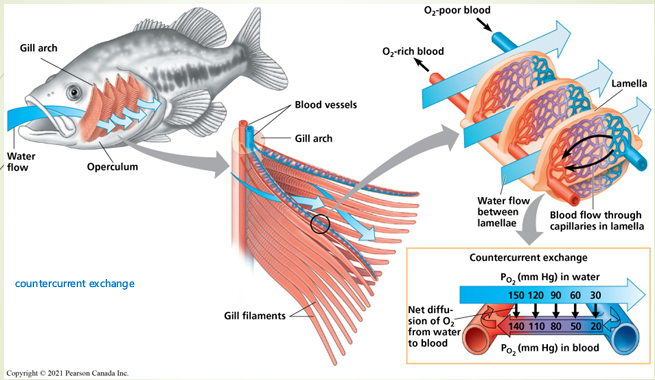
Gills
Out-foldings of the surface of the body suspended in water
Movement of the gills in water (ventilation) maintains the partial pressure gradients necessary for gas exchange
Different strategies for this…
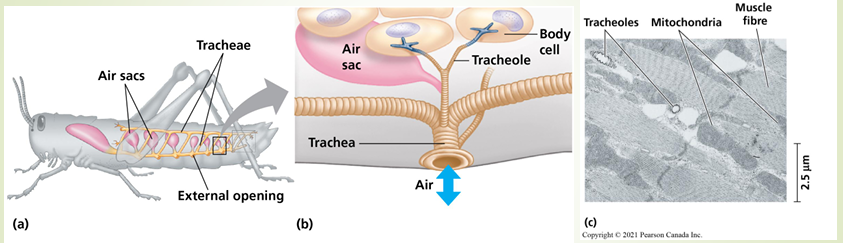
Tracheal systems
Lungs
Lungs are infoldings of the body
The gas exchange surface of the lung is not in direct contact with the rest of the body; thus the circulatory system bridges this gap and moves gases to/from the lungs/rest of body
airway pathway
Air enters via nostrils; nose hairs filter out particles, sample odors, and warm and humidify the air
The larynx contains muscular bands called vocal cords. Air passing these makes sounds
Air travels down the trachea (windpipe) \
Trachea separates into two bronchi (one to each lung)
Each bronchus branches into finer and minor tubes called bronchioles
The epithelium of the “tree” is covered mucus which traps particulates and cilia which beat these back upward to the pharynx, where it can be swallowed
At the end of each bronchiole are air sacs called __
alveoli
Humans have __ alveoli
millions
What is the total surface of the alveoli?
Positive pressure breathing
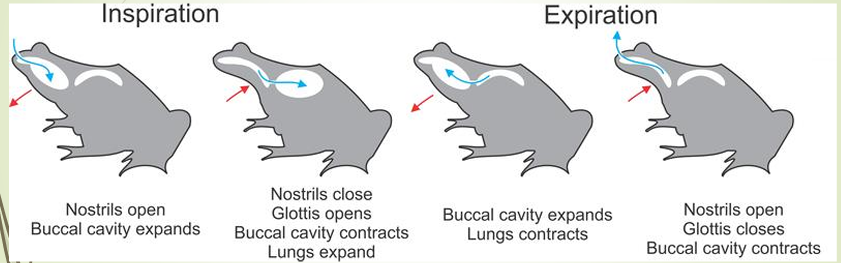
Bellows-breathing
• Efficient because air passes over the gas exchange surface in only one direction
• Incoming fresh air does not mix with air that has already carried out gas exchange
Negative-pressure breathing
Pulling air in, rather than pushing it into the lungs
Muscle contraction actively expands the thoracic cavity; this lowers the pressure in the lungs to below that of the outside world
Gas flows from high to low pressure, so can travel down the breathing tubes to alveoli
Tidal volume
how much air you inhale/exhale
What is human tidal volume at rest?
c. 500 mL
Vital capacity
tidal volume during maximal inhalation and exhalation
What is your max vital capacity if female?
What is your max vital capacity if male?
Residual volume
: air that remains in lungs after a forced exhalation
Why do we not exhale all the air in our lungs?
Mixing fresh air with oxygen depleted air means the maximum PO in the alveoli is always less than the atmosphere
Homeostatic control of breathing
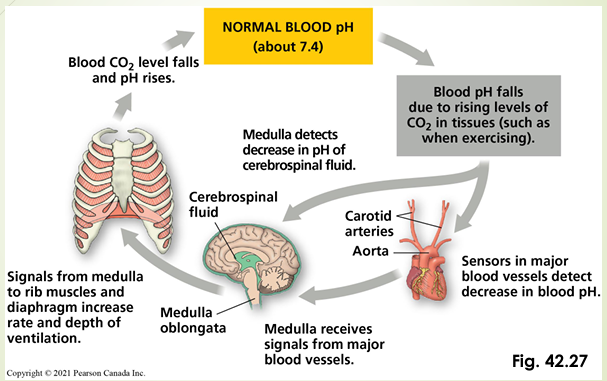
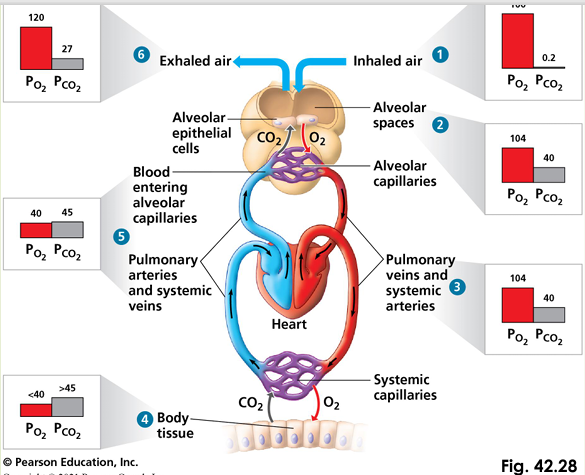
Putting the circulatory and gas exchange systems together
As breathing increases, circulation does too, so that exchange of O2 and CO2 between blood and lungs is maintained
Movement of gases between alveoli and blood vessels is influenced by partial pressures
Pigments in the blood (respiratory pigments) facilitate this
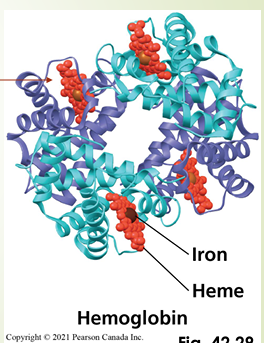
respiratory pigments
Pigments are proteins that circulate with blood and bind to specific cells
E.g., Hemoglobin binds to erythrocytes (red blood cells)
Each iron atom can bind 4 molecules of O2
4 iron atoms per hemoglobin molecule
Adaptations for gas exchange
include pigments that bind and transport gases
Birds can breathe at high altitudes because they inhale fresh air each breath
High altitude animals often have elevated hemoglobin
Diving mammals slow their metabolism and store oxygen in blood rather than lungs (via myoglobin)