Toughness and Creep Resistance
 Call Kai
 Learn
Learn Practice Test
 Spaced Repetition
 Match
Match Flashcards
 Knowt Play
1/25

There's no tags or description
Looks like no tags are added yet.
Name | Mastery | Learn | Test | Matching | Spaced | Call with Kai |
|---|
No analytics yet
Send a link to your students to track their progress
26 Terms
What is toughness?
The energy required to fracture a material; it represents a material’s resistance to brittle fracture or sudden cracking under load.
How is toughness represented on a stress–strain curve?
By the total area under the curve — the greater the area, the tougher the material.
How is toughness different from strength?
Strength measures the maximum stress a material can withstand, while toughness measures the energy absorbed before fracture.
What are two ways to measure toughness?
Energy absorbed to fracture a specimen (J), AND Energy per unit fracture area (J/m²)
What are the main types of fracture?
Ductile (high-energy, cup-and-cone) and brittle (low-energy, flat fracture surface).
How does temperature affect toughness?
Lower temperatures make materials more brittle, reducing toughness; higher temperatures make them more ductile.
What is the Charpy impact test used for?
To measure the impact energy absorbed during fracture and determine the brittle-ductile transition temperature (BDTT)
Describe the Charpy impact test procedure?
A notched bar is struck by a pendulum hammer; the energy lost by the pendulum equals the energy absorbed by the specimen.
What does the Charpy test plot show?
Impact energy vs. temperature, showing low energy (brittle) at low T and high energy (ductile) at high T.
What is the brittle-ductile transition temperature (BDTT)?
The temperature at which a material changes from brittle to ductile behaviour on the Charpy plot.
Does the Charpy test give a material property?
No, it provides a comparative measure of toughness, not an intrinsic property
Define creep?
The increase of strain with time at a constant stress and sufficiently high temperature
How is the deformation of most metals and ceramics different (on dependence) at room temperature compared to high temperatures?
Low temp: ε = f(σ)
High temp: ε = f(σ,t,T)
What can determine approximate sensitivity to creep?
T/Tm = operating temp/melting temp
When does creep become important for polymers?
Above room temperature
When does creep become important for metals?
above 0.3–0.4 Tₘ
When does creep become important for Ceramics?
above 0.4–0.5 Tₘ
Give examples of components affected by creep
Turbine blades, high-pressure pipes, boiler tubes, and light-bulb filaments
Describe the main regions of a creep curve (ε against time)
Initial elastic strain, primary creep , secondary creep (steady-state), tertiary creep (accelerating until rupture).
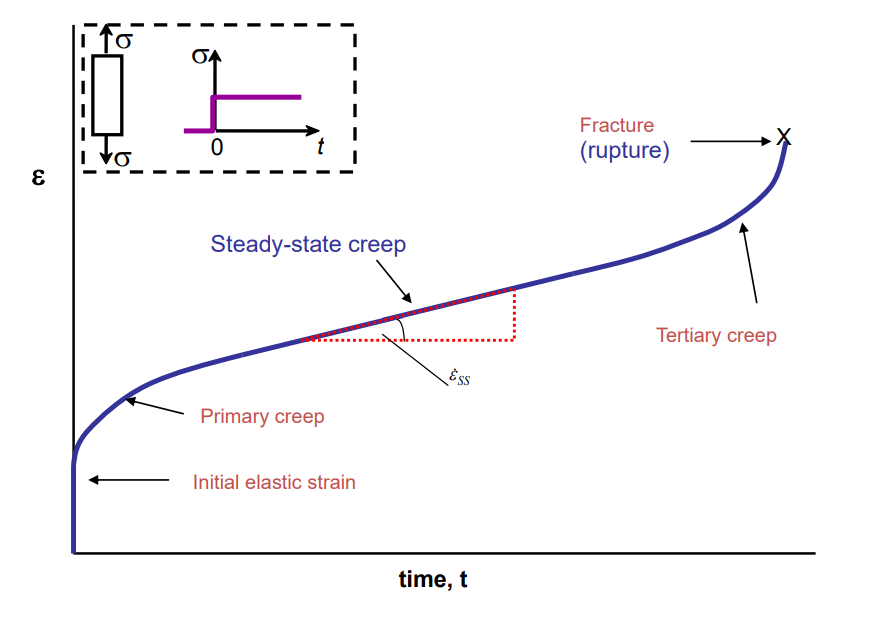
What is steady-state creep rate and why is it important? (ε˙s)
It’s the constant creep rate in the secondary stage; used to design long-life components such as power-plant parts
Write the generalised creep law
ε˙s=Ae−Q/RTσn
What do the constants in the creep law represent?
A = material constant, Q = activation energy, R = gas constant (8.31 J mol⁻¹ K⁻¹), T = temperature (K), n = creep exponent (3–8).
Why is creep characterisation carried out at constant stress or constant temperature?
It enables the effect of stress or temperature to be isolated, hence determined.
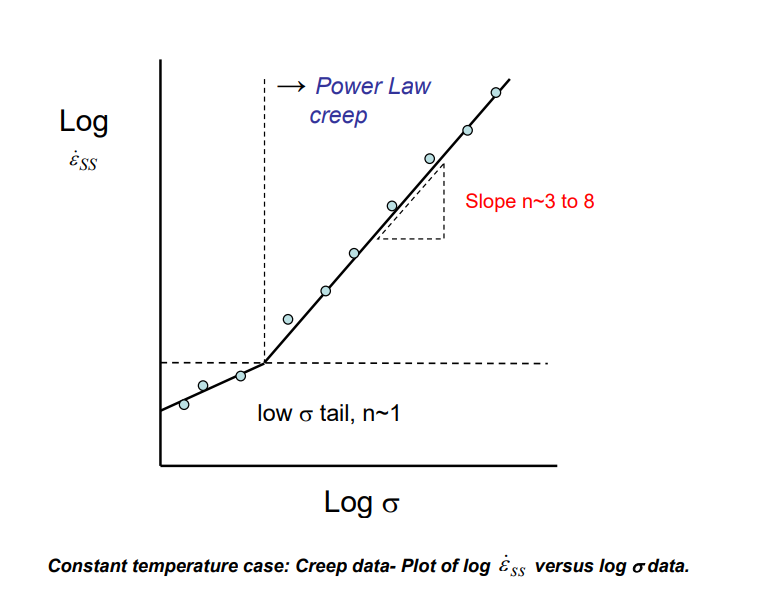
What is the simplified form of the creep law at constant temperature?
ε˙s=Bσn; plotting log ε̇ vs log σ gives a straight line with slope n
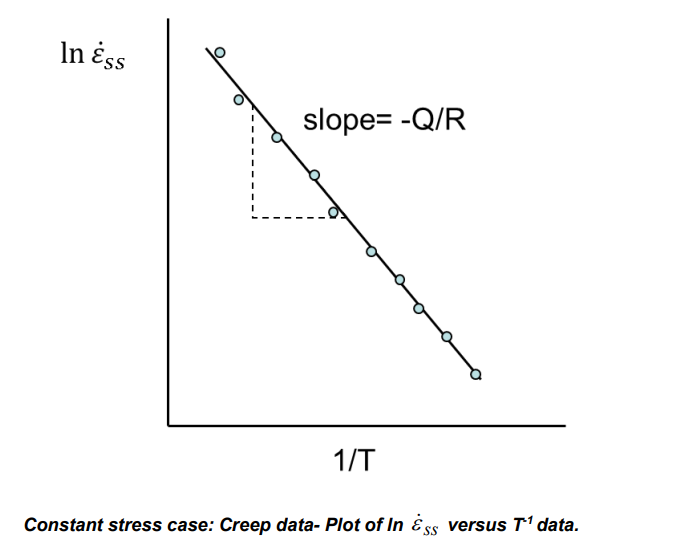
What is the simplified form of the creep law at constant stress?
ε˙s=Ce−Q/RT; plotting ln ε̇ vs 1/T gives a straight line with slope −Q/R.
What causes creep at the atomic level?
The diffusion and movement of atoms and dislocations that allow slow plastic deformation over time.