PHP 0320 Final - 2/3 of Course
 Call Kai
 Learn
Learn Practice Test
 Spaced Repetition
 Match
Match Flashcards
 Knowt Play
1/64

There's no tags or description
Looks like no tags are added yet.
Name | Mastery | Learn | Test | Matching | Spaced | Call with Kai |
|---|
No analytics yet
Send a link to your students to track their progress
65 Terms
What is age-adjusted mortality rate
Method of standardization to account for different underlying demographics of populations
Allows for fair comparisons of death risk across populations or time periods
Reduces confounding by age
systematic epidemiology
a data-driven, scientific approach to studying the distribution, determinants, and natural history of health-related states in populations, aimed at controlling health problems
how do you report measure of occurrences
use percentages or x per 100
how do you report specificity, ppv + and -
percentages
what does the Council of State and Territorial Epidemiologists do
recommends state health departments report cases of selected diseases to CDC's National Notifiable Diseases Surveillance System
but states can decide whether they will notify the cdc
Cases may be reportable by law, but not necessarily required to report to the CDC
Internal validity
The program does what it is intended to do
external validity
Is it adopted by all students
Is it generalizable
How is age-adjusted mortality interpreted
If a county has a high crude death rate, but a low age-adjusted rate, it indicates the high mortality was likely driven by an older population, not necessarily by poorer health conditions
what are the key concepts of epidemiology
systematic, population, disease, distribution, frequency
what is frequency within epidemiology
measure of disease occurrence
Prevalence: what percent of the population has a disease at a given time (all cases of a disease)
Incidence: what percentage of the population acquires the disease in a given time period (new cases of disease
what is distribution within epidemiology
the characteristics of those with the disease - by age, geography, socioeconomic status
what is population within epidemiology
Groups of people who share common characteristics
Crude mortality rate
number of deaths in a period of time / total population
Measures the death rate for an entire population
Period life expectancy
Assumes that people will experience the same mortality rates in the future as they do now
Cohort life expectancy
Actual average age of death of a group born in a specific year (historical cohort)
Accounts for anticipated future improvements in mortality rates
Years of Potential Life Lost (YPLL)
Used to measure relative impact of different causes of death
Ypll = target/threshold age - age of death
Quantitative evidence
numerical data that gives us the why
issues with convenience samples vs full probability samples
convenience samples have biases built into them, are hard to track, and can give false results
full probability samples pick random people which allows for results to be generalized to the entire population
why is a full probability sample difficult to do for underrepresented populations
expensive
What are two ways to counter the poor representation of underrepresented populations in data?
Oversampling underrepresented population
Weight the samples so it matches the whole population successfully
Which group is described as the 'hardest to reach population' for data collection
undocumented immigrants
In the CDC Health Impact Pyramid, which level has the smallest population impact but requires the most individual effort?
counselling and education
In the CDC Health Impact Pyramid, which level has the largest population impact but requires the least individual effort?
socioeconomic factors - connect for health, housing and food security initiatives
What are the primary components of a community health needs assessment?
Reports of progress on the previous implementation plan
Health needs assessment
Implementation strategy
what does a chna require a hospital to do
to define the community it serves and assess the community’s health needs
Why did Brown hire an outside firm for the methodology of a chna, and what was the trade-off?
It became too difficult to do in-house; however, they lost the "rich data" gained when staff used to go directly to individuals' houses.
What groups are at greatest risk for maternal and child death
Black and Hispanic women and babies
What are the 5 steps of Program Development?
1. Identify the problem and risk factors
2. Set goals and objectives
3. Develop an intervention
4. Implement the intervention
5. Evaluate the intervention
Why is it necessary to conduct a Needs Assessment?
To avoid creating "bad" interventions
To create community trust
To avoid wasting resources
What are the 2025 concerns for Brown health
access to care
behavioral health
chronic diseases
maternal and child health
older adult health and wellbeing
social drivers of health, especially housing
what diseases are among the top causes of death in ri
Diabetes and heart disease
What factor influences health the most
socioeconomic factors
Qualitative evidence
Used to understand how, what, when, where phenomena occur, focusing on human experiences, perceptions, and behaviors
How is a "Target Population" identified in public health?
By geography, culture, age, interest, or occupation
What is a Logic Model
A visual depiction of a program showing what will occur, what will be accomplished, and the "If-then" relationships between elements
What are the core components of a Logic Model "Process" and "Outcomes"?
Process: Inputs — Activities — Outputs
Outcomes: Short-term — Intermediate — Long-term
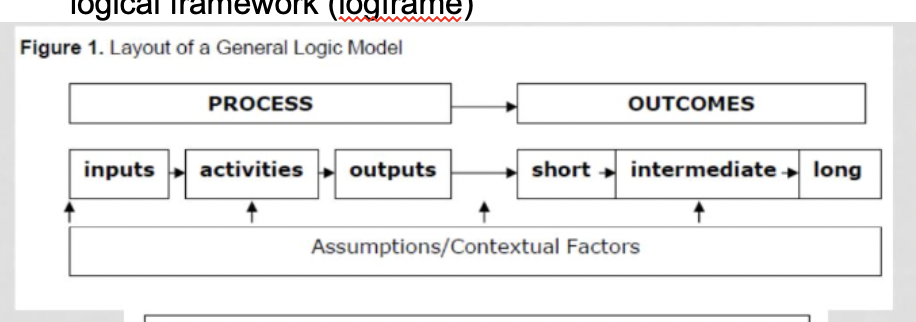
In a Logic Model, what is the difference between an Output and an Outcome?
Output: The direct product of activities (e.g., number of classes held, number of people trained).
Outcome: The change that occurs because of the activities (e.g., increased knowledge, behavior change, or reduced disease rates).
Define Efficacy in the context of program evaluation
Did the program work under ideal conditions? (e.g., high funding, highly trained staff, best possible circumstances)
Define Effectiveness in the context of program evaluation
Did the program work in real-world conditions? (e.g., after grant money runs out, integrated into normal hospital operations, facing community barriers like transportation).
What was the specific skill development intervention for the youth program?
Paid work experience in various hospital departments (Radiology, Physical Therapy, Nursing, Dietary Care, or Respiratory Care)
What does the SMART acronym stand for in program goal setting?
Specific, Measurable, Attainable, Relevant, Timely
What are the three necessary conditions for causality?
1. Temporal relationship: The exposure occurred before the outcome changed.
2. Correlation: Exposure and outcome variables co-vary.
3. Consideration of counterfactual: Ruling out alternative explanations (other factors) for the change.
evaluation design: post-test only - what is the major limitation of a "One Group: Post-test Only" design?
It lacks a comparison group
no "baseline" data from before the intervention
evaluation design: How does a "Two Group: Post-test Only" design work?
One group receives the intervention and the assessment; the other (comparison) group only receives the assessment
What is an concern regarding two-group evaluation designs?
Whether it is ethical to withhold an intervention from the comparison group (individuals who do not get the program)
Describe a Time-Series evaluation design.
It involves a participant group being tested multiple times both during and after the intervention to track changes over time.
What factors influence the selection of an evaluation design?
The evaluation question
Availability of resources.
Importance of establishing causality.
Timing of the evaluation initiation.
Availability of archival data.
Which design is best for measuring "Satisfaction with a program"?
Post-test only
Which design is best for measuring a "Change in symptoms"?
Pre- and Post-test is required to see the difference from baseline.
What are the components of Emergency Preparedness?
Training, Medical/Public Health, Infrastructure, Communications, Transportation, Finance, and Logistics.
What are the five phases of the Emergency Management Cycle?
Prevention (e.g., vaccinations, fire prevention)
Mitigation (reducing the impact of a disaster)
Preparedness (personnel on standby, communication plans)
Response (immediate action during the event)
Recovery (resetting and learning from the disaster)
In the context of disaster communication, what are Interoperability and Redundancy?
Interoperability: A framework allowing different agencies (firefighters, police, etc.) to communicate and work together easily despite using different channels.
Redundancy: Ensuring there are multiple ways to do something (e.g., having backup communication methods if cell towers fail).
What is an EOC, and what is its purpose?
Emergency Operations Center
a central location where people with specific roles gather to funnel information and work on problems together as they arise
What is the sequence of response levels after an event occurs?
1. Event
2. Activation of EMS
3. Local response
4. Regional response (if a town cannot respond alone)
5. Federal response (if disaster exceeds regional resources; must be requested by the Governor and approved by the President).
What is DMAT?
Disaster Management Assistance Teams.
Federal-level contracted employees who set up medical tents, vaccination clinics, and shelters during a disaster.
Harm reduction emerged as a response to what historical factors?
Grassroots/mutual aid efforts reacting to institutional neglect and punitive drug policy, particularly during the HIV/AIDS crisis.
Name three tools used specifically for Overdose Prevention.
1. Naloxone (Narcan) distribution.
2. Fentanyl test strips.
3. Overdose Prevention Centers (safe spaces for supervised use).
what are Managed Alcohol Programs, and who are they for?
Programs where alcohol is dosed at set intervals for people with high-intensity alcohol use for whom abstinence-based programs have not been effective.
What was the primary economic driver of Flint, MI in the 1960s, and how did it change by 2010?
Flint was a prosperous manufacturing hub led by General Motors.
By 2010, employment dropped from 80,000 to 8,000 due to automation and the loss of automotive jobs.
Why did Flint switch its water source in April 2014, and what was the change?
To save costs, the city stopped purchasing water from Detroit and began drawing water from the Flint River.
What was the "critical divergence" involving General Motors in October 2014?
GM stopped using Flint water because high chlorine levels were corroding their engine parts, yet the city continued to tell residents the water was safe for human consumption
What are the three stages of the Framework for Public Health Advocacy?
1. Information Stage: Collecting/analyzing data to describe the problem.
2. Strategy Stage: Devising a plan to address the determinants or causes.
3. Action Stage: Implementing strategies, activities, and programs.
Define Environmental Justice.
The right of all people and communities to live and thrive in safe, healthy environments with equal environmental protections and meaningful involvement in decision-making.
according to the Michigan Civil Rights Commission, what were the root causes of the Flint crisis?
Deeply embedded institutional, systematic, and historical racism.
How do "Hog Farms" contribute to environmental health disparities?
Waste pits contaminate underground water sources. Communities closer to these farms often have higher poverty rates and higher non-white populations.