UNIT 1 APBio Final Exam
 Call Kai
 Learn
Learn Practice Test
 Spaced Repetition
 Match
Match Flashcards
 Knowt Play
1/58

Earn XP
Description and Tags
CB 1-8: Unit 1 1.1, 1.2, 1.2-5, 1.6-7, U1 progress check MCQ
Name | Mastery | Learn | Test | Matching | Spaced | Call with Kai |
|---|
No analytics yet
Send a link to your students to track their progress
59 Terms
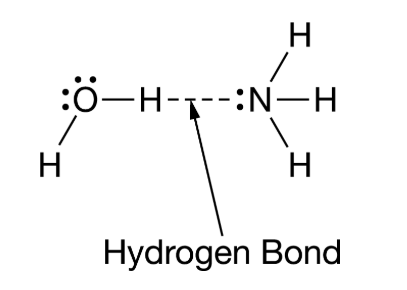
Water and ammonia interact to form hydrogen bonds, as represented in the figure. Which statement best helps explain the formation of the hydrogen bond represented in the figure?
A) The oxygen has a partial positive charge, and the nitrogen has a partial negative charge.
B) The nitrogen has a partial negative charge, and the hydrogen attached to the oxygen has a partial positive charge.
C) The hydrogen attached to the oxygen has a partial negative charge, and the nitrogen also has a partial negative charge.
D) The nitrogen has a partial positive charge, and the hydrogen attached to the oxygen also has a partial positive charge.
B) The nitrogen has a partial negative charge, and the hydrogen attached to the oxygen has a partial positive charge.
oxygen and nitrogen have strong electronegativity than hydrogen— meaning they pull electrons closer to themselves. Nitrogen has partial negative charge, hydrogen has partial positive charge
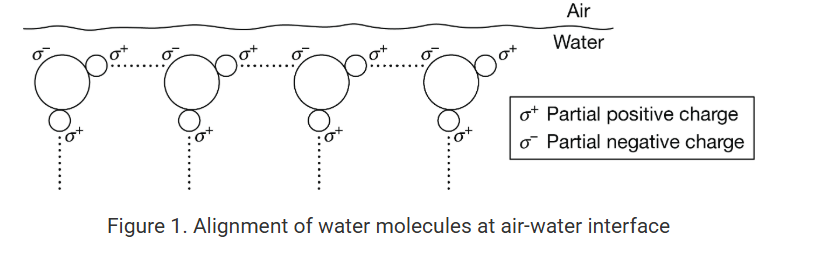
Figure 1 is a diagram of water molecules at the air-water interface at the surface of a pond. Based on Figure 1, which of the following best describes how the properties of water at an air-water interface enable an insect to walk on the water's surface?
A) Covalent bonds between water molecules and the air above provide cohesion, which causes tiny bubbles to form under the feet of the insect.
B) Ionic bonds between molecules at the surface of the water provide an electric charge, which attracts the feet of the insect, keeping it on the surface.
C) Polar covalent bonds between molecules at the surface of the water provide adhesion, which supports the weight of the insect.
D) Hydrogen bonds between molecules at the surface of the water provide surface tension, which allows the water surface to deform but not break under the insect.
D) Hydrogen bonds between molecules at the surface of the water provide surface tension, which allows the water surface to deform but not break under the insect.
Hydrogen bonds form between water molecules due to the partial charges from the polarity of water molecules. The strength of the attraction allows organisms to walk across surface without breaking the hydrogen bonds.
Which of the following is most directly responsible for water’s unique properties?
A) It contains oxygen atoms.
B) It contains hydrogen atoms.
C) It is an ionic compound.
D) It forms hydrogen bonds.
E) It is nonpolar.
D) It forms hydrogen bonds.
Which of the following is responsible for the cohesive property of water?
A) Hydrogen bonds between the oxygen atoms of two adjacent water molecules
B) Covalent bonds between the hydrogen atoms of two adjacent water molecules
C) Hydrogen bonds between the oxygen atom of one water molecule and a hydrogen atom of another water molecule
D) Covalent bonds between the oxygen atom of one water molecule and a hydrogen atom of another water molecule
E) Hydrogen bonds between water molecules and other types of molecules
C) Hydrogen bonds between the oxygen atom of one water molecule and a hydrogen atom of another water molecule
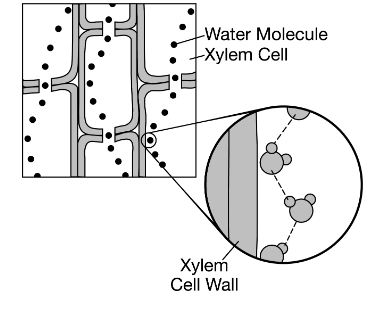
The diagram shows how water can adhere to the xylem in the stems of plants, which contributes to water movement in the plant. Which of the following best explains how water is able to move upward from the roots of a plant, through its xylem in the stem, and out to the leaves?
A) Water is polar, and the walls of the xylem are nonpolar. Water molecules have the ability to form hydrogen bonds with one another but not with the xylem walls.
B) Water is nonpolar, and the walls of the xylem are polar. Water molecules are able to form hydrogen bonds with the xylem walls, and they are pulled up the xylem.
C) Water and the xylem are both nonpolar. Water molecules have the ability to form hydrogen bonds with one another but not with the xylem walls.
D) Water and the xylem are both polar. Water molecules have the ability to form hydrogen bonds with each other and with the walls of the xylem.
D) Water and the xylem are both polar. Water molecules have the ability to form hydrogen bonds with each other and with the walls of the xylem.
Humans produce sweat as a cooling mechanism to maintain a stable internal temperature. Which of the following best explains how the properties of water contribute to this physiological process?
A) The high specific heat capacity of water allows the body to absorb a large amount of excess heat energy.
B) The high heat of vaporization of water allows the body to remove excess heat through a phase change of water from liquid to gas.
C) The high surface tension of water contributes to the physical process by which water leaves the body.
D) The high melting temperature of water allows the body to remove excess heat through a phase change of water from solid to liquid.
B) The high heat of vaporization of water allows the body to remove excess heat through a phase change of water from liquid to gas.
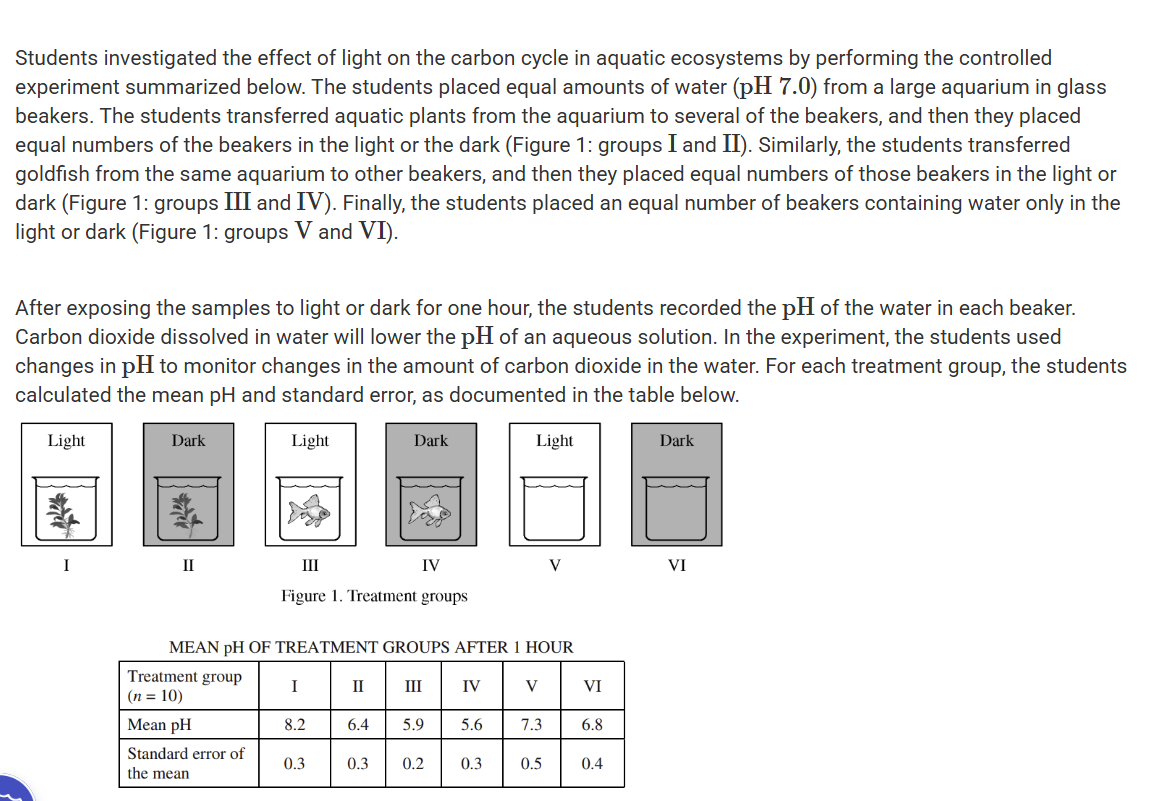
Which of the following graphs is the most appropriate representation of the experimental results documented in the table?
B) bar graph
Bacteriophages are viruses that infect bacteria. In an experiment, bacteriophages were labeled with either radioactive phosphorus or radioactive sulfur. The labeled bacteriophages were incubated with bacteria for a brief amount of time and then removed. The infected bacteria cells were found to contain significant amounts of radioactive phosphorus but not radioactive sulfur.
Based on the results of the experiment, which of the following types of molecules did the bacteriophages most likely inject into the bacteria cells?
A) Simple carbohydrate
B) Amino acid
C) DNA
D) Polypeptide
C) DNA
DNA: CHONP
Amino acid: CHONS
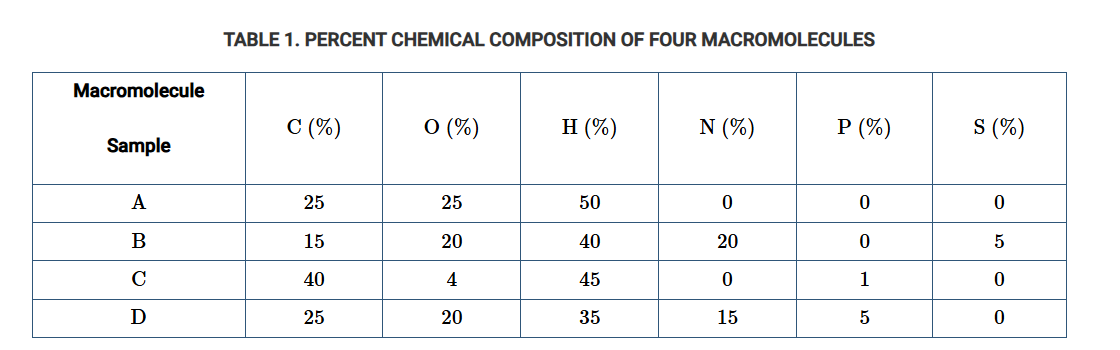
A researcher analyzed four different samples of macromolecules, where all macromolecules in each sample are of the same type. The researcher measured the percent of carbon, oxygen, hydrogen, nitrogen, phosphorus, and sulfur atoms in each sample. The results are shown in Table 1.
Which of the following claims is best supported by the data in Table 1 ?
A) Sample A contains nucleic acids.
B) Sample B contains protein.
C) Sample C contains nucleic acids.
D) Sample D contains protein.
B) Sample B contains protein.
A is CHO, so most likely carb or lipid
B is CHONS, so amino acid —> protein
C is CHOP, so most likely phospholipid
D is CHONP, so most likely nucleic acid

Students conducted a controlled experiment to investigate whether sawdust provides enough nutrients to support plant growth. The students separated ten nearly identical sunflower seedlings into two groups. They grew the seedlings in the first group in potting soil and the seedlings in the second group in sawdust composed mostly of cellulose. After twenty days, the students recorded observations about the seedlings in each group. The students’ observations are presented in the table.
The observed differences between the groups most likely resulted from differences in the ability of the seedlings to produce which of the following monomers?
A) lipid & glucose
B) amino acid only
C) amino acid and nucleotide
D) nucleotide and lipid
C) amino acid and nucleotide
saw dust only provides cellulose (CHO). No phosphorus or nitrogen nutrients, causing amino acids (CHONS) and nucleotides (CHONP) to have reduced production
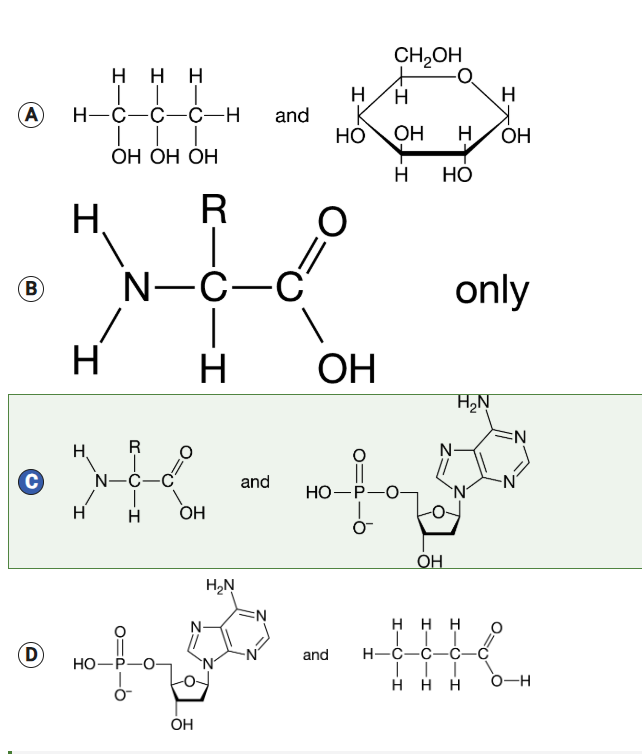
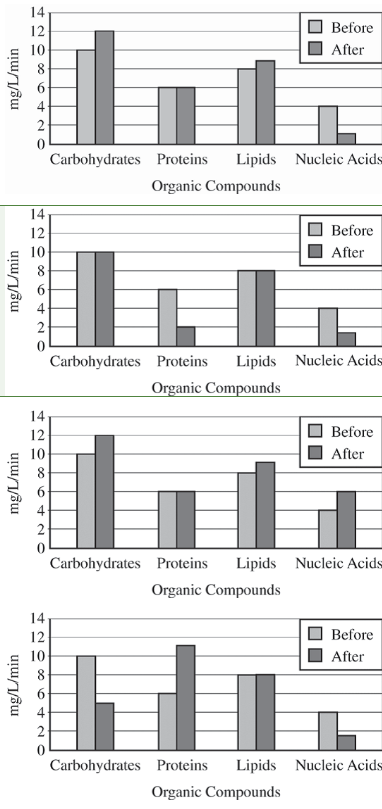
A culture of Spirogyra (an autotrophic alga) is maintained in a water solution containing dissolved carbon dioxide and a source of phosphates but lacking nitrogen compounds. A researcher determines the rates of synthesis of several organic compounds found in the Spirogyra before and after several weeks in the water solution. Which of the following graphs best illustrates a likely result of the experiment?
B) Carbohydrates the same, Proteins decreased, lipids the same, nucleic acids decreased
Phosphates present, nitrogen lacking.
CHO/CHOP —> carbs/lipids, no influence
CHONS —> amino acids, nitrogen lacking reduces production
CHONP —> nucleic acids, nitrogen lacking reduces production
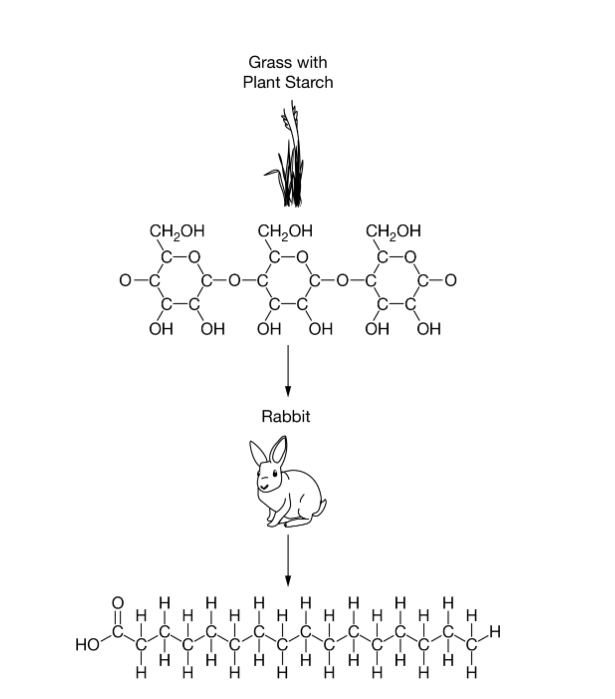
Which of the following statements best describes how organisms such as rabbits obtain the carbon necessary for building biological molecules?
A) Rabbits eat plants and use energy absorbed from the plants to make carbon atoms from electrons, protons, and neutrons in the air.
B) Rabbits eat plants and break down plant molecules to obtain carbon and other atoms that they rearrange into new carbon-containing molecules.
C) Rabbits eat plants and use water absorbed from the plants to hydrolyze , which the rabbits breathe in from the air and use as a carbon source.
D) Rabbits eat plants and make carbon-containing molecules by using carbon atoms that the plants absorbed from the soil and stored in the cells of their leaves.
B) Rabbits eat plants and break down plant molecules to obtain carbon and other atoms that they rearrange into new carbon-containing molecules.
organisms don’t make atoms from protons, neutrons, electrons. Organisms do break down molecules from plants to rearrange into different or bigger molecules. Organisms do use water from plants, but do not get their source of carbon from the air. plants don’t absorb carbon from the soil
Cholinesterase is an enzyme that catalyzes the hydrolysis of the signaling molecule acetylcholine. Which of the following best explains how cholinesterase carries out its function?
A) Cholinesterase breaks covalent bonds within acetylcholine by the addition of a water molecule.
B) Cholinesterase breaks covalent bonds within acetylcholine by removing a water molecule.
C)Cholinesterase forms covalent bonds between acetylcholine and another molecule by the addition of a water molecule.
D) Cholinesterase forms covalent bonds between acetylcholine and another molecule by removing a water molecule.
A) Cholinesterase breaks covalent bonds within acetylcholine by the addition of a water molecule.
Hydrolysis: using water to break the covalent bonds of a polymer, splitting it into smaller units (monomers)
Amylase is an enzyme that converts carbohydrate polymers into monomers. Glycogen synthase is one of the enzymes involved in converting carbohydrate monomers into polymers.
Which of the following best explains the reactions of these enzymes?
A) Amylase aids in the removal of a water molecule to break covalent bonds whereas glycogen synthase aids in the addition of a water molecule to form covalent bonds.
B) Amylase aids in the addition of a water molecule to break covalent bonds whereas glycogen synthase aids in the removal of a water molecule to form covalent bonds.
C) Amylase aids in the addition of a water molecule to form covalent bonds whereas glycogen synthase aids in the removal of a water molecule to break covalent bonds.
D) Amylase aids in the removal of a water molecule to form covalent bonds whereas glycogen synthase aids in the addition of a water molecule to break covalent bonds.
B) Amylase aids in the addition of a water molecule to break covalent bonds whereas glycogen synthase aids in the removal of a water molecule to form covalent bonds.
Amylase: polymers —> monomers; hydrolysis (adding water to break covalent bonds)
Glycogen synthase: monomers —> polymers; dehydration synthesis (removing water to form covalent bonds)
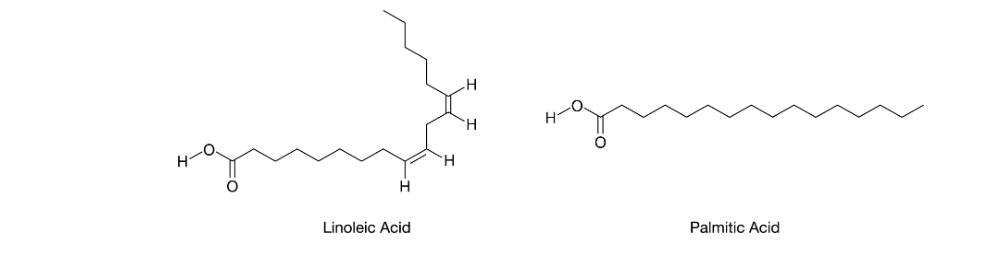
The molecular structures of linoleic acid and palmitic acid, two naturally occurring substances, are shown in the figure.
Based on the molecular structures shown in the figure, which molecule is likely to be solid at room temperature?
A) Linoleic acid, because the absence of carbon-carbon double bonds allows the molecules to pack closely together.
B) Linoleic acid, because the presence of carbon-carbon double bonds prevents the molecules from packing closely together.
C) Palmitic acid, because the absence of carbon-carbon double bonds allows the molecules to pack closely together.
D) Palmitic acid, because the presence of carbon-carbon double bonds prevents the molecules from packing closely together.
C) Palmitic acid, because the absence of carbon-carbon double bonds allows the molecules to pack closely together.
Double bonds create a kink, making it usually liquid in room temperature. Linoleic has double bonds, while palmitic acids don’t, causing them to stay solid in room temperature
Which of the following best describes the hydrolysis of carbohydrates?
A) The removal of a water molecule breaks a covalent bond between sugar monomers.
B) The removal of a water molecule forms a covalent bond between sugar monomers.
C) The addition of a water molecule breaks a covalent bond between sugar monomers.
D) The addition of a water molecule forms a covalent bond between sugar monomers.
C) The addition of a water molecule breaks a covalent bond between sugar monomers.
The process of hydrogenation is used in the food industry to convert lipids that are liquids at room temperature into solids at room temperature. The process involves the chemical addition of hydrogen atoms to the fatty acid tails of lipids, breaking some or all of the carbon-carbon double bonds in the fatty acid tails. Which of the following best explains why hydrogenation converts liquid lipids to solid lipids?
A) Hydrogenation makes the fatty acids more saturated, enabling them to be more densely packed together.
B) Hydrogenation makes the fatty acids less saturated, enabling them to be more densely packed together.
C) Hydrogenation makes the fatty acids more saturated, resulting in fewer lipid molecules fitting within a given space.
D) Hydrogenation makes the fatty acids less saturated, resulting in fewer lipid molecules fitting within a given space.
A) Hydrogenation makes the fatty acids more saturated, enabling them to be more densely packed together.
hydrogenation breaks double bonds, making the fatty acids more saturated so that they will be more tight together, causing the lipid to be a solid in room temperature
Which of the following statements best describes the structure of complex carbohydrates?
A) Several polysaccharide chains are linked via hydrogen bonds.
B) Monosaccharides are connected by covalent bonds.
C) Several polysaccharide chains are linked via ionic bonds.
D) Monosaccharides are joined by peptide bonds.
B) Monosaccharides are connected by covalent bonds.
Complex carbohydrates are made up of monosaccharides connected my covalent bonds
A feature of organic compounds NOT found in inorganic compounds is the presence of
A) ionizing chemical groups
B) electrons
C) carbon atoms covalently bonded to each other
D) oxygen
E) hydrogen bonds
C) carbon atoms covalently bonded to each other
Organic molecules are carbon-based molecules usually containing C-H bonds and associated with living organisms.
Inorganic molecules are compounds that lack C-H bonds like water, ammonia, salts, acids, and co2.
Hydrogen bonds are found in both inorganic/organic molecules (water). Organic compounds are characterized by carbon atoms bonded to each other, forming carbon skeletons/chains.
Which of the following best describes the process by which gas from the atmosphere is obtained by plants and used to build lipids?
A) Gas is fixed by plants as part of the sulfur cycle.
B) Gas is fixed by plants as part of the nitrogen cycle.
C) Gas is directly obtained by plants as part of the carbon cycle.
D) Gas is directly obtained by plants as part of the magnesium cycle.
C) Gas is directly obtained by plants as part of the carbon cycle.
Lipids is made out of CHO, so carbon cycle is the main process used plants use from the atmosphere
Which of the following statements best describes the formation of complex carbohydrates?
A) Monosaccharides are converted to simple sugars.
B) Monomers of polysaccharides are linked together through peptide bonds.
C) Nitrogen-containing bases are used to build complex carbohydrates.
D) Monosaccharides are joined together through covalent bonds.
D) Monosaccharides are joined together through covalent bonds.
monosaccharides link together via covalent bonds to make polysaccharides
Which of the following best describes the structures of carbohydrates?
A) They only occur as disaccharides.
B) They occur as monomers, chains of monomers, and branched structures.
C) They only occur as long and branched structures.
D) They occur as chains of monomers that hydrogen bond with complementary chains of monomers.
B) They occur as monomers, chains of monomers, and branched structures.
Carbohydrates have different forms:
glucose —> monomer
sucrose —> chains of monomers
amylopectin —> branched structure
The synthesis of protein or carbohydrate polymers always produces which of the following as a byproduct?
A) ATP
B) Oxygen
C) Carbon dioxide
D) Urea
E) Water
E) Water
dehydration synthesis: removing water to form polymers; water as a byproduct
A researcher is studying a specific type of cellular defect in animal cells. She notices that cells with this defect have reduced energy storage and decreased cell membrane stability.
Which of the following predicts the type of cellular defect that is the most likely cause of the researcher’s observation?
A) A defect in fatty acid synthesis, reducing the formation of fats and phospholipids
B) A defect in cholesterol synthesis, leading to reduced cholesterol in cell membranes
C) A defect in steroid hormone production, leading to a depletion of energy reserves
D) A defect in unsaturated fatty acid production, affecting membrane fluidity
A) A defect in fatty acid synthesis, reducing the formation of fats and phospholipids
fats/triglycerides affects energy storage and phospholipids affects the membrane structure
Researchers analyzed the composition of cell membranes of bacteria living in different environments. Thermophiles are bacteria that live at extremely high temperatures, typically at or above 70 degrees C.
Which of the following best predicts the effect of a greater proportion of saturated fatty acids, as compared with unsaturated fatty acids, on the stability of the cell membrane in thermophiles?
A) A greater proportion of saturated fatty acids has no effect on cell membrane stability because both saturated and unsaturated fatty acids are hydrophobic.
B) A greater proportion of saturated fatty acids leads to increased membrane stability at lower temperatures because saturated fatty acids increase the stability of the membrane.
C) A greater proportion of saturated fatty acids leads to decreased membrane stability because saturated fatty acids decrease the fluidity of the membrane.
D) A greater proportion of saturated fatty acids leads to increased membrane stability at higher temperatures because saturated fatty acids pack tightly together.
D) A greater proportion of saturated fatty acids leads to increased membrane stability at higher temperatures because saturated fatty acids pack tightly together.
Hot environment → more saturated fats, greater proportion of fatty acids increase membrane stability
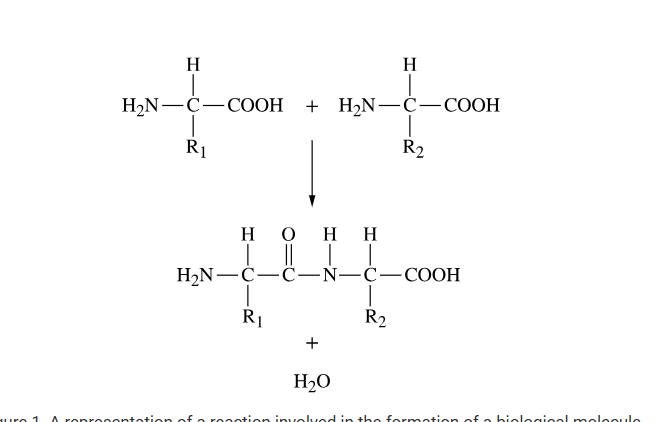
Figure 1. A representation of a reaction involved in the formation of a biological molecule
Which of the following best explains the reaction represented in Figure 1?
A) It is a dehydration synthesis reaction involved in the formation of a lipid.
B) The reaction is the hydrolysis of a nucleic acid and results in the formation of a nucleotide.
C) The reaction is the hydrolysis of a nucleic acid and results in the formation of a phospholipid.
D) It is a dehydration synthesis reaction involved in the formation of a polypeptide.
D) It is a dehydration synthesis reaction involved in the formation of a polypeptide.
Two monomers becoming polymer with a byproduct of water —> dehydration synthesis
Carboxyl group, R group, amino group —> protein, making a polypeptide
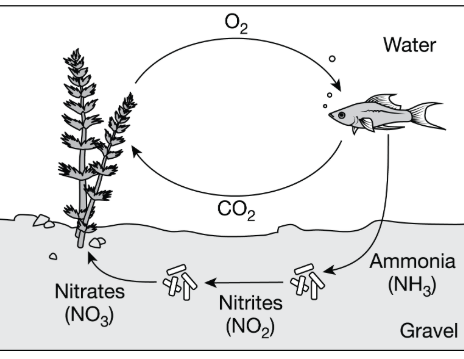
The figure shows a model of the exchange of matter between the organisms that live together in an aquarium. The model includes matter exchange between plants, fish, and bacteria. The bacteria are represented as rod-shaped organisms living in the gravel at the bottom of the aquarium.
A) The carbon dioxide molecules released by the fish are converted by the bacteria to oxygen atoms, which are used by the plants to make water molecules.
B) The oxygen molecules released by the fish are converted by the bacteria to ammonia molecules, which are used by the plants to make lipids and fatty acids.
C) The nitrites released by the fish are converted by the bacteria to carbon dioxide molecules, which are used by the plants to make carbohydrates.
D) The ammonia molecules released by the fish are converted by the bacteria to nitrates, which are used by the plants to make proteins and nucleic acids.
D) The ammonia molecules released by the fish are converted by the bacteria to nitrates, which are used by the plants to make proteins and nucleic acids.
Focus on the bacteria’s role: converting ammonia into nitrate, which then the plants use for nucleic acids/proteins. Bacteria doesn’t convert CO2 into oxygen, doesn’t convert oxygen into CO2, or convert nitrites into nitrates.
Which of the following statements best describes a difference between proteins and nucleic acids?
A) Proteins contain sulfur, while nucleic acids do not.
B) Proteins contain phosphorus, while nucleic acids contain sulfur.
C) Both proteins and nucleic acids contain sulfur as a key element.
D) Both proteins and nucleic acids contain nitrogen and sulfur.
A) Proteins contain sulfur, while nucleic acids do not.
Proteins: CHONS
Nucleic acid: CHONP
A typical bag of fertilizer contains high levels of nitrogen, phosphorus, and potassium but trace amounts of magnesium and calcium. Which of the following best matches the fertilizer component with the molecule in which it will be incorporated by organisms in the area?
A) Nitrogen will be incorporated into nucleic acids.
B) Phosphorus will be incorporated into amino acids.
C) Potassium will be incorporated into lipids.
D) Magnesium will be incorporated into carbohydrates.
Nitrogen will be incorporated into nucleic acids.
nucleic acid: CHONP
protein: CHONS
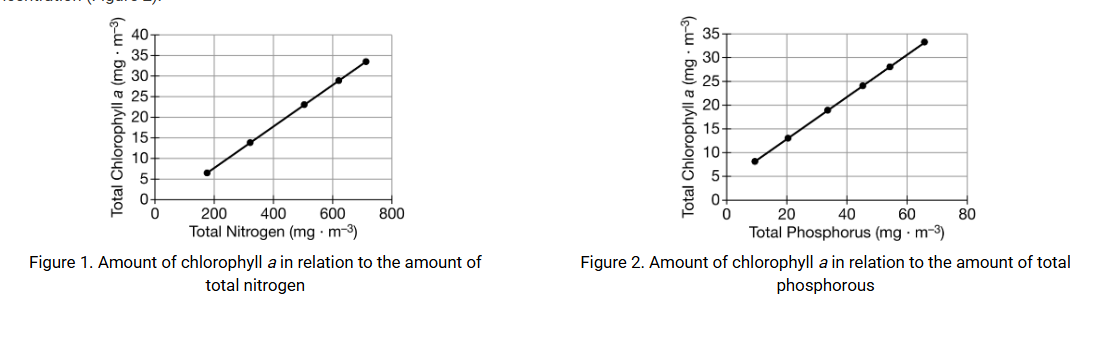
High levels of certain plant nutrients in runoff can lead to rapid growth of algae (an algal bloom) in aquatic ecosystems. These algal blooms are generally followed by algal death and decomposition, which consumes large amounts of dissolved oxygen in the water and results in oxygen levels insufficient to support aerobic respiration. This process is known as eutrophication. The amount of algae present in a body of water can be estimated from the amount of chlorophyll a in a sample of the water. A researcher studying eutrophication collected samples at different times of the year in a freshwater ecosystem. The samples were analyzed for total nitrogen and chlorophyll a concentration (Figure 1) as well as total phosphorus and chlorophyll a concentration (Figure 2).
Which of the following best explains how higher concentrations of nitrogen and phosphorus contribute to eutrophication?
A) An increase in the population of algae results in more nitrogen and phosphorus in the water, causing severe eutrophication.
B) Both bacteria and algae require nitrogen and phosphorus, so the algae must grow faster to compete with bacteria.
C) Nitrogen and phosphorus stimulate oxidative phosphorylation, which consumes the available oxygen in the water.
D) Algae require nitrogen and phosphorus to build macromolecules, so higher concentrations of these nutrients can result in algal blooms.
D) Algae require nitrogen and phosphorus to build macromolecules, so higher concentrations of these nutrients can result in algal blooms.
algal populations grow in the presence of nitrogen/phosphorus, algae doesn’t compete with bacteria, nitrogen and phosphorus doesn’t stimulate oxidative phosphorylation. algae uses phosphorus/nitrogen to synthesize macromolecules
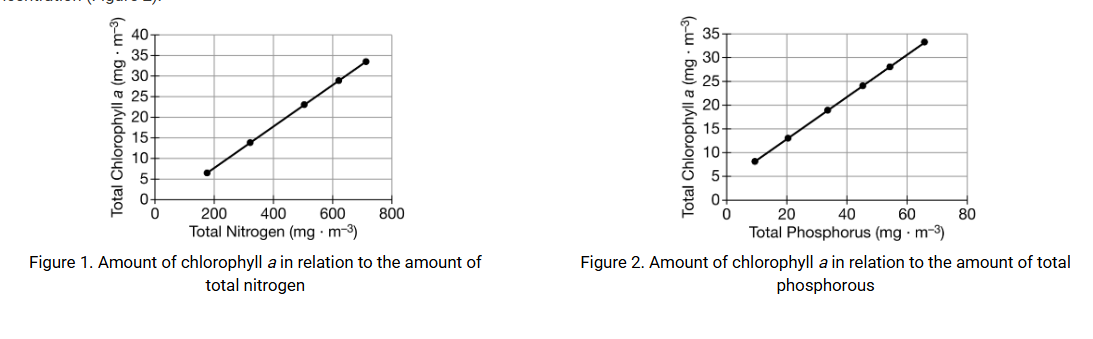
High levels of certain plant nutrients in runoff can lead to rapid growth of algae (an algal bloom) in aquatic ecosystems. These algal blooms are generally followed by algal death and decomposition, which consumes large amounts of dissolved oxygen in the water and results in oxygen levels insufficient to support aerobic respiration. This process is known as eutrophication. The amount of algae present in a body of water can be estimated from the amount of chlorophyll a in a sample of the water. A researcher studying eutrophication collected samples at different times of the year in a freshwater ecosystem. The samples were analyzed for total nitrogen and chlorophyll a concentration (Figure 1) as well as total phosphorus and chlorophyll a concentration (Figure 2).
Which of the following was the dependent variable in the researcher’s study?
A) The concentration of chlorophyll a
B) The concentration of total nitrogen and phosphorus
C) The slope of the trend line showing the rate of change
D) The variance of the data points from the trend line
A) The concentration of chlorophyll a
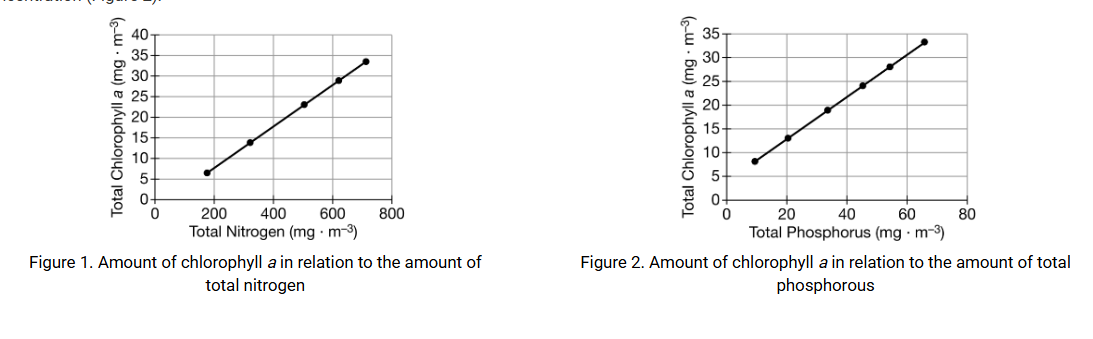
High levels of certain plant nutrients in runoff can lead to rapid growth of algae (an algal bloom) in aquatic ecosystems. These algal blooms are generally followed by algal death and decomposition, which consumes large amounts of dissolved oxygen in the water and results in oxygen levels insufficient to support aerobic respiration. This process is known as eutrophication. The amount of algae present in a body of water can be estimated from the amount of chlorophyll a in a sample of the water. A researcher studying eutrophication collected samples at different times of the year in a freshwater ecosystem. The samples were analyzed for total nitrogen and chlorophyll a concentration (Figure 1) as well as total phosphorus and chlorophyll a concentration (Figure 2).
Which of the following describes the relationship between the amount of chlorophyll a in a water sample and the concentration of nitrogen in that sample?
A) As the concentration of chlorophyll a increases, the concentration of nitrogen decreases.
B) The concentrations of nitrogen and chlorophyll a are directly correlated.
C) The concentrations of chlorophyll a and nitrogen increase throughout the year.
D) There is no relationship between the concentrations of chlorophyll a and nitrogen.
B) The concentrations of nitrogen and chlorophyll a are directly correlated.
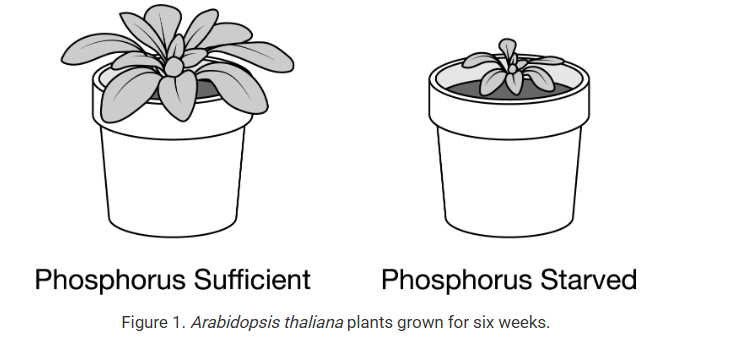
Phosphorous (P) is an important nutrient for plant growth. Figure 1 shows Arabidopsis thaliana plants grown under phosphorus‐sufficient (left) and phosphorus‐starved (right) conditions for six weeks.
Figure 1. Arabidopsis thaliana plants grown for six weeks.
Which of the following is the most likely reason for the difference in leaf growth?
A) The phosphorus-starved plant was unable to synthesize both the required proteins and lipids, limiting growth.
B) The phosphorus-starved plant was unable to synthesize both the required proteins and carbohydrates, limiting growth.
C) The phosphorus-starved plant was unable to synthesize both the required nucleic acids and lipids, limiting growth.
D) The phosphorus-starved plant was unable to synthesize both the required carbohydrates and nucleic acids, limiting growth.
C) The phosphorus-starved plant was unable to synthesize both the required nucleic acids and lipids, limiting growth.
Lipids: CHO(P) → phospholipids
Nucleic acids: CHONP → phosphate group
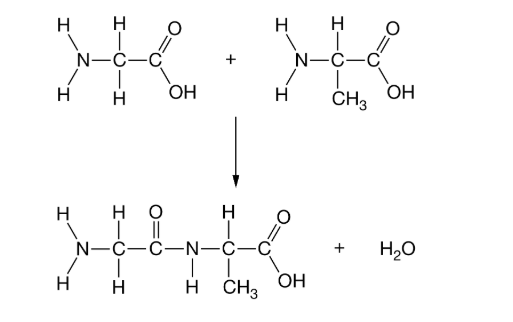
Figure 1 represents a common process that occurs in organisms.
Which of the following is an accurate description of the process shown in Figure 1 ?
A) The linking of amino acids with an ionic bond as an initial step in the protein synthesis process
B) The formation of a more complex carbohydrate with the covalent bonding of two simple sugars
C) The hydrolysis of amino acids with the breaking of covalent bonds with the release of water
D) The formation of a covalent peptide bond in a dehydration synthesis reaction
D) The formation of a covalent peptide bond in a dehydration synthesis reaction
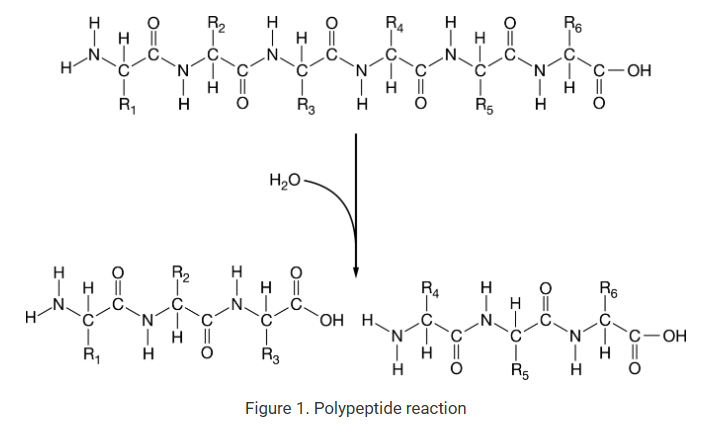
Which of the following best describes the formation of the bond shown in Figure 1 ?
A) An ionic bond is formed between a carbon atom of one amino acid and the nitrogen atom of the other amino acid.
B) An ionic bond is formed when the negative charge of an OH group is balanced by the positive charge of a hydrogen ion.
C) A covalent bond is formed between a carbon atom and a nitrogen atom along with the formation of H2O.
D) A covalent bond is formed that replaces the hydrogen bond between the OH group and H atom.
C) A covalent bond is formed between a carbon atom and a nitrogen atom along with the formation of H2O.
There is no hydrogen bond between OH group and H atom
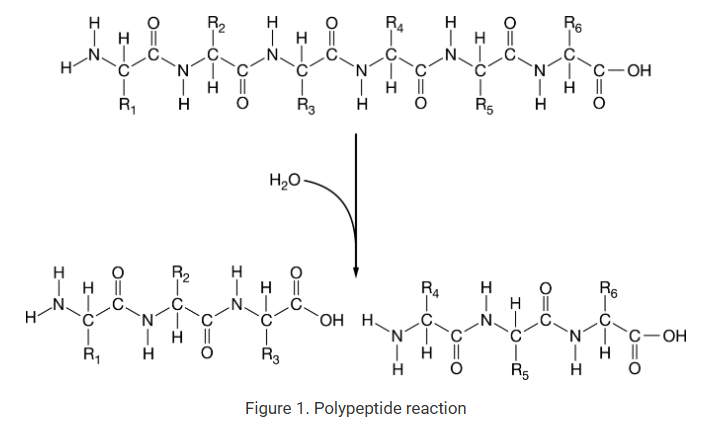
Polypeptides are continuously being formed and degraded.
One of these processes is shown. Which statement is the most accurate description of the reaction shown in Figure 1?
A) It represents monomers linked by dehydration synthesis.
B) It represents a polypeptide chain that folds to form the tertiary structure.
C) It represents a polypeptide chain that is denatured into the primary structure.
D) It represents a polypeptide chain that is broken down through a hydrolysis reaction.
D) It represents a polypeptide chain that is broken down through a hydrolysis reaction.
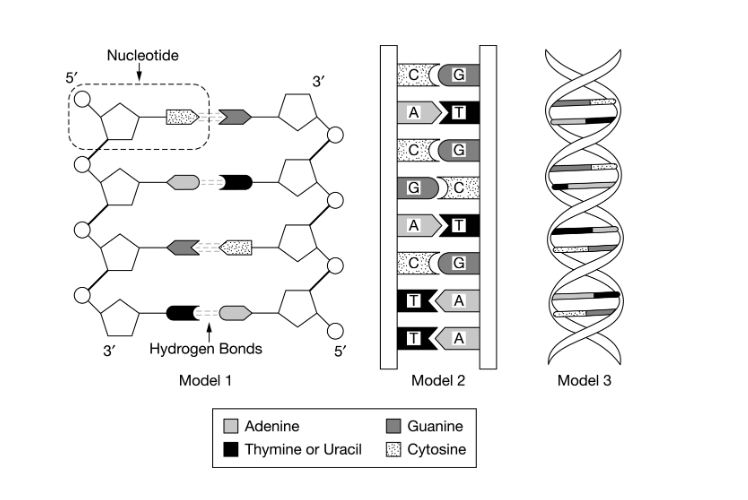
Which feature of model 1 best illustrates how biological information is coded in a molecule?
A) The and labels at the ends of each strand
B) The labeling of the hydrogen bonds between base pairs
C) The lines connecting sugars and phosphate groups that represent covalent bonds
D) The linear sequence of the base pairs
D) The linear sequence of the base pairs
base pairs play a key role in the coding of biological information
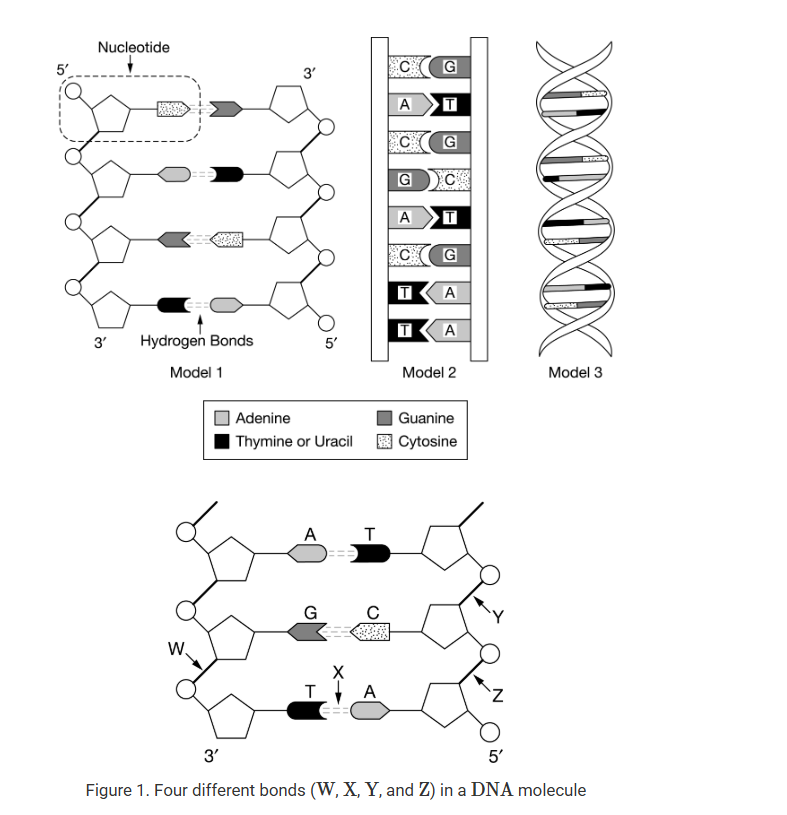
Figure 1 represents a segment of DNA. Radiation can damage the nucleotides in a DNA molecule. To repair some types of damage, a single nucleotide can be removed from a molecule and replaced with an undamaged nucleotide. Which of the four labeled bonds in Figure 1 could be broken to remove and replace the cytosine nucleotide without affecting the biological information coded in the DNA molecule?
A) Bond X only
B) Bond W only
C) Bonds Y and Z at the same time
D) Bonds W and Z at the same time
C) Bonds Y and Z at the same time
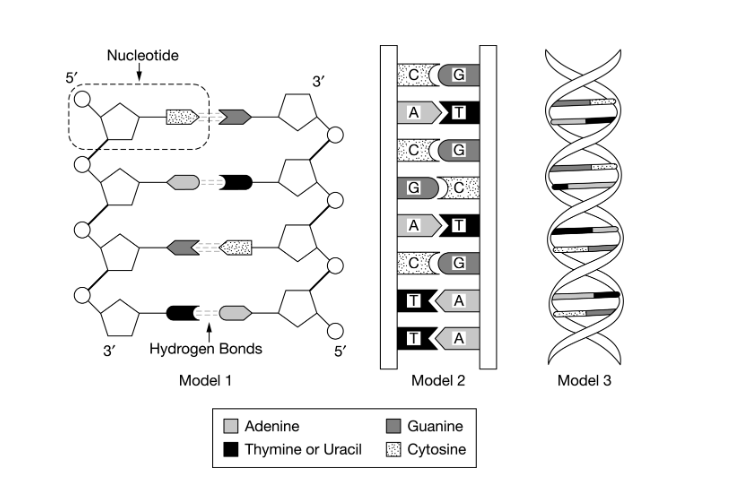
A student wants to modify model 1 so that it represents an double helix instead of a double helix. Of the following possible changes, which would be most effective in making model 1 look more like than ?
A) Changing the sequence of the base pairs
B) Changing the deoxyriboses to riboses by adding -OH groups
C) Changing the shapes of the nitrogenous bases to match those shown in model 2
D) Changing the sugar-phosphate backbone to a ribbon, as shown in model 3
B) Changing the deoxyriboses to riboses by adding -OH groups
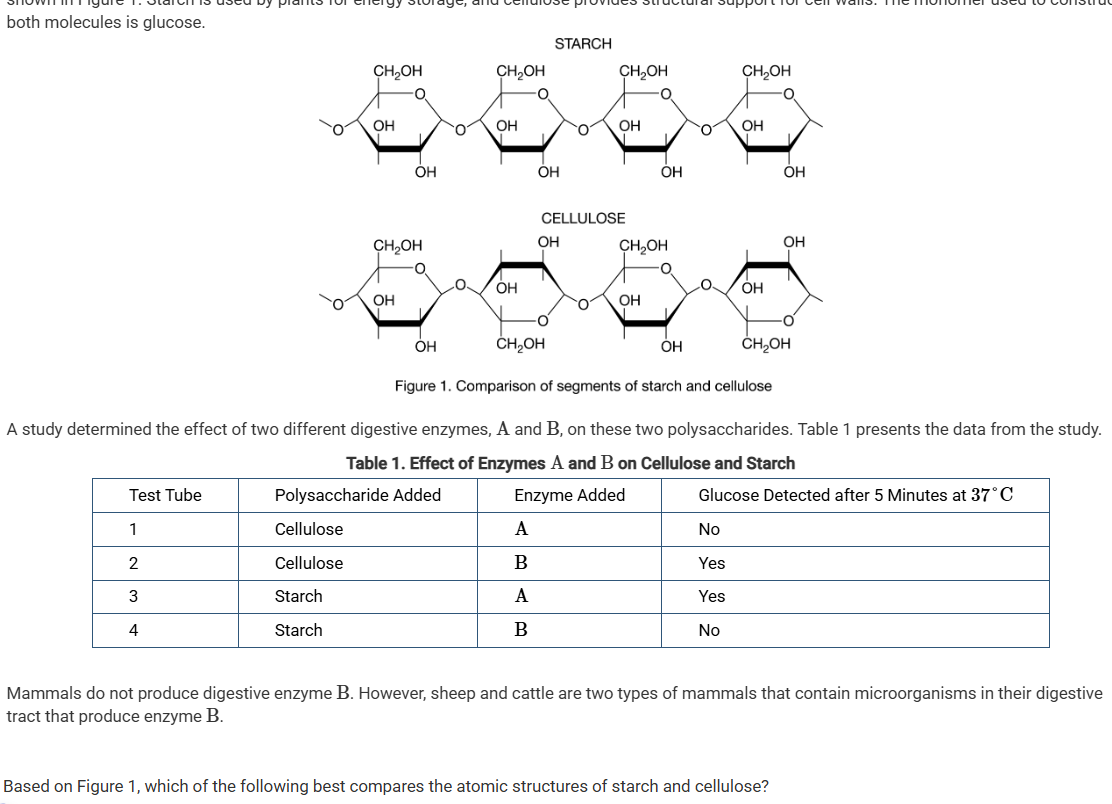
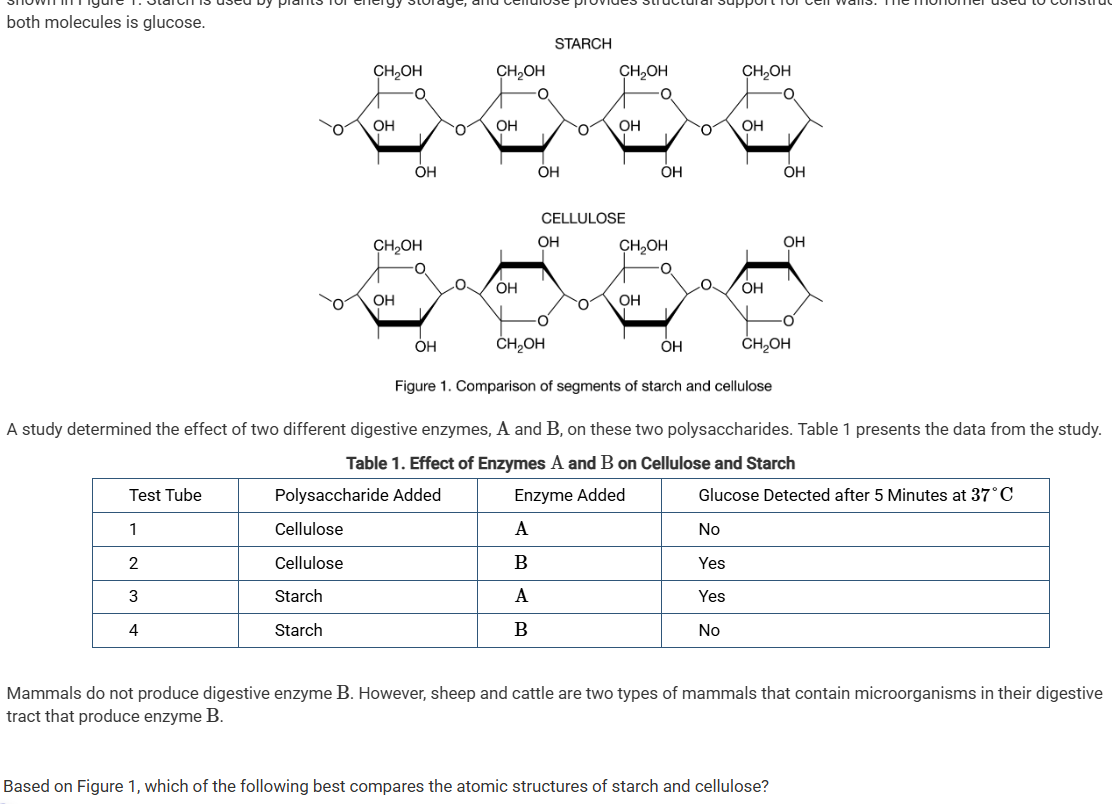
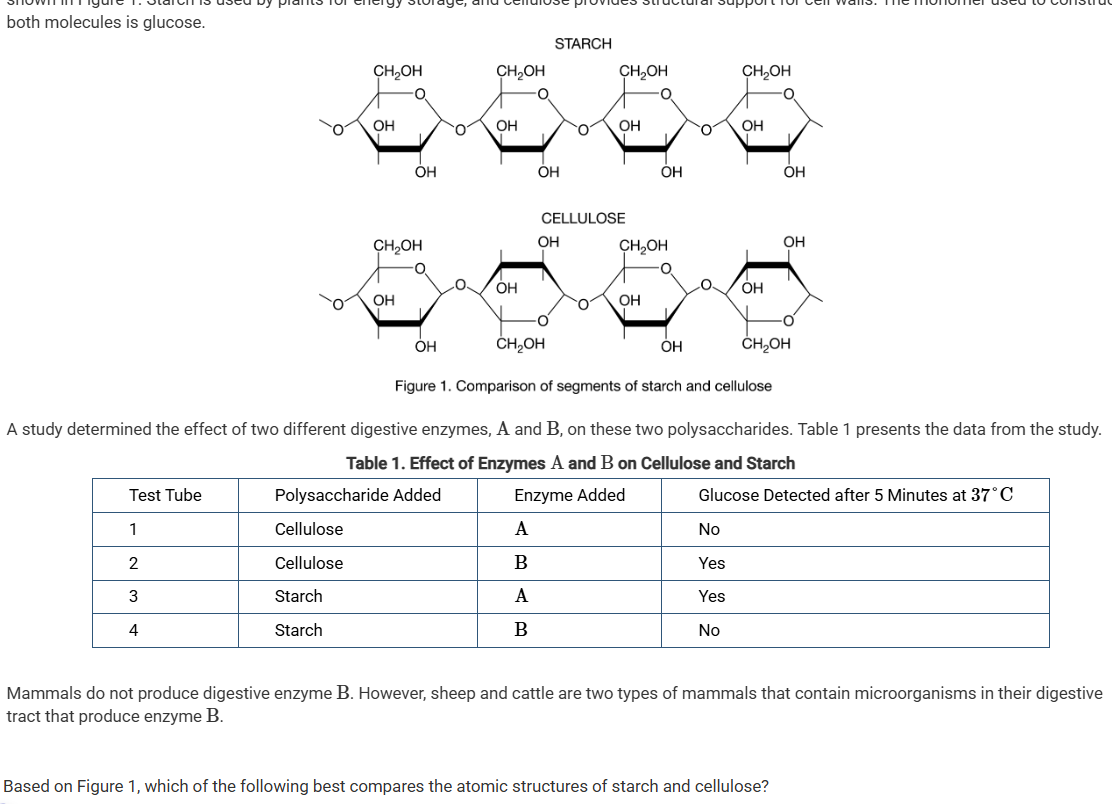
Different polysaccharides are used by plants for energy storage and structural support. The molecular structures for two common polysaccharides are shown in Figure 1. Starch is used by plants for energy storage, and cellulose provides structural support for cell walls. The monomer used to construct both molecules is glucose.
Mammals do not produce digestive enzyme B. However, sheep and cattle are two types of mammals that contain microorganisms in their digestive tract that produce enzyme B.
Based on Figure 1, which of the following best compares the atomic structures of starch and cellulose?
A) Starch is composed of carbon, hydrogen, and oxygen, while cellulose also contains nitrogen.
B) Starch and cellulose are composed of repeating glucose monomers; however, in cellulose every other glucose monomer is rotated 180 degrees.
C) Starch is composed of monomers that each have a CH2OH group, while cellulose only has a CH2OH group on every other monomer.
D) Starch and cellulose are composed of identical monomers and therefore have identical structures.
B) Starch and cellulose are composed of repeating glucose monomers; however, in cellulose every other glucose monomer is rotated 180 degrees.
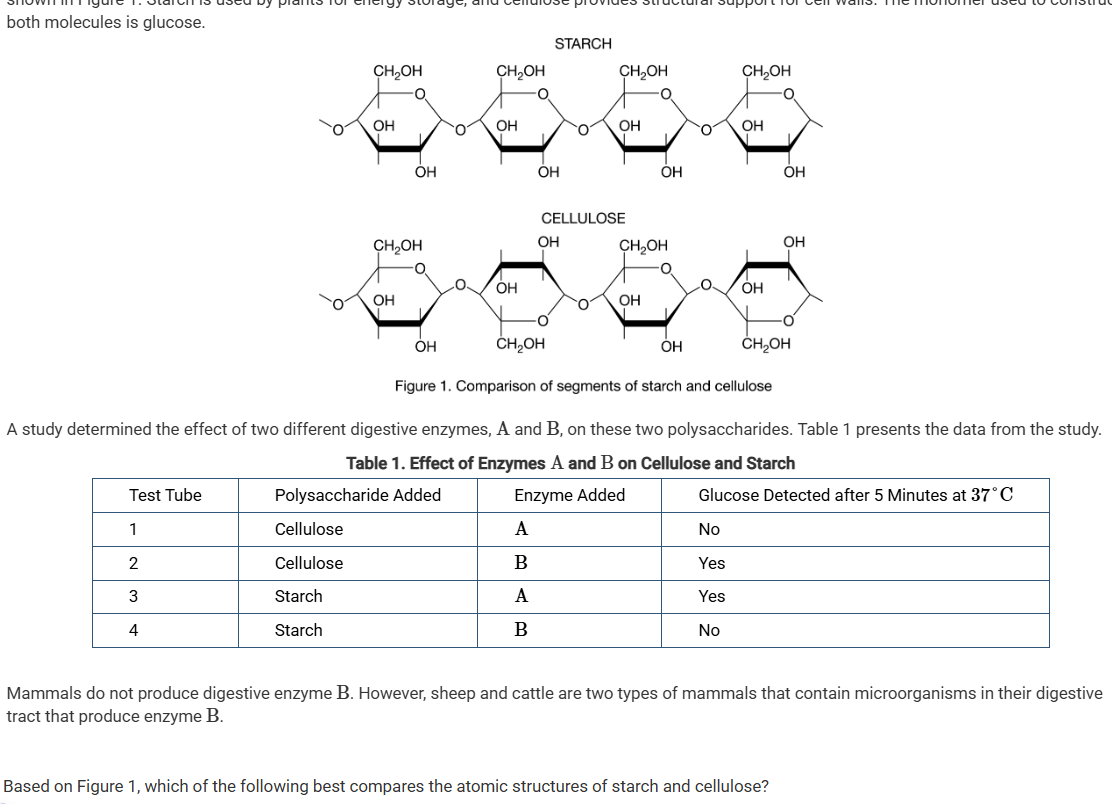
Different polysaccharides are used by plants for energy storage and structural support. The molecular structures for two common polysaccharides are shown in Figure 1. Starch is used by plants for energy storage, and cellulose provides structural support for cell walls. The monomer used to construct both molecules is glucose.
Mammals do not produce digestive enzyme B. However, sheep and cattle are two types of mammals that contain microorganisms in their digestive tract that produce enzyme B.
Which of the following statements best describes the different functions of starch and cellulose in plants?
A) The differences in the assembly and organization of the monomers of these two polymers result in different chemical properties.
B) Since starch and cellulose are composed of identical monomers, the cellular environment where they are located controls their function.
C) The monomers of cellulose are connected by covalent bonds, making it idea for structural support.
D) The monomers of starch are connected by ionic bonds, making it ideal for energy storage for plants.
A) The differences in the assembly and organization of the monomers of these two polymers result in different chemical properties.
Different polysaccharides are used by plants for energy storage and structural support. The molecular structures for two common polysaccharides are shown in Figure 1. Starch is used by plants for energy storage, and cellulose provides structural support for cell walls. The monomer used to construct both molecules is glucose.
Mammals do not produce digestive enzyme B. However, sheep and cattle are two types of mammals that contain microorganisms in their digestive tract that produce enzyme B.
Which of the following best describes the process that adds a monosaccharide to an existing polysaccharide?
A) The monosaccharide is completely broken down by a specific enzyme and then the atoms are reorganized and made into a polysaccharide.
B) Ionic bonds are formed between adjacent carbon atoms of the monosaccharide and the polysaccharide by adding water (H2O) and a specific enzyme.
C) A specific enzyme removes the hydrogen (H) from the monosaccharide and the hydroxide (OH) from the polysaccharide, creating a bond between the two and creating a water (H2O) molecule.
D) A specific enzyme removes two hydroxides (OH), one from the monosaccharide, and one from the polysaccharide, creating a bond between the two monosaccharides and creating a hydrogen peroxide (H2O2) molecule.
C) A specific enzyme removes the hydrogen (H) from the monosaccharide and the hydroxide (OH) from the polysaccharide, creating a bond between the two and creating a water (H2O) molecule.
Different polysaccharides are used by plants for energy storage and structural support. The molecular structures for two common polysaccharides are shown in Figure 1. Starch is used by plants for energy storage, and cellulose provides structural support for cell walls. The monomer used to construct both molecules is glucose.
Mammals do not produce digestive enzyme B. However, sheep and cattle are two types of mammals that contain microorganisms in their digestive tract that produce enzyme B.
Which of the following best describes the process that adds a monosaccharide to an existing polysaccharide?
Which of the following would most likely occur if cattle lost the ability to maintain a colony of microorganisms in their digestive tract?
A) Cattle would no longer be able to synthesize cellulose.
B) Cattle would have to convert cellulose to starch before digesting it.
C) Cattle would have to start producing enzyme B without the help of the bacteria.
D) Cattle would no longer be able to use cellulose as a primary source of glucose.
Cattle do not have enzymes to convert cellulose to starch. If they did, enzyme B wouldn’t be produced by bacteria. Cellulose without enzyme B wouldn’t be digested
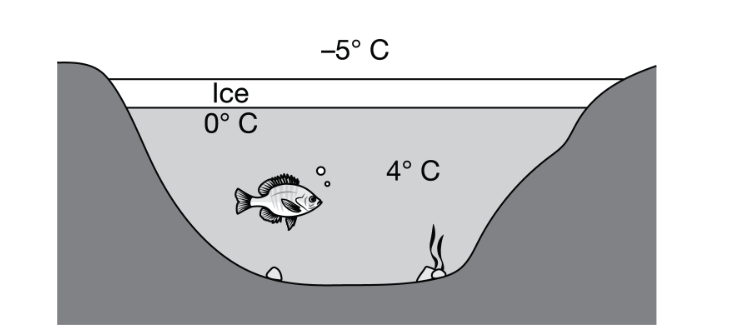
As shown in the diagram, when environmental temperatures drop below freezing, a layer of ice typically forms on the surface of bodies of freshwater such as lakes and rivers.
Which of the following best describes how the structure of ice benefits the organisms that live in the water below?
A) The water molecules in ice are closer together than those in liquid water, so the ice prevents the passage of air to the water, maintaining a constant gas mixture in the water.
B) The water molecules in ice are closer together than those in liquid water, so the ice forms a barrier that protects the organisms in the water from the freezing air temperatures.
C) The water molecules in ice are farther apart than those in liquid water, so the ice floats, maintaining the warmer, denser water at the lake bottom.
D) The water molecules in ice are farther apart than those in liquid water, so the ice floats, preventing the escape of gases from the liquid water.
C) The water molecules in ice are farther apart than those in liquid water, so the ice floats, maintaining the warmer, denser water at the lake bottom.
The water molecules in ice are farther from each other than are water molecules in liquid water, so ice is less dense than liquid water and floats on its surface. Dense water sinks, maintaining steady temperature.
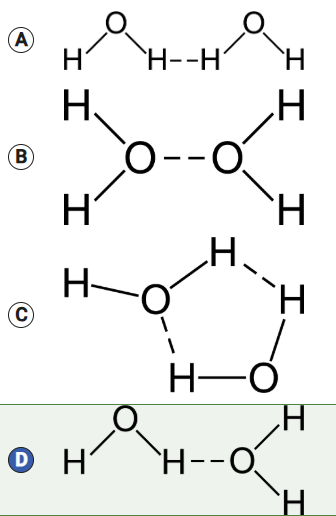
Water molecules are polar covalent molecules. There is a partial negative charge near the oxygen atom and partial positive charges near the hydrogen atoms due to the uneven distribution of electrons between the atoms, which results in the formation of hydrogen bonds between water molecules. The polarity of water molecules contributes to many properties of water that are important for biological processes.
Which of the following models best demonstrates the arrangement of hydrogen bonds between adjacent water molecules?
D). shows attractive force of one hydrogen atom of one water molecule and oxygen atom of another water molecule by making a hydrogen bond
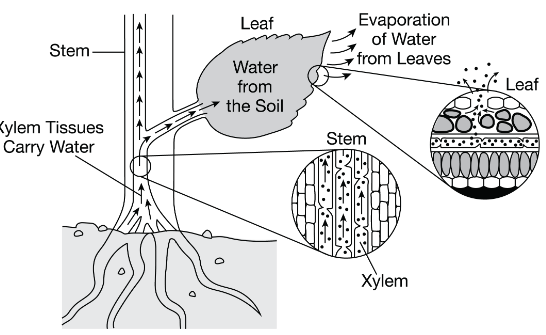
In vascular plants, water flows from root to leaf via specialized cells called xylem. Xylem cells are hollow cells stacked together like a straw. A student explains that evaporation of water from the leaf pulls water up from the roots through the xylem, as shown in Figure 1.
Which statement describes how water is pulled up through the xylem to the leaves of the plant?
A) As water exits the leaf, hydrogen bonding between water molecules pulls more water up from below.
B) As water exits the leaf, signals are sent to the roots to pump more water up to the leaves through the xylem by adhesion.
C) Evaporation from the leaf decreases the hydrogen bonds that form between the water molecules in the xylem, which helps the water molecules to be pulled up the xylem.
D) Evaporation of water from the leaf increases the hydrogen bonds that form between water molecules in the air, providing the energy for transport.
A) As water exits the leaf, hydrogen bonding between water molecules pulls more water up from below.
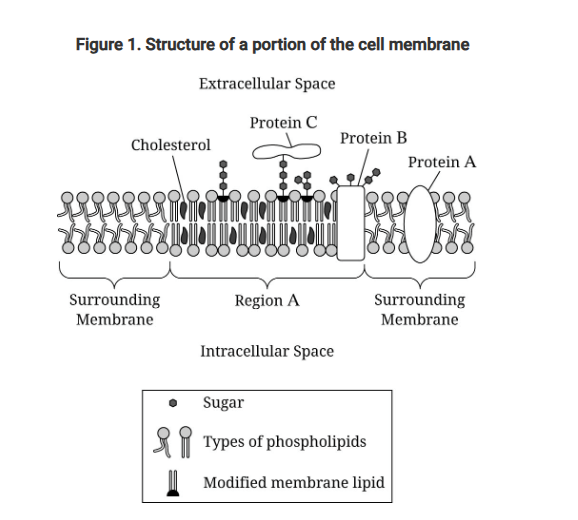
Researchers have identified regions, including region A in Figure 1, of the cell membrane that have a different density and composition than the surrounding membrane.
Which of the following best describes the chemical composition of the different types of macromolecules that make up the membrane represented in Figure 1?
A) All the molecules contain carbon and oxygen, but only some contain nitrogen.
B) All the molecules contain carbon and hydrogen, but only some contain oxygen.
C) All the molecules contain carbon and oxygen, but only some contain hydrogen.
D) All the molecules contain carbon and nitrogen, but only some contain oxygen.
A) All the molecules contain carbon and oxygen, but only some contain nitrogen.
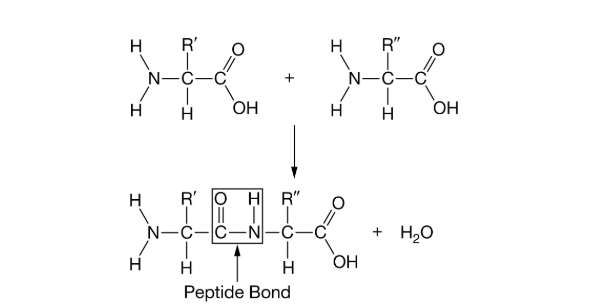
A polypeptide is polymer of amino acids held together by peptide bonds. The process of dehydration synthesis creates these peptide bonds, as shown in Figure 1.
As shown in Figure 1, an amino acid must have which of the following properties in order to be incorporated into a polypeptide?
A) The ability to remain stable in the presence of water molecules
B) An R-group that is compatible with the of the last amino acid incorporated
C) A central carbon atom that reacts with a nitrogen atom to form the peptide bond
D) The ability to form a covalent bond with both its NH2 group and its COOH group
D) The ability to form a covalent bond with both its NH2 group and its COOH group
Which of the following is common feature of the illustrated reactions showing the linking of monomers to form macromolecules?
A) Two identical monomers are joined by a covalent bond.
B) Two different monomers are joined by a covalent bond.
C) Monomers are joined by a covalent bond, and a water molecule is produced.
D) Monomers are joined by ionic bonds, and a water molecule is produced.
C) Monomers are joined by a covalent bond, and a water molecule is produced.
Which of the following describes a key difference among the 20 amino acids that are used to make proteins?
A) Only some amino acids have an R-group.
B) Only some amino acids have a carboxyl group (COOH).
C) Some amino acids are hydrophobic.
D) Some amino acids contain the element phosphorus.
C) Some amino acids are hydrophobic.
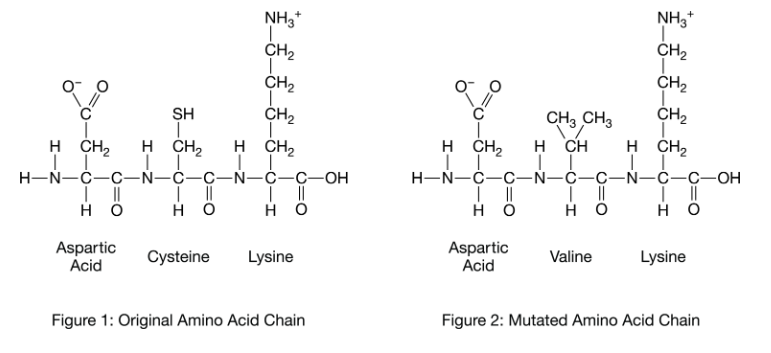
Figure 1 shows three amino acids that are part of a polypeptide chain. Figure 2 shows the same section of the chain after a mutation has occurred.
How might this change affect the structure and function of the protein?
A) The R-group of the new amino acid, valine, has different chemical properties than the R group of cysteine. This will cause the protein to misfold and not function properly in the cell.
B) The new amino acid, valine, has replaced cysteine in the new protein. Since the number of amino acids has remained the same, there will be no change in the three-dimensional folding, or function, of the protein.
C) Since this is a linear section, it does not influence protein folding. Thus, there will be no change in protein structure or function.
D) Since the new amino acid is bounded on one side by an amino acid with a negatively charged and by an amino acid on the other side with a positively charged , the charges will balance and the protein will fold as usual.
A) The R-group of the new amino acid, valine, has different chemical properties than the R group of cysteine. This will cause the protein to misfold and not function properly in the cell.
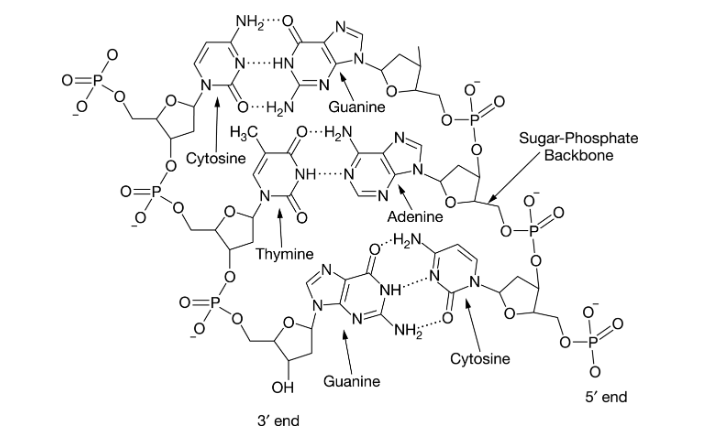
Figure 1 shows a short segment of a double-stranded nucleic acid molecule.
Which of the following statements is correct about the molecule shown in Figure 1 ?
A) It is RNA because of the relative direction of the two strands.
B) It is RNA because of the number of different nucleotides found in the molecule.
C) It is DNA because of the nature of the hydrogen bonds between guanine and cytosine.
D) It is DNA because of the nucleotides present.
D) It is DNA because of the nucleotides present.
Thymine is present, therefore its DNA
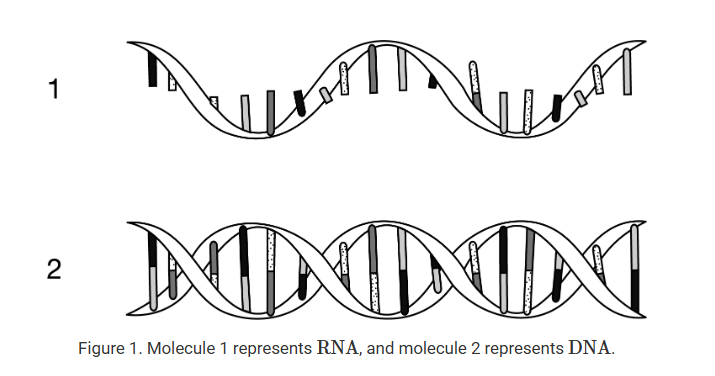
Which of the following best describes a structural similarity between the two molecules shown in Figure 1 that is relevant to their function?
A) Both molecules are composed of the same four nucleotides, which allows each molecule to be produced from the same pool of available nucleotides.
B) Both molecules are composed of the same type of five-carbon sugar, which allows each molecule to act as a building block for the production of polysaccharides.
C) Both molecules contain nucleotides that form base pairs with other nucleotides, which allows each molecule to act as a template in the synthesis of other nucleic acid molecules.
D) Both molecules contain nitrogenous bases and phosphate groups, which allows each molecule to be used as a monomer in the synthesis of proteins and lipids.
C) Both molecules contain nucleotides that form base pairs with other nucleotides, which allows each molecule to act as a template in the synthesis of other nucleic acid molecules.
DNA replication or transcription or reverse transcription can be used. the molecules are note use as a monomer for synthesizing proteins or lipids
Which of the following statements best describes a difference between proteins and nucleic acids?
A) Proteins contain sulfur, while nucleic acids do not.
B) Proteins contain phosphorus, while nucleic acids contain sulfur.
C) Both proteins and nucleic acids contain sulfur as a key element.
D) Both proteins and nucleic acids contain nitrogen and sulfur.
A) Proteins contain sulfur, while nucleic acids do not.
Protein: CHONS; Nucleic acid: CHONP
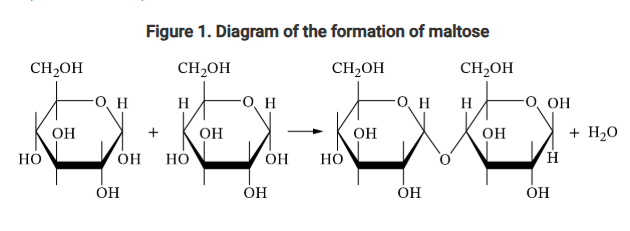
Figure 1 shows the formation of maltose (a disaccharide) from two glucose molecules.
Which of the following statements best describes the molecular changes that occur during the reaction shown in Figure 1?
A) Two hydroxyl groups are removed from each glucose molecule, and one water molecule is formed.
B) A water molecule is added to the hydroxyl groups to form the covalent bond between the two glucose molecules.
C) A hydroxyl group from one glucose molecule and a hydrogen atom from the other glucose molecule are removed, and one water molecule is formed.
D) A hydrogen atom in one glucose molecule and a hydroxyl group in the other glucose molecule form a hydrogen bond.
C) A hydroxyl group from one glucose molecule and a hydrogen atom from the other glucose molecule are removed, and one water molecule is formed.
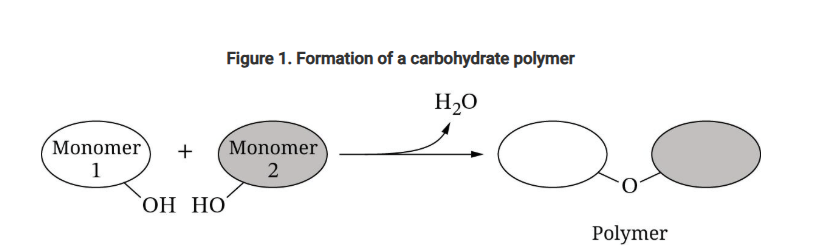
Figure 1 shows the formation of a carbohydrate polymer.
Which of the following best describes how the carbohydrate polymer is being built in Figure 1?
A) A water molecule is added to form a hydrogen bond between two monomers.
B) A water molecule is added to form a covalent bond between two monomers
C) A water molecule is removed to form a hydrogen bond between two monomers.
D) A water molecule is removed to form a covalent bond between two monomers.
D) A water molecule is removed to form a covalent bond between two monomers.
Which of the following best describes a characteristic of saturated fatty acids?
A) They contain at least one double bond between carbon atoms.
B) They have a kinked carbon chain structure.
C) They contain only single bonds between carbon atoms.
D) They are more liquid at room temperature than unsaturated fatty acids
C) They contain only single bonds between carbon atoms.
Which of the following best describes the role of phospholipids?
A) Phospholipids provide structural stability to animal cell membranes.
B) Phospholipids support physiological functions, including growth.
C) Phospholipids provide energy storage and support cell function.
D) Phospholipids form the lipid bilayer found in cell membranes.
D) Phospholipids form the lipid bilayer found in cell membranes.
One form of the genetic disorder lipodystrophy involves the lack of an enzyme that is required for the synthesis of triglycerides, a type of lipid. Triglycerides serve as an energy reserve in fat cells.
Which of the following best describes the most likely effect of lipodystrophy on cell function?
A) There will be a decrease in phospholipids in cell membranes.
B) There will be a decrease in cholesterol in cell membranes.
C) There will be a decrease in fat storage in cells.
D) There will be a decrease in fatty acid synthesis in cells.
C) There will be a decrease in fat storage in cells.
the problem is not making fatty acids, its assembling triglycerides from them