Lecture 8 - Different Allais paradox explanations
 Call Kai
 Learn
Learn Practice Test
 Spaced Repetition
 Match
Match Flashcards
 Knowt Play
1/22

There's no tags or description
Looks like no tags are added yet.
Name | Mastery | Learn | Test | Matching | Spaced | Call with Kai |
|---|
No analytics yet
Send a link to your students to track their progress
23 Terms
models / approaches to explain “Allais paradoxes”
“Maximise something else”
e.g. Cumulative Prospect theory
“Maximise with error”
e.g. “Fechnerian error” model
“Not maximising”
e.g. Salience theory
CCE & CRE features
Switch from safer option → riskier option when the same problem is made ‘less attractive’
Violates EUT
Can be riskier in more attractive → safer in less BUT uncommon
how CRE could be random error
Agents have “true preferences” described by EUT BUT make “white noise” errors in “computing” EU
They then choose actions that maximise “computed EU
Simple Fechnerian error model
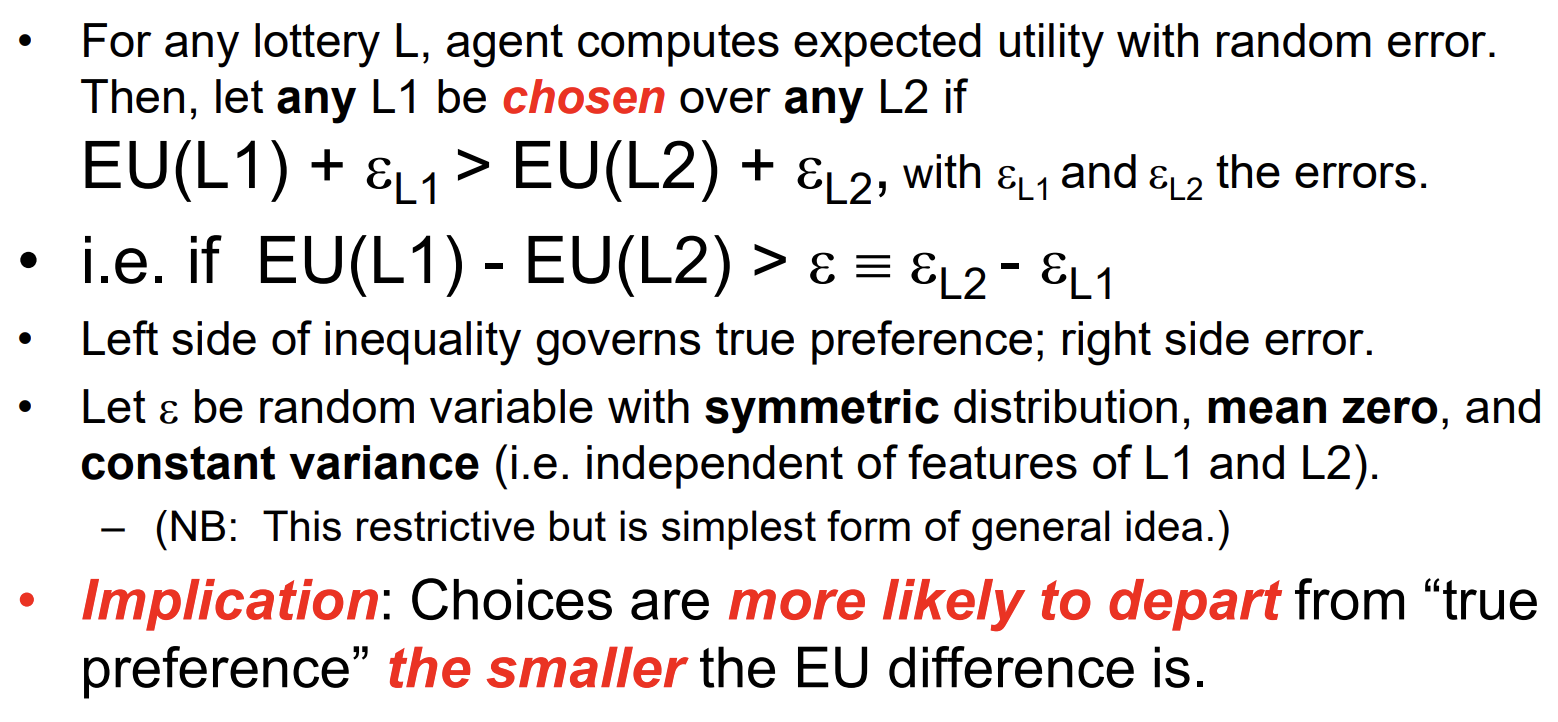
Choose L1 so long as true value of 1 not overridden by computation errors
errors random & constant variance so dont favour either choice or depend on the lotteries (big assumption)
Fechnerian error model & CRE
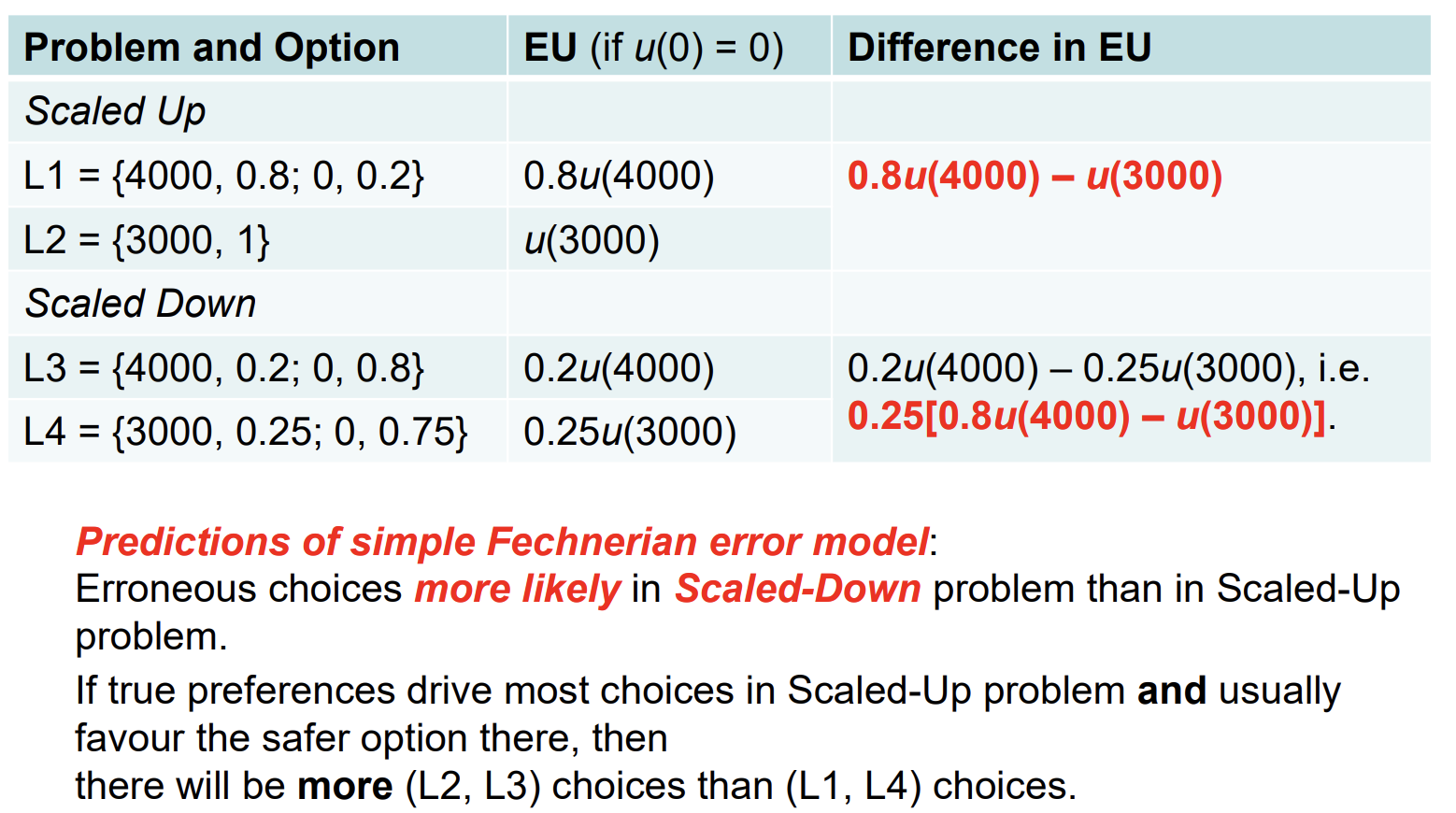
Problems for Fecnerian model
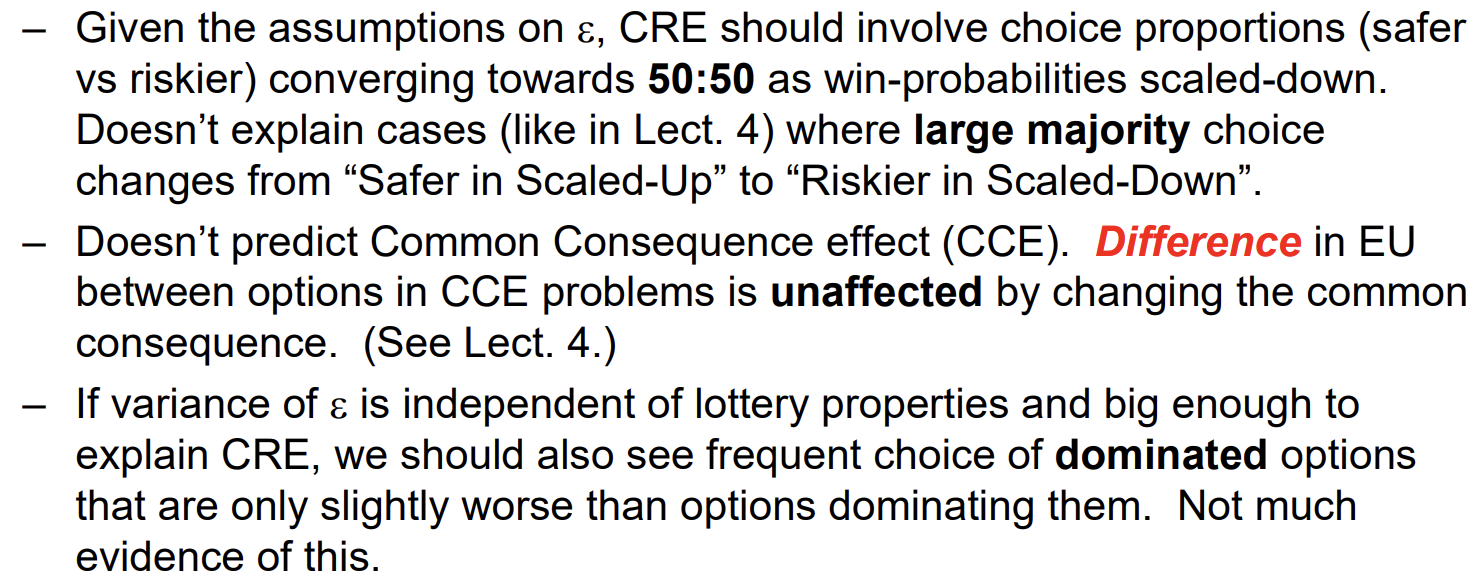
Errors symmetric so choice should converge towards 50/50 not swap in large amounts
Same EU difference for both choices in CCE so cant explain CCE
Predicts more violations of dominance than seen in reality
Problems might be avoided by more complex Fechnerian error model where stochastic properties of errors depend on characteristics of lotteries in “appropriate” way
Are CRE & CCE correlated or independent
Are processes that resolve uncertainty in the less attractive problem correlated
- No difference in EUT or prospect theory
- Now relevant for Salience theory
event
A possible resolution of uncertainty
Choices made by comparing available options in different events
Salience theory for risk
Decision-weights now attach to events
People are influenced by events where outcomes differ a lot
Ceteris Paribus, larger the difference is, larger decision weight on event
For simplicity, we approximate this by assuming choice between options fully determined by comparing them in the event where they differ most
Relative to prob we overweight event where outcome changes most
Implication - Available options can’t be evaluated in isolation from one another
Salience theory example
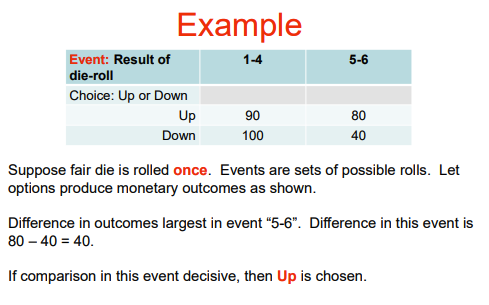
Choose event with largest difference - Pick the one with highest outcome
Attention based theory of salience theory
Decision-maker has limited attention.
Agent drawn (or allocated) to events where choice between options matters most
largest difference draws our attention
Regret based salience theory
Regret arises from comparison of chosen action and what might have been if agent had chosen differently
Decision-makers very averse to large regrets, so act to prevent them them
Modified salience theory example
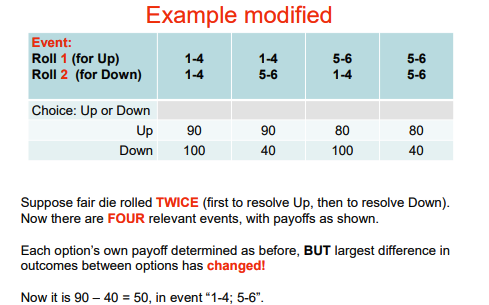
How do simple vs modified salience theory examples differ
Original:
One roll resolves both options - options stochastically-dependent
Outcomes correlated - each option gives its highest payoff in same event, “1-4”
Modified:
Two independent rolls resolve the options, one for each option - options stochastically-independent
Outcomes uncorrelated
e.g. there is an event (“1-4; 5-6”) with best outcome of Up but worst outcome of Down
Under Salience theory, this event has a lot of weight
Salience theory & CCE example
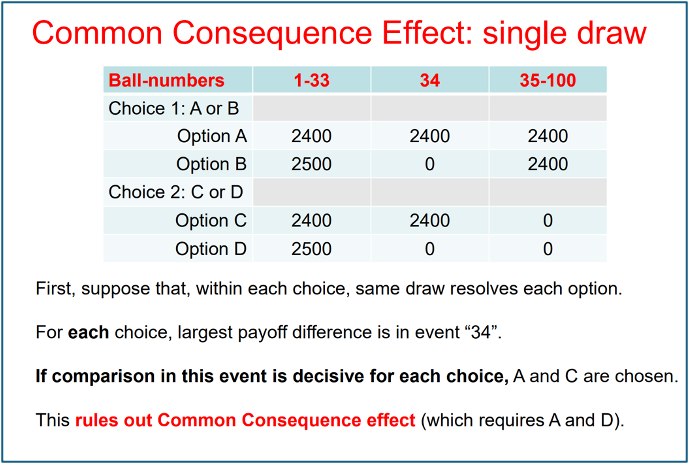
CCE would choose A & D (35-100 common outcome)
CCE & salience theory
CCE can occur in Salience theory if risks in options of each problem stochastically independent
i.e. resolved by different draws
CCE will not occur if risks in the options stochastically dependent
i.e. resolved by same draw
CRE follows similar pattern of only appearing if event resolved by different draws
stochastically independence effects on CCE
Compared with stochastic-dependence, stochastic independence:
Makes no difference to the more attractive choice problem provided safer option is a certainty
BUT changes less attractive choice problem by “creating” event where agent “lucky in riskier option, but unlucky in safer one”
This event has large payoff-difference!
If comparison in this event decisive, riskier option chosen in less attractive problem
in line with direction of CCE
CPT vs ST & lotteries
CPT - Decision-weighting driven by probabilities (and rank-order of consequences) within each lottery
ST - Decision-weighting driven by comparisons of consequences across available lotteries
Implication: How lotteries resolved can discriminate between prospect theoretic and salience theoretic accounts.
Bruhin et al (2022) - OV
Each subject faces two blocks of choices:
one with choices between stochastically-independent lotteries;
one with corresponding choices between stochastically-dependent lotteries.
Order of blocks and order of tasks in blocks randomised by subject, to avoid order effects
Bruhin et al (2022) - Predictions
Predictions differ between model used
EUT: Subjects will not display CCE or CRE forms of Allais paradox
Cumulative Prospect theory: Subjects may display Allais Paradox behaviours but will be equally prone to this regardless of whether lotteries stochastically dependent or independent
Salience theory: Subjects may display Allais Paradox behaviours but only when lotteries stochastically independent.
Bruhin et al (2022) - Design
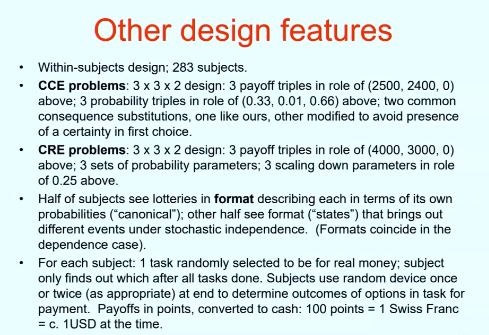
½ see ‘states’ which makes stochastic independence very obvious
‘canonical makes it less obvious’
Bruhin et al (2022) - Results aggregated
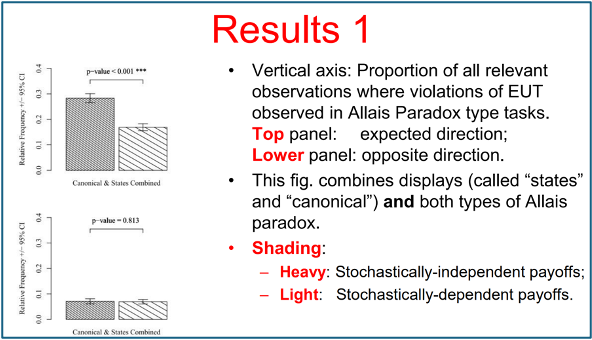
Aggregates across CRE & CCE
Shows EUT violated but NOT always
EUT violations in expected direction more frequent
EUT violations more frequent when payoffs random/independent - as salience theory predicts
Violations also present in stochastically-dependent payoffs case (no ST but CPT predicts it)
Gap between indep/dep in top diagram shows effect that ST predicts that CPT doesnt - CPT also valid as Allais paradox shown
Bruhin et al (2022) - Results individual
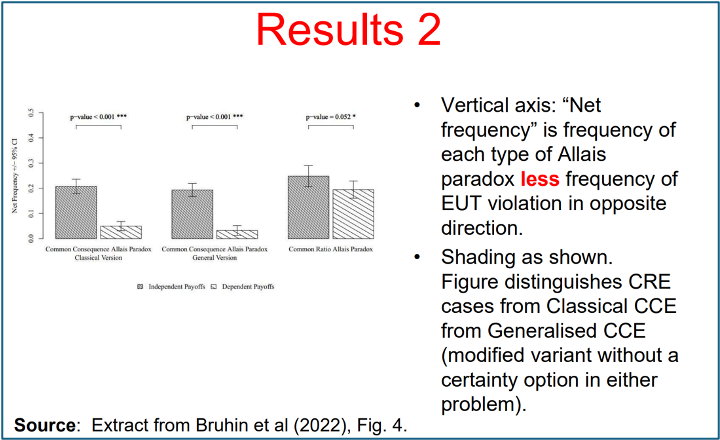
Expected direction of EUT violation dominates opposite
especially for stochastically independent payoffs
Dep vs Indep matters more for CCE than CRE
direction of effect predicted by ST
CRE still seen when ST doesnt predict it (CPT present)
Further study ascribed which theory fits best to an individual
EUT, ST or CPT
Roughly all equal at 1/3