Bio Lesson 2: DNA structure
 Call Kai
 Learn
Learn Practice Test
 Spaced Repetition
 Match
Match Flashcards
 Knowt Play
1/15

There's no tags or description
Looks like no tags are added yet.
Name | Mastery | Learn | Test | Matching | Spaced | Call with Kai |
|---|
No analytics yet
Send a link to your students to track their progress
16 Terms
What shape is DNA
Double Helix
What is Transformation?
a process where a cell absorbs DNA from its environment, incorporates it into its own genetic material, and expresses it, allowing the cell to gain new traits.
Why is DNA important in our bodies (use Gene and Protein)
DNA stores the information in genes, which dictate the production of proteins, which make our bodies work.
What is a Nucleotide and what is it make of
The monomer of DNA - 1 phosphate group, 1 sugar, and a Nitrogen containing base
Name the Nitrogen Containing bases and what group they correspond in
Adenine, Guanine - Purines (Bigger)
Cytosine, Thymine - Pyrimidines (Smaller)
which Nitrogen Containing bases connect to for double helix? and their amount of bonds
A - T : 2 hydrogen bonds
G - C : 3 hydrogen bonds
What is Nucleic Acid
A chain of repeating nucleotides
What is the back bone of DNA
Hydrogen Bonds connecting nucleotides
What allows Nucleotides to be attached to a chain of other nucleotides
Covalent bonds holds each of the Antiparallel strands in their lines
What does DNA stand for?
Deoxy-ribo-nucleic Acid
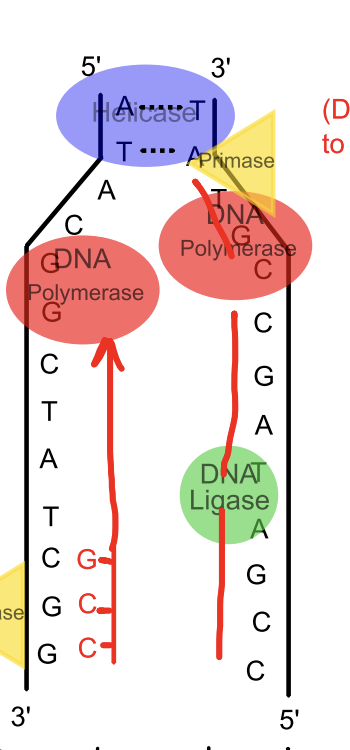
In this model, what does each enzyme do?
Helicase: Breaks hydrogen bonds to separate the two DNA strands so replication can begin.
Primase: Lays down short RNA primers to give DNA polymerase a starting point.
DNA polymerase: Adds complementary nucleotides to build the new DNA strand
DNA ligase: Seals gaps between DNA okazaki fragments to form a continuous strand.
Why is the order of. the nitrogenous bases so important
each strand made up of bonded nitrogen containing bases create sequences that stores all instructions for building, running, and repairing living organisms in DNA and RNA.
What are the enzymes used in replication called?
Helicase, DNA Polymerase, Primase, Ligase
describe or draw a replication model with the big 4
lagging: 5’ P → Poly + L
Leading: 5’ P ————> Poly
Difference between leading and lagging strands
Leading strand: DNA is made continuously in the same direction as helicase moves.
Lagging strand: DNA is made in short fragments opposite to helicase movement and then is later joined together by ligase.
why does dna need to replicate before the cell divides
to ensure that each resulting daughter cell receives a complete and identical set of genetic instructions