Hell World: Term 2 Week 4: Kings, Leagues and cities
 Call Kai
 Learn
Learn Practice Test
 Spaced Repetition
 Match
Match Flashcards
 Knowt Play
1/46

There's no tags or description
Looks like no tags are added yet.
Name | Mastery | Learn | Test | Matching | Spaced | Call with Kai |
|---|
No analytics yet
Send a link to your students to track their progress
47 Terms
What is the Hellenistic world often tied up with the idea of?
The Hellenistic world is often tied up with the idea of the end of the polis (a city and its territory).
What are the suggested points for when the polis may have ended?
If one were to emphasis independence certain moments when the independence of the polis seems to be curved one way e.g. the battle of Chseronea (338)- sometimes seen as the point where the polis ended
Another point the polis may have ended could be the Lamian war (322), a Greek state rebellion against Antipater
What do these ‘turning points’ of when the Greek city ended apply to?
Most of the points only really apply to the cities of old greece- in this period there are many new Greek cities founded
Focus on independence seems to really depend on the independence of Athens rather than other Greek city states
Did the Hellenistic period act as a Renaissance for the Polis?
More than 100 new foundations all over the eastern Mediterranean and Asia
Many existing cities grew larger, and their centres were sometimes 'monumentalised'.
The largest cities of the Hellenistic world (Alexandria in Egypt) were much larger than any Greek city of the classical period.
Who was instrumental in founding cities and why did they do it?
The Successors were instrumental in founding cities, particularly antigonous
Main aim was to provide land for their Greek and Macedonian soldiers, who would then continue to show loyalty to that ruler by controlling local populations on his behalf
Where were many of these new cities/foundations built?
Many of these new foundations were created on existing settlements, various things may have happened to the original population e.g. evicted or continue to live there as second class citizens/servants
How did people often get citizenship of a polis?
Citizenship of a polis (often, but not exclusively, reserved for landowners)
What did the political structure of the polis resemble?
The political structure of government resembled the old poleis (as far as can be discerned), often with classical Athens taKen as the model
What was the citizens assembly?
The citizens assembly (ecclesia), which voted on city finances, food supply defence, relations with other states and kings, laws
How were magistrates elected?
Magistrates elected by popular vote- this becomes an important part fo the life of the polis
How did people inscribe laws?
The practice of inscribing laws and decrees on stone, making them accessible and permanent reminders (this was particularly a habit in Asia minor)
What did many of these places call themselves?
Many of these places called themselves democracies event though they were probably not like the Athenian democracy of the 5th century
What were new traits of the polis?
Posh houses become more prominent (example on slide 8 of one from Delos)- Elites freer to flaunt wealth and status
Opulent houses built, with elaborate mosaic floors
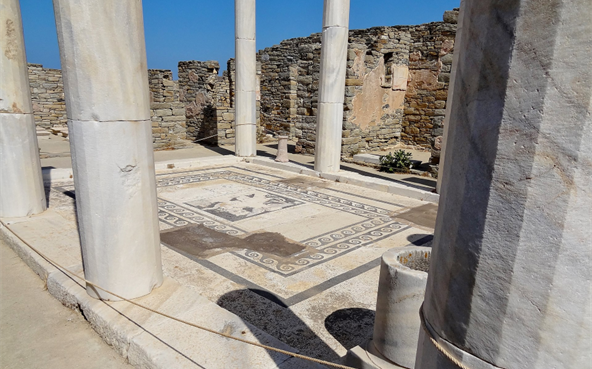
The elites are no longer pretending to be equal to other citizens and instead are showing off their wealth
What often acts as the monumental city centre?
Most cities have monumental central areas such as the agora
The Hellenistic agora at Priene in Asia minor (slide 9)
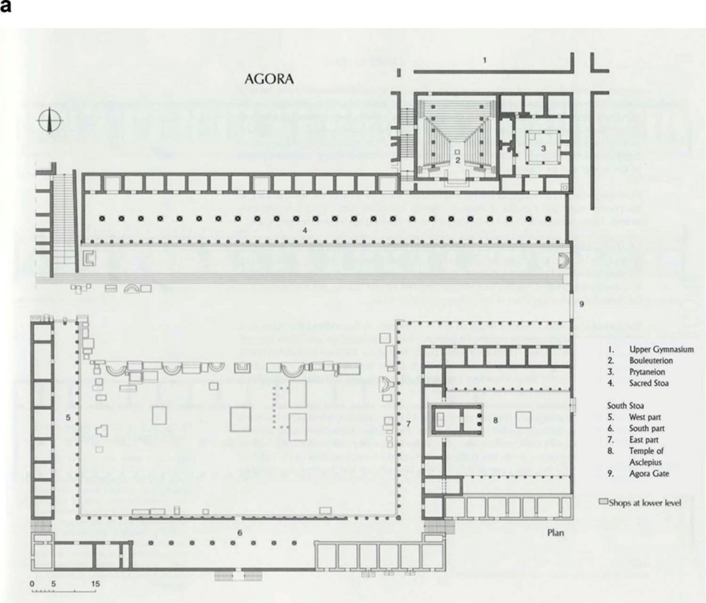
The agora is often a political and economic centre of the city, they often turn into markets but that is not their purpose
Quite small cities investing in this type of architecture
What is a stoa?
Constructed around the edges of agora, the one on slide 9 is a gift from a king to the Athenians
They may contain rooms rhat you can hire out for businesses, they also provide areas in the shade to walk
What is this surviving inscription evidence for:
•Resolved by the people, proposal of the synedroi: since Eudemus son of Thallion has chosen to benefit the people and to perpetuate for all time the memory of his own glory, and has promised to give for the education of the free children ten talents of silver on behalf of himself and his brothers Menander and Dion, the Milesians have voted: to praise Eudemus for his zeal for the most worthy pursuits, and to commend him to the attention of the council and the people.
•(Austin, no. 119)
Lots of epigraphic evidence survives for the gymnasium (the image above is an example of an inscription)
Give extracts from a gymnasium law from Beroea, Macedonia, second century BCE (Austin, no. 118)
The city shall appoint a gymnasiarch at the same time as the other magistrates, and he shall not be below the age of 30 nor above 60.
No one under the age of 30 may take off his clothes when the signal is lowered, unless the leader gives his assent. When the signal is raised, no one else may do so unless the leader gives his assent.
All those who frequent the gymnasium shall obey whoever is appointed by the gymnasiarch to act as leader, as is specified for the gymnasiarch; whoever does not obey the leader, the gymnasiarch shall punish him with flogging, and he shall fine the others.
The gymnasiarch shall have the power to flog the boys and the physical trainers who show indiscipline, if they are not free, and to fine those who are free.
Those who may not take part in the gymnasium: no one may enter the gymnasium and take off his clothes if he is a slave, a freedman, or a son of these, if he has not been to the wrestling school (palaestra), if he is a pederast, or has practiced a vulgar trade, or is drunk, or mad. If the gymnasiarch knowingly allows any of these to anoint himself, or does so after someone has reported to him and pointed this out, he shall be fined 1,000 drachmas.
What are some social changes in the polis during the Hellenistic period?
Polarisation (rich and poor)- society is quite stratified
Role of women as benefactors- in the classical period they tend to be more confined to religious roles, but occasionally they turn up as benefactors of cities- elite women made benefactions in former buildings in thor own name with their own money. E.g. the cavity of megalopolis, a woman paid for a temple and a hotel. Among even elite women we find them playing a more prominent role in families.
Adult male citizens might form units in the royal army, if the city had a royal garrison citizens paid for its maintenance
Where does a lot of this information come from
A lot of this relies on the interpretation of archaeological evidence,w hich sint always clear cut (some surveys in Greece suggest that the countryside became dominated by large rich men and the people originally there had to move to towns to find work- but this isn’t consistent everywhere)
Did Kings have influence over the polis and what did this mean?
Kings could exert considerable influence over a polis
But often this was couched as a kind of two-way negotiation
Cities on the boundaries of, or between kingdoms, could sometimes negotiate to their advantage
This often meant that, in international relations, the king-city relationship could be more important than city-city relations (although these remained extremely important)
What would kings often bestow?
Privileges were bestowed by kings more than by the city’s own, independent actions in the international arena- they would give major monuments or declare the city to have particular rights
Kings werent always free to do as they pleased which lead to negotiations, where cities would negotiate their position with the kings
What was Didyma?
Didyma was an ancient Greek sanctuary on the coast of Ionia in the domain of the famous city of Miletus
What was Didyma famous for?
It was famous for an oracle of the god Apollo (there was gigantic Hellenistic temple built around the oracle)
Why was Didyma favoured?
This city was favoured because of the oracle and because of the kinship with the king himself:
‘•King Seleucus to the council and people of Miletus, greetings. Whereas our ancestors and our father conferred many great benefits on your city because of the oracles rendered from the sanctuary of Apollo Didymeus, and because of their kinship with the god himself, and also because of the gratitude shown by your people; and whereas we can see ourselves, from the policies you have constantly pursued towards our interests, which our father’s Friends have pointed out to us, and from the speech made by Glaucippus and Diomander, your envoys who have brought the sacred crown from the shrine with which your people has crowned us, that you remain sincere and firm in your friendships and remember benefactions you have received, we welcomed the policy of your people, and since we are anxious and attach the greatest importance to raising [your city] to a more distinguished position … the privileges …’
Letter of Seleucus II to Miletus (Austin, no. 186)
Write out Teos honours Antiochus III (204/3 BCE; Austin, no. 151) (Teos is a city)
•Previously, when staying in the region beyond the Taurus, [Antiochus] was the cause of many benefits to us; when he came to our region he settled affairs in an advantageous way, and when he stayed in our city he saw that we were exhausted both in our public and our private affairs because of the continuous wars and the great burdens of the contributions we were bearing. Wishing to display piety towards the god to whom he consecrated our city and territory, and wanting to do a favour to the people and the association of Dionysiac artists, he came forward in person in the assembly and granted that our city and territory [be] holy (hiera), inviolate (asylos), and free from tribute (aphorologetos), and undertook to free us himself from the other contributions we pay to King Attalus (I), so that by bringing about an improvement in the city’s fortunes he would receive the title not only of benefactor of the people, but of its saviour. He stayed in the city with his friends and the military forces which accompanied him, and gave ample evidence of the good faith he already shows towards all men, and after this has constantly been responsible for many favours to us, thereby giving an example to all the Greeks of how he treats those who are his benefactors and who are well disposed towards him.
Write out Letter of a Seleucid governor to a city in Iran called Laodicea (Austin, no. 158)
Menedemus (satrap) to Apollodorus (royal governor at Laodicea) and the magistrates and city of Laodicea, greetings. Appended below is the copy of the edict sent to us in writing [by the king]. Do therefore conform to the instructions given and see to it that the edict is inscribed on a stone stele and dedicated in the most distinguished sanctuary in the city. Farewell. Year 119, on the 10th of the month of Panemus (June or July 193 BCE).
King Antiochus (III) to Menedemus, greetings. Wishing to increase further the honours of our sister and Queen Laodice, and believing this to be most imperative for us, not only because of the affection and care she shows in her life with us, but also because of her piety towards the deity, we continue to perform affectionately everything that is fitting and just [for her] to receive from us, and in particular it is our decision that just as chief-priests of ourselves are appointed throughout the kingdom so too chief-priestesses should be set up in the same who shall wear gold crowns with her portrait on them, and who shall be inscribed on business contracts after the chief-priests of our [ancestors] and ourselves. Therefore since Laodice has been appointed in the provinces under [your] command, [let] everything [be done] in conformity with what is written above and let the copies of the letters be inscribed on stelae and dedicated in the most distinguished [places], so that [our good disposition] towards our sister should be made manifest in these matters too now for the future. Year 119, …
Write out the The ‘ithyphallic hymn’ by the Athenians to Demetrius Poliorcetes in 291 BCE, preserved in Athanaeus (Austin, no. 35)
How the greatest and dearest of the gods have come to the city! For the hour has brought together Demeter and Demetrius; she comes to celebrate the solemn mysteries of her Daughter (Persephone), while he is here full of joy, as benefits the god, fair and laughing. His appearance is majestic, his friends all around him and he in their midst, as though they were the stars and he the sun. Hail son of the most powerful god Poseidon and of Aphrodite! For the other gods are either far away, or they do not have ears, or they do not exist, or do not take any notice of us, but you we can see present here; you are not made of wood or stone, you are real. And so we pray to you: first bring us peace, dearest; for you have the power. And then, the Sphinx that rules not only over Thebes but over the whole of Greece, that Aetolian sphinx sitting on a rock like the ancient one, who seizes and carries away all our people, and I have no defence against her (for it is the Aetolian habit to seize the property of neighbours and now even what is far afield). Most of all punish her yourself; if not find an Oedipus who will either hurl down that sphinx from the rocks or reduce her to ashes.
Analyse that text
Extreme flattery?
We are unaware of how much and what they pratticed, we know they were dedicated to Demeter and Persephone
The phallic refers to in Dionysiac processions the people who carried giant phalluses
What was the idea of autonomia for the polis?
The idea of autonomia- not ‘independence’, but self governing (managing its own internal affairs)- the way we understand autonomy isn’t how they understood it, they viewed it as self governing rather than independence
Autonomy was nevertheless coveted by Geek cities
What did the cities autonomy extend to?
The city’s autonomy extended to decisions about relationships with kings, as well as other cities, and other benefactors; to decisions about maintenance of public works (e.g. gymnasia) and food supplies; and concerned themselves with their sanctuaries and festivals and the rules for these
What would the magistrates who were elected oversee?
They elected magistrates who oversaw all kinds of tasks: making sure prices in the marketplace were fair; educating the young; keeping public order, some were responsible for keeping public spaces clean- magistrates were essentially to make sure that the city ran smoothly
Write out Antiochus I in Babylon (Austin, no. 189) (shows Royal relations with non-greek communities)
I am Antiochus, the great king, the legitimate king, the king of the world, king of Babylon, king of all countries, the caretaker of the temples Esagila and Ezida, the firstborn son of King Seleucus, the Macedonian, king of Babylon.
When I conceived the idea of reconstructing Esagila and Ezida, I formed with my august hands in the country Hatti (Syria) the first brick for Asagila and Ezida with the finest oil and brought it with me for the laying of the foundation of Esagila and Ezida. And in the month of Addaru, the 20th day, the 43rd year (268 BCE), I did lay the foundation of Ezida, the only true temple of Nebo which is in Borsippa.
(There then follows lengthy praise of Nebo.)
O Nebo, foremost son, when you enter Ezida, the only true temple, may there be on your lips words of favour for Antiochus, the king of all countries, for Seleucus, the king his son and for Stratonice, his consort, the queen!
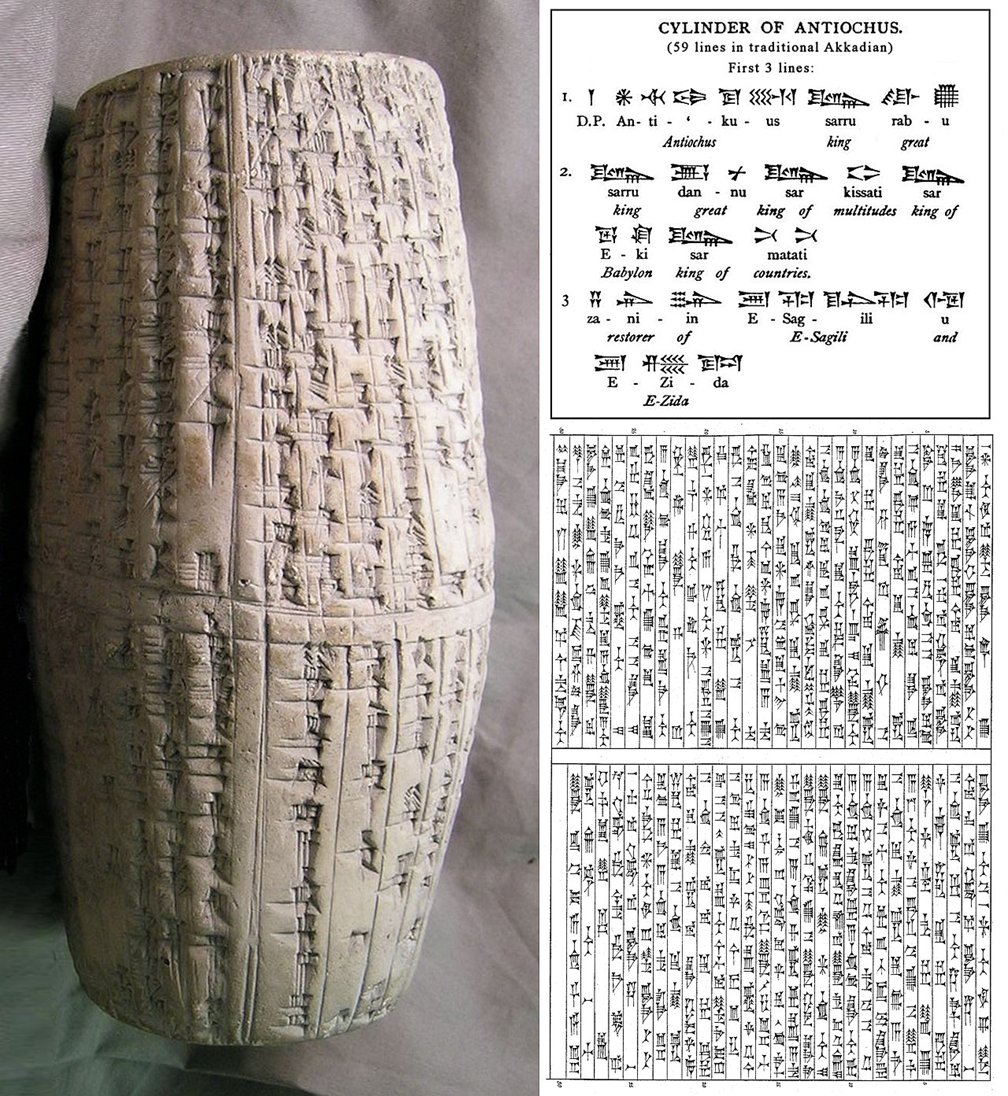
Identify this
The ‘Antiochus Cylinder’- The Antiochus cylinder is a devotional cylinder written in traditional Akkadian for Antiochus I Soter, c. 250 BCE. Discovered in Borsippa
Where did leagues and federations develop?
Most important of these leagues and federations developed in response to the power of Hellenistic kings, particularly in those places on the fringes of kingdoms, or outside them
What is the Achean league?
The Achaean League was a prominent Hellenistic-era confederation of Greek city-states (280–146 BC) based in the northern Peloponnese, designed for mutual defense and political, economic, and military cooperation
When was the Achean Leaugue refounded?
Achean league- refounded in 280 BCE (did exist before, but was refoudned)
What was the Aetolian league?
Aetolian League, existed before the Hellenistic age. Spared suppression by Antipater after the Lamian War, the Aetolians extended their power into Central Greece and were instrumental in defeating a Gaulish army advancing on Delphi. The Aetolians had a reputation for piracy, and extended their power to the Aegean. Originally a league based on ethnicity, it extended to include cities that were outside Aetolia itself.
What is the Hellenic League?
A Hellenic League, a structure formed by Antigonus Doson in 224, drew together several Leagues, so that it consisted of an alliance of Leagues rather than cities. The Aetolians were not a part of the Hellenic League, and were in conflict with it; the Achaean League was part of it
What is an isopoliteia?
Isopoliteia (equal citizenship) was a diplomatic treaty in ancient Greece, common in the Hellenistic period, allowing citizens of one city-state (polis) to enjoy rights and potential citizenship in another without losing their original citizenship
Write out the Isopoliteia between the citizens of Chios and the Aetolian League (Austin, no. 52)
Since the League, because of the ancestral kinship and [friendship] which exist between our people and the Aetolians, voted previously to grant us citizenship and forbade all to plunder the property of the Chians from whatever starting-base on pain of being liable to prosecution before the councillors (or the League) on a charge of harming the common interests of the Aetolians; for this the people (of Chios) graciously accepted their goodwill and voted that the Aetolians should be citizens and share in all the rights the Chians share in, and decided they should have priority of access to the council and the ecclesia, and be invited to seats of honour at all contests organized by the city …
Explain the Achaen League
The Achaean League, which attempted to throw off Macedonian control in southern Greece, developed some supra-polis institutions and supra-polis magistracies.
It had an annually elected general who commanded a common military force, and an assembly that met four times a year, and its own council. All male citizens of the cities in the League were supposed to attend the assemblies.
All or most of its members also issued a common coinage, with a common weight standard and common designs.
What are less formal links between cities?
•Arbitration in disputes
•Agreements to respect the asylia of each other’s sanctuaries
•Assisting each other in dealing with backlogs of court cases
•Citizens of one city could give benefactions to other cities
•Sense of a community of Greek-speakers (many used a modified form of the Attic dialect, koine; a common system of elite education in gymnasia; similar systems of governance
What did cities start to rely on?
Due to them paying tribute to external factors their finances arent as good as they once were
Tendency for cities to rely on benefactions, either from wealthy foreigners or kings- thes benefactors could receive special titles
What would cities do inr esponse to these benefactions?
Citizens assemblies voted public thanks and honours for these benefactors
What are disadvantages of benefactions?
Disadvantages: famous cities like Athens more likely to attract benefactions (your benefaction was more likely to be seen and admired in a famous place than in an obscure one)