Physical development in adolescence
 Call Kai
 Learn
Learn Practice Test
 Spaced Repetition
 Match
Match Flashcards
 Knowt Play
1/13

There's no tags or description
Looks like no tags are added yet.
Name | Mastery | Learn | Test | Matching | Spaced | Call with Kai |
|---|
No analytics yet
Send a link to your students to track their progress
14 Terms
Puberty
A set of anatomical and physiological changes.
Period of life during which a person undergoes physical and hormonal changes that mark the transition from childhood to adulthood.
Secondary sexual characteristics and, under normal circumstances, reproductive capacity appear.
Process leading to sexual maturity or fertility → ability to reproduce (resulting from the production of certain hormones).
Adolescence
Developmental transition between childhood and adulthood involving major physical, cognitive and psychosocial changes.
Occurs between 11-19/20 years old.
Adolescence as a social construct.
PERIOD OF TRANSITION AND EXPERIMENTATION
Physical changes during adolescence
Growth
Muscle strengthening
Shoulder broadening
Hormonal development
Change of sexual organs
Adolescent growth:
• Rapid increase in height, weight, muscle and bone growth that occurs during puberty.
• Girls: 10 years / Boys: 12-13 years.
Psychosocial changes
Need for maturity
Need for self-identity
Psychological separation from parents
More social bonding (friendships)
Social problems
Learning to task risks
New dangers
Cognitive changes
Loss of synaptic connections (pruning)
Mind reaches new domains and capacities
Myelinisation
Vulnerability
Confusion
Early adolescence (11-14 years)
Begin to grow physically
Begin to develop more complex cognitive abilities
Greater capacity for social relationships
Increased self-awareness
Middle adolescence (14-16 years)
Physical growth continues
Increased social challenges
Greater intimacy in couple relationships
Parent-child relationship changes
Late adolescence (17-18 years)
Physical growth stabilises
Psychosocial changes stabilise
Physical development of the body: puberty
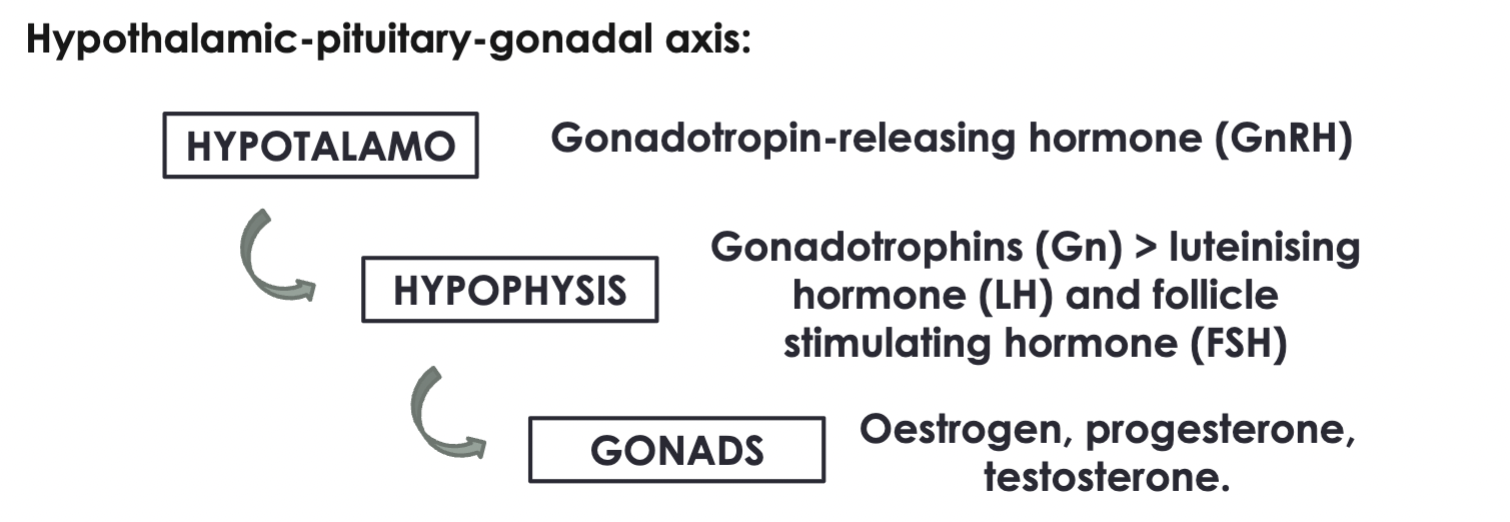
Hormonal changes > Concentrations of certain hormones increase dramatically: estrogen (key in female development) and testosterone (predominant in male development).
Hormonal changes > Two stages:
First stage → 6-8 years
Activation of the adrenal glands: Adrenal glands → ↑ androgens (dehydroepiandrosterone, DHEA):
growth of pubic, axillary and facial hair; faster body growth; increased skin fat; development of body odour.
Second stage → Maturation of sexual organs
Females: ovaries → ↑ oestrogens = growth of female genitalia and development of breasts and pubic and axillary hair.
▪ Males: testes → ↑ androgens = male genitalia growth, increased muscle mass and body hair development.
Physical development of the body: sexual characteristics
Primary sexual characteristics
• Organs necessary for reproduction: during puberty they enlarge and mature.
• Females: ovaries, fallopian tubes, uterus, clitoris and vagina.
• Males: testicles, penis, scrotum, seminal vesicles and prostate.
Secondary sexual characteristics
• Physiological signs of sexual maturation that do not directly involve the sexual organs:
• Females: breasts.
• Males: broad shoulders.
• Other signs: changes in voice and skin texture, muscle development, hair growth, etc.
Signs of puberty
External signs
• Females: breast tissue and pubic hair.
• Males: enlargement of the testicles.
Other signs
• Pubic hair > coarse, dark and curly.
• Voice > deeper, especially in males.
• Skin > thicker and oilier.
Signs of sexual maturity
Maturation of reproductive organs generates:
• Male sperm > first ejaculation as a sign of sperm production. Average: 13 years.
• Menarche in females > first menstruation resulting from monthly shedding of the lining of the uterus.
Average range: 10-16 years.
Timing of menarche in females
Individual differences:
• Genetic: age of menarche of the mother.
• Physical: prepubertal fat and body weight (obesity).
• Contextual: toxins (maternal smoking during pregnancy).
• Emotional: chronic stress (family conflict, cold and distant relations with parents, family breakdown)
Timing of puberty
Secular growth trend: decreasing ages of onset and attainment of adult height and sexual maturity.
Possible cause → better quality of life (nutrition, health...).
Others point out that it could be due to harmful factors (too much fat and a sedentary lifestyle that increase obesity, as well as endocrine disruptors = toxins that act like hormones).
• Early or late puberty has been linked to physical (obesity), health (cancer, polycystic ovaries) and psychosocial (anxiety, depression, early pregnancy) effects.
• It is difficult to generalise because the psychological effects of the onset of puberty will depend on how the adolescent and those close to him or her interpret the changes.
• The effects of early or late maturation are more likely to be negative when adolescents' development is much higher or lower than that of their peers, when they do not see the changes as advantageous, and when several stressful events (onset of puberty and transition to secondary school) occur at the same time