MD401 - T22 - Psychiatric Patient Assessment and Diagnosis
 Call Kai
 Learn
Learn Practice Test
 Spaced Repetition
 Match
Match Flashcards
 Knowt Play
1/54

There's no tags or description
Looks like no tags are added yet.
Name | Mastery | Learn | Test | Matching | Spaced | Call with Kai |
|---|
No analytics yet
Send a link to your students to track their progress
55 Terms
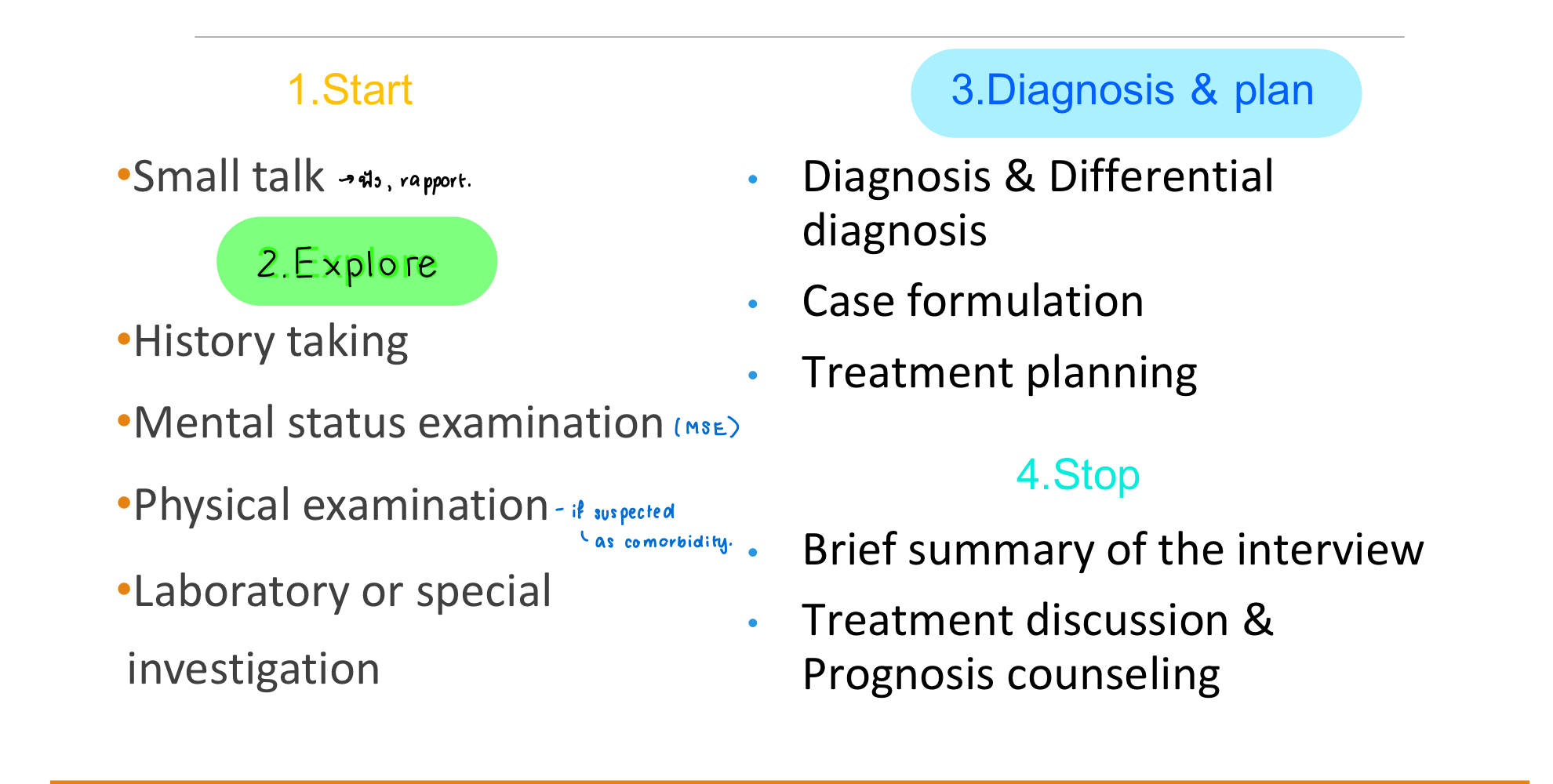
Psychiatric assessment - steps
Present illness - notice what
specific symptoms and behavioral patterns
impact on function + suicidal or homicidal risk
Psychiatric disorder - symptom groups
Anxiety, Mood, Psychotic and Somatic
Major Depressive Disorder: DSM-5 - duration
2 wks period
Major Depressive Disorder: DSM-5 - Major Symptoms (2)
distress (depressed)
impairment
Major Depressive Disorder: DSM-5 - Minor Symptoms
major weight loss or gain
insomnia or hyperinsomnia
agitation or retardation
fatigue
worthlessness or guilt
can’t concentrate, indicisiveness
death thoughts
DSM-5 - positive
5 symptoms, one being major
DSM-5 - cutoff
does it disrupt daily life
Hierarchy model - in psycho disorder
should start by rulling out the more severe one first
Past Hx - Information
all psychiatric illness and their course
treatment and complaince
suicidal, violence or homical,
substance abuse
past medical history
Past History - note
If the detail is disconected should be added in past hx
โรคประจำตัว should be noted
4P models
Predisposing, Precipitating, Perpetuating, Protective
4P models - Predisposing
Risk factor
4P models - Precipitating
Recent trigger event,
4P models - Perpetuating
Why does the problem still occur
4P models - Protective
what is the strength or support system of the patient?
Hx Taking should cover - what.
Family hx, development hx, and social hx
Hx Taking - Stakeholder
Gather from otehr people as well
What is MSE for?
as a physical examination, to correlate what the pt says to observation
MSE - 10 points
Appearance and behavior
Motor activity
Mood
Affect
Speech
Thoughts
Perception
Cognition
Judgement
Insight
MSE - Appearance and behavior
looks, act, and approach
MSE - Motor activities
Quantity and Quality
MSE - Mood
their emotional stage
MSE - Affect
Mood expression (atm)
MSE - Speech
Fluency, amount, rate, volume, tone
MSE - Thoughts
Thought content and process**
what they think, and how does it formulates
MSE - Perception
Abnormal Sensory Process
MSE - Perception - Hallucination vs Illusion
No external stimulus v. Have external illusion
i.e. seeing an insect when it isn’t present, vs. seeing the insect and percieving that its an insect instead
MSE Cognition - what
Consciousness, orientation, attention and concentration, memory (recall, recent, remote), having knowledge abstract reasoning
MSE - Judgement
Capacity to make good decision and act on them
MSE - Insight
awareness, understanding and identification of their illness
scale : no insight, partial insight, full insight