economics unit 4
 Call Kai
 Learn
Learn Practice Test
 Spaced Repetition
 Match
Match Flashcards
 Knowt Play
1/86

There's no tags or description
Looks like no tags are added yet.
Name | Mastery | Learn | Test | Matching | Spaced | Call with Kai |
|---|
No analytics yet
Send a link to your students to track their progress
87 Terms
globalisation
-process in which national economies have become increasingly integrated and inter-dependent
factors contributing to globalisation over last 50 years -
trade liberalisation, removing or reducing barriers in trade to get free trade and reduction in trade barriers
trading blocs, agreement between countries to reduce/eliminate trade barriers among members, promoting integration and cooperation
growth of multi-national corporations, as grow in size the more they spread around the world
tech advancements, easier to transport goods/services and better communication
greater mobility of labour and capital
impacts of globalisation and global companies on consumers and producers
producers -
lower prices from increased competition, forces business to be more efficient to remain competitive, therefore lowering costs of production for businesses
greater potential for increased output, can expand in size, benefit from greater EoS
consumers -
lower prices from increase international competition, increases consumer surplus, more consumer welfare
more choice and quality of goods/services
Impacts of globalisation and global companies on individual countries and governments
-greater EC
-tax rev from increased trade
-greater employment, social welfare increases, less spending on benefits
-growing inequality, not good for maximising social welfare
-higher structural UE
-trade imbalances for countries that rely on export-led growth, factors such as a shock that limit the growth potential of exports (or if outcompeted elsewhere) can be damaging
-greater risk of external shocks as more inter-dependent
Impacts of globalisation and global companies on workers
-greater employment, more opportunity for work if firms expanding in size, new firms may be setting up in the country as well
-higher EG from globalisation led to higher wages
-can however lead to structural UE with increasing development away from certain industries, businesses struggle to compete with other countries who can produce for cheaper leading to industry decline in that country
-increased migration may result in wages being forced down
Impacts of globalisation and global companies on the environment
-increased finite resource depletion from increased production of goods
-climate impacts, e.g from transportation or increased travel by individuals
-rising world population linked to globalisation puts strain on natural resources
absolute and comparative advantage
absolute advantage - when a country can produce a product using fewer FOP than another nation
comparative advantage - a country should specialise in goods/services it can produce at the lowest opportunity cost, and then trade with another country
-in example India have the absolute advantage in both computers and cotton (assuming both countries have the same factors of production and India are more efficient)
-India are giving up 0.5 computers per tonne of cotton, while Ghana give up 1/8 a computer
-India give up 2 tonnes of cotton for 1 computer, while Ghana give up 8 tonnes for 1 computer
-Ghana has opportunity cost advantage for cotton as they give up less of a computer
-India has opportunity cost advantage for computers as they give up less cotton
-so Ghana should make cotton and India computers and specialise in these then trade

diagram for absolute and comparative advantage
-look at whichever axis has the biggest gap between the PPCs, whoever is producing more on that axis has comparative advantage for that good/service (so India has comparative advantage in computer production), and on the other axis the other country has comparative advantage
-for trade to be mutually beneficial there needs to be a suitable rate of exchange
-to work this out opportunity cost ratio can be drawn, how much cotton can be made for 1 computer
-for each country to exploit it’s comparative advantage, then trade, for the trade to be mutually beneficial a rate of exchange has to be suitable
-the rate must lie between the opportunity costs of production (between the 2 and the 8), as what you get back in return needs to be more than what you could have produced yourself (India need at least 2 tonnes of cotton for every computer they sell to Ghana)
-the more you move away from the middle, the more it will benefit one country and harm the other
what determines whether a country has a comparative advantage
-quantity and quality of factor endowments in a given nation
-such as an abundance of cotton plants or fertile soil
assumptions and limitations relating to the theory of comparative advantage
-assumes there are no transport costs
-assumes there is perfect information
-no economies of scale (constant returns to scale, meaning increase in inputs leads to a constant, proportional increase in output)
-no R and D/innovation (non-price factors play no part)
-assumes FOP are perfectly mobile, can be switched from producing one good to another
-increased specialisation may lead to larger firms, which can give rise to diseconomies of scale
Advantages and disadvantages of specialisation and trade in an international context
pros -
lower prices and more choice for consumers, due to greater competition
countries have access to goods/services they would not otherwise be able to produce
innovation, free trade encourages competition, leads to firms being innovative, rewards for investment and innovation are large global markets
cons -
risk of dumping by foreign firms (sell to foreign markets below costs, to put rivals out of business of clear inventory)
increased UE due to competition and dumping
countries more exposed to external shocks as more integrated
environmental damage from increased transportation and the depletion of natural resources
Factors influencing the pattern of trade between countries and changes in trade flows between countries
-comparative advantage, countries develop cost advantages in the production of certain goods, pattern of trade changes to reflect these advantages, lower costs costs of prod due to comparative advantage means trade increases
-growth of trade bloc and bilateral trading agreements, trade more with countries within their trade bloc as no tariffs
-impact of emerging economies, as countries grow in size they tend to import more, impacting the pattern of global trade, these countries may also need to export more to pay for their foreign expenditure
-changes in relative exchange rates, exchange rate is the value of one currency in terms of another, a stronger exchange rate can erode comparative advantage by making exports more expensive
terms of trade
-calculated as the weighted average of export prices / weighted average of import prices X 100
-most popular imports put in basket and weighted accordingly based on expenditure on them and the basket is given a price, also done for exports to get weighted average
-terms of trade is an index, numbers are then put into index form
-base year = 100, next years show %increase or decrease e.g 102 is 2% increase
-terms of trade shows the quantity of exports that need to be sold in order to purchase a given level of imports, want to look at if there is an improvement or deterioration in the terms of trade (improvement shows price of exports can buy more of imports from it)
Factors influencing a country's terms of trade
short run factors -
demand/supply of exports/imports
relative inflation rates, high inflation reduces export competitiveness (although this shows as an improvement in TOT)
exchange rate movements
long run factors -
incomes, as countries develop and experience sustained increases in income, demand for manufactured goods will increase compared to demand for primary commodities which is fairly income inelastic, as income per capita rises in developed countries more income elastic luxury goods may be bought and other manufactured goods but not as many more primary commodities, can lead to LR deterioration in TOT for countries exporting these commodities as price will not rise by as much compared to manufactured goods due to demand, improvement in developed countries TOT therefore
productivity, if improves lowers costs of prod, lower export prices
technology, same as productivity so deterioration in TOT (not necessarily bad as improves competitiveness of a nation)
Impact of changes in a country's terms of trade
improvements in TOT -
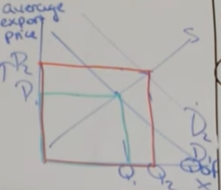
if demand for exports increases, price of exports increase, more revenue (shown on diagram p1q1 to p2q2 box gets bigger)
can also increase due to high relative inflation (improvement as export prices rise) however effect depends on elasticity of demand for exports, good if demand inelastic, bad if elastic
deteriorations in TOT -
may not always be a bad thing, such as improvements in productivity, more internationally competitive due to the lower costs, so lower export prices, but may lead to greater quantities of exports being sold (could lead to higher overall export revenue)
depends on -
international competitiveness
quantities of exports and imports being bought/sold
depends on PED of exports and imports, determining impact on export revenue and and import expenditures, therefore current account position and final effect on AD
trading blocs
an agreement between a group of countries that promotes and manages trade between member states, members agree to remove protectionist measures
-they are typically regional trade agreements
-bilateral agreements exists between 2 countries
-multilateral agreements exist between more than 2 countries
types of trading blocs
free trade area - all barriers to trade removed, members can still impose barriers on non-member countries
customs union - all barriers to trade between members removed, common external tariffs imposed on non-member countries
common market - same features as customs union, labour and capital have freedom of movement within the area
monetary union - all barriers to trade between members removed, members have a single, common currency and central bank
in order for monetary unions to be successful criteria must be met, such as maintaining responsible fiscal policy, ensuring similar inflation and interest rates, common monetary policy through central bank
such as the European central bank in the eurozone
costs and benefits of regional trade agreements
costs -
agreements don’t often cover a wide range of goods/services, so the impact can be weak and therefore limit economic benefits
reduced national sovereignty
benefits -
benefits from increased specialisation such as reduced AC for firms
creation of increased competition within the area of the bloc, increased innovation
increased trade volume between member states
world trade organisation (WTO)
-international organisation that regulates world trade
according the the WTO ideal trade should be -
non-discriminatory
free from barriers (protectionism)
predictable
promoting fair competition
beneficial to developing counties through special provisions if needed
functions of WTO
-set and enforce rules on international trade
-resolve trade disputes
-provide a forum for negotiating trade liberalisation
-monitor further trade liberalisation
Possible conflicts between regional trade agreements and the WTO
-a common external tariff contradicts the WTOs principles, protectionism imposed on non-members
-some argue WTO is too powerful and favours developed over developing countries
-setting up customs unions or a free trade area may be seen to violate the WTOs principle of having all trading partners treated equally
-WTO damages native cultures by adopting a western materialistic approach
Reasons for restrictions on free trade
-to protect infant industries and sunset industries to protect employment
-retain self-sufficiency
-correct imbalances on current account
-retaliate against restrictions imposed by another country
-to prevent dumping
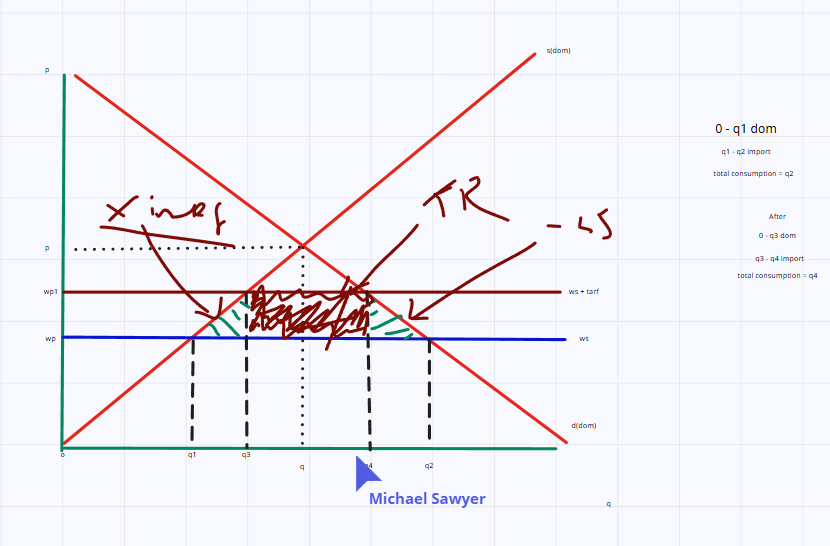
types of protectionism - tariffs and tariff diagram
-tax on imports that raises the price of imports
-domestic supply at q1 domestic demand at q2, imports difference between
-gov wants to reduce level of imports so impose a tariff
-price increases
-shows an extension of domestic supply q1 to q3
-contraction of domestic demand q2 to q4
-imports now only between q3 and q4
-shows welfare loss for producers and consumers (x-inefficiency and living standards) and gov tax rev
other types of protectionism
-quotas, physical limits on the quantity of a certain good that can be imported
-subsidies to domestic producers, grants that allow them to lower production costs, therefore lowering prices which should make the country’s products more internationally competitive
-non-tariff barriers, include product specifications, health and safety regulations, environmental regulations and labelling of products
-embargo, official ban on trade or other commercial activity within a particular country
Impact of protectionist policies
-higher prices and lower quantity, consumers may struggle with affordability as a result of this, tariff may also be regressive, widening inequality, lower quantity also restricts consumer choice
-gov have risk of retaliation, can lead to trade wars
-harm to domestic firms as tariffs can drive up costs of production for firms if tariffs placed on their raw material imports, will also suffer from retaliatory protectionism
-cost of protectionist policies such as subsidies can be high for gov, level of gov revenue collected depends on elasticity of the goods which are receiving tariffs
-in the LR the industry likely to loose competitiveness due to increased costs of production, as a result UE may rise, therefore living standards may deteriorate
-trade unions represent workers and often aim for greater equality, they are often in favour of greater restrictions to trade to protect their members, as free trade can result in some industries facing competition which may result in job losses or closure
components of the balance of payments
current account - trade in goods and services, investment income, transfers
capital account -
debt forgiveness
inheritance tax
sales of tangible (produced) and intangible (non-produced) assets
financial account -
portfolio investment transactions
FDI
reserves (either in currency or gold)
causes and consequences of a CA deficit
causes -
strong domestic growth, higher marginal propensity to import (demand side)
recession overseas, incomes fall, less demand for UK exports (demand side)
low productivity (supply side), makes exports less competitive
high relative inflation (supply side), makes exports less competitive
supply side harder to rectify than demand (good for eval)
consequences -
net trade component of AD, if this is negative, AD will be reduced
therefore fall in real GDP, fall in EG
however depends on size of deficit, if a small % of GDP then barely reduces AD
causes and consequences of current account surplus
-high incomes abroad or low incomes at home (demand side)
-weak exchange rate (demand side)
-low relative inflation (supply side)
-gains in comparative advantage (supply side)
consequences -
most likely trade surplus, therefore in AD right, however may also increase demand pull
appreciation in the exchange rate, value of exports exceeds imports, so more demand for the currency than supply so appreciation, therefore surplus may not be long lasting as exports become less competitive
measures to rectify a current account deficit
must first identify cause of deficit
-contractionary monetary/fiscal policy
however conflict of less growth and more UE as a result
depends on level of multiplier, consumer confidence ect
-protectionist measures
can result in retaliation
imported inflation from domestic producers increase costs of prod on imports such as raw materials
-allow currency to depreciate
depends on PED for exports and imports
can lead to imported inflation
-supply side policies
time lag
may not work
costly to gov
Significance of global trade imbalances
-large and persistent deficits can be damaging as there is a need to finance the increasing expenditure on imports, usually through loans from abroad
-large and persistent surpluses can be a problem as resources are focused on producing to meet export demand rather than domestic demand, so consumer choice and resulting living standards could be low
-imbalances may also lead to large currency fluctuations, which can have a destabilising impact on world trade
exchange rate systems definitions and basic diagram (floating)
floating - price of one currency in terms of another determined by the forced of demand and supply
fixed - when a currency is set in value to another, maintained by regular intervention from authorities
managed - an exchange rate determined by the forces of demand and supply with periodic intervention from the government
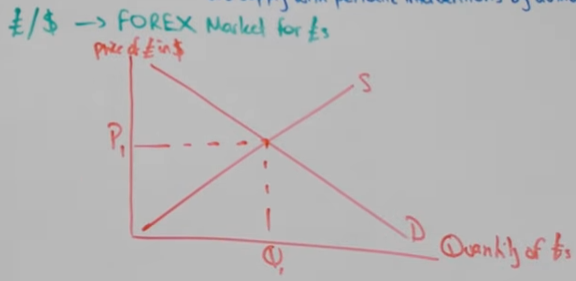
-write down exchange rate on Y axis
-quantity on x axis
-supply is any owner of the currency looking to sell, demand anyone looking to buy pounds
-equilibrium at where the curves meet, the price is the exchange rate
Factors influencing floating exchange rates (causing depreciations, opposite for appreciation)
depreciation - where a currency can buy less of another
increased import demand (increase in supply), as more selling of the pound to buy in foreign currency
reduction in IR (increased supply and lowered demand), due to hot money outflows, investor savings get less interest on savings in the UK, so move money elsewhere
low confidence (increased supply lowered demand), could lead to capital flight (people move money out of the UK for safekeeping elsewhere)
lower export demand (decrease in demand)
Distinction between revaluation and appreciation of a currency and distinction between devaluation and depreciation of a currency
appreciation and depreciation used under a floating exchange rate system, to describe increases and decreases in the value of a country’s currency in relation to other currencies
revaluation and devaluation are the terms used under a system of fixed exchange rates to describe increases and decreases in the value of a country’s currency in relation to other currencies determined by the country’s central bank
Government intervention in currency markets through foreign currency transactions and the use of interest rates (example for falling, rising is the opposite)
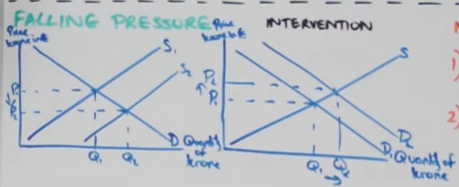
-for fixed exchange rates, currency set in value to another and maintained by regular intervention from authorities
-if a currency comes under falling pressure (shown by supply shifting right), triggers intervention by the country that’s currency is set to this currency
-in this situation done by creating demand for their own currency (d1 to d2), moving the exchange rate back to the fixed level
interest rates -
in this situation IR would need to be increased to create more demand for their own currency, encouraging hot money inflows
foreign currency transaction -
sell foreign currency reserves and buy their own currency within FOREX markets
Competitive devaluation/depreciation and its consequences
-country may deliberately devalue it’s currency to give it competitive advantage
-it’s exports will be cheaper to foreign consumers, should lead to increased demand for them (and a fall in imports) and therefore increase in AD
-will only work if other countries do not retaliate
-imports become more expensive for consumers, increased costs of living
Impact of changes in exchange rates - the current account of the balance of payments (reference to Marshall-Lerner condition and J curve effect)
-the Marshall-Lerner condition states that a currency depreciation will only correct a current account deficit if PED for exports + PED for imports is greater than 1 (elastic)
-if PED for exports is inelastic and price falls (due to the currency depreciation), so will total revenue
-if PED for imports is inelastic and price rises (due to the currency depreciation), total expenditure increases
-therefore if overall elasticity of net exports is inelastic a currency depreciation may worsen CA position
-in SR consumers/firms take time to adjust to currency depreciation, so inelastic in SR before elastic in LR (J-curve effect)
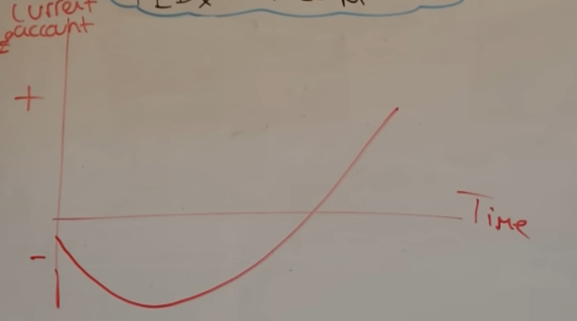
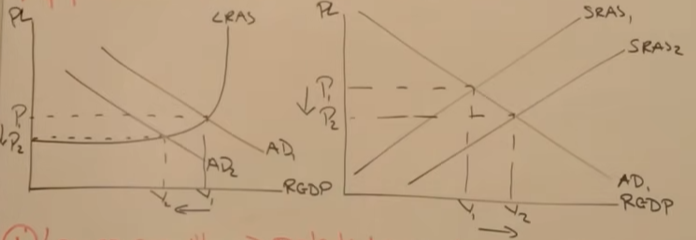
Impact of appreciation in exchange rates
-exports more expensive so AD left on diagram, cheap imports so business SRAS right as cheaper costs of prod
lower growth (AD falling), higher UE in exporting industries as less competitive, and in domestic as have to compete with cheaper imports from abroad
lower demand-pull and cost-push inflation as shown on diagrams
less FDI flows as foreign firms have to spend more in their own currency to purchase the same UK assets, so the investment is more expensive
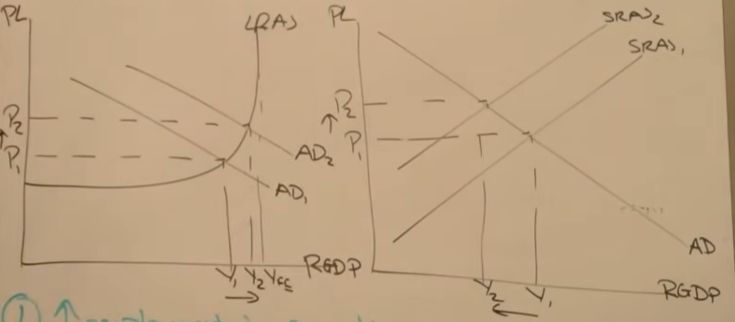
impact of a depreciation in the exchange rate
-exports cheap (AD right), imports dear (SRAS left)
more economic growth and employment (shown on diagram as closer to Yfe)
more demand-pull and cost-push inflation as shown on diagram
international competitiveness
the ability of a nation to compete successfully overseas and to sustain improvements in living standards and output
determinants of international competitiveness -
price competitiveness
non-price competitiveness
ability to attract FOP (FDI in particular, attracting firms and capital)
measures of international competitiveness
relative unit labour costs -calculated as total labour costs / output
relative export prices
Factors influencing international competitiveness
-labour flexibility
-labour skills
-tax regimes, low income tax may attract workers from abroad, domestic people also more likely to enter workforce as more incentive to work
-infrastructure, good infrastructure can boost efficiency in domestic firms
-regulation, less strict regulation can result in lower prices
Significance of international competitiveness
benefits of being internationally competitive -
likely export-led growth, positive implications for employment, higher demand for exports so AD right and positive multiplier
good position on CA
problems of being internationally uncompetitive
trade deficit, worse position on CA
UE higher
domestic exporting firms struggle
absolute and relative poverty
absolute poverty - income below a threshold to access the most basic-life sustaining goods/services ($3 a day)
relative poverty - incomes below a given average in society
equity and equality
equity - fair distribution of income
equality - equal distribution of income
horizontal equity - equal treatment of individuals, those with the same incomes taxed the same
vertical equity - higher incomes taxed more progressive/proportional taxes
causes of poverty
-UE, mainly cyclical and structural
-poor education/skills
-poor health/healthcare, limit productivity, earning potential and the amount individuals can work
-wage differentials, the greater the difference between high and low income earners the greater the relative poverty
Measures of absolute poverty and relative poverty
absolute - international poverty line, world bank defines this as living on $2.15 per day (set in 2022)
relative - measured as a % of the median income within society, in the UK this is defined as living in a household with a disposable income less than 60% of the national median after housing costs
Distinction between wealth and income inequality
wealth inequality - wealth is the value of money in assets held by an individual, inequality when this is not distributed equally
income inequality - income is the amount of income an individual receives over a period of time
Causes of income and wealth inequality within countries and between countries
-wage rates, certain skills more in demand than others in an economy, those with more desirable skills command higher wages
-ownership of assets, wealthier people own more assets, these may be passed down through inheritance, ownership of these assets can create further wealth and income, further increasing inequality
-access to education and training, this is not equally accessible both across a nation and between different nations, therefore countries gain advantage over ones with poorer quality of education and training
measurements of income inequality
Lorenz curve
shows how far a country deviates from the line of perfect equality
the further away the Lorenz curve from the line of perfect equality, the less equally distributed income is
Gini coefficient
mathematical indicator of income inequality
calculated as section A / section A + section B
0 is perfect equality
1 is perfect inequality
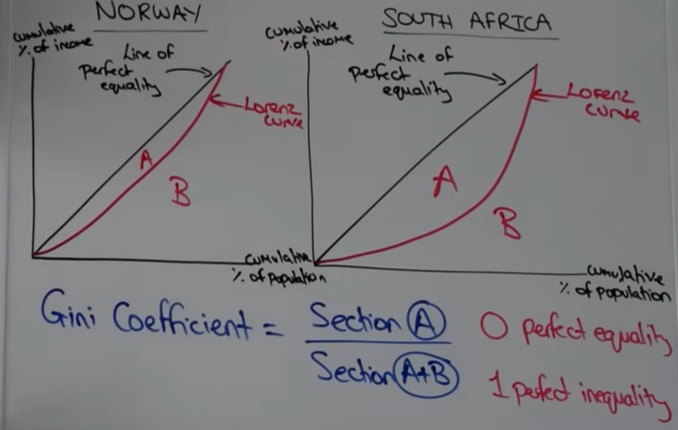
Impact of economic change and development on inequality
-as an economy grows, particularly developing economies, it is often true that inequality will increase
-this is because workers move from lower productivity jobs into higher productivity areas
-incomes will not increase at the same rate and inequality will grow
-inequalities may then start to decline as gov has greater means to redistribute income through benefits, progressive tax and investment in education and training
Significance of capitalism for inequality
-in a capitalist free market inequality is inevitable as people with higher skills and abilities attract higher wages, private ownership of resources means that some people can acquire considerably more assets than others, however inequality is not always bad
it provides more incentive for people to work harder to earn more
encourages enterprise, new businesses and opportunity to find work
may create a “trickle-down effect” as the rich become richer, spend more on goods/services, creating income for lower-income workers
the 3 dimensions of the HDI and how they are measured and combined
-education, health and living standards (weighted equally)
-health, measured by life expectancy
-education, measured by average and expected years in school (and adult literacy rate)
-living standards, real GDP (or GNI) per capita and/or purchasing power parities
-score of 0-0.49 low development while 0.7+ high development and 0.8+ very high development
pros and cons of HDI
pros -
broad measure, not just economic factors
allows for progress to be measured over time, and compare to other countries
can focus attention (e.g aid) to countries with low development
cons -
does not look at distribution of income
arbitrary weighting, may make it harder to allocate resources to lacking areas as each area weighted equally
other factors e.g crime, poverty, corruption
Other indicators of development
-gini coefficient
-environmental sustainability indicators
-gender inequality index, evaluates gender disparities in areas such as health, education and economic participation
economic factors influencing growth and development (primary product dependency, volatility of commodity prices, savings gap and the Harrod-Domar model, foreign currency gap, capital flight and absence of property rights)
primary product dependency, many developing nations are dependent on primary products (commodities), the demand for most commodities is price inelastic, therefore any changes in global demand have a significant impact on price, an economy reliant on these industries may find it harder to encourage economic development
volatility of commodity prices, incomes therefore fluctuate in these industries fluctuate considerably, also disincentivises investment as the value added to the commodities is low
savings gap and the Harrod-Domar model, in LICs high levels of poverty make it hard to generate savings to fund investment projects, this increases reliance on high-interest borrowing to finance capital investment (savings gap), the Harrod-Domar model states the growth rate of an economy is directly linked to 1. the level of savings in an economy 2. the efficiency with which capital in an economy can be deployed, increasing either of these factors leads to faster rates of EG
foreign currency gap, occurs when capital outflows are greater than capital inflows in a country, could be caused by export dependency, LICs receive less for exports and have to pay more for imports
capital flight and absence of property rights, capital flight where people move their savings abroad instead of holding them domestically, could be due to absence of property rights (without cleat laws and legal controls, property rights may be uncertain), can lead to less gov tax rev therefore lower levels of development
economic factors influencing growth and development (education, demographics and skills, international debt, access to credit and banking, infrastructure)
education, demographics and skills, demographic factors can have a significant impact on the rate of developments, in country’s with fast growing populations there is typically a fall in GNI per capita and standards of living (leads to lower skills and less productive workforce), a result of fast growing population is more children which puts pressure on the education system so fewer children receive good education, poverty can also keep children out of school (in extreme cases may need to work instead), an ageing population results in a greater proportion of dependents vs the working population (pressure on benefits and healthcare)
international debt, developing countries may have taken out low interest loans, as the value of the currency they took out the loan in rises in proportion to their own, they may struggle to pay it back, causing increasing flows of money out of the country
access to credit and banking, less accessible in lesser-developed countries so harder for people to save/borrow or invest
infrastructure, countries with high levels of development tend to have extensive and well-developed infrastructure, growth in physical capital is important if the pace of development is going to increase
non-economic factors influencing growth and development
war - disruption of international trade and low business confidence
geographical - such as access to coats, climate in which crops can be grown
corruption - corrupt regimes often mean economic policy is not applied in the interests of society
disease - diseases such as malaria can have heavy impact on the workforce and healthcare system
market orientated strategies influencing growth and development
trade liberalisation - opening an economy up to free market philosophy and the opportunity of non-protectionist trade with other nations
removal of government subsidies - artificially low market equilibrium prices encourage inefficiency and business reliance on subsidies as well as an opportunity costs to the government of paying them, so subsidies are removed
floating exchange rate systems - gov does not have to intervene, rate set by the market, can make the currency more attractive to foreign investors and increase competitiveness
microfinance schemes - microfinance refers to the availability of small scale loads to entrepreneurs and businesses, developing countries may have weaker financial sectors so less accessible microfinance in these countries
promotion of FDI - brings capital inflows, transfers global technology, can boost industrial growth and employment, countries can promote FDI by facilitating more knowledge and tech transfer and offering targeted incentives
privatisation - more profit motive, more efficient
interventionist strategies influencing growth and development
development of human capital and infrastructure - more productive and efficient
protectionism - support domestic industries, protect employment in these industries as well
managed exchange rates - maintain a stable currency value, reducing uncertainty in international trade and investment (predictable costs of exporting so can remain competitive) and helps to control inflation by creating less volatility
promotion of joint ventures with global companies - gov may seek to encourage FDI and partnerships with international companies, can lead to capital inflows creating jobs and higher national output, higher wages and better working conditions
buffer stock schemes - aims to protect buyers and sellers through maximum and minimum prices, during periods of excess supply gov will buy excess supply and stockpile it, during a shortage gov will then release the buffer stock to increase supply, maintaining a stable price for consumers
other strategies influencing growth and development
industrialisation (the Lewis model) - in developing counties the majority of labour is in the agricultural sector, the Lewis model assumes that there is excess labour in this sector (same output could be achieved with fewer workers) therefore no opportunity costs of these workers transferring from agriculture to industry to take advantage of higher paid jobs (however not easy to transfer labour and requires investment in education and training)
development of primary industries - developing countries may choose to use incomes generated from commodity exports to diversify their industries so they are less dependent on markets where value added is low and prices can fluctuate greatly
development of tourism - can create more money inflows however is very seasonal
fairtrade schemes - principles of fairtrade seek to ensure producers in developing countries receive a fair price for their goods and that production is sustainable
aid and debt relief - aid involves transferring resources from one country to another, can reduce absolute poverty and the savings gap and create a positive multiplier effect directly increasing AD
debt relief involves cancelling a country’s debt, can lead to money being freed up for public services, healthcare ect
role of international organisations and NGOs on influencing growth and development
-world bank, can provide low-interest loans, grants for developing countries and interest free credit, also supports the development of infrastructure and capital investment to encourage international trade
-international monetary fund (IMF), set up to ensure the stability of the international monetary system, each member country has a quota on the amount of financial resources they have to make available to the IMF, these resources are then used to offer loans to lower-income countries with the aim to support projects fighting poverty and improving living standards, IMF also provides support to developing countries on policies that maintain economic stability
-non-government organisations (NGOs), private organisations and charities that support similar objectives of reducing poverty, protecting the environment, equality ect
they generally operate on a small scale and support projects at a community level
types of financial markets
money markets - provide short term finance such as borrowing and lending
capital markets - provide long term finance mainly by the trading of bonds and shares
foreign exchange markets - where different currencies are traded
role of financial markets
-to facilitate saving
-to lend to businesses and individuals
-facilitate the exchange of goods/services
-to provide forward markets in currencies and commodities, firms prefer to have certainty when making decisions, so they may choose to buy or sell forward (e.g farmer chooses to sell potatoes for £1000 3 months in advance) forward markets made possible by financial institutions
-to provide a market for equities, equities are the shares of a company, issuing shares is an important way for firms to raise finance to fund investment, stock markets trade shares
market failure in the financial sector - asymmetric information
-when one party in the transaction has more information than the other parties
-can lead to the buyer/seller with more information being able to exploit the information gap, leading to an inefficient outcome
market failure in the financial sector - externalities
-costs paid by other individuals, firms or govs, but not the financial markets creating the costs
-such as banks being supported by the government in financial crisis, therefore supported by the taxpayers as well
market failure in the financial sector - moral hazard
-this occurs when someone is more willing to take risks because they understand someone else will pay the costs if it goes wrong
-such as banks more likely to provide loans to risky customers as gov, taxpayers or central bank will bail them out
-moral hazard involves excessively risky behaviour
market failure in the financial sector - speculation and market bubbles
-speculation, involves buying assets at a relatively low price and selling them at a later date at a higher price with the aim of making a profit, speculation involves risk, if the asset falls in price the speculator will loose money
-market bubbles, occur when the price of an asset is forced excessively high (well beyond it’s true value) before falling back, speculators buy assets because others are doing so, this increases demand and pushes up the price, when price is felt to have reached it’s maximum investors sell and the price falls
-can lead to overpaying for assets, can also lead to debt once demand and price fall as asset worth significantly less
market failure in the financial sector - market rigging
-when individuals or a group collude to fix prices or exchange information to help them make gains for themselves at the expense of others
-such as the LIBOR scandal where a group of banks colluded to fix the London Interbank Offered Rate (LIBOR) in their favour
role of central banks
implementation of monetary policy, manipulation of IR and the money supply
banker to the government, manages the national debt of the gov, handles the accounts of different government departments and makes short-term loans to gov
lender of last resort, supports commercial banks by acting as the “lender of last resort”, is a banker to the bank, important for the stability of the banking system, banks can sometimes run short of liquidity (having enough money to pay liabilities)
regulation of the banking industry, to prevent customers from being affected by risky behaviour of financial institutions, regulation is in place to prevent systemic risk such as reserve requirements (banks requires to have certain % of their assets in the form of reserves, ensures they have sufficient reserves to cover losses) as well as central banks ensuring that competition exists in financial markets to make sure consumers are not exploited
Distinction between capital expenditure, current expenditure and transfer payments
capital expenditure - gov spending on long term investments and assets that provide benefits over multiple years e.g infrastructure
current expenditure - day to day gov spending on recurring items such as maintenance of public services and public sector wages
transfer payments - payments made to individuals or groups without any expectation of repayment or anything in return such as welfare spending
Reasons for the changing size and composition of public expenditure in a global context
the economic cycle, in periods of slow growth or recession, public expenditure rises due to more spending on welfare benefits
changing age distribution, ageing populations in developed countries place greater pressure on healthcare systems and more spent on benefits
financial crises, gov may have to bail out financial institutions
The significance of differing levels of public expenditure as a proportion of GDP on:
productivity and growth - increased spending on infrastructure leads to improved supply side performance in the economy
decreased public expenditure leads to spending being transferred to the private sector, may result in more efficient and productive outcomes
living standards - public spending can have a big impact on living standards, especially those receiving benefits or who use public goods and infrastructure frequently
with no public expenditure there would be market failure from under provision of public goods, absolute poverty (no benefits)
crowding out - public expenditure leads to lower private sector investment spending, resource crowding out occurs when economy operating near FE and the expansion of the public sector means a shortage of resources in the private sector
financial crowding out occurs when the expansion of the state sector is financed by increased gov borrowing, causes an increased demand for loanable funds that drives up IR and crowds out private sector investment
level of taxation - if public expenditure high taxation must be too to fund this
lower levels of expenditure, less tax so growth more free for firms
equality - public spending on education can help create more equal opportunity, more spending on benefits and pensions also improves living standards
may be funded by tax, if regressive or set wrong could increase inequality
Distinction between progressive, proportional and regressive taxes
progressive - as income rises a larger % of that income is paid in tax
proportional - the % of income paid in tax is constant, no matter what level of income
regressive - as income rises a smaller % of it is paid in tax
The economic effects of changes in direct and indirect tax rates on other variables: incentives to work
-free market economists believe lower tax rates increase incentives to work and improve supply-side performance in the economy
-a corporation tax leads to less incentive for firms to invest
-higher rates of income tax reduces incentives for workers to work extra hours, or join the workforce at all
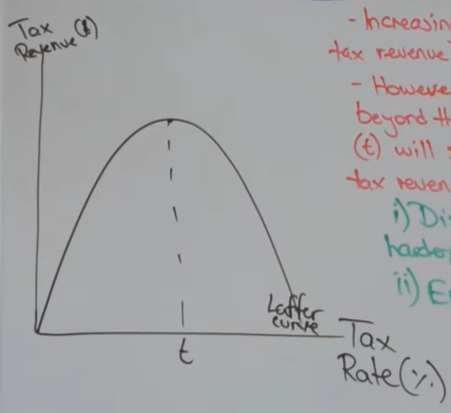
The economic effects of changes in direct and indirect tax rates on other variables: tax revenues, the Laffer curve
-increases taxes will increase tax revenue up to a certain point
-however increasing taxes beyond the efficient tax rate (t) will see a reduction in tax revenue due to:
disincentives to work harder/be entrepreneurial
rise in the number of tax exiles (people who leave the country to avoid paying tax)
tax evasion/avoidance
The economic effects of changes in direct and indirect tax rates on other variables: income distribution
-refers to how total income is divided within a population, a progressive tax will help redistribute income, especially if the tax revenues raised are used to benefit the poor
The economic effects of changes in direct and indirect tax rates on other variables: real output and employment
-an increase in taxes will reduce AD as taxes are a leakage from the circular flow of income, this may reduce real output and increase UE (can be shown diagrammatically)
-in the LR changes in tax rates can impact AS, lower direct taxes can lead to higher incentives, leading to increased investment by firms and higher participation in the labour market, effect of this is increase in EG and rise in employment
The economic effects of changes in direct and indirect tax rates on other variables: the price level
-increase in indirect tax can be inflationary if it causes a wage-price spiral
-e.g increased indirect tax causes a rise in prices, so workers demand higher wages, causing firms costs to rise, therefore further rise in prices
The economic effects of changes in direct and indirect tax rates on other variables: the trade balance and FDI
-increase in income tax would reduce disposable income and consumption
-this would reduce demand for imports and so result in an improvement in trade balance
-higher rate of corporation tax could deter FDI if rates are lower in other countries
Distinction between automatic stabilisers and discretionary fiscal policy
discretionary fiscal policy - involves the government making decisions about it’s spending or taxes, discretionary policy is different to automatic changes that occur
automatic stabilisers - some fiscal policies occur automatically as the economy moves through the economic cycle, during a recession gov spending will increase automatically as more people UE, not a decision they have taken (discretionary)
this spending increase when UE rises prevents AD from falling by as much as it would have if there were no state benefits, offsetting the effects of the recession
Distinction between a fiscal deficit and the national debt
fiscal deficit - when gov spending exceeds tax rev, so gov needs to borrow
national debt - cumulative total of past gov borrowing
Distinction between structural and cyclical deficits
cyclical fiscal deficit - occurs during a downturn in the economy because tax revenues will be falling and gov spending rising, this deficit should disappear when the economy returns to it’s growth rate
structural fiscal deficit - remains even when the economy is operating at it’s full potential, so regarded as more serious than a fiscal deficit
Factors influencing the size of fiscal deficits
-economic cycles, during periods of EG, fiscal deficits tend to be small or become surpluses
-housing market, during periods of growth in the housing markets, tax revenues for the government increase due to a rise in the amount of stamp duty (tax on house sales) received
-political priorities and unplanned events, gov may have to respond to unforeseen events that are not covered in the budgets set aside, may need to bail out financial institutions for example such as in global financial crisis
Factors influencing the size of national debts
-the size of national debt may be influenced by government policy, where gov embarks on policies that require high levels of borrowing this will translate into higher national debt
-where current borrowing is on aspects that improve the supply side of the economy, may be long term increased productivity and higher employment, therefore higher tax rev for gov, can lead to a reduction in national debt in the LR
-if current spending is on short-run aspects such as pensions or wages for public sector workers then the effect may lead to higher national debt
The significance of the size of fiscal deficits and national debts
-interest rates, rise in gov borrowing may lead to rise in IR, the price of borrowed money is the rate of interest, so the rise in demand should lead to a rise in interest rate, this can lead to lower AD and crowding out
-the rate of inflation, if a gov needs more money as tax receipts don’t cover expenditure, can either use QE (leads to inflation as more money in circulation raises prices), or they can borrow money (causing the higher fiscal deficit and national debt) this means the gov spends more as a % of GDP and the private sector spends less, there is no increase in AD as a result and therefore little impact on inflation
-debt servicing, as the national debt grows the total amount of interest paid will increase, debt interest features in current spending and therefore affects fiscal balance, higher interest payments can therefore lead to an increase in fiscal deficit
Use and impact of macroeconomic policies to respond to external shocks to the global economy
external shocks - unpredictable negative events affecting the economy
Monetary policy – to reduce inflation or boost economic growth
Fiscal policy – higher government borrowing to finance higher government spending.
Devaluation – reduce the value of the currency to boost exports
Supply-side policies
External help – e.g. Accept bailout from IMF, EU (often requiring conditions such as structural adjustment)
Measures to control global companies' (transnationals') operations:
the regulation of transfer pricing - transfer pricing refers to the pricing policies adopted by groups of companies for transactions between companies in the group, such as the sale of goods/services
with corporate tax rates varying considerably from country to country, there is the potential for global companies to reduce their global tax charge by manipulating the prices charged on intra-group transactions
measures to regulate transfer pricing are harder for less powerful countries
-one limit to a government’s ability to control global companies is that many are “footloose”, means they may be able to move to another country easily and with little cost
Problems facing policymakers when applying policies:
inaccurate information - information can sometimes be inaccurate as it is difficult to collect such as GDP, UE or the CA
risks and uncertainties - may be difficult for the authorities to predict the impact of some policies, such as QE or the impact of a country leaving the eurozone, further uncertainties relate to the future behaviour of consumers or businesses in their spending and investment plans
inability to control external shocks - in an increasingly globalised world in which countries are more economically integrated, it becomes more difficult for an individual country to isolate itself from external shocks