STAT 101 CHAP 5
 Call Kai
 Learn
Learn Practice Test
 Spaced Repetition
 Match
Match Flashcards
 Knowt Play
1/25

There's no tags or description
Looks like no tags are added yet.
Name | Mastery | Learn | Test | Matching | Spaced | Call with Kai |
|---|
No analytics yet
Send a link to your students to track their progress
26 Terms
Fill in the blanks.
Abstract Model
is a description of the essential properties of a phenomenon that is formulated in mathematical terms
Deterministic Model
Stochastic/Probabilistic Model
Types of Abstract Models
FALSE, It is KNOWN
[T/F] Deterministic model describes a phenomenon through unknown relationships among the states and events, in which a given input will always produce the same output
True
[T/F] Stochastic/Probabilistic Model describes a phenomenon by assigning a likelihood of occurrence to the different possible outcomes of the process.
Deterministic Model
[WHAT MODEL?] A given input will always produce the same output
random experiment
A _________ is a process that can be repeated under similar conditions but whose outcome cannot be predicted with certainty beforehand.
True
[T/F] A random experiment is a process that can be repeated under similar conditions but whose outcome cannot be predicted with certainty beforehand.
Sample space
Sample point
A random experiment is associated with what?
True, we have roster method and rule method
[T/F, Explain] The description of the sample space is not unique
An event is a subset of the sample space whose probability is defined.
An _______ is a subset of the sample space whose probability is defined.
FALSE,
An event occurred if the outcome of the experiment is one of the sample points belonging in the event;
[T/F] An event did not occurred if the outcome of the experiment is one of the sample points belonging in the event;
The impossible event is the empty set, ∅
The impossible event is the ______.
The sure event is the sample space, Ω.
The sure event is the __________.
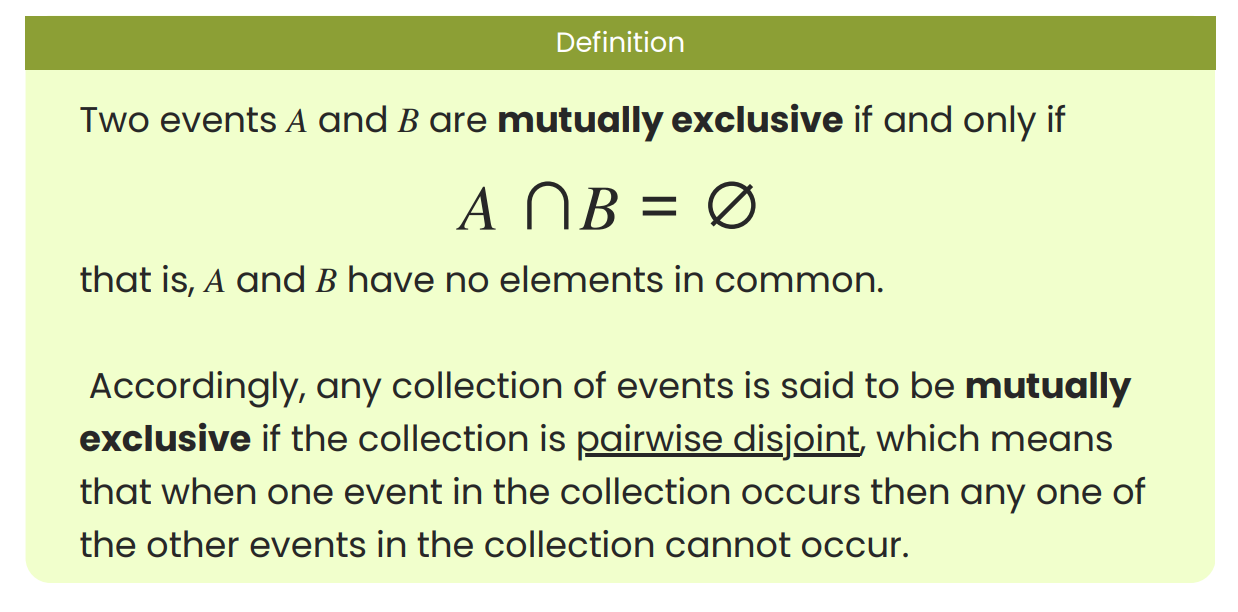
𝐴 and 𝐵 have no elements in common
When are events mutually exclusive?
Any collection of events is said to be mutually exclusive if the collection is pairwise disjoint.
Any collection of events is said to be mutually exclusive if the collection is ________.
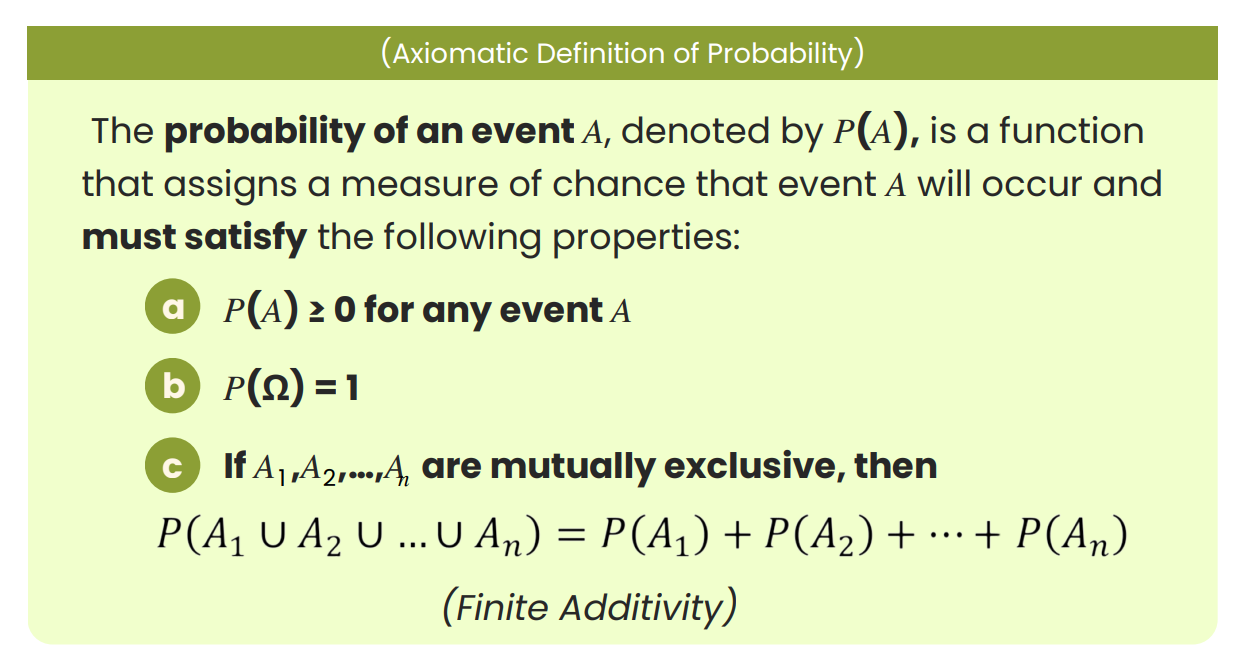
Each event probability must be positive.
Probability of all should be equal to 1.
Finite Additivity of probabilities if classified as mutually exclusive.
In Axiomatic Definition of Probability, what are the properties to be satisfied?
Priori/Classical probability
Posteriori/Empirical Probability
Subjective Probability
What are the approaches in assigning probabilities?
Equiprobable.
Additionally: need equiprobable and finite yung outcomes.
In die-rolling for priori probability, the dice needs to be fair for it to be _______.
Posteriori/Empirical Probability
If a random experiment is repeated many times under uniform conditions, then what approach in assigning probabilities formula is suited?
True
[T/F] But whatever the assignments may be, these measures must still conform to axiomatic definition of a probability.
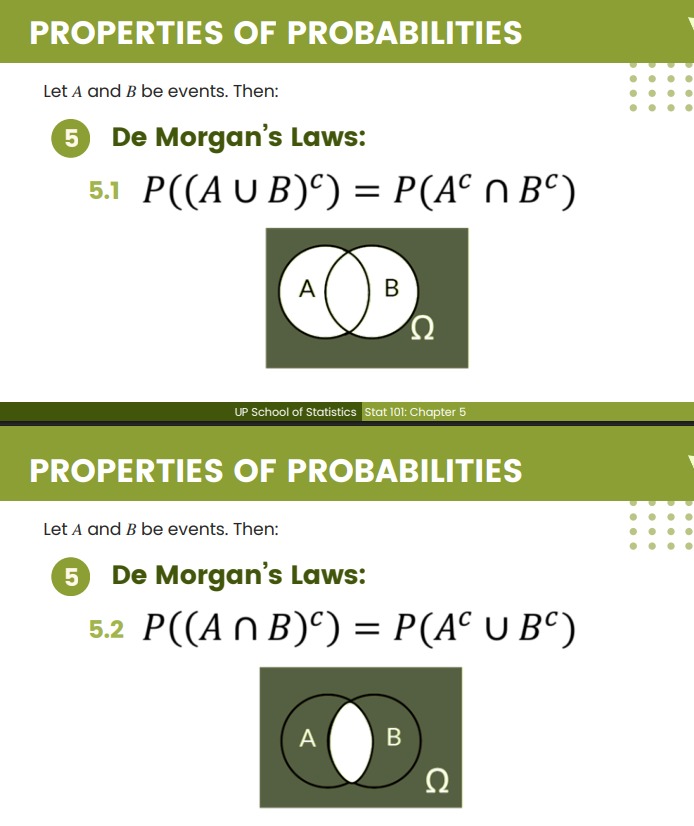
State the De Morgan Laws of Probabilities
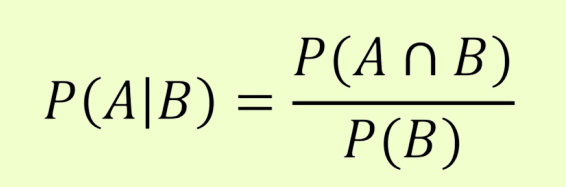
“the probability of 𝐴 given 𝐵”
Let 𝐴 and 𝐵 be two events where 𝑃(𝐵)>0
How is this read? Also what is the conditions for this to hold?
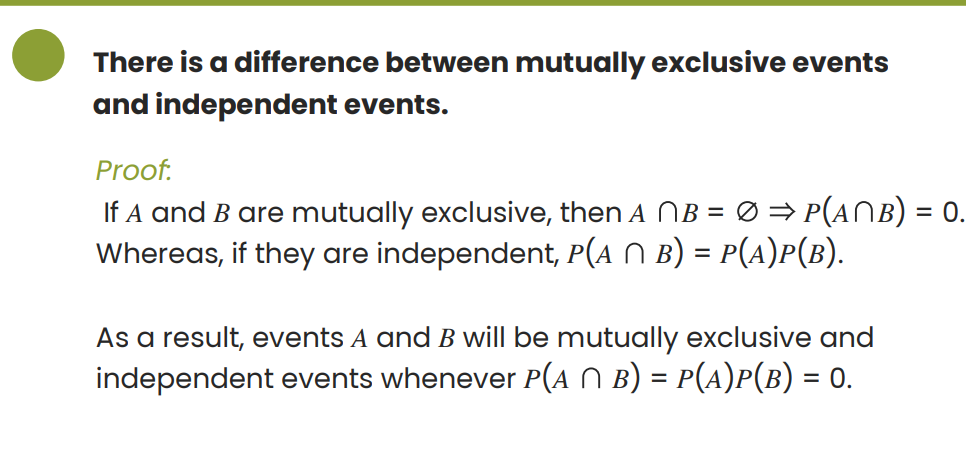
𝑃(𝐴 ∩ 𝐵) = 𝑃(𝐴)𝑃(𝐵) = 0.
When is two events mutually exclusive and independent?