BSCI 170: Membranes, Osmosis, Facilitated/Active transport
 Call Kai
 Learn
Learn Practice Test
 Spaced Repetition
 Match
Match Flashcards
 Knowt Play
1/44

Earn XP
Description and Tags
Exam 2 material
Name | Mastery | Learn | Test | Matching | Spaced | Call with Kai |
|---|
No analytics yet
Send a link to your students to track their progress
45 Terms
Whats the current model of the plasma membrane?
fluid mosaic model
What are the membranes mostly composed of?
lipids, proteins, & carbohydrates
Membrane lipids are mostly ______.
Phospholipids
lipids in fluid state
mostly unsaturated fatty acids
Proteins are ____ in the membrane & are ____ in the lipid fluid
dispersed
free to float
both lipids and proteins are ____
amphipathic (partly hydrophilic and partly hydrophobic)
Movement of lipids in membrane
free to move in 2-D plane of membrane
move sidways (laterally) very frequently (10^7x per s)
flip flop across membrane rarely (once a month)
bc its harder for hydrophilic head to travel through hydrophobic part
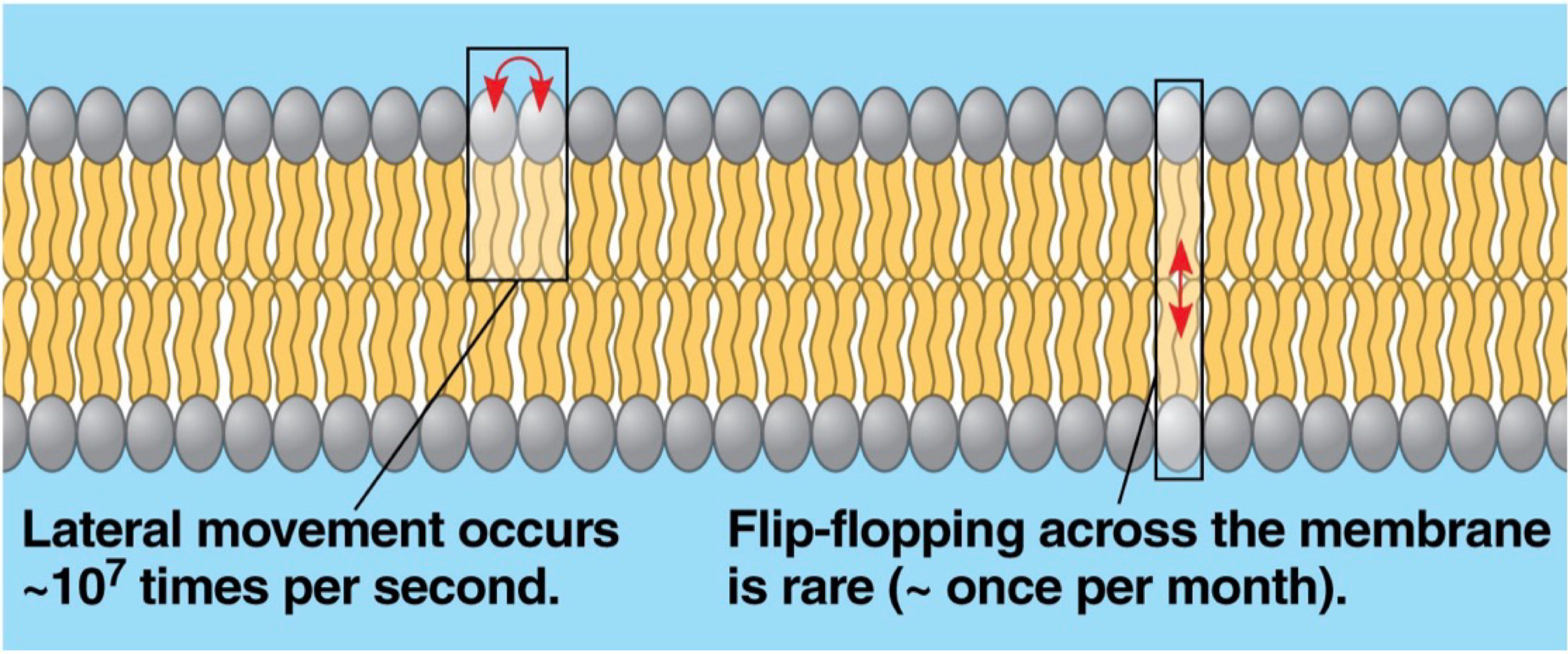
3 predictions of the fluid mosaic model
movement of lipids
proteins exists as discrete particles
Proteins should be able to move in membrane —> proven that they move laterally
Transition temperature (Tm)
temperature at which the membrane undergoes fluid to solid phase change
like the melting point
affected by changes in lipid structure
membrane fluidity varies with ____
temperature
relationship between saturation levels of lipids and fluidity
more kinks = more fluid membranes:
increased number of C=C, decresed Tm
What does cholesterol do to the membrane?
reduces membrane fluidity at moderate temperature but it hinders solidification at low temperatures (makes it a lil more fluid)
acts as fluidity buffer
alters interactions between adjacent fatty acids
interacts with hydrophobic tails
Cholesterol
lipids that are soluable in hydrophobic core of membrane bilayer
have one polar region
number and types of proteins depend on ____
function of the membrane
Intergral membrane proteins
integrated into the membrane
penetrate the hydrophobic core
removed only by solubilizing the membrane
many are transmembrane
amphipathic: function of both sides of membrane
Anchored membrane proteins
covalently attached to lipids that insert into membrane
no exposed hydrophobic regions
Peripheral Membrane proteins
loosely bind to intergral proteins or lipids
removed w/o destroying membrane
differ on each side of membrane
only function on one side of membrane
membrane carbohydrates
short chains of monosaccaraides added to protein/lipid
glycoprotein or glycolipid
attachment in rough ER or golgi
glycosylation
found in outer membrane layer
Functions of membrane carbohydrates
defense: immune system, recognizing self from non-self
protection; cell lining of GI, respiratory, & reproductive trats
cell sorting: during embryogenesis
I don’t think we have to know the specifics but just in case 😎
functions of proteins
transport
enzyme activity
signal transduction
cell-cell recognition
intercellular joining
attachment to cytoskeletom & extracellular matrix
are cells able to create and maintain different environments?
selective permeability & regulated transport
Diffusion
movement from region of higher concentration to lower concentration
What molecules are able to diffuse across the membrane more rapidly?
smaller and hydrophobic ones
Rank these based on their ability to diffused across the membrane: ions, hydrophobic molecules, small polar molecules, & large polar molecules
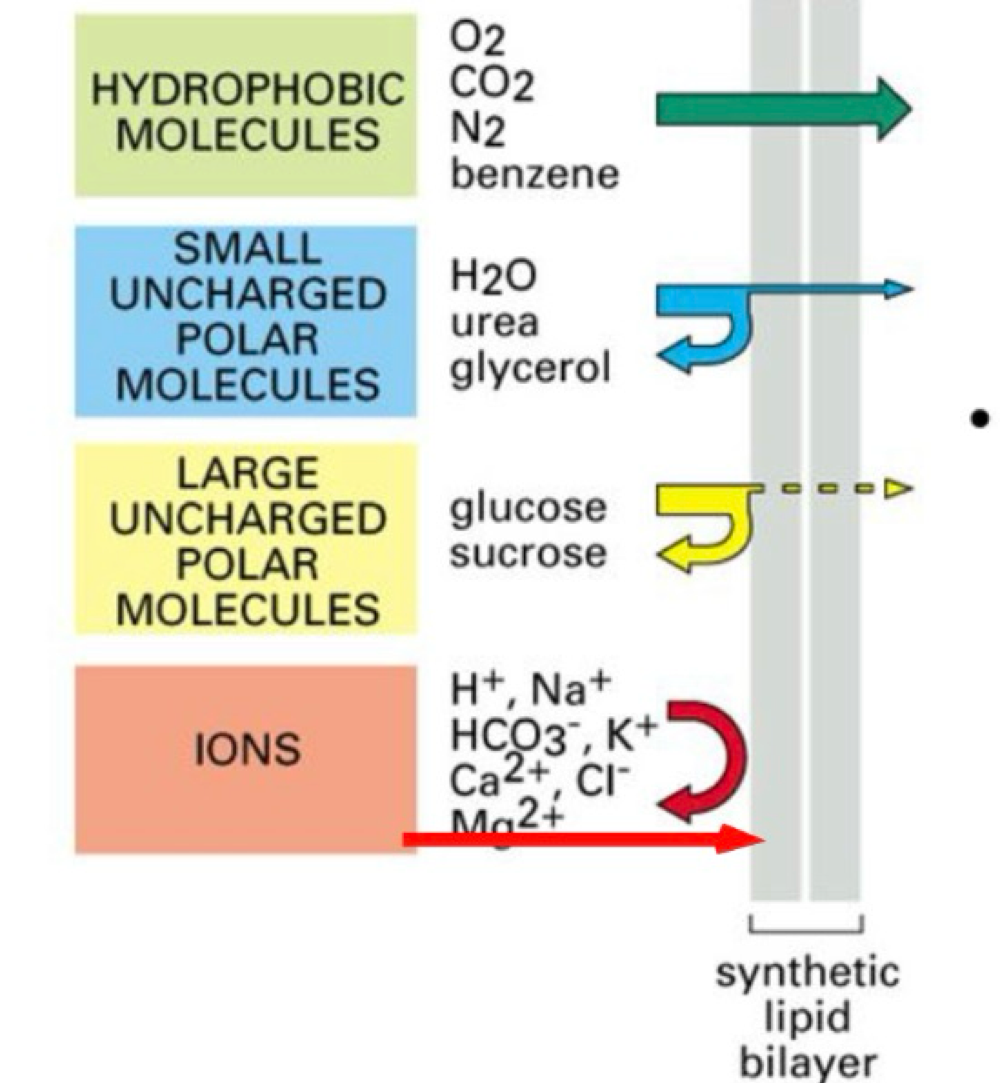
What allows polar or charged molecules to diffuse through the membrane?
intergral (transmembrane) proteins
Channel proteins
hydrophilic pores; no specific binding
allow rapid movement of ions and water
can transport millions/billions per second
Carrier proteins
specific binding of solute
requires conformation/shape change
transports 100s-1000s per sec (slower than channels)
Passive vs Active transport
Passive:
no energy added
[higher] to [lower]
driving force determined by direction of electrochemical gradient
Active:
energy is added
[lower] to [higher]
driving force is inout of energy
Osmosis
passive movement of water across a membrane
water uses special channels called ____
aquaporins
Isotonic vs Hypertonic vs hypertonic
isotonic: solution around cell has same [solute] as inside the cell (equilibrium)
hypertonic: solution around cell cell has higher [solute] than inside the cell
net movemnet OUT of cell
shriveled cell
hypotonic: solution around cell cell has lower [solute] than inside the cell
net movement INTO the cell
swollen cell
In osmosis: water moves from region of ___ to ___
lower [solute] to higher [solute]:
hypo to hyper
more water to less water
Why does water go from regions with less solute to more?
some water bounds to solute, forming a hydration shell, so when the more solute there is the less unbound water there is that is able to move freely
Facilitated diffusion
passive transport that is aided by proteins (both channels and carriers)
uniporter
In facilitated diffusion, in what ways can channels be “gated” to control transport
ligand gated
electrically gated
mechanically gated
what happens when carrier proteins are saturated?
rate of diffusion slows down because all carrier proteins are occupied
uniport vs symport vs antiport
uniport: moves 1 substance at a time
Cotransport systems:
symport: can move 2 things together
antiport: move things in opposite directions
In active transport, substances are transported ___ their concentration gradients
against
active transport allows cells to generate & maintain ___
different concentrations of across a membrane (gradient)
active transport only uses ____
carriers
stored potential energy
when you have a bunch of (+) charged things on one side and (-) on the other
in this example, h+ wants to move down its chemical gradient but also wants to move down the electrical gradient towrads (-)
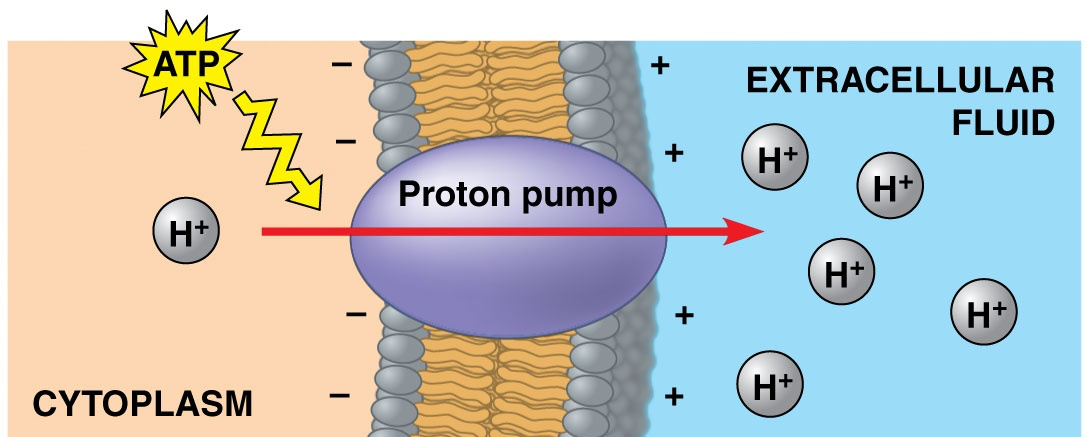
secondary active transport
stored potential energy can drive the active transport of another solute with a separate cotransport portein
Bulk transport
movement of LARGE molecules like proteins & polysaccharaides
exocytosis
endosytosis
Exocytosis
secretion of material
endocytosis
uptake of materials
what are the 3 types of endocytosis
phagocytosis: cellular eating
cell engulfs particle into vesicle like a fatty
pinocytosis: cellular drinking
gulp of fluid taken to vesicle
receptor mediated: bringing in SPECIFIC receptors
ligands bind to specific receptors
transferred to lysosome for digestion