Foundations of Muscle Performance
 Call Kai
 Learn
Learn Practice Test
 Spaced Repetition
 Match
Match Flashcards
 Knowt Play
1/72

There's no tags or description
Looks like no tags are added yet.
Name | Mastery | Learn | Test | Matching | Spaced | Call with Kai |
|---|
No analytics yet
Send a link to your students to track their progress
73 Terms
What are the Neural Systems strength training adaptations?
↑ recruitment in # motor units
↑ rate of firing (↓ twitch contraction time)
↑ synchronization of firing
What are the Neural Systems endurance training adaptations?
none
What happens in the 1st 4-8 weeks of resistance training?
EMG activity increase with little to no evidence of muscle hypertrophy.
What neural responses contribute to motor learning and improved coordination?
decreased inhibition of CNS, decreased sensitivity of GTO, or changes at myoneural junction
of MU
What are the Skeletal muscle structure strength training adaptations?
▪ Hypertrophy
▪ Possible hyperplasia of muscle fibers
▪ Fiber type composition
▪ ↓ or no change in capillary bed density
▪ ↓ in mitochondrial density and volume
Which fiber is hypertrophy greatest?
type IIB fibers
What fiber type composition occurs during strength training?
remodeling of type IIB to IIA, no change in type I to II
distribution
What are the Skeletal muscle structure endurance training adaptations?
▪ Min to no fiber hypertrophy
▪ ↑ in capillary bed density
▪ ↑ mitochondrial
density and volume
What is the body composition strength training adaptations?
▪ ↑ lean (fat-free) body mass
▪ ↓ body fat percentage
What are the body composition endurance training adaptations?
▪ No change in lean body mass
▪ ↓ body fat percentage
When and how does hypertrophy occur?
occurs after ~4-8 weeks of moderate to high-intensity training, but can be as early as 2-3 weeks with very high-intensity training
What is the greatest increase in hypertrophy associated with?
high-volume, moderate-resistance ECC exercise
Plasticity of type IIB fibers
Transformation of IIB to IIA with endurance and heavy
resistance training (early phase) which makes them more fatigue-resistant
What are the connective tissue strength training adaptations?
▪ ↑ tensile strength of tendons, ligaments,
connective tissue
▪ ↑ bone mineral density
▪ No change or bone mass
What are the connective tissue endurance training adaptations?
▪ ↑ tensile strength of tendons,
ligaments, connective tissue
▪ ↑ bone mineralization with
land-based WB activities
Increased tendon/ligament strength/thickness occurs to
support adaptive strength
and size changes of muscle
True or False: Non-contractile tissue strength may develop more rapidly with ECC exercise
True
What is Progressive Resistance Exercise?
Starting with a small number of reps until fatigue, rest, then repeat, progress
What is FITTVP?
Frequency
Intensity
Time
Type
Volume
Progression
What is FITTVP used for?
Progressive overload
Frequency
Number of resistance training sessions/week
What does frequency depend on?
- intensity and volume
- goals, stage of healing, post-op phase,
general health status, previous participation, response to
training, intensity, volume
What is the optimal frequency to gain?
min of 2-3x/week
- may start with daily or multiple times/day for reconditioned or post-op patients
What is the optimal frequency to maintain?
1-2x/week
Intensity
The "load" (exercise load or training load)
- submax vs. max
The use of Submaximal vs maximal load depends on....
• Goals
• Expected functional outcomes
• Cause and extent of muscle performance deficits
• Stage of healing of injured tissues
• Age
• General health status
• Fitness level
• Psychological readiness/status
How can you determine 1-RM?
- Test it
- Base it on experience
- Calculate it
1 RM =
(r/30 +1) x w
r = repetition
w = amount of weight used
Strength
%1RM: >85%
Sets: 2-6
Reps: <6
Rest: 2-5 min
Recovery: 48 hrs
Power
%1RM: 75-90%
Sets: 3-5
Reps: 1-5
Rest: 2-5 min
Recovery: 48 hrs
Hypertrophy
%1RM: 67-85%
Sets: 3-6
Reps: 6-12
Rest: 30-90 sec
Recovery: 48 hrs
Endurance
%1RM: <67%
Sets: 2-3
Reps: >12
Rest: <30 sec
Recovery: 48 hrs
Where do you start resistance training?
30-40% 1RM (sedentary, untrained) to >80% 1RM (highly trained)
What is the typical training zone?
40-70% 1RM for healthy
untrained adults
Low Intensity
40-60% 1RM X 15 reps
Moderate Intensity
65-75% 1RM x 10 reps
High Intensity
80-90% 1RM x 4-5 reps
EMOMs
• Perform 1 exercise per minute
- Work for TIME
- Work for REPs
• Can add 1-3 minutes of rest
• Circuit training with different movements
AMRAPs
• As many reps as possible
• Fixed Total WORK Time
• Complete all reps for 1 exercise before moving to the next
• # of exercises varies: 3-5
movements typically
What are other ways to determine training load?
-MMT
- Dynamometry
- Percentage of BW
- Functional performance testing
- Choose a load, then see how many times someone can lift/move it
Time for a progressive load
Time under tension (TUT) = total amount of
time muscle activated during a set
Type of exercise for progressive load
• Manual/mechanical resistance
- Constant or variable load
- Accommodating resistance (isokinetic)
- BW
• Isometric exercise
• Type
• Dynamic exercise
• CONC/ECC
• Open chain vs Closed chain
What is manual resistance?
active-resistive exercise applied externally by an individual
What is constant resistance?
Free weights, handheld cuff
weights, weight machines, pulley systems
What is Variable resistance?
• Cybex machines
- Provides varying levels of resistance
thru exercise to load muscles more
effectively at multiple points in ROM
• Elastic resistance band/tube (TB)
What is isokinetic exercise?
• Velocity held constant by rate-limiting device
• Accommodating resistance exercise- external resistance adjusts to the effort
What is isometric exercise?
An exercise in which muscles are contracted and held for a few seconds, but the body doesn't move.
What do isometric exercises do to muscles?
• Decrease pain/spasm, promote circulation, maintain mobility, especially in the acute phase of healing
• Minimize muscle atrophy if joint movement is restricted
• Re-establish NM control when joint movement is not advisable
What do isometric exercises do for stability?
Develop postural or joint stability
What are multiple-angle isometrics?
Used when joint motion is allowed but dynamic resistance could
compromise joint integrity
What does Heavy isometrics do?
Reduces tendon pain immediately, reduces excess muscle inhibition, increases muscle force, and can be done anytime
Greater loads can be controlled with
ECC
Gain in strength/mass greater with
max effort ECC training
Adaptions associated with ______ training are more ________ & ________ specific.
ECC; mode; velocity
_____ contractions are more efficient metabolicslly, less fatigue.
ECC
When is there greater stress on the CV system?
During ECC
How do you determine volume during progressive overload?
Total volume = Reps x Sets ( x intensity?)
What to think about during the progression phase?
- patient's goals
- logically about function
- type of muscle contraction
- plane of movement
- base of support
- speed or velocity
- ROM or body position
- OC or EC
What are the determinants of a resistance exercise program?
- alignment
- stabilization
- intensity
- volume
- exercise order
- frequency
- rest interval
- duration
- mode
- velocity
- periodization
- integration
What is periodization?
An approach that partitions a training program into specific time intervals and establishes systematic variation in intensity, reps, sets, and frequency
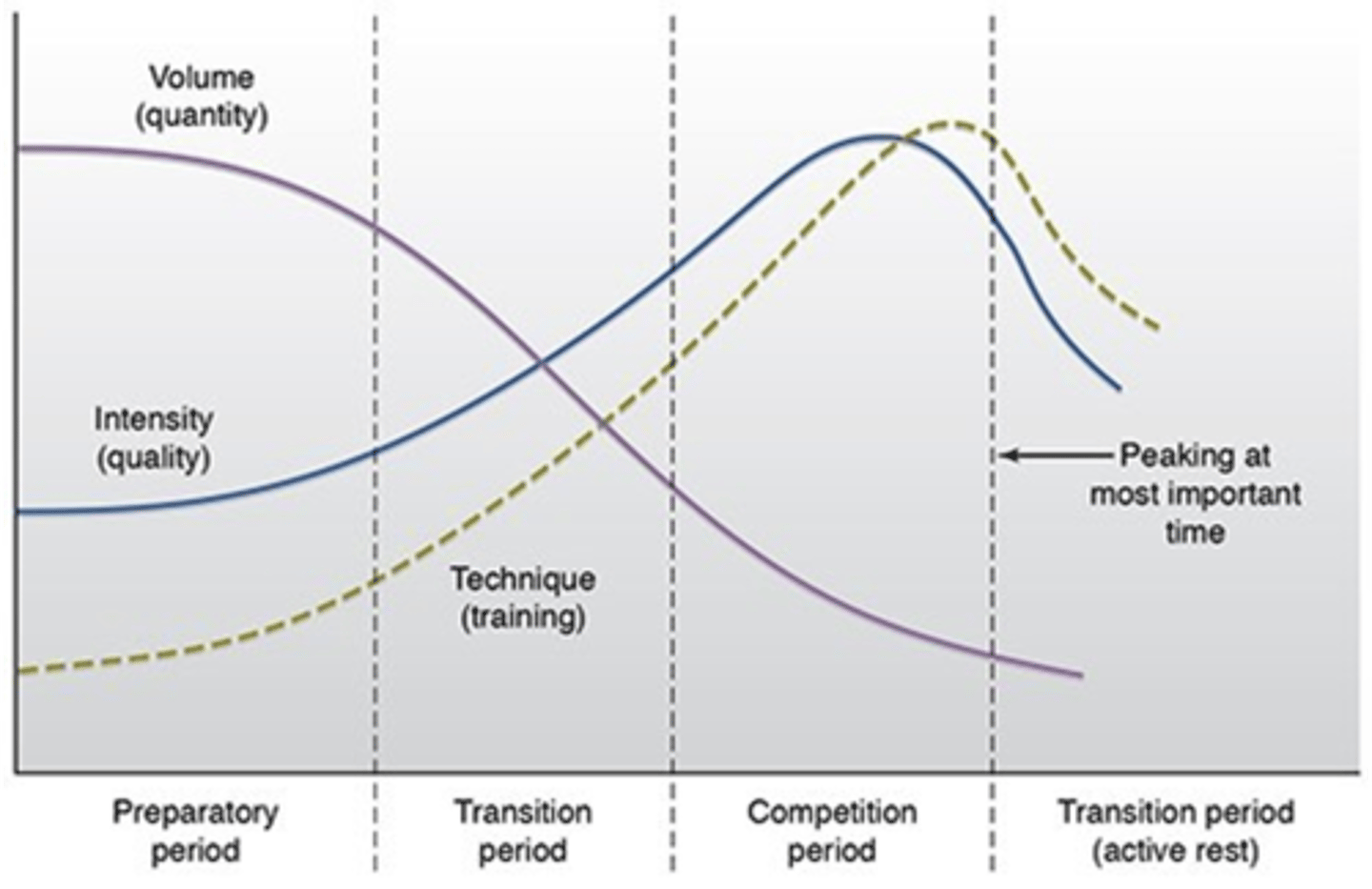
What are the goals of periodization?
• Prepare for a "peak performance"
• Optimally progress a training program
• Prevent overtraining and psychological staleness
What are the precautions for progressive resistance exercise?
• Valsalva maneuver (or breath
holding)
• Substitute motions
• Overtraining and overwork
• Exercise-induced muscle soreness
- Acute muscle soreness
- Delayed onset muscle soreness
• Pathological fracture
• Medications
What are the contraindications for progressive resistance exercise?
• Severe pain
• Inflammatory neuromuscular diseases
• Severe cardiopulmonary disease
What is delayed onset muscle soreness (DOM)?
• Soreness, tenderness, aching
• Develops 12-24 hrs after exercise, peaks 48-72 hrs and subsides 2-3 days later
• Soreness/pain with passive lengthening or active contraction
• Local edema and warmth may be present
• Decreased ROM during the time course of soreness
• Decreased strength prior to onset of soreness and may persist 1-2 weeks after soreness subsides
What is the taxonomy of motor tasks?
System of analyzing functional activities and a framework for
understanding the conditions under which simple to complex
motor tasks can be performed
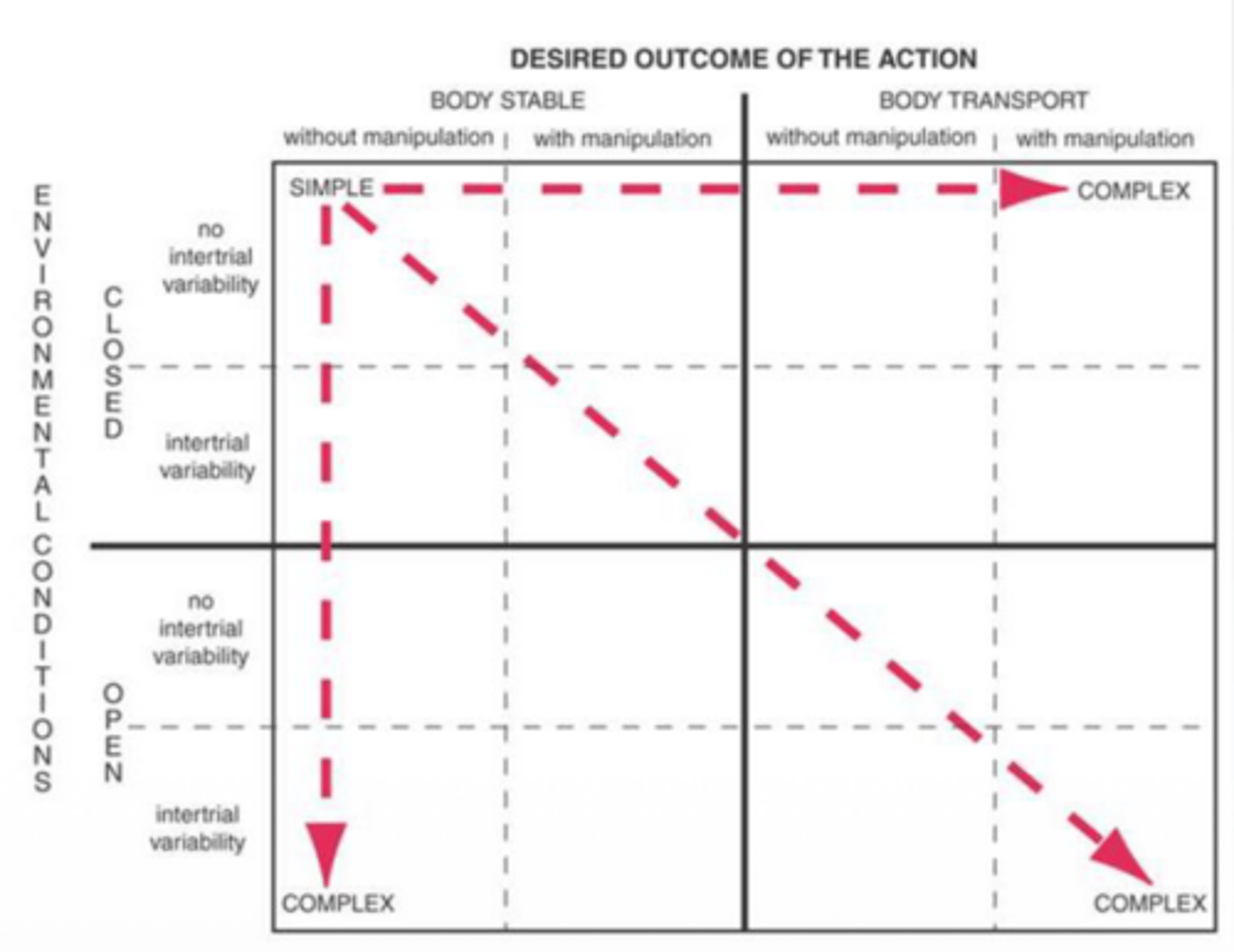
Closed environmental conditions of the taxonomy of motor tasks
• Stationary
• Objects around the patient and the surface on which the task is performed do not move
• Examples:
- Standing in an empty room
- Eating while sitting in a chair
- Tall kneeling on the mat
Open environmental conditions of the taxonomy of motor tasks
• Objects or people in the environment are in motion, or the support surface is
unstable
• Examples:
- Maintaining sitting balance on a moving surface
- Standing on a moving train
- Crossing a street at a busy intersection
Absent Inter-trial variability of the taxonomy of motor tasks
• Environment is constant or unchanging
• Environmental conditions are predictable
• Little attention to the task required
• Examples:
- Practicing lifting with the same weight
- Sit to stand from the same chair height
Present Inter-trial variability of the taxonomy of motor tasks
• Environment is changing or variable
• Requires more attention to the task
• Examples:
- Lifting objects of different sizes and weights
- Climbing stairs of different heights
Body Stable: Desired outcome of the taxonomy of motor tasks
• Body is stationary
• Examples:
- Maintaining balance while standing on 1 leg
- Drinking a glass of tea in the kitchen
Body Transport: Desired outcome of the taxonomy of motor tasks
• Body is moving from 1
place to another
• Examples:
- Transfers
- Climbing
- Squatting
- Lunging
- Walking
- Ascending/descending stairs
Absent Manipulation of objects of the taxonomy of motor tasks
• UE's are not doing anything
• Less complex
Present Manipulation of objects of the taxonomy of motor tasks
• UE's required to manipulate an object
• More complex
• Examples:
- Throwing /catching an object while in SLS
- Holding a child during sit to stand
- Holding arms out straight or in a certain position