Anatomy II Exam 5 (Glossopharyngeal and Vagus Nerve)
 Call Kai
 Learn
Learn Practice Test
 Spaced Repetition
 Match
Match Flashcards
 Knowt Play
1/48

There's no tags or description
Looks like no tags are added yet.
Name | Mastery | Learn | Test | Matching | Spaced | Call with Kai |
|---|
No analytics yet
Send a link to your students to track their progress
49 Terms
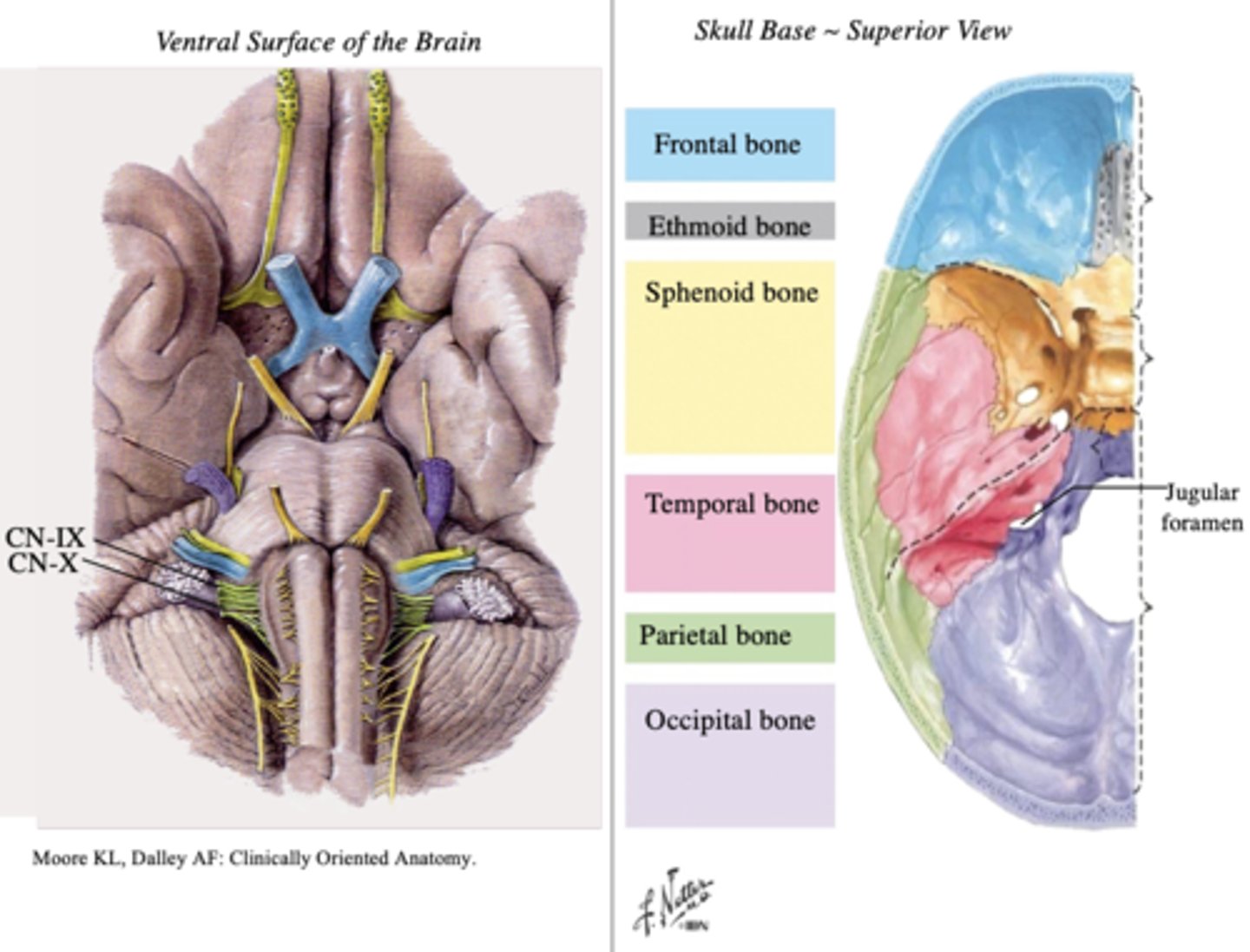
The glossopharyngeal and vagus nerves emerge from the ________________ _______________ as several rootlets that coalesce to form their respective nerves (____________ rootlets form CN-IX; _______________ rootlets form CN-X) and exit the posterior cranial fossa via the jugular foramen
lateral medulla, rostral, caudal
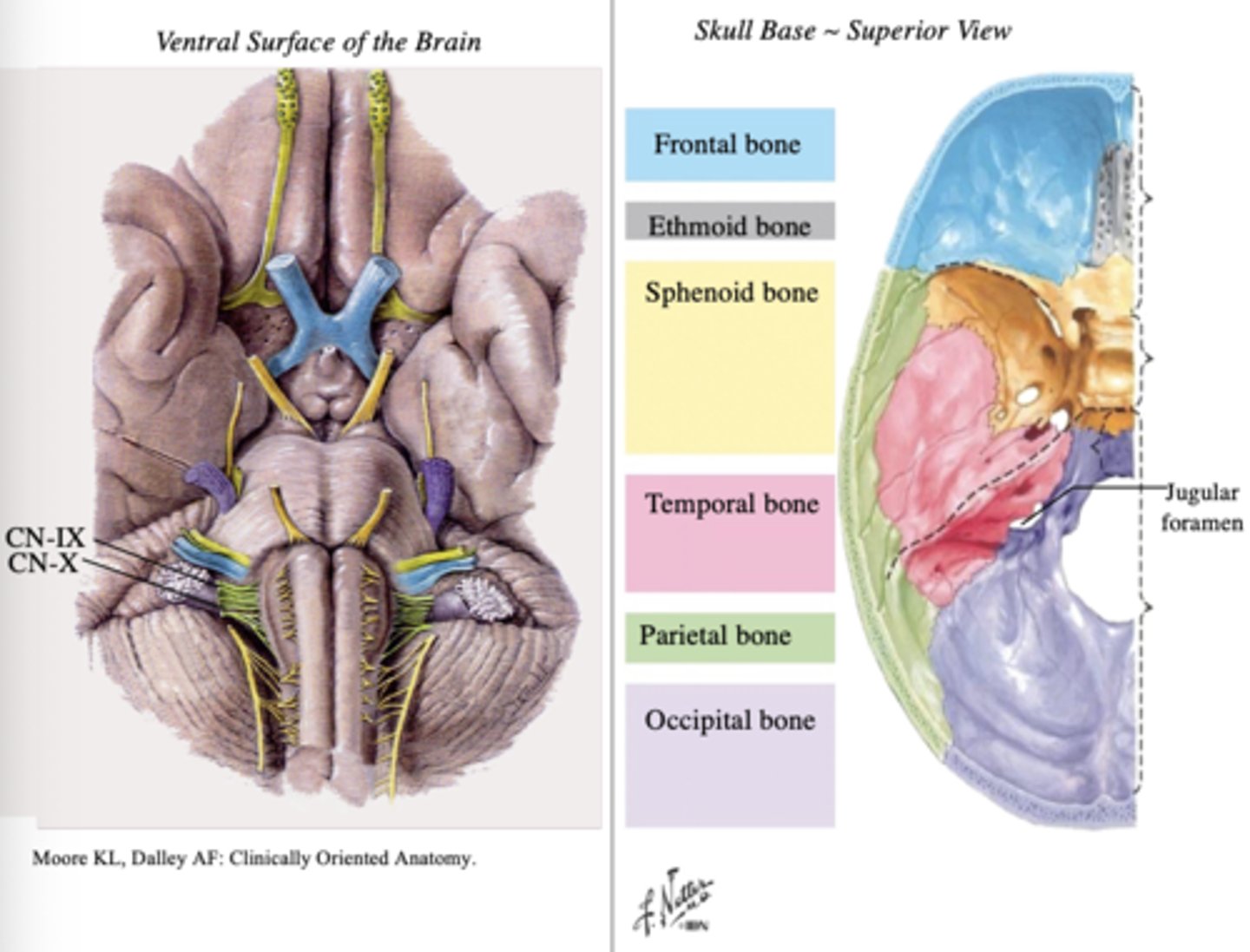
T/F CN-IX and CN-X are both comprised of:
- Branchiomotor (SVE) fibers
- Visceral motor (GVE) fibers
- Somatosensory (GSA) fibers
- Visceral sensory (GVA) fibers
- Special sensory (SA) fibers
True
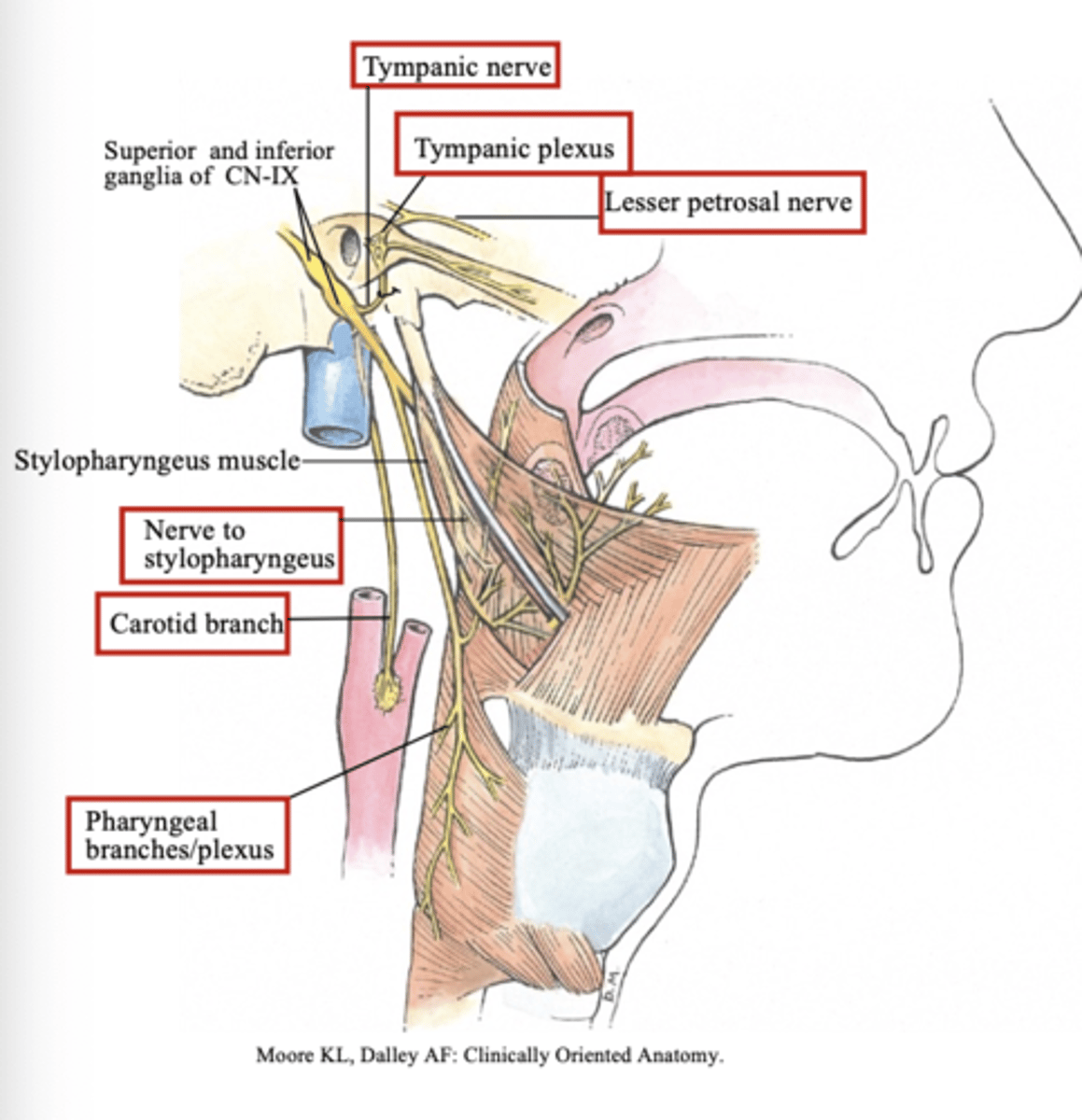
What are the 7 branches of the Glossopharyngeal Nerve?
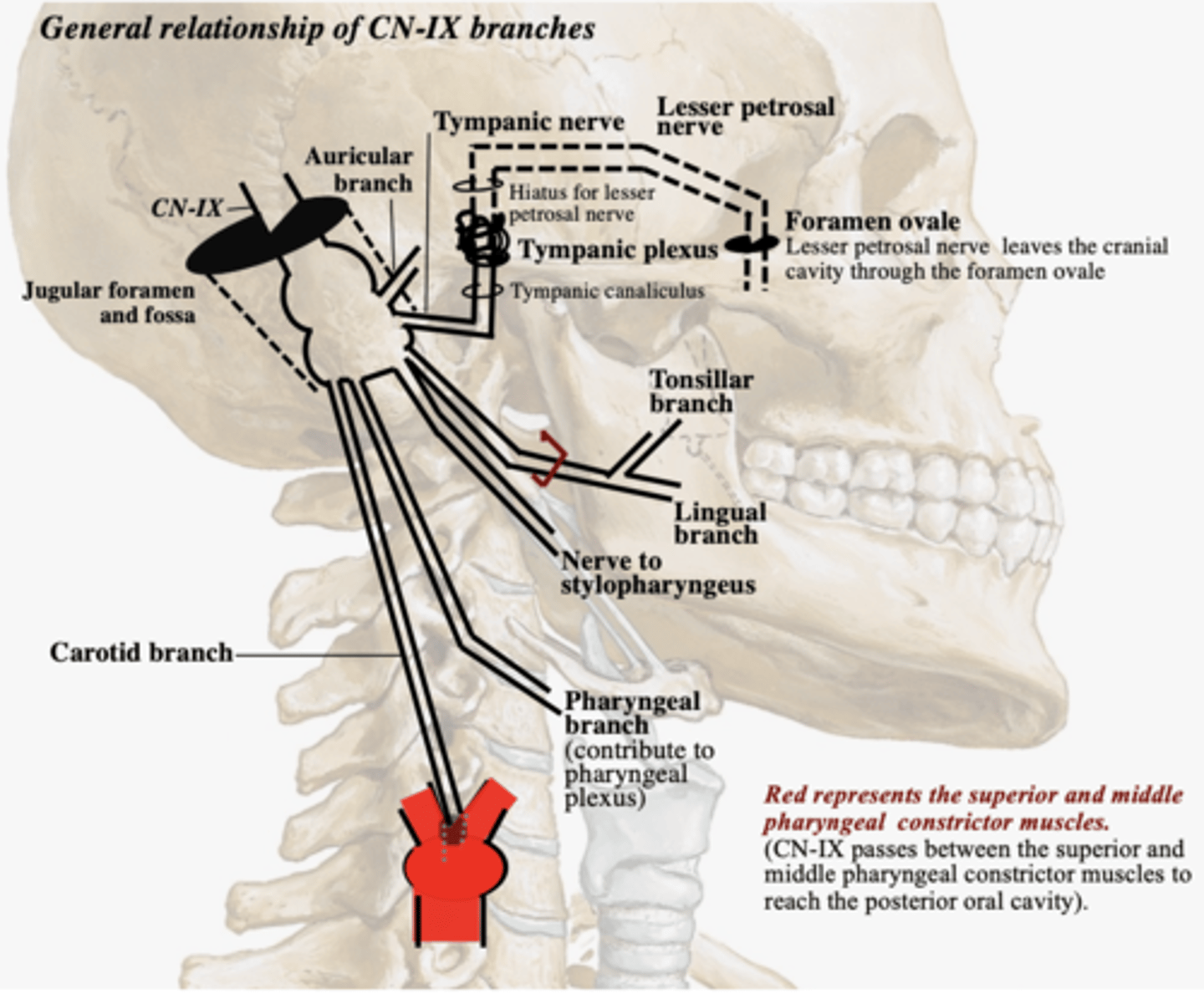
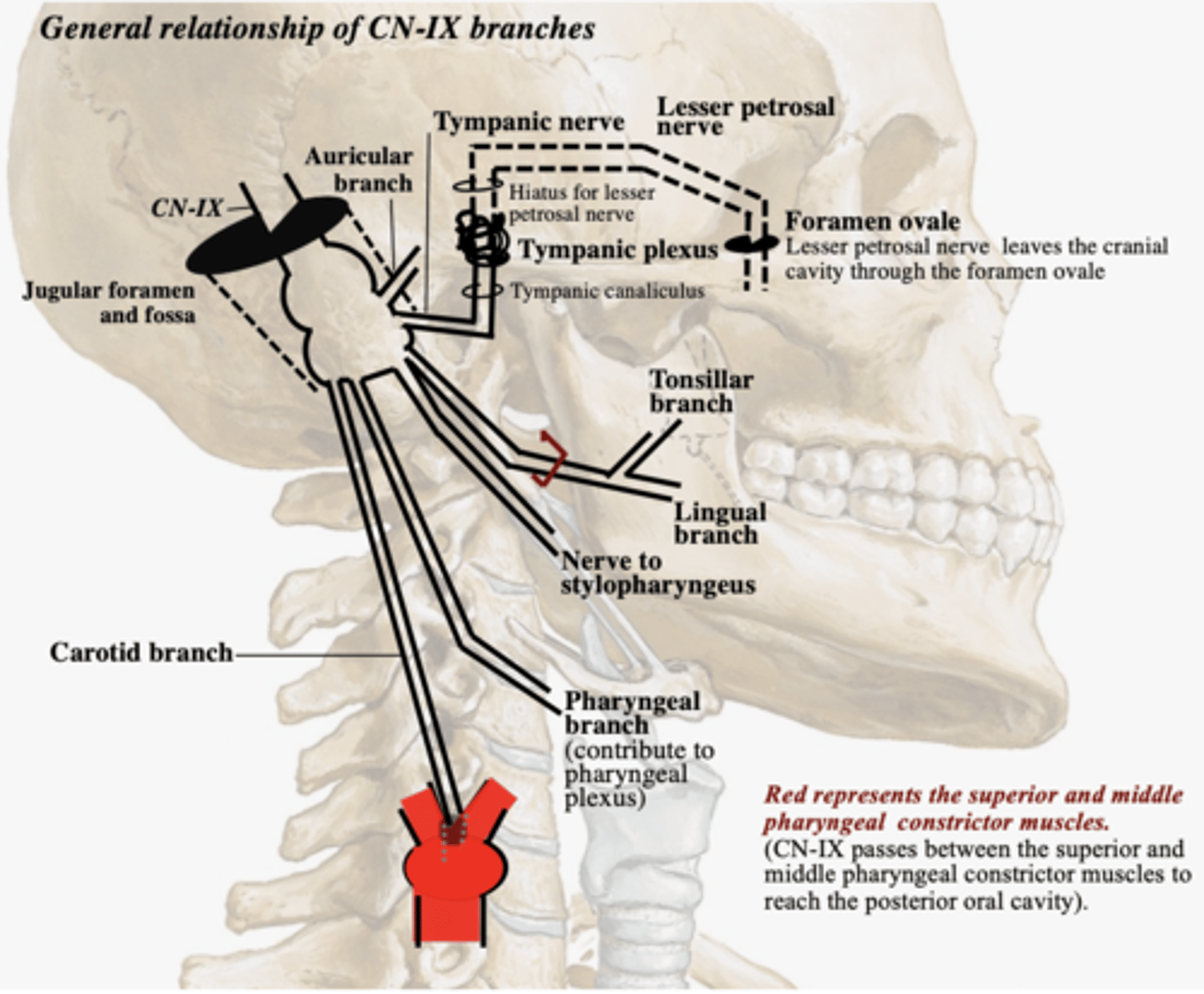
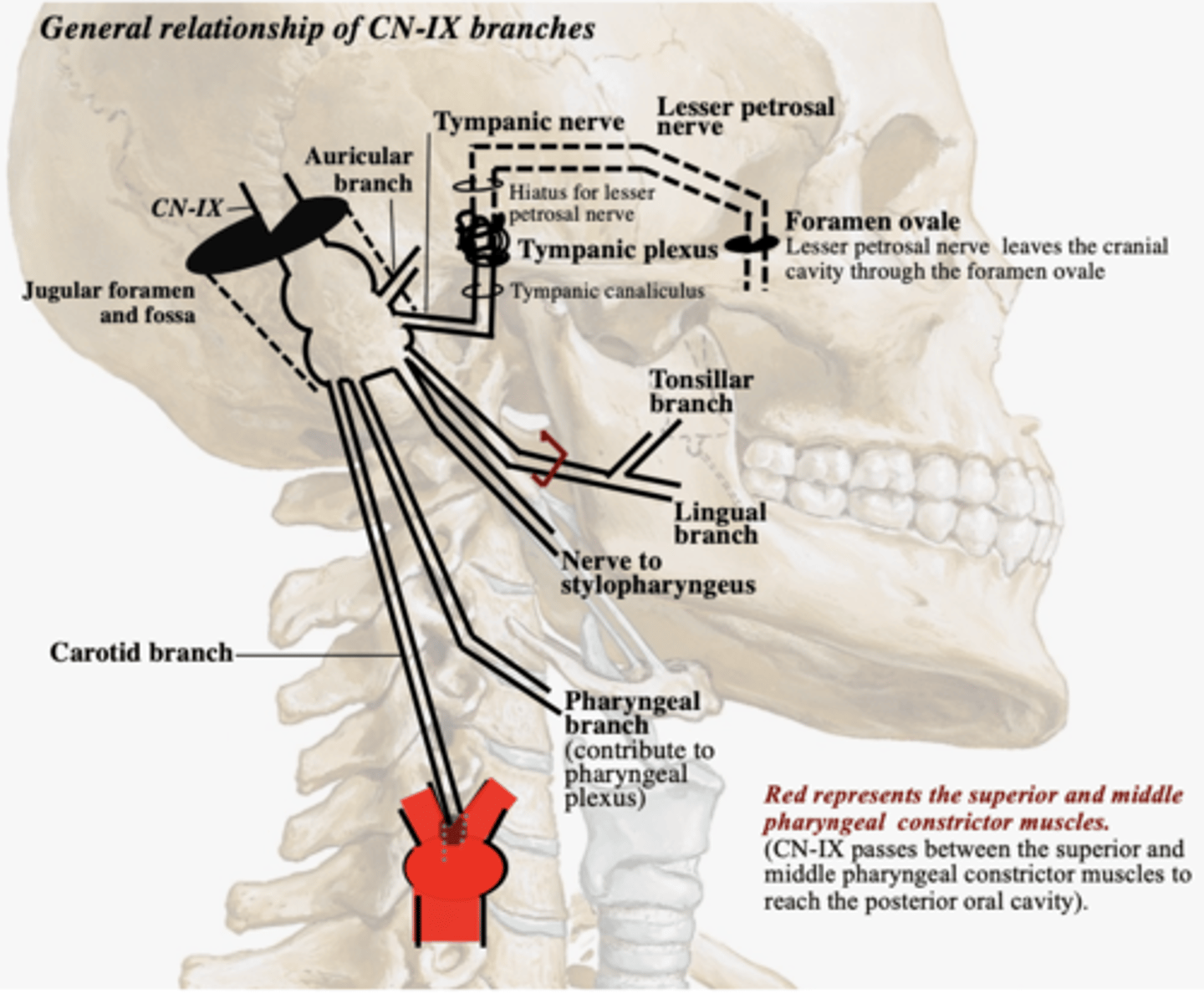
1) Auricular branch
2) Tympanic nerve
3) Carotid branch of CN-IX
4) Pharyngeal branches
5) Nerve to the stylopharyngeus muscle
6) Tonsillar branch
7) Lingual branch
The tympanic nerve travels to what plexus before becoming what nerve?
tympanic nerve TO tympanic plexus TO lesser petrosal nerve
What branch of CN-IX descends to the carotid body and carotid sinus?
Carotid branch
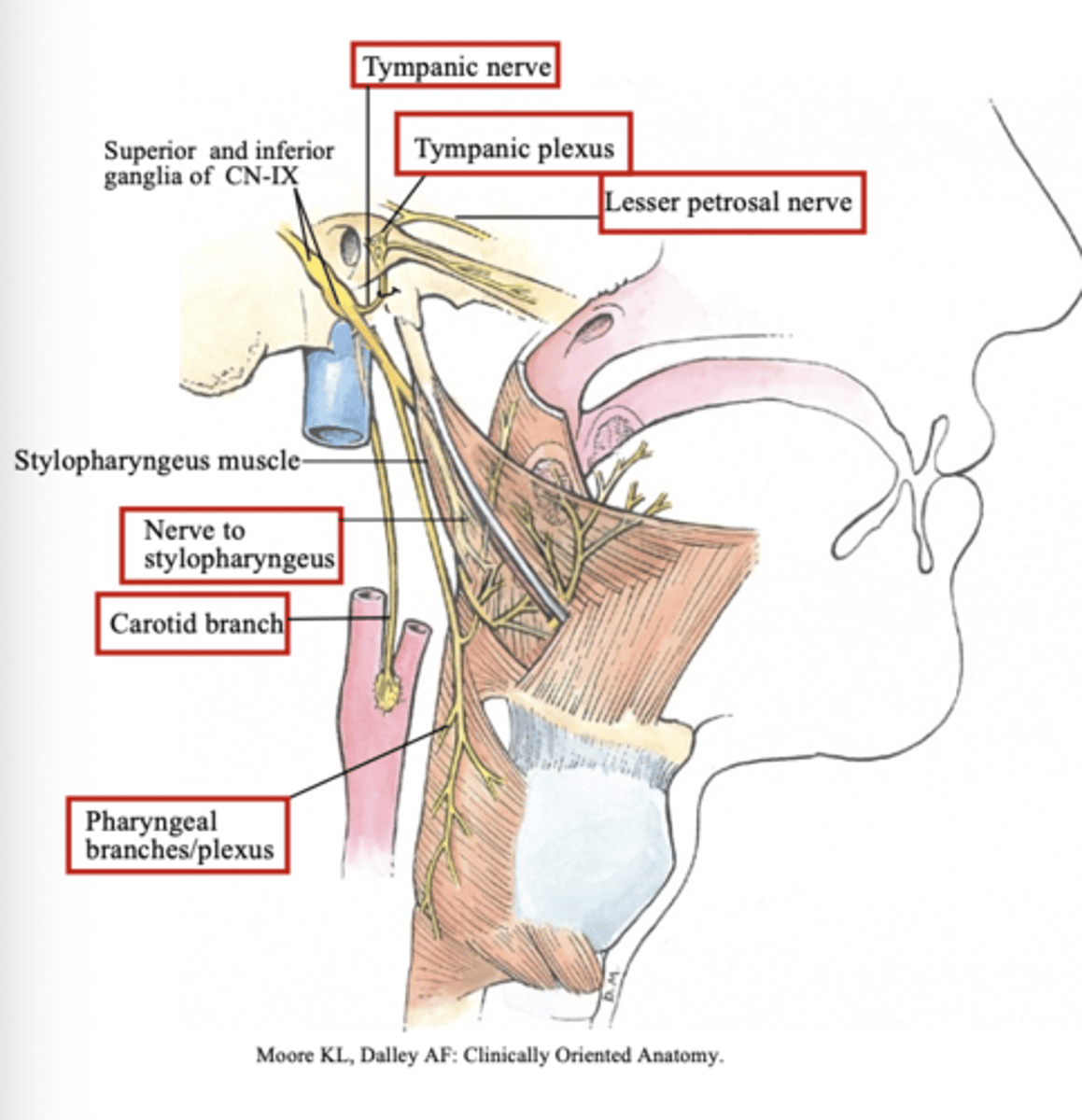
What three structures come together to form the pharyngeal plexus?
1) Pharyngeal branches of CN-IX
2) Pharyngeal branches of CN-X
3) Postganglionic sympathetic fibers (GVE)
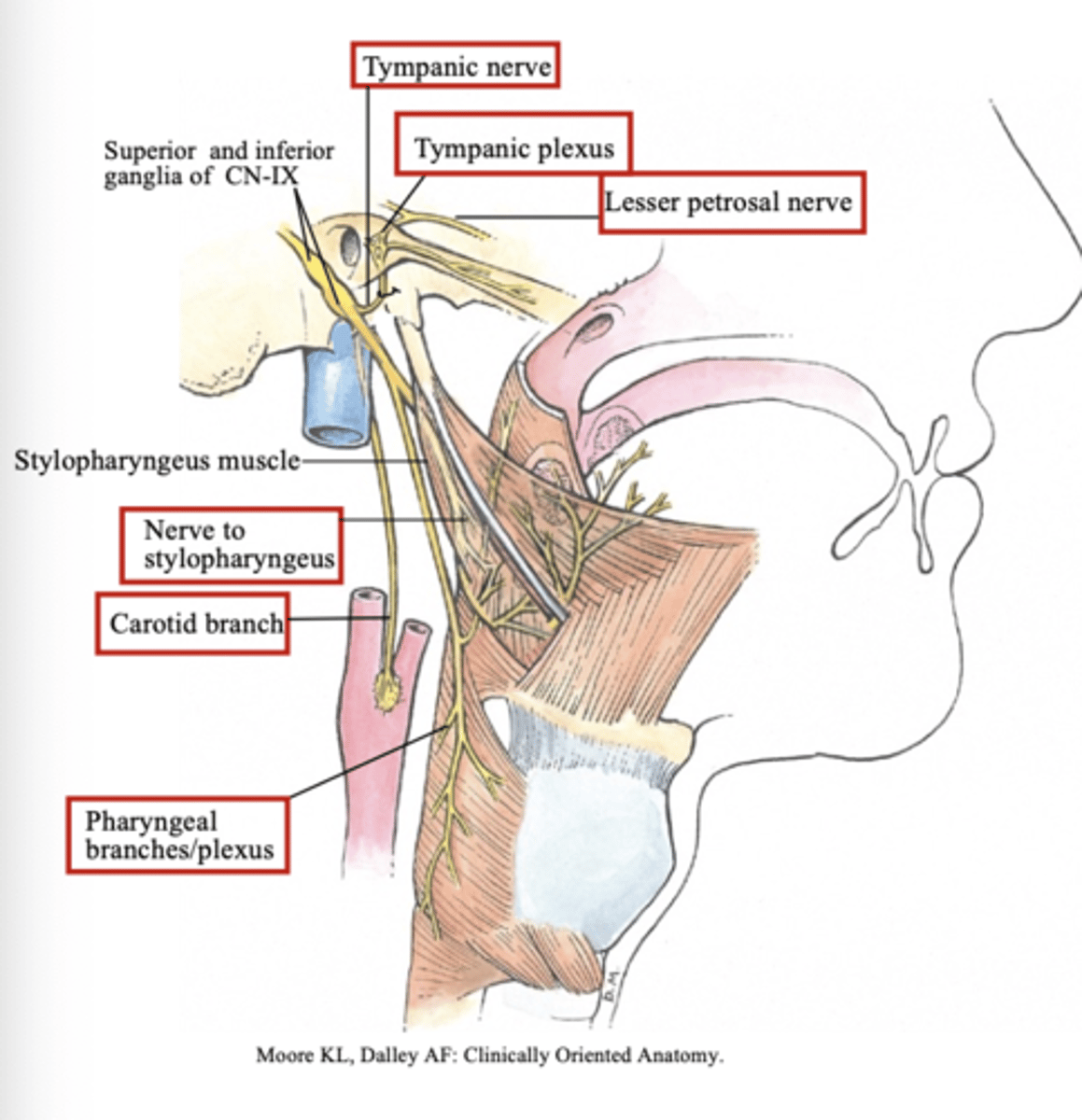
What nerve passes to the stylopharyngeus muscle?
nerve to stylopharyngeus
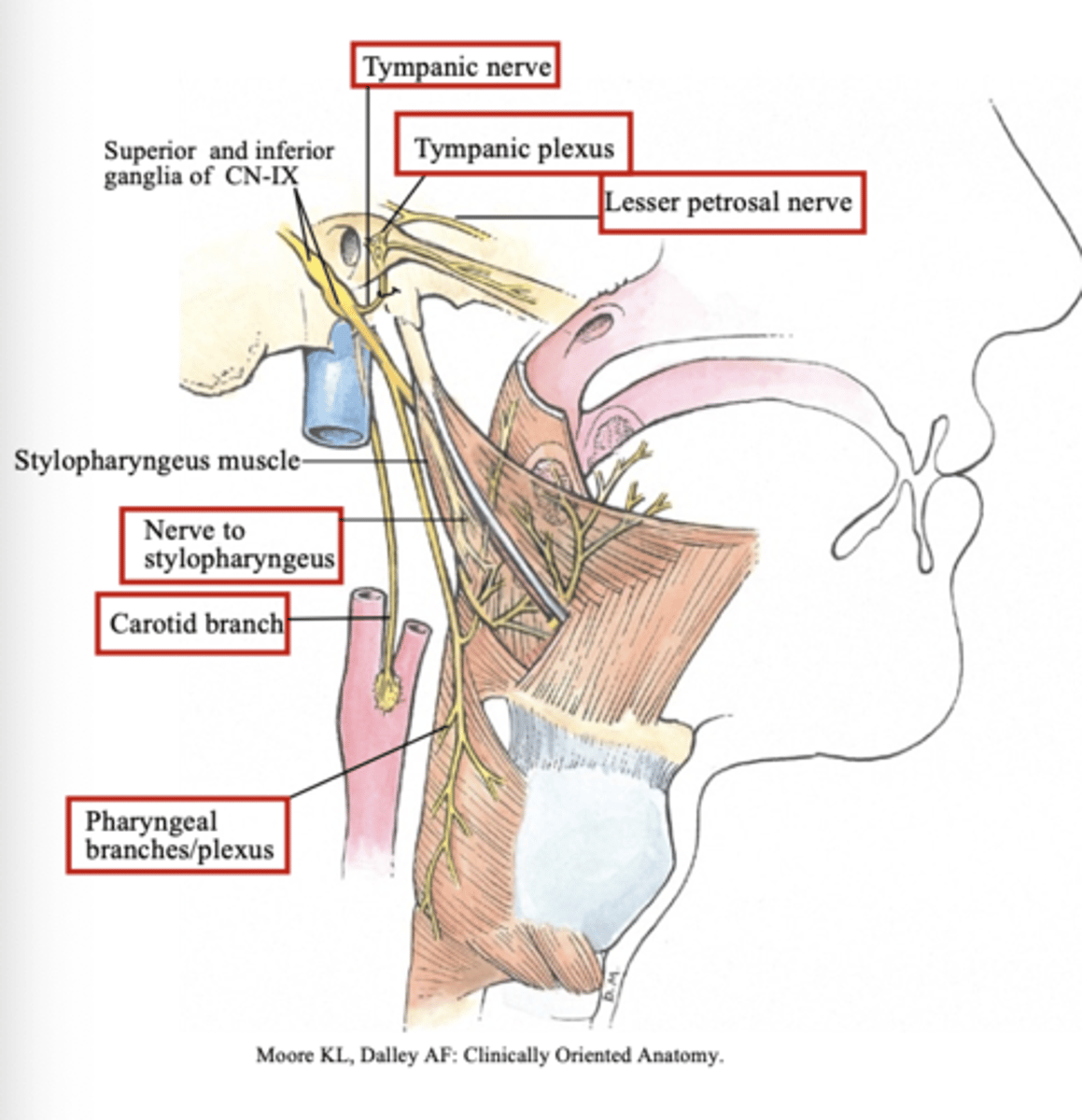
After CN-IX gives rise to the carotid branch, pharyngeal branches, and nerve to stylopharyngeus muscle, CN-IX passes between the _____________ and _____________ pharyngeal constrictor muscles and gains access to the pharynx and posterior oral cavity.
superior and middle
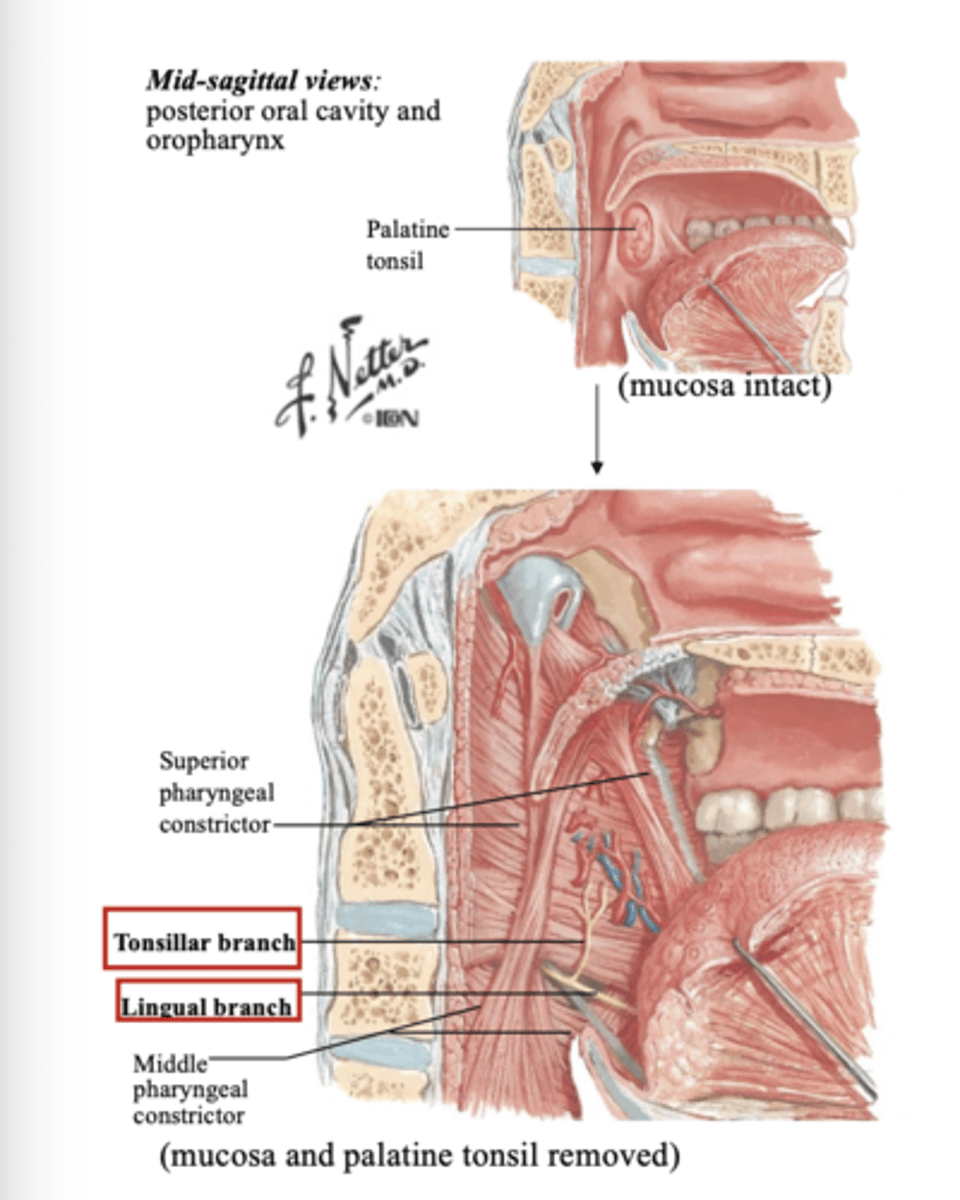
In the pharynx and posterior oral cavity what does the CN-IX give rise too? (HINT 2)
1) tonsillar branch
2) lingual branch
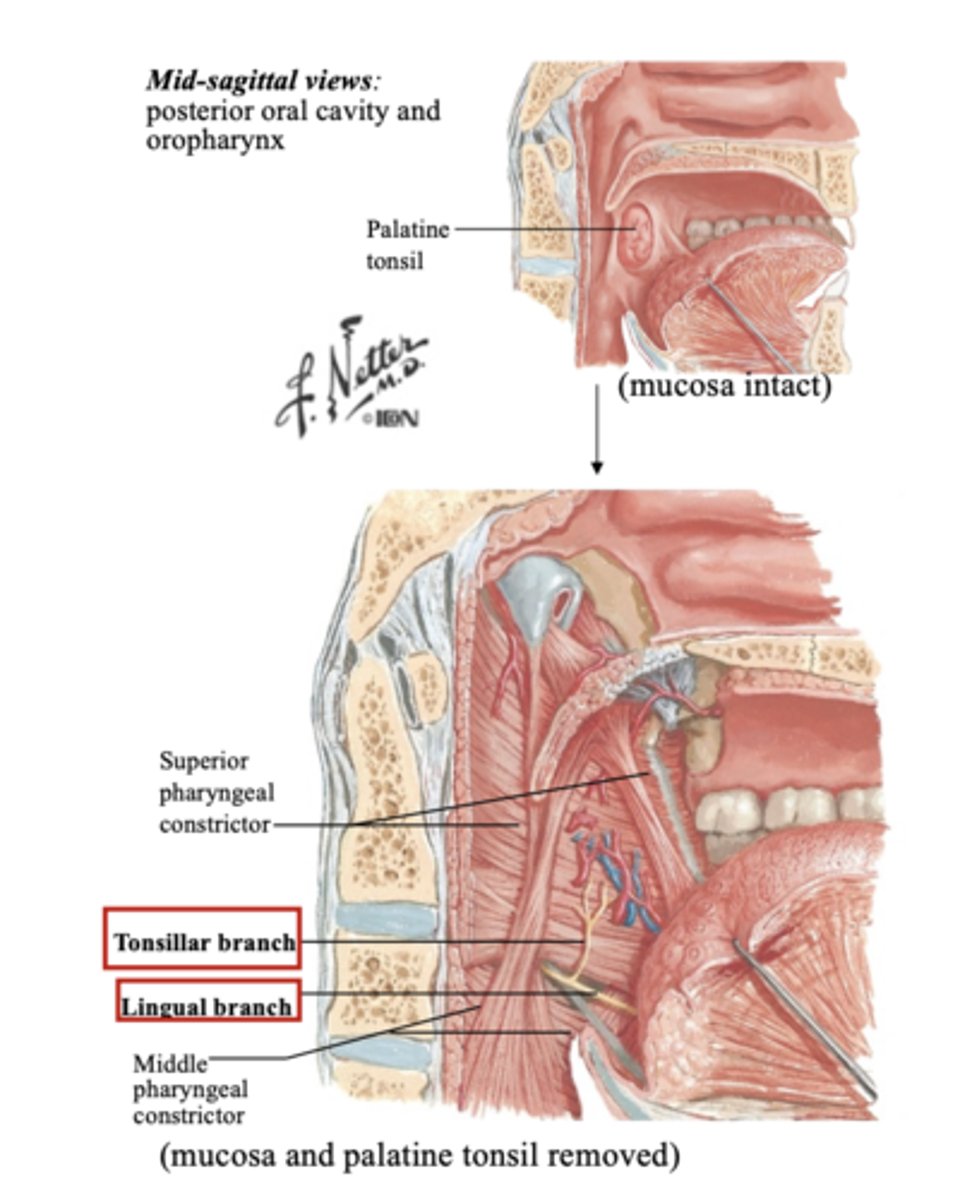
The tympanic nerve takes a what type of course?
a recurrent course
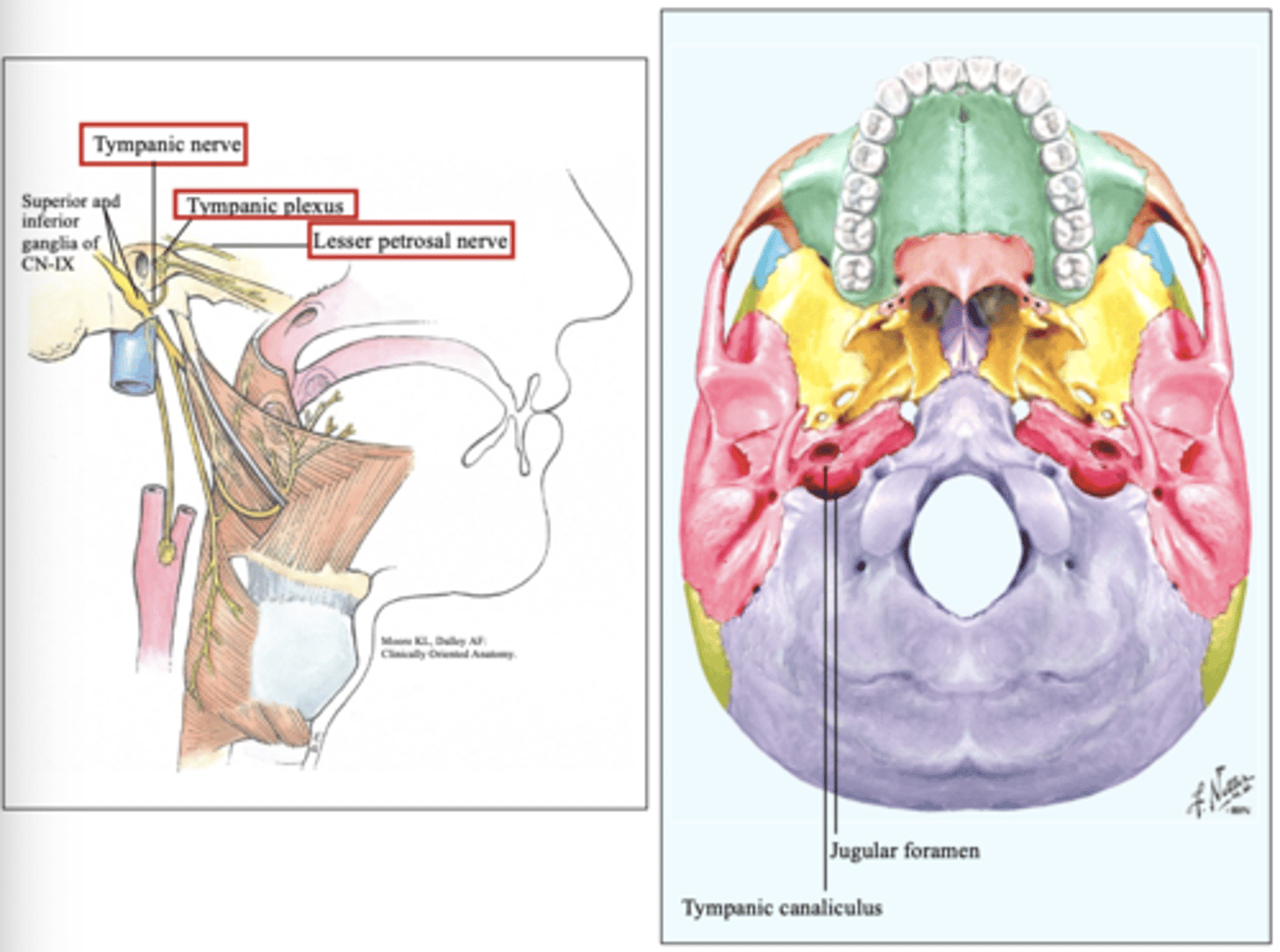
The tympanic nerve emerges from the inferior ganglion of CN-IX THEN exits the __________________ ______________ AND turns superiorly to re-enter the skull through the ________________ _______________ WHERE it enters the __________________ _________________. (middle ear cavity)
jugular foramen, tympanic canaliculus, tympanic cavity
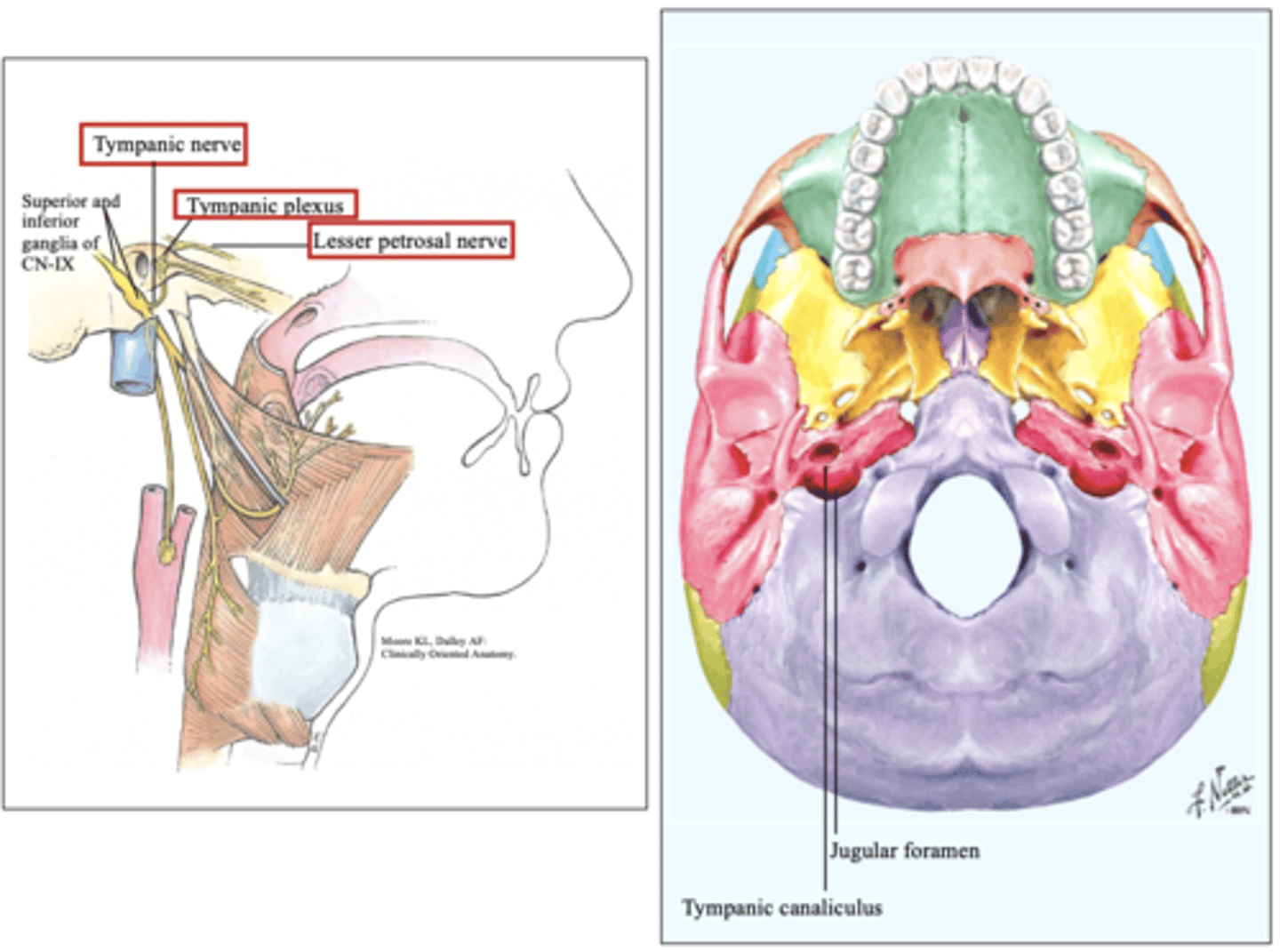
The tympanic nerve (GVA, GVE) enters the tympanic cavity via the tympanic canaliculus and courses from inferior to superior along the medial wall of the tympanic cavity where it branches and contributes to what?
tympanic plexus
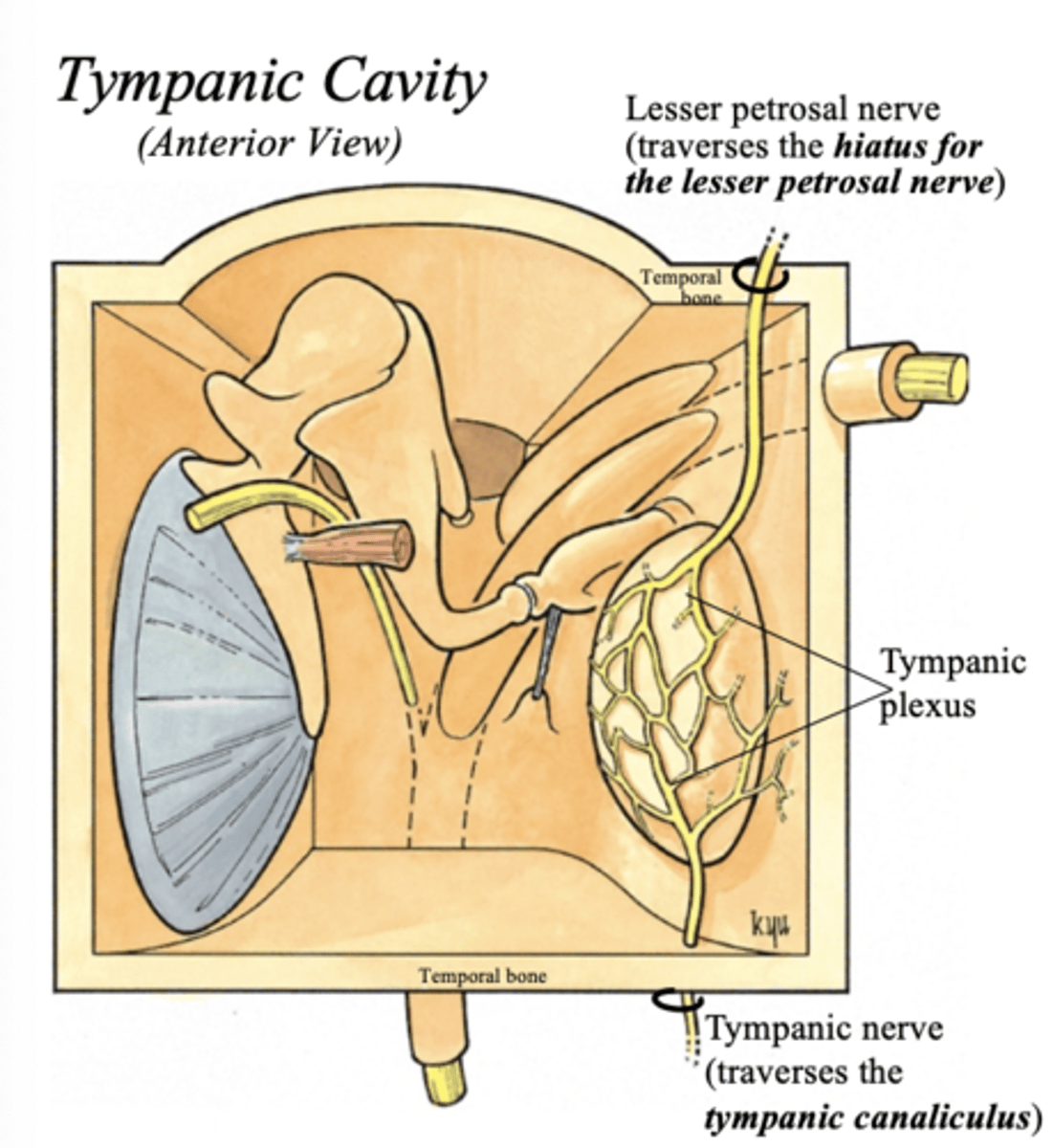
The lesser petrosal nerve (GVE fibers only) emerges from the _____________ _____________ and courses superiorly to reach the hiatus for the lesser petrosal nerve where it passes through in order to reach the ________________ _______________ ________________.
tympanic plexus, middle cranial fossa
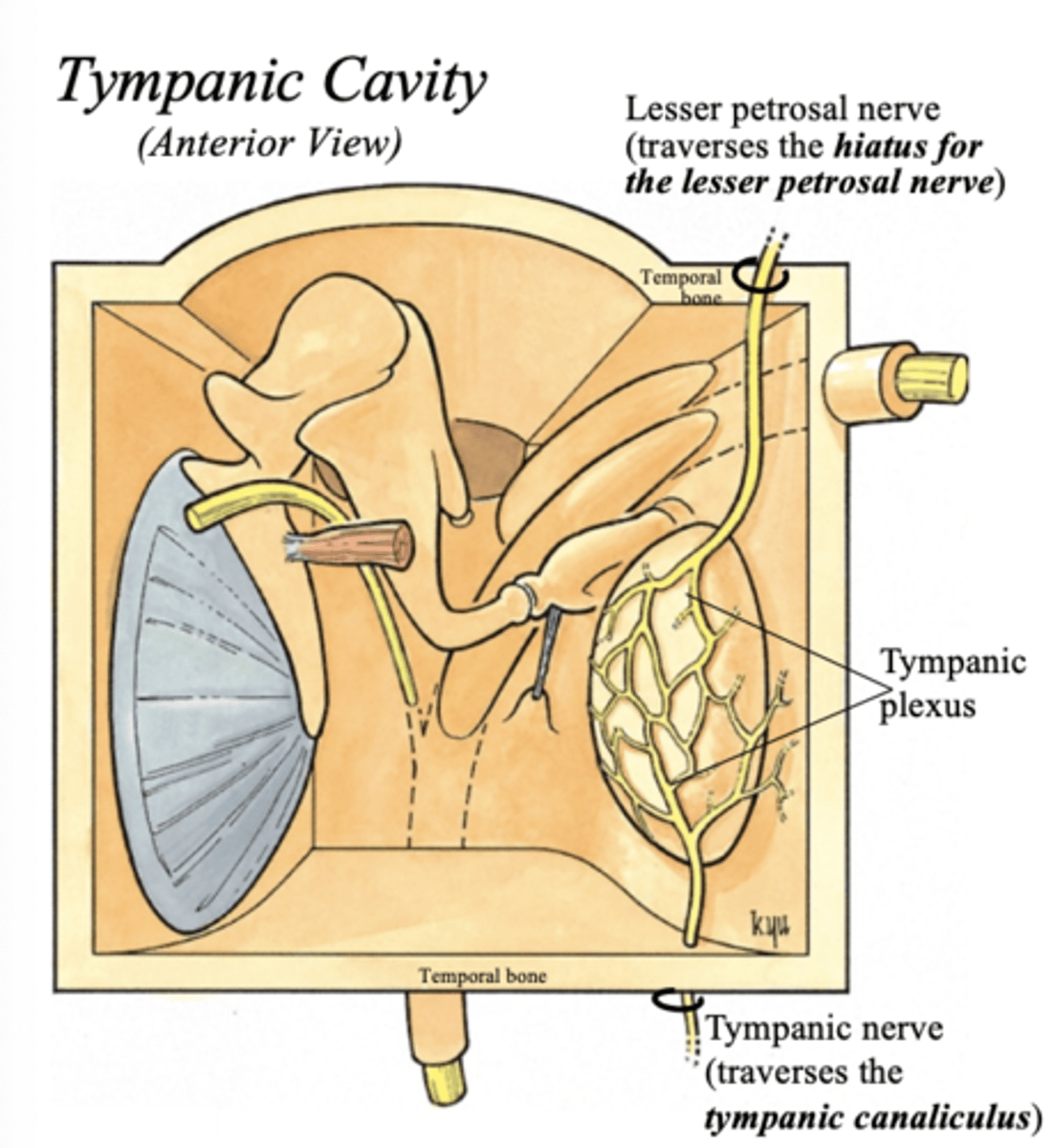
The lesser petrosal nerve courses in an anteromedial direction on the floor of the middle cranial fossa to reach what?
foramen ovale
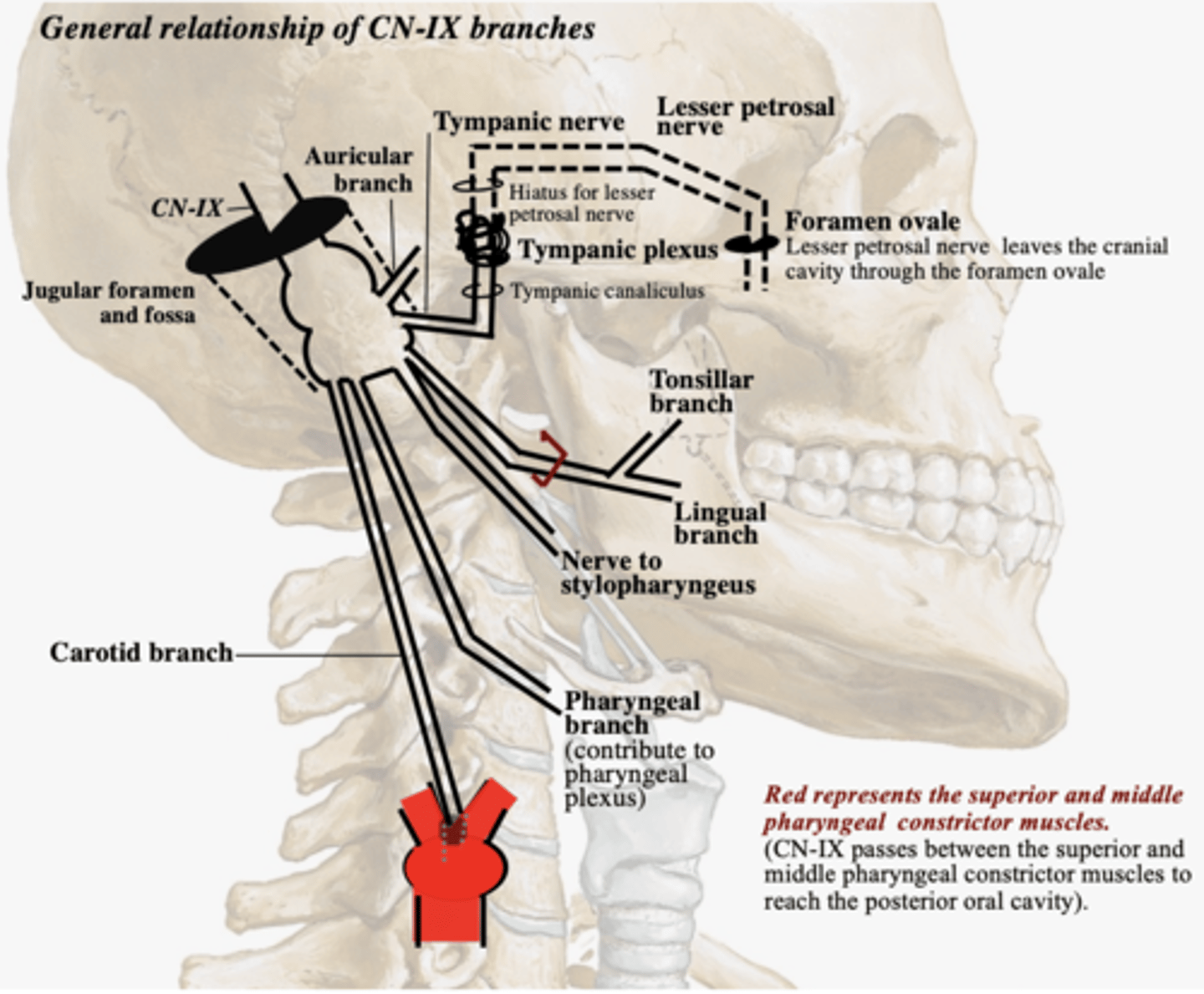
The lesser petrosal nerve exits the cranial cavity via the foramen ovale and enters what?
infratemporal fossa
The preganglionic parasympathetic fibers (GVE) that form the lesser petrosal nerve pass to the ___________ _______________ where they synapse with parasympathetic ganglion cells.
otic ganglion
Postganglionic parasympathetic fibers leave the otic ganglion and course along with the ___________________ nerve (V3) to reach the _______________ gland.
auriculotemporal, parotid
T/F CN-X carries general sensations from the external ear.
False: CN-IX carries general sensations from the external ear.
(BRANCHIOMOTOR)
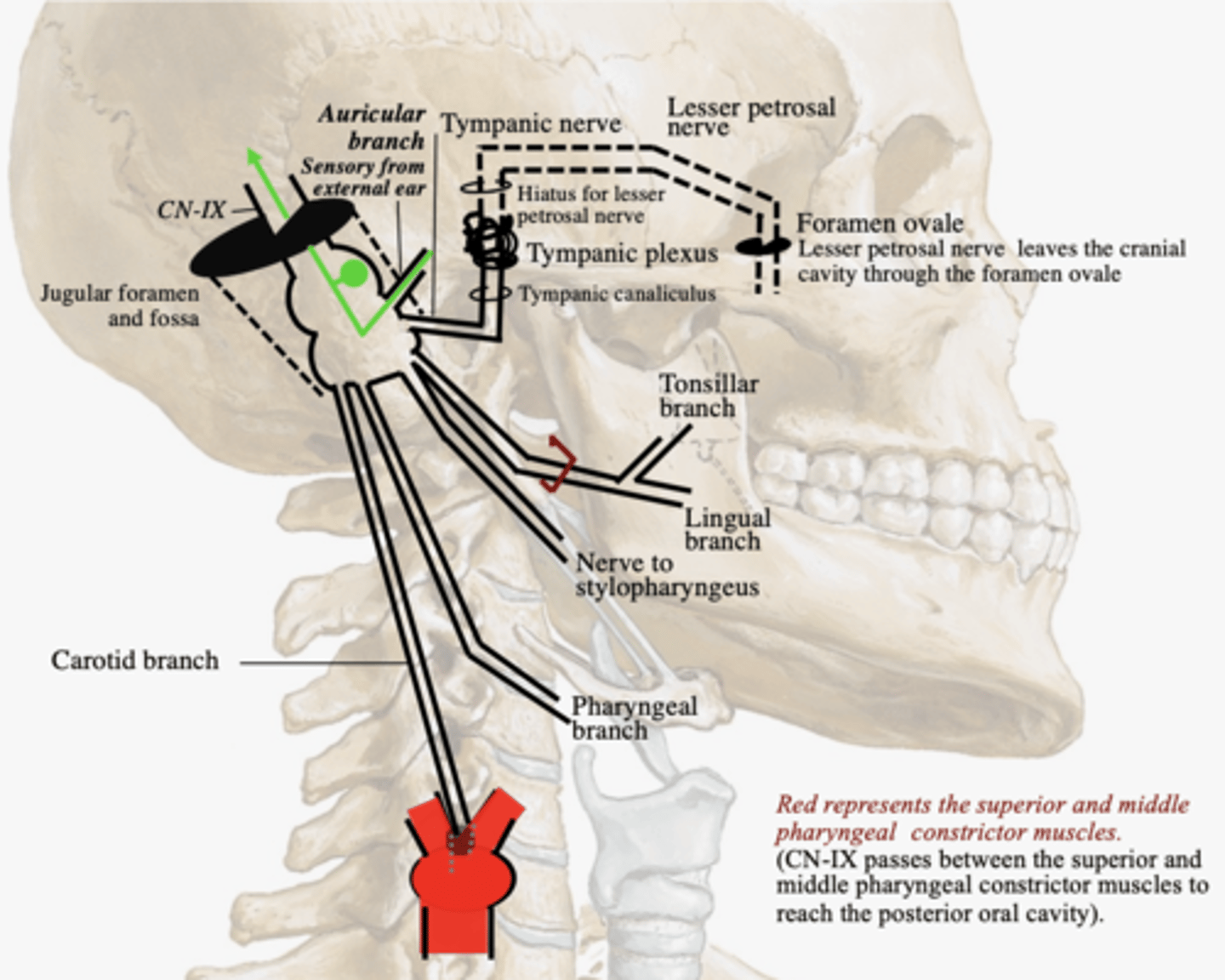
The lingual branch of CN-IX innervates what part of the tongue and what other structure to transmit taste? (SPECIAL SENSORY)
posterior 1/3 of the tongue and vallate papilla
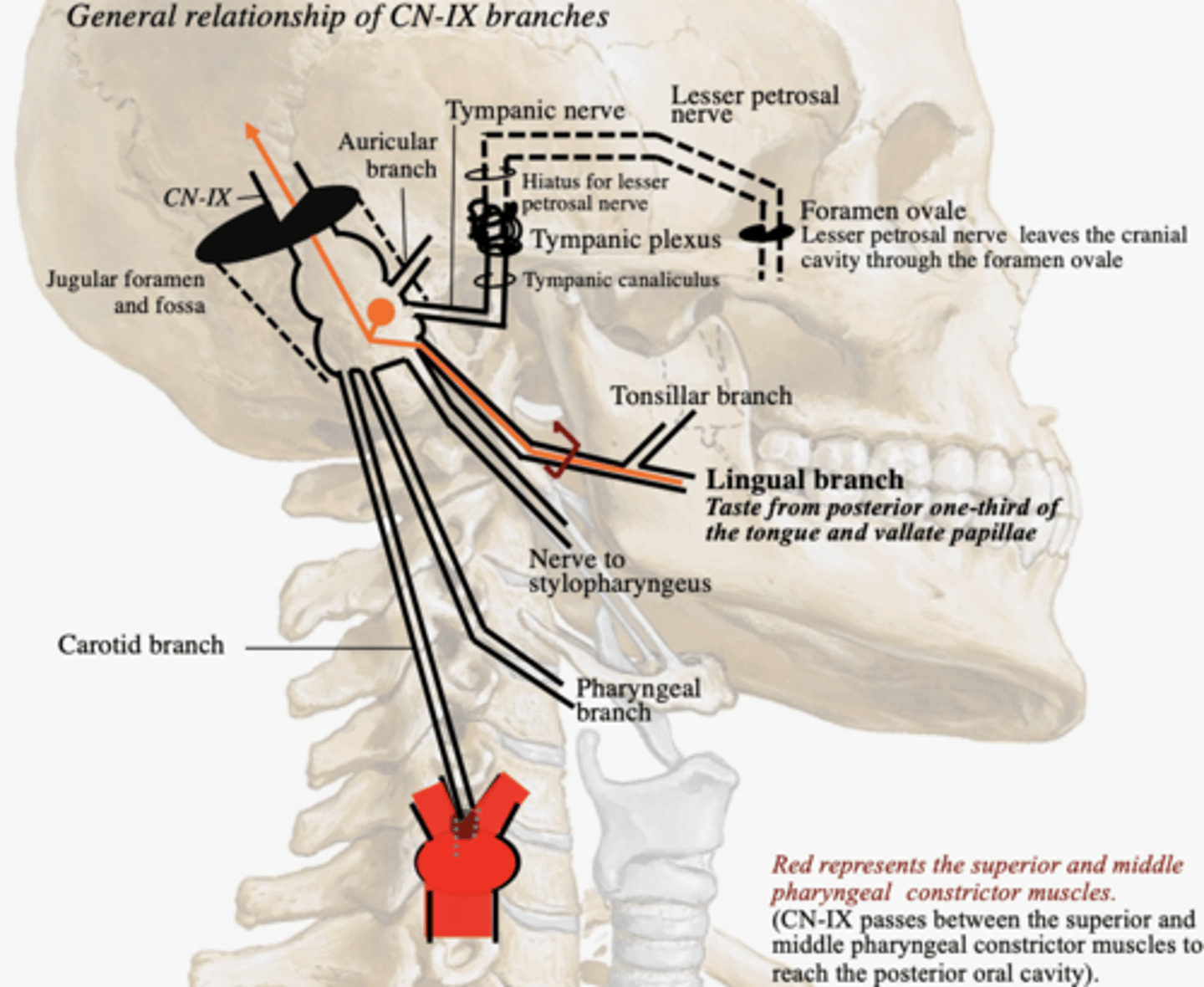
T/F GVA fibers contribute to the tympanic plexus and carry sensory info from the tympanic cavity and pharyngotympanic tube
True
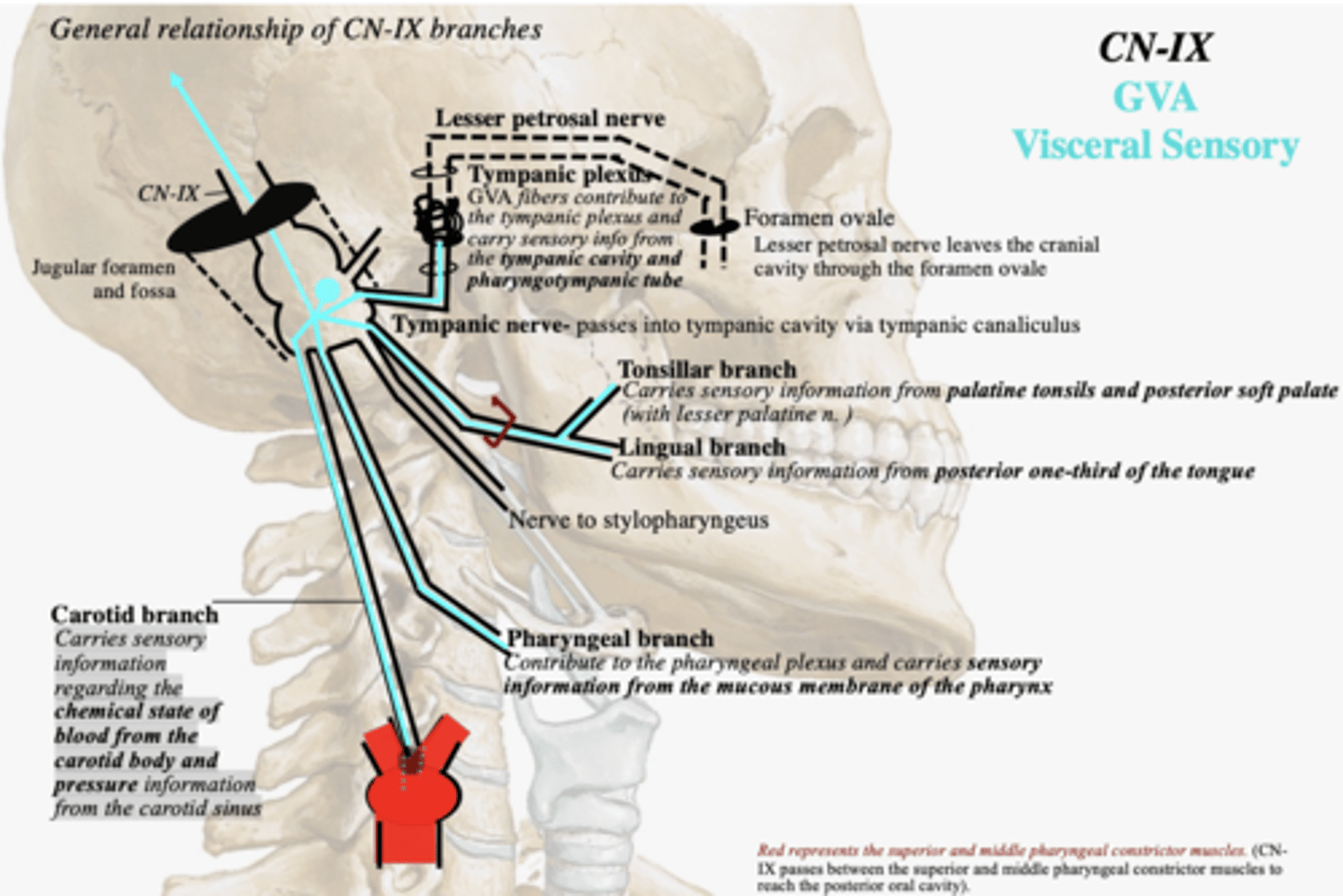
What branch of CN-IX carries VISCERAL SENSORY information from palatine tonsils and posterior soft palate?
Tonsillar branch
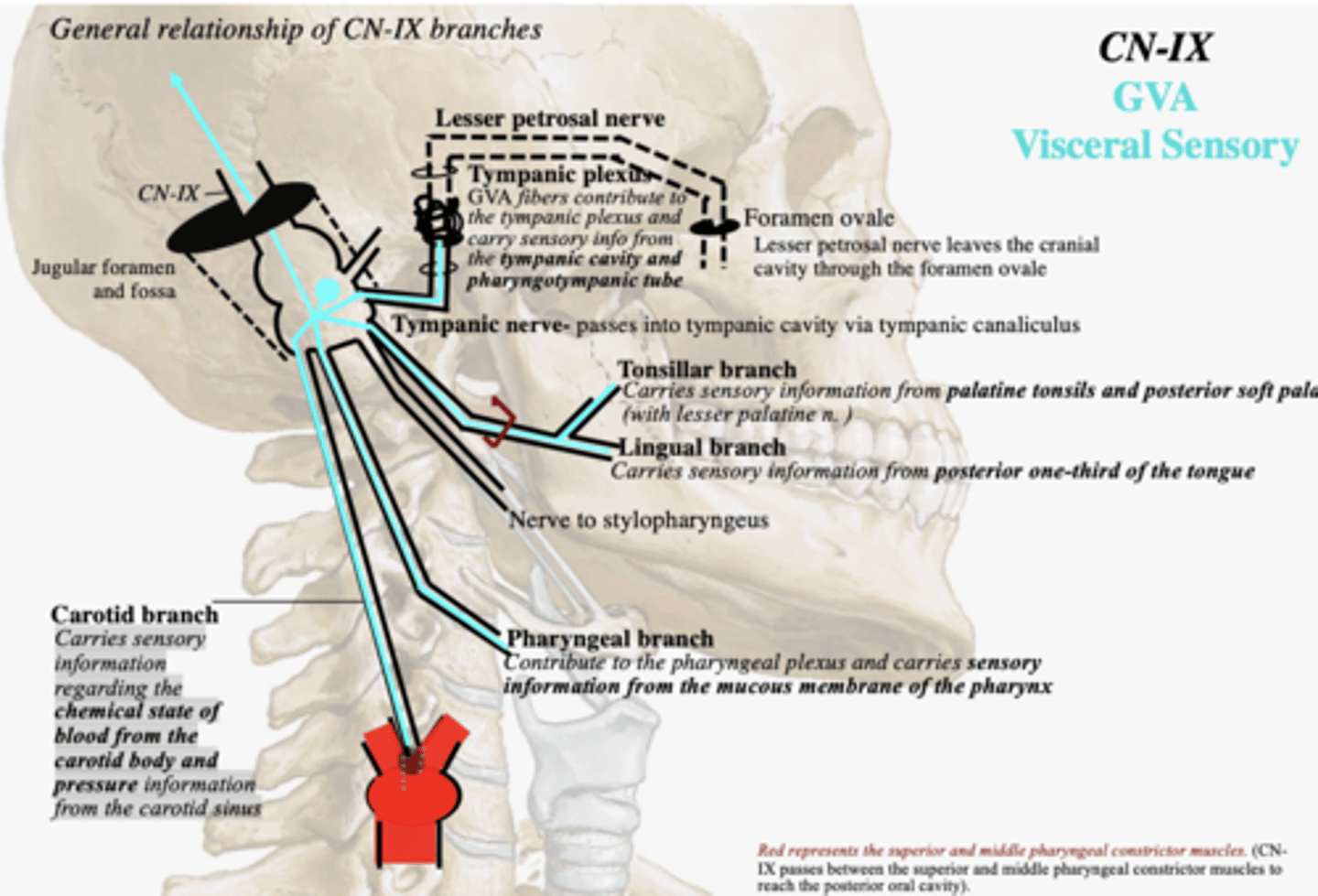
What branch of CN-IX carries VISCERAL SENSORY information from the mucous membrane of the pharynx?
pharyngeal branch
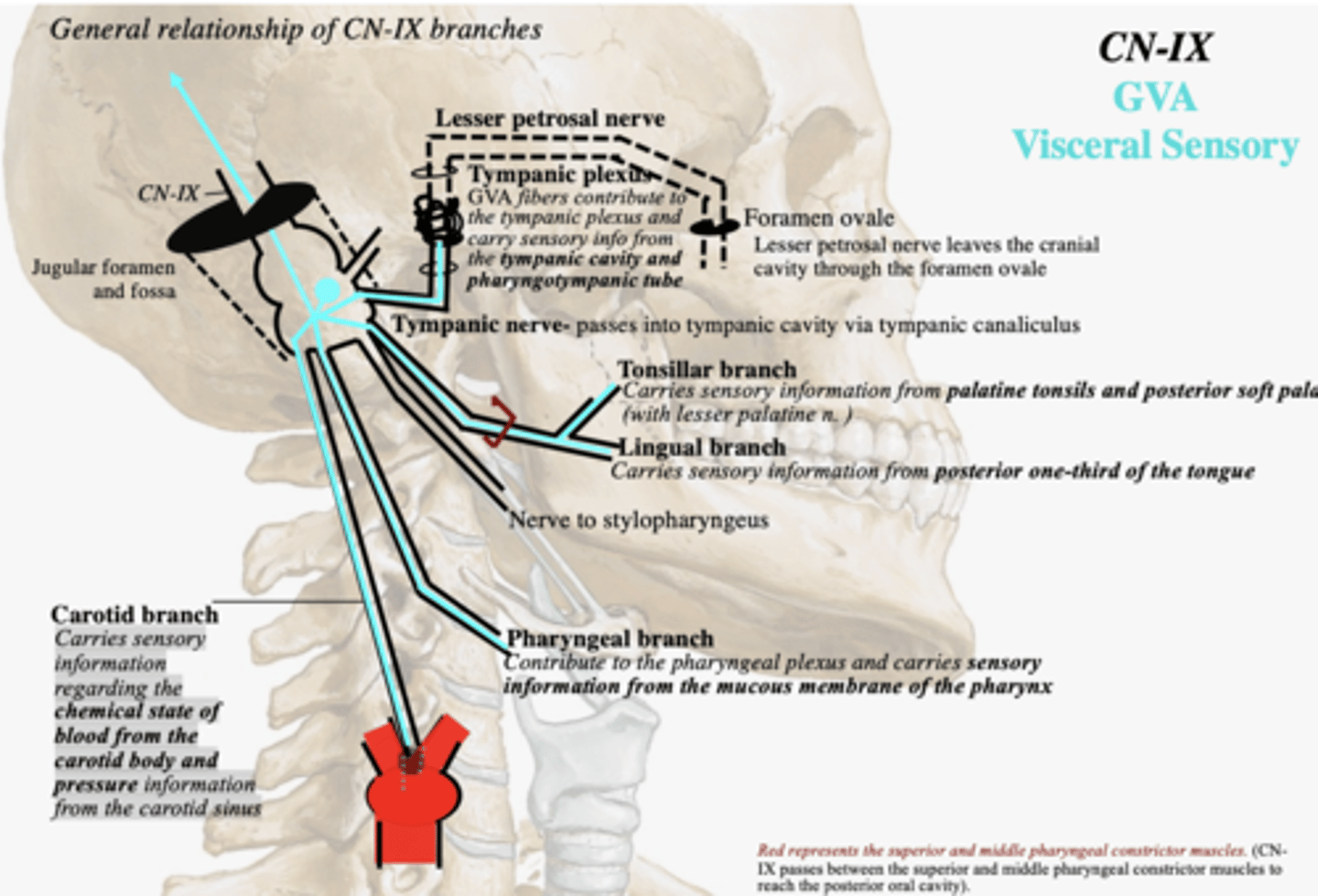
T/F The carotid branch carries sensory information regarding the chemical state of blood from the carotid body and pressure information from the carotid sinus
True
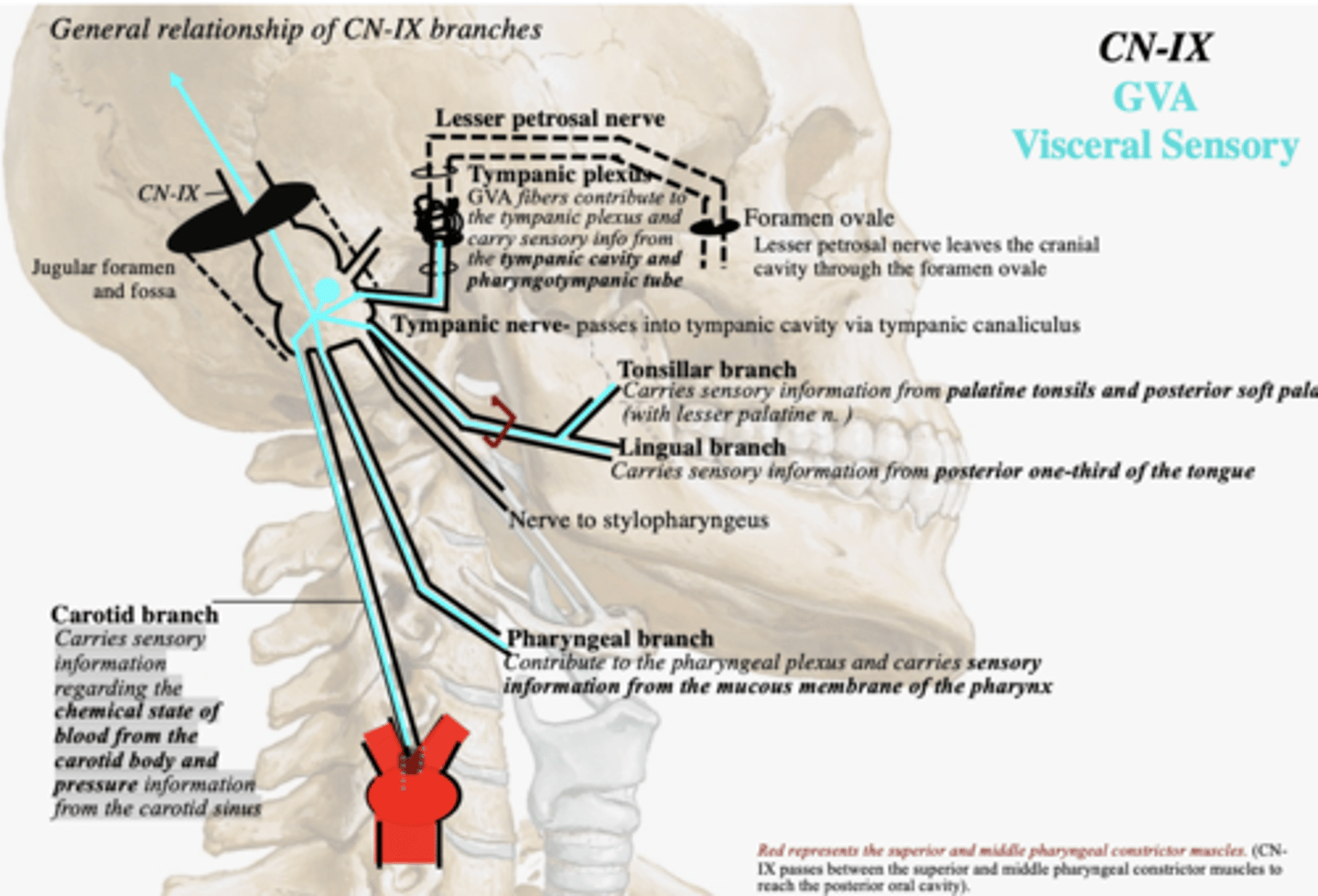
A homeowner was painting his home when he slipped from the ladder and fell 8 feet to the ground. He sustained a temporal bone fracture and injured the lesser petrosal nerve as it passed into the middle cranial fossa. As you review the course and function of the lesser petrosal nerve, you correctly recall that this nerve ______________.
A) traverses the foramen spinosum to enter the infratemporal fossa.
B) traverses the foramen ovale to enter the pterygopalatine fossa
C) is comprised of preganglionic parasympathetic fibers that synapse in the otic ganglion.
D) is comprised of postganglionic sympathetic fibers that synapse in the pterygopalatine ganglion.
E) is comprised of postganglionic sympathetic fibers that synapse in the superior cervical ganglion.
A) traverses the foramen spinosum to enter the infratemporal fossa.
B) traverses the foramen ovale to enter the pterygopalatine fossa
C) is comprised of preganglionic parasympathetic fibers that synapse in the otic ganglion.
D) is comprised of postganglionic sympathetic fibers that synapse in the pterygopalatine ganglion.
E) is comprised of postganglionic sympathetic fibers that synapse in the superior cervical ganglion.
A 19-year-old woman sustained injury to the lingual and palatine branches of the glossopharyngeal nerve during an emergency intubation following an MVA (motor vehicle accident). She is now doing well, but you decide to examine the function of these two branches, and correctly recall that the _____________.
A) Lingual branch of CN-IX carries taste from the anterior 2/3 of the tongue
B) Lingual branch of CN-IX carries taste from the posterior 1/3 of the tongue
C) Tonsillar branch of CN-IX carries motor to the soft palate
D) Tonsillar branch of CN-IX carries motor to the muscles of the tongue
E) Both B and D are correct
A) Lingual branch of CN-IX carries taste from the anterior 2/3 of the tongue
B) Lingual branch of CN-IX carries taste from the posterior 1/3 of the tongue
C) Tonsillar branch of CN-IX carries motor to the soft palate
D) Tonsillar branch of CN-IX carries motor to the muscles of the tongue
E) Both B and D are correct
What are the 6 branches of the vagus nerve we are required to know?
1) Meningeal branch
2) Auricular branch
3) Pharyngeal branch
4) Superior laryngeal branch
5) RIGHT recurrent laryngeal nerve
6) LEFT recurrent laryngeal nerve
What are the two branches of the vagus nerve in the jugular fossa?
1) Meningeal branch
2) Auricular branch
What are the 3 branches of the vagus nerve we are required to know in the neck?
1) Pharyngeal branch
2) Superior laryngeal branch
3) RIGHT recurrent laryngeal nerve
What is the branch of the vagus nerve we are required to know in the thorax?
LEFT recurrent laryngeal nerve
T/F There are many branches of the vagus nerve in the abdomen.
True
What branch of CN-X carries general sensations from the external ear?
Auricular branch
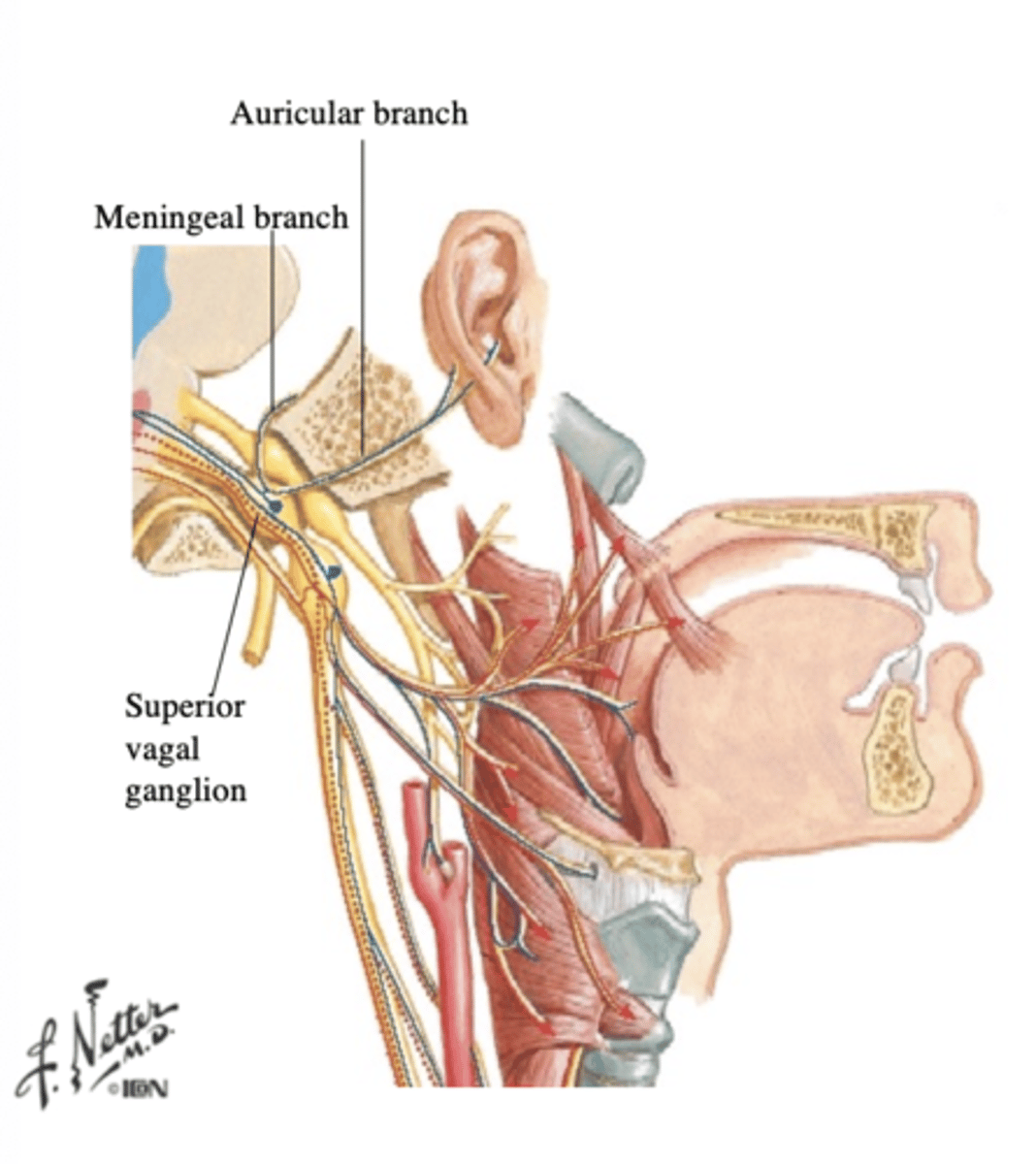
What branch of CN-X contributes to the pharyngeal plexus along with a CN-IX branch?
pharyngeal branch
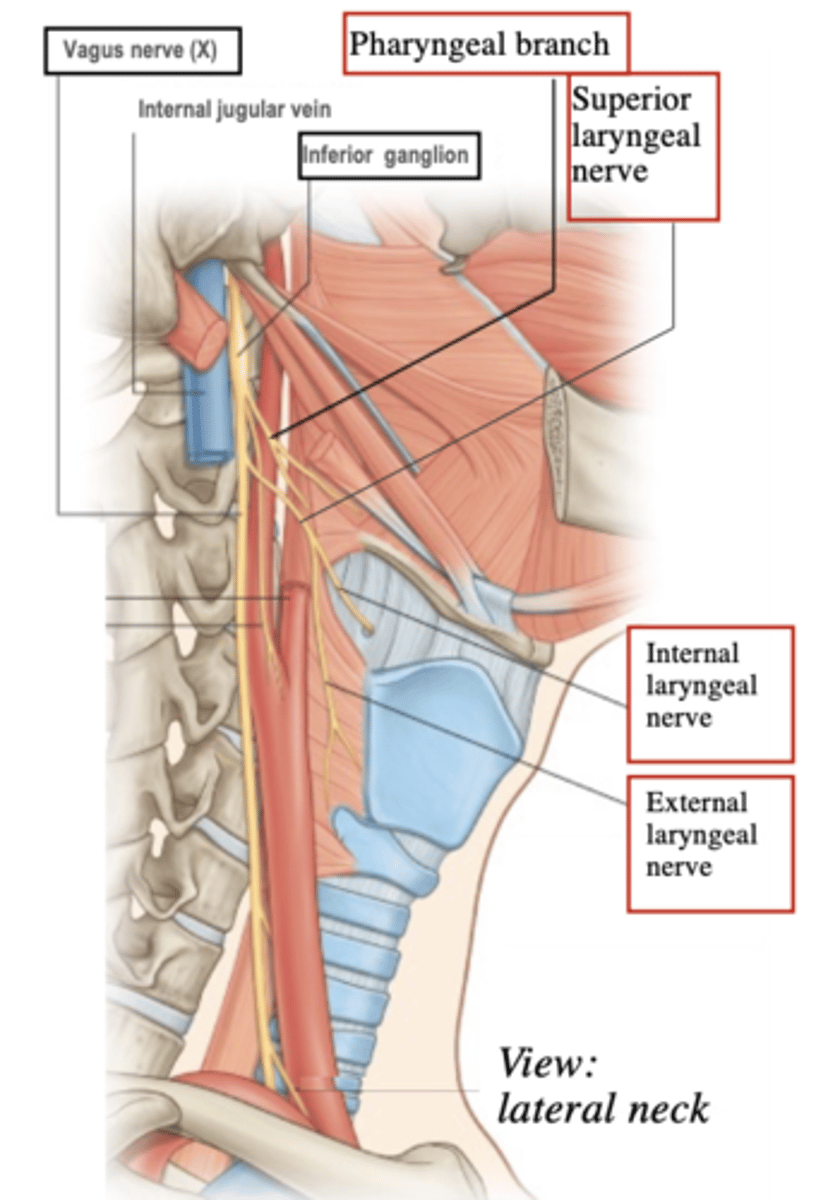
The superior laryngeal nerve of the vagus nerve gives rise to what two structures?
1) Internal laryngeal nerve
2) External laryngeal nerve
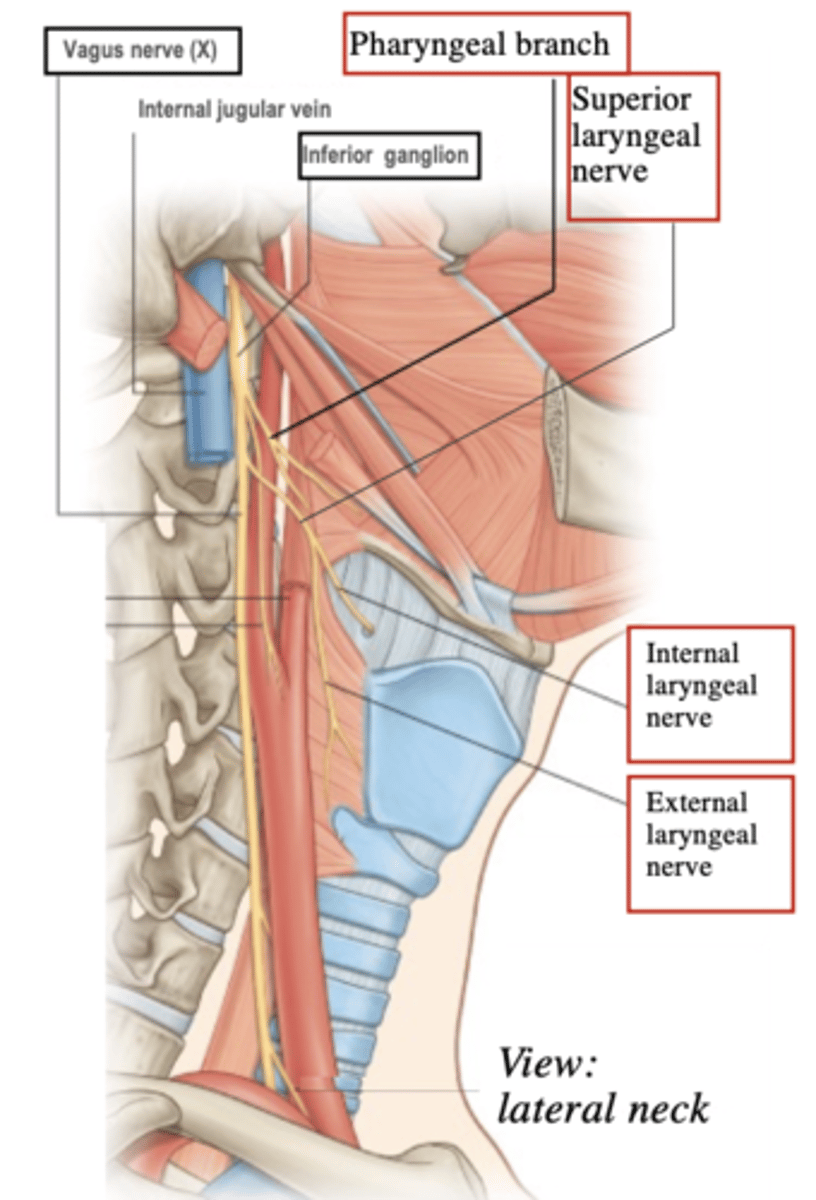
What nerve pierces thyrohyoid membrane to gain access to the larynx?
Internal laryngeal nerve (aka: internal branch of superior laryngeal nerve)
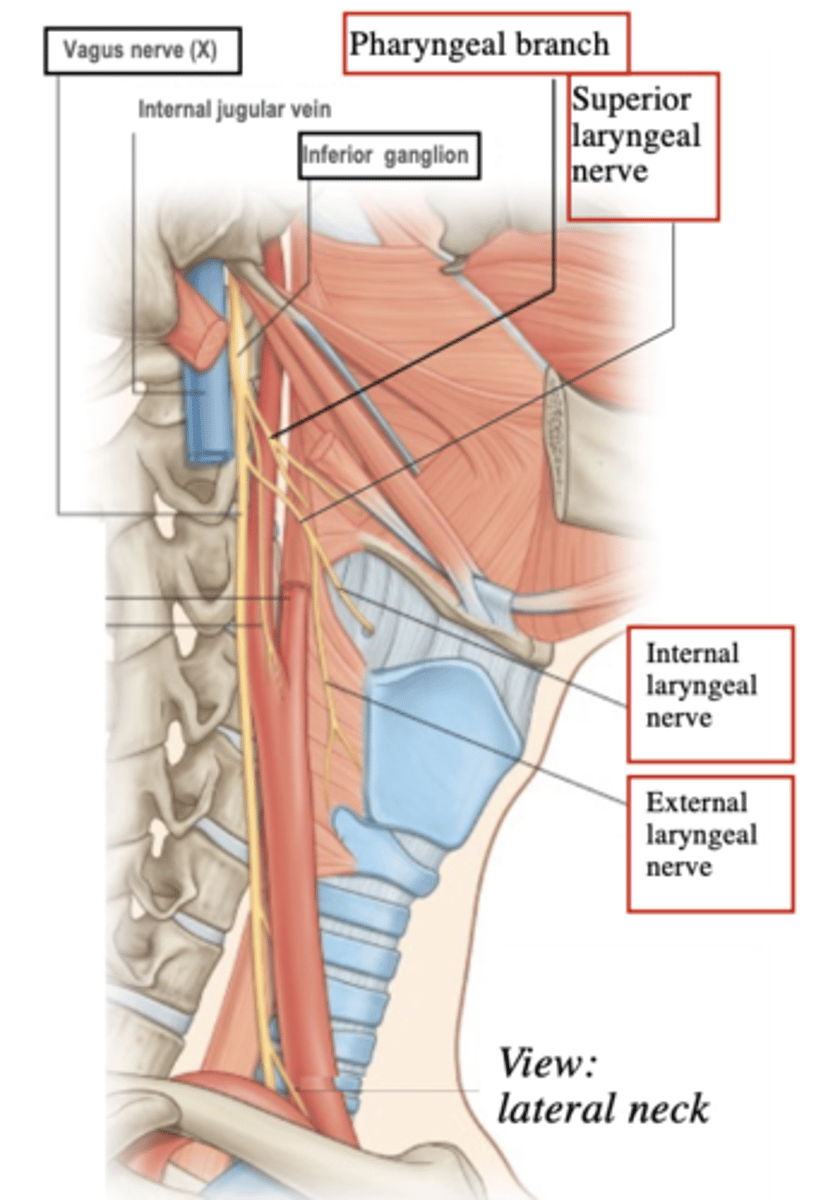
What nerve innervates the cricothyroid muscle?
External laryngeal nerve (aka: external branch of superior laryngeal nerve)
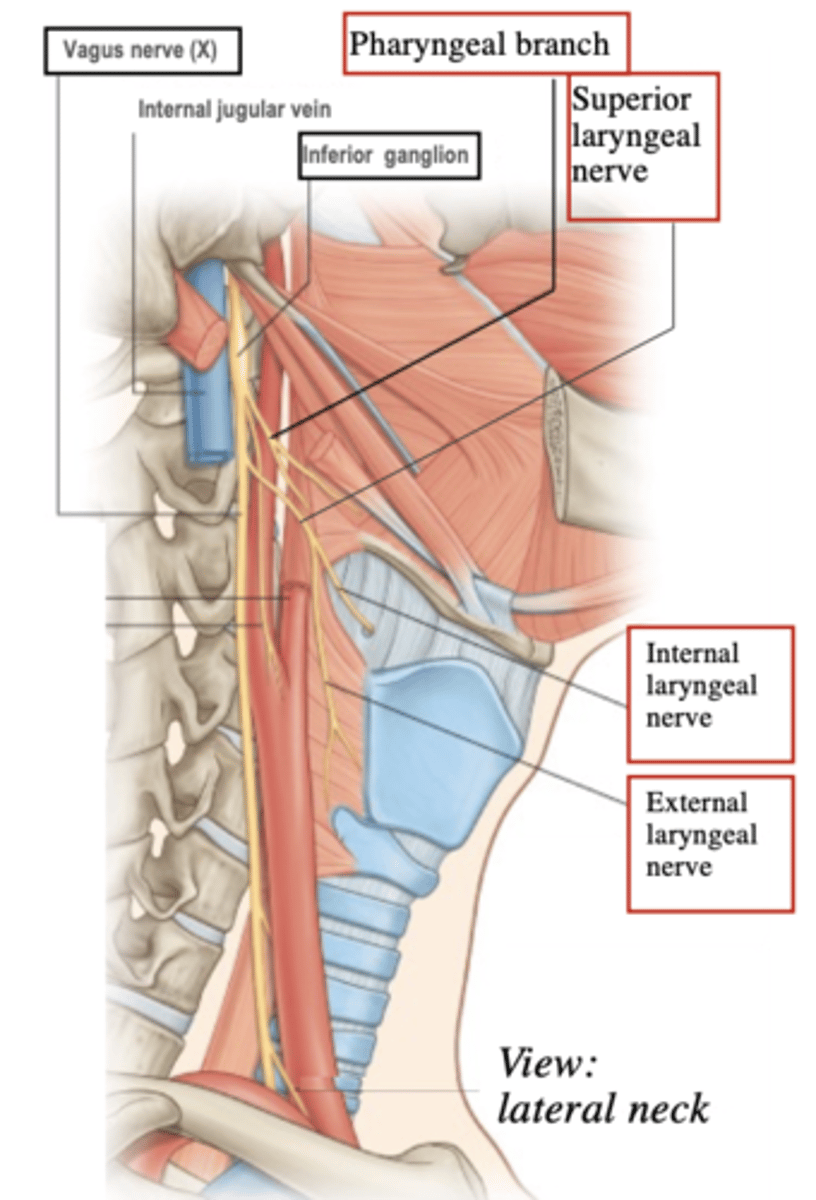
What nerve arises from CN-X in the thorax and courses around the aortic arch?
LEFT recurrent laryngeal nerve
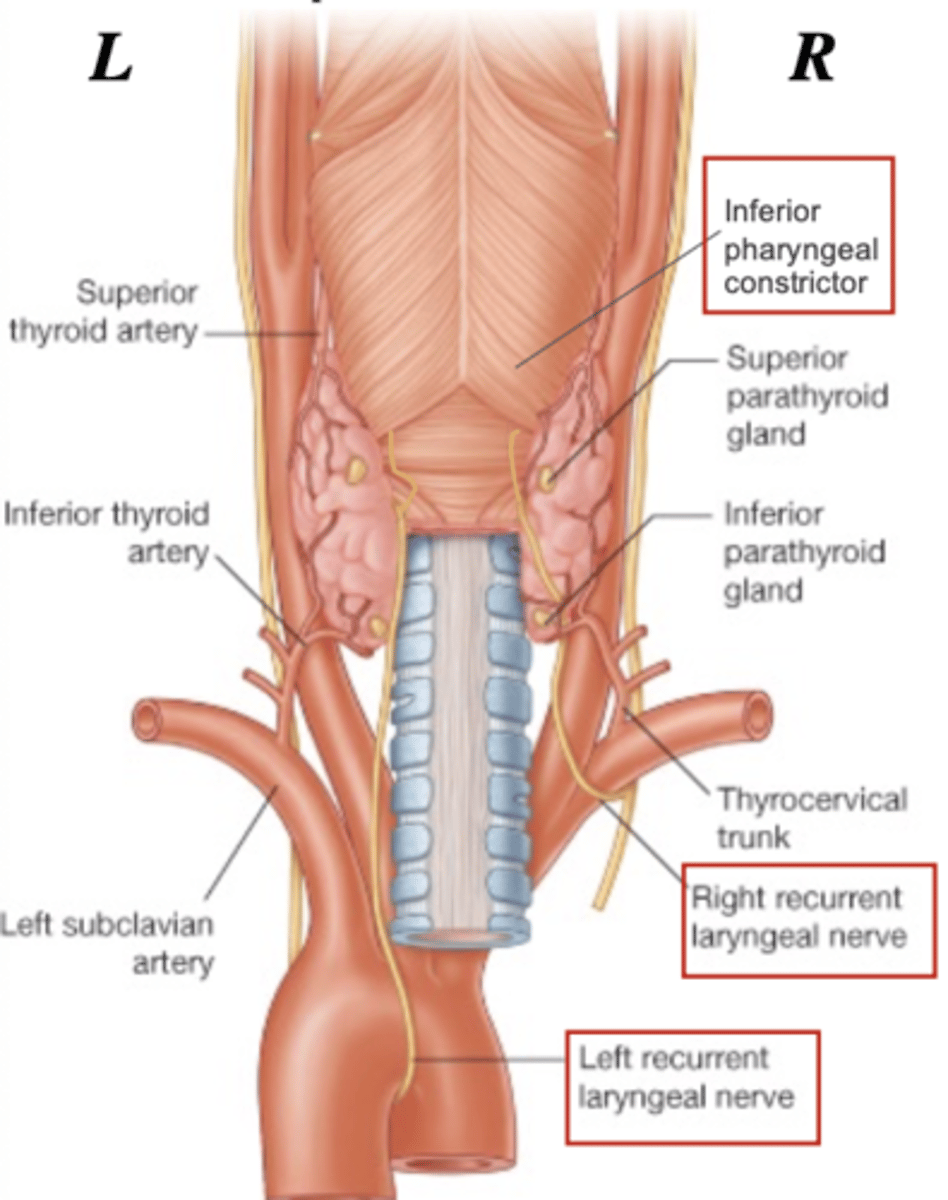
What nerve arises from CN-X in the neck and courses around the subclavian artery?
RIGHT recurrent laryngeal nerve
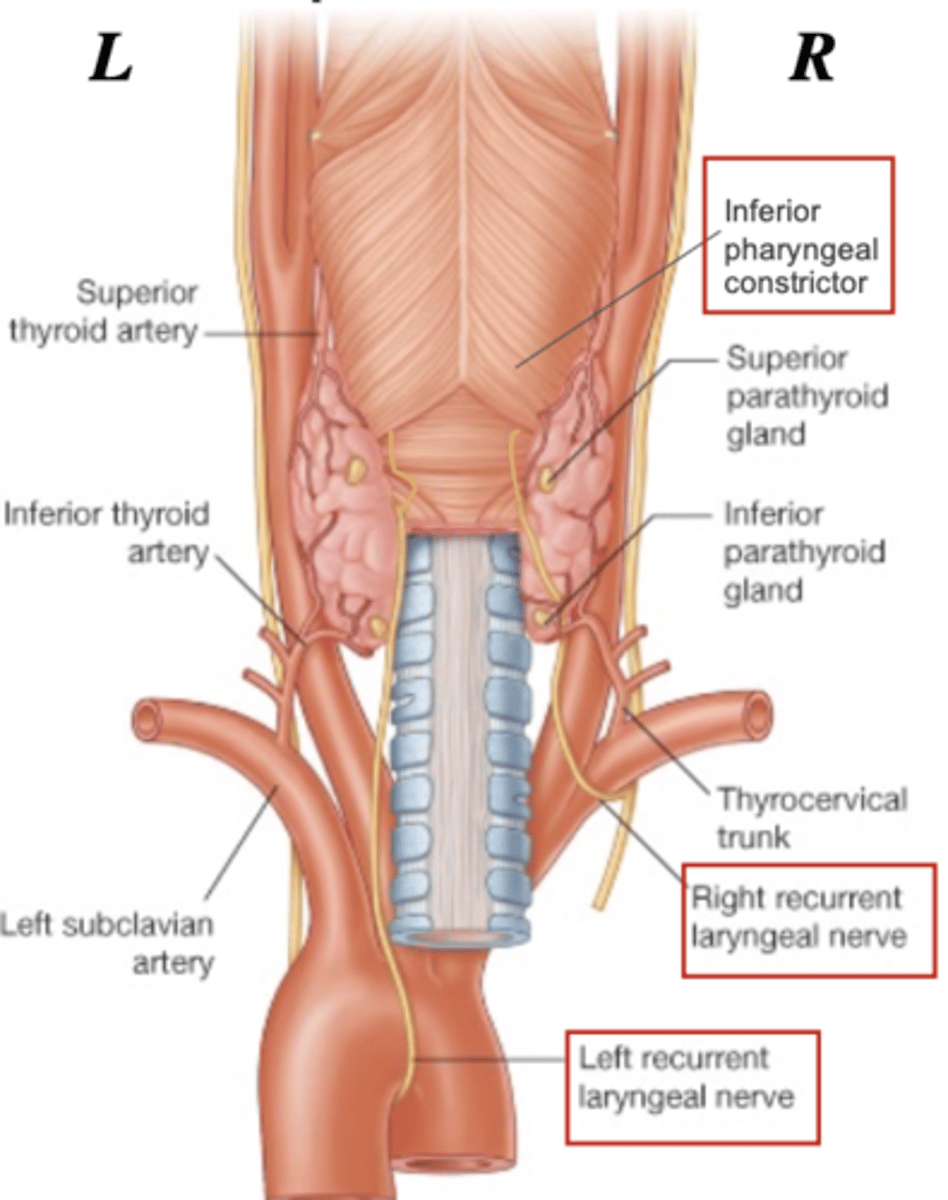
The right and left recurrent laryngeal nerves ascend in a groove between the ___________ and _______________, before reaching what?
trachea and esophagus, inferior pharyngeal constrictor
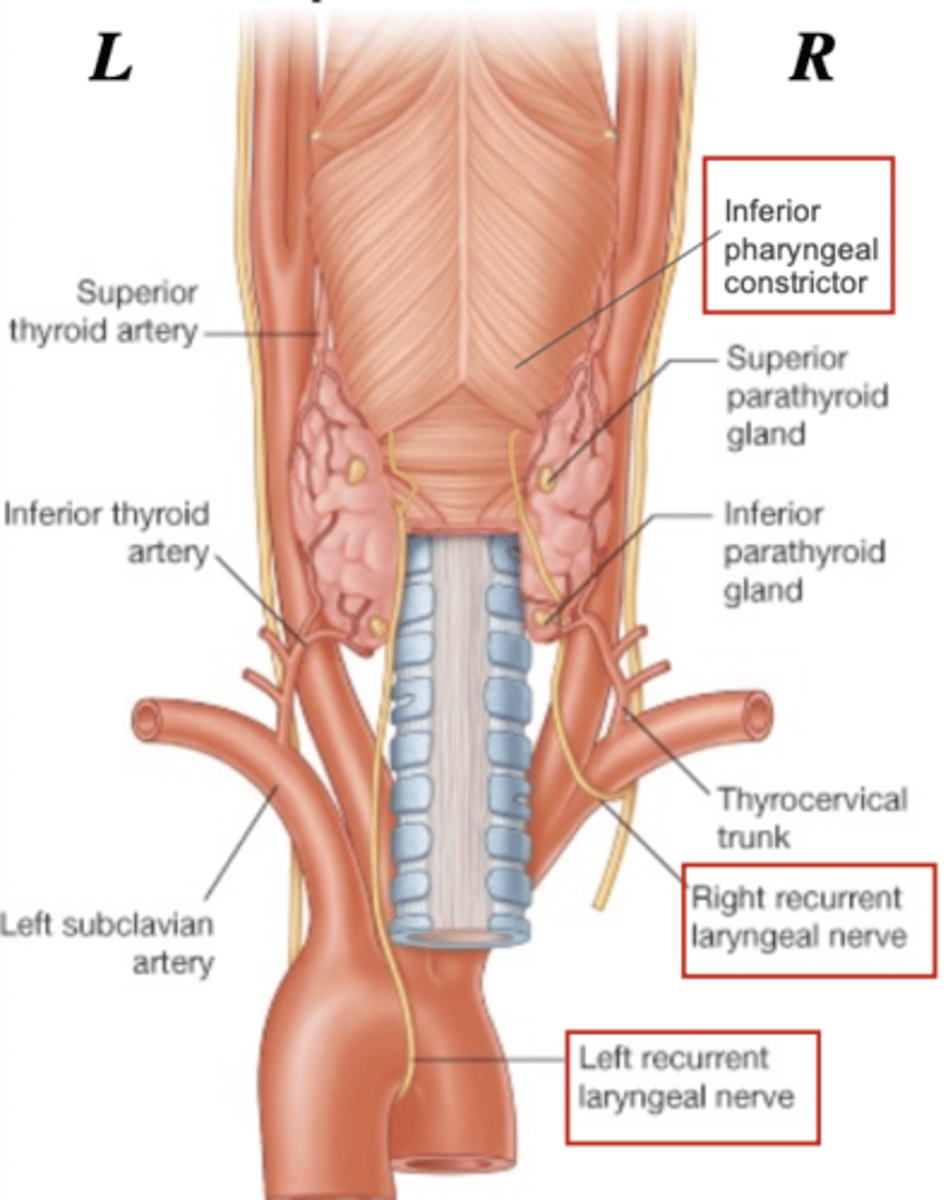
The right and left recurrent laryngeal nerves pass deep to the inferior pharyngeal constrictor to gain access to the ______________, where it may be referred to as what?
larynx, inferior laryngeal nerve
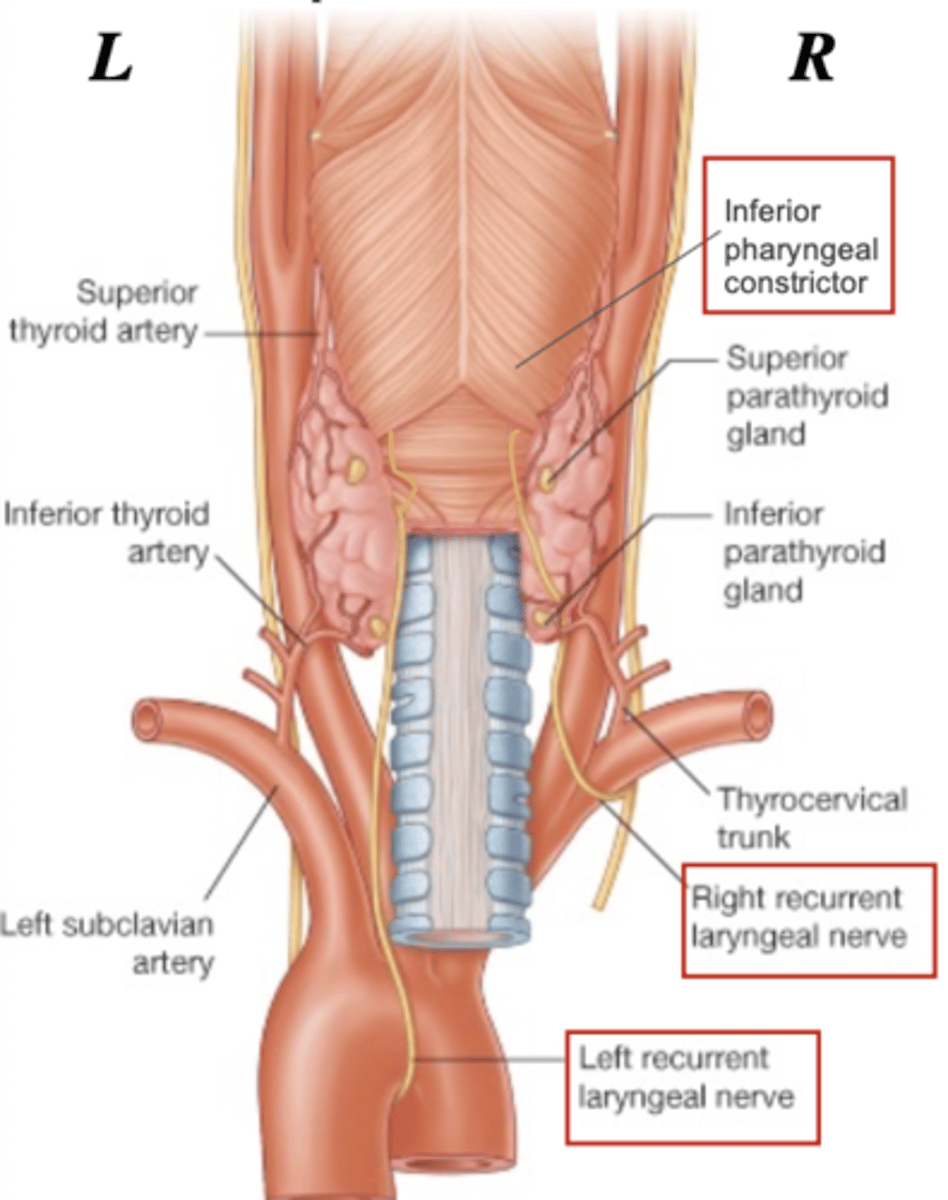
What two nerves through the inferior laryngeal nerve contribute sensory and motor innervation to the larynx?
right and left recurrent laryngeal nerves
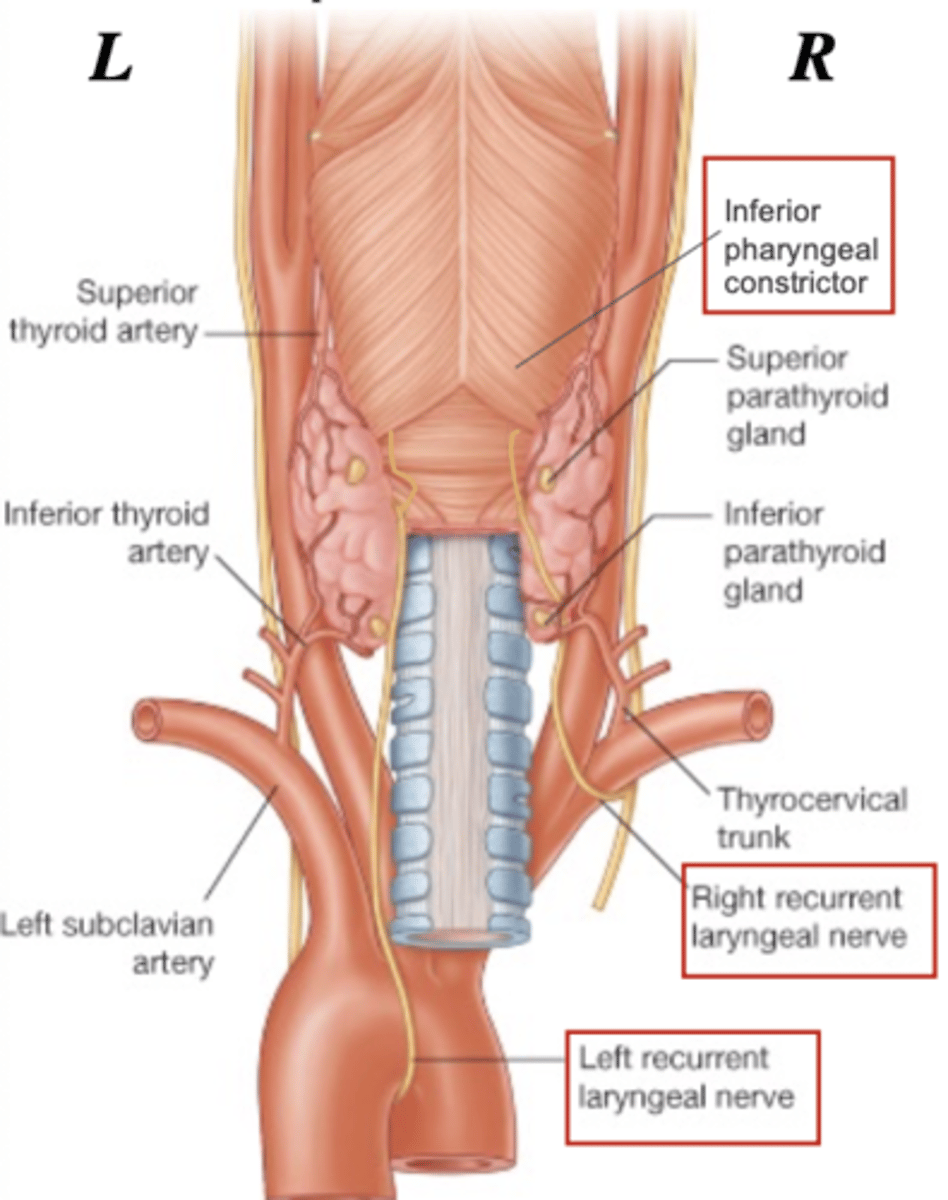
What nerve passes through the thyrohyoid membrane?
Internal laryngeal nerve
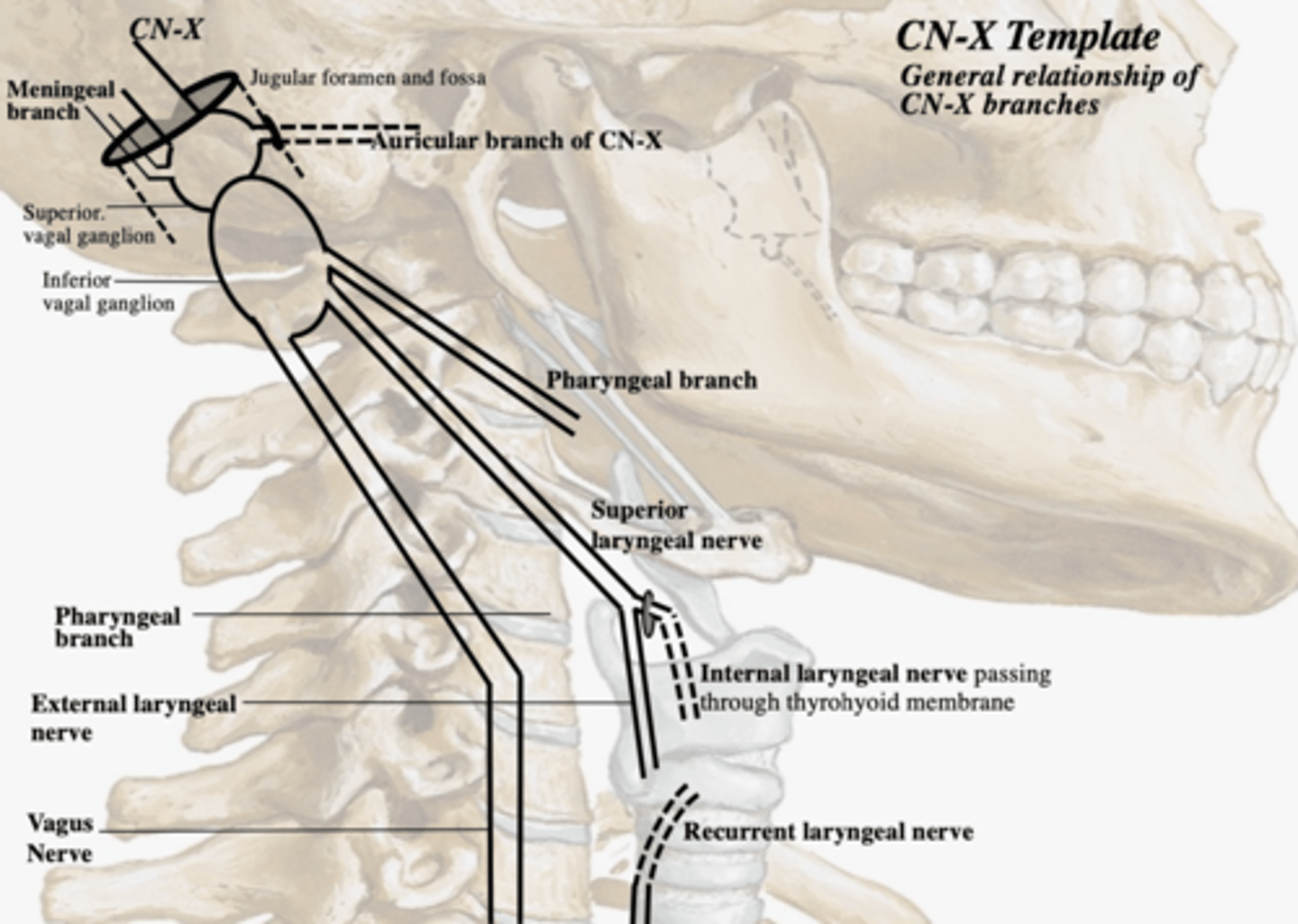
T/F CN-X carries general sensations from the external ear.
True
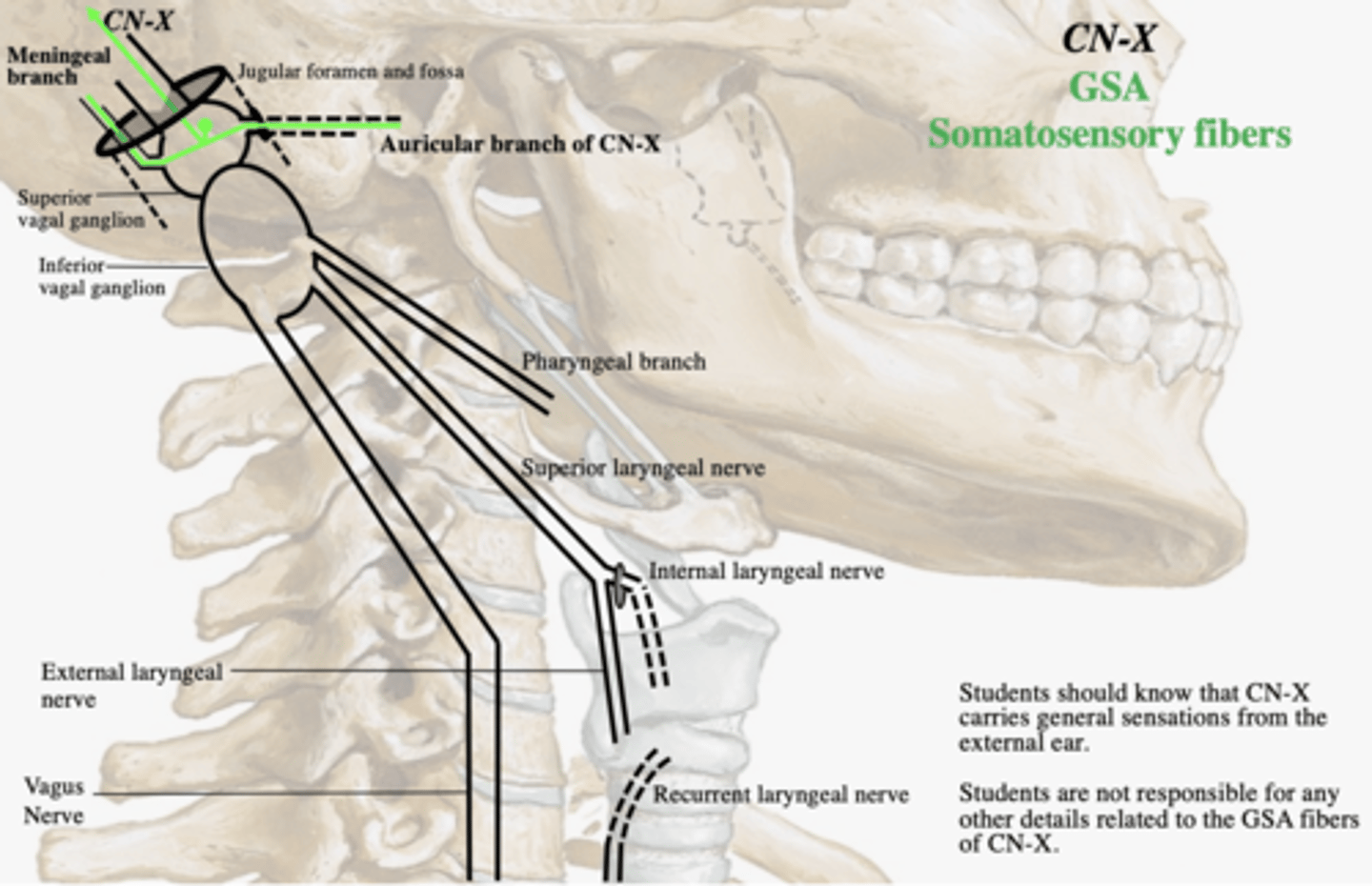
The pharyngeal branch of CN-X gives BRANCHIMOTOR innervation to the muscles of soft palate except _________________ and muscles of the pharynx except the _______________.
tenor veli palatini, stylopharyngeus
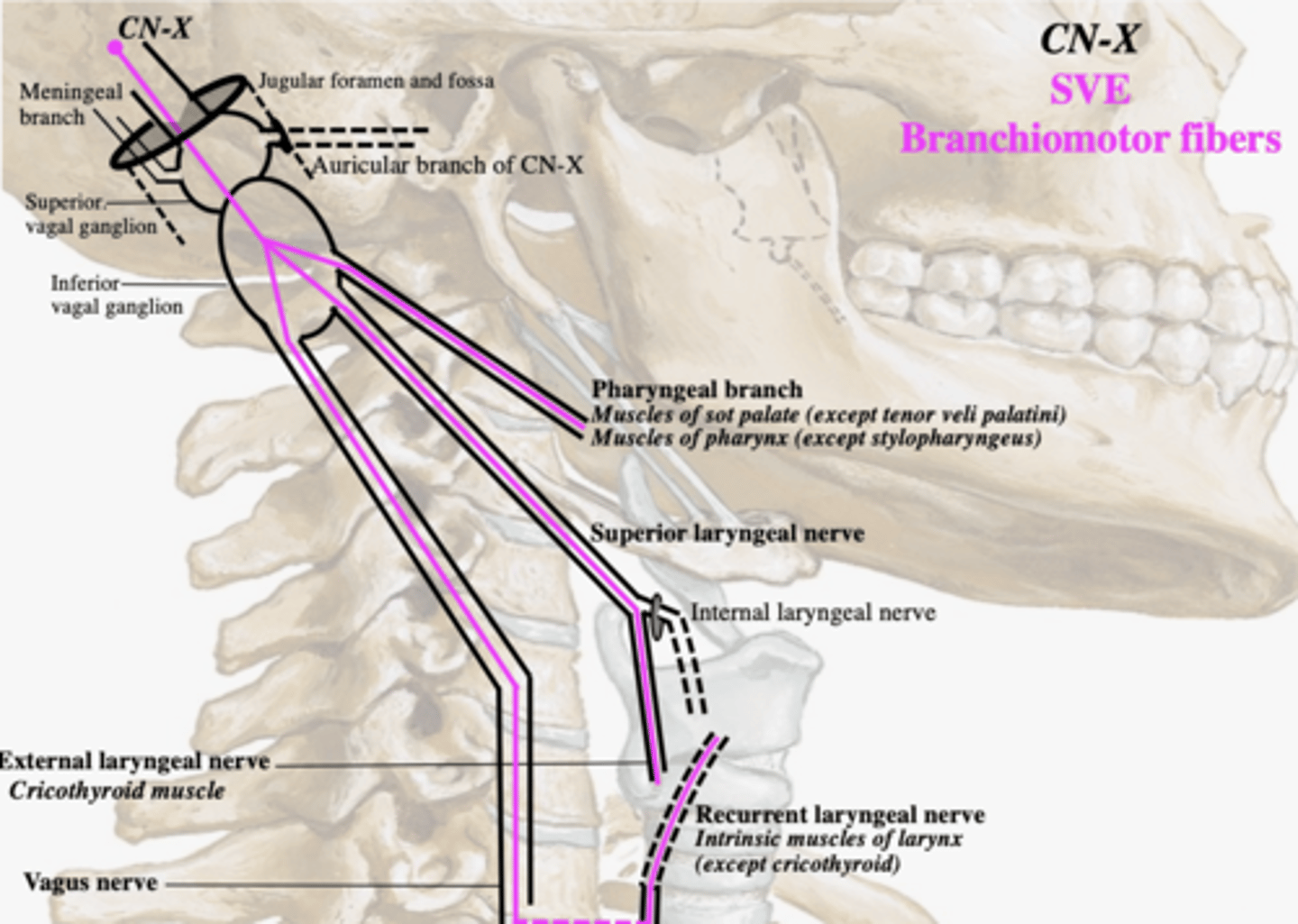
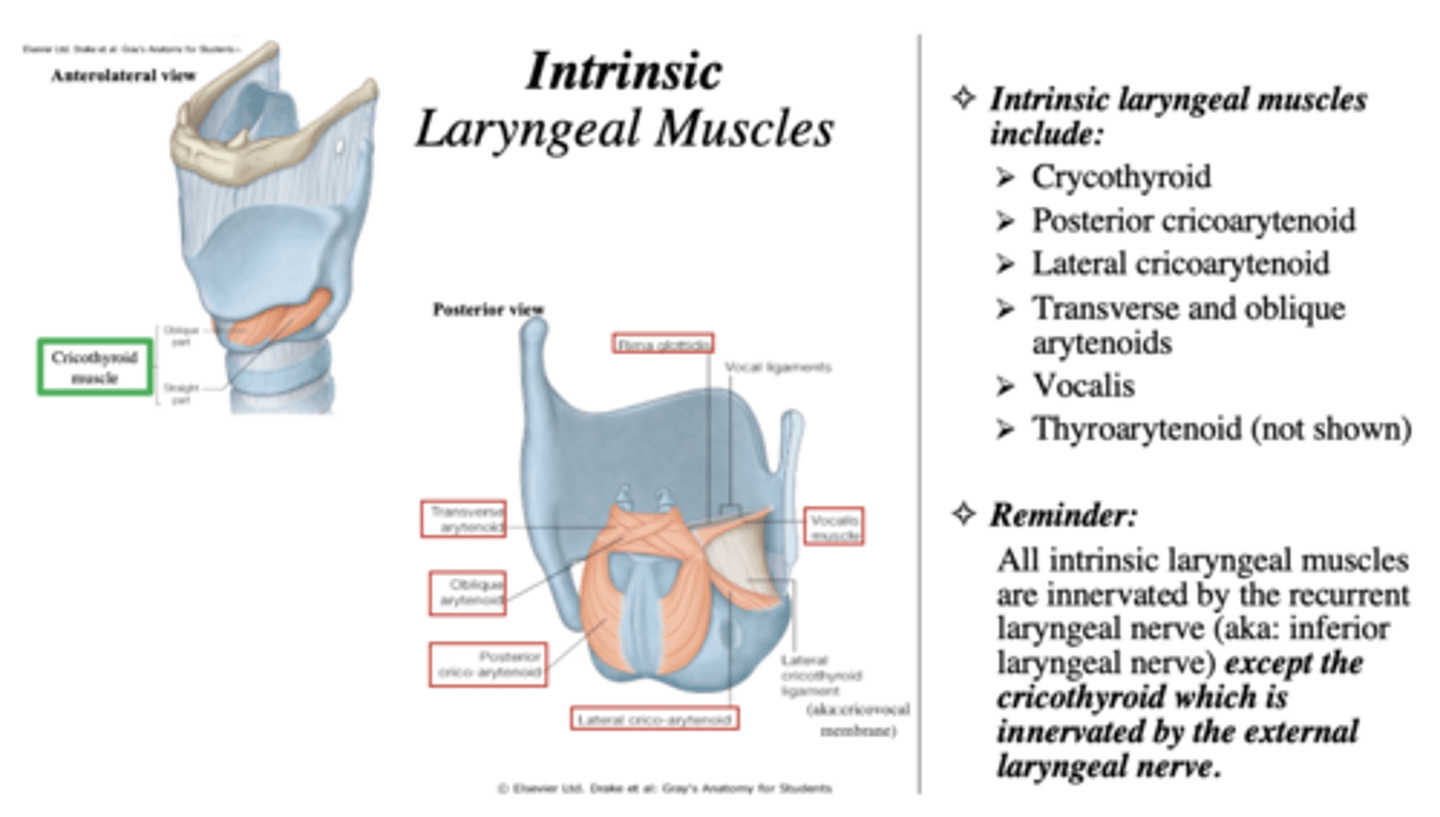
The recurrent laryngeal nerve gives BRANCHIOMOTOR innervation to the intrinsic muscles of larynx except the ________________.
cricothyroid
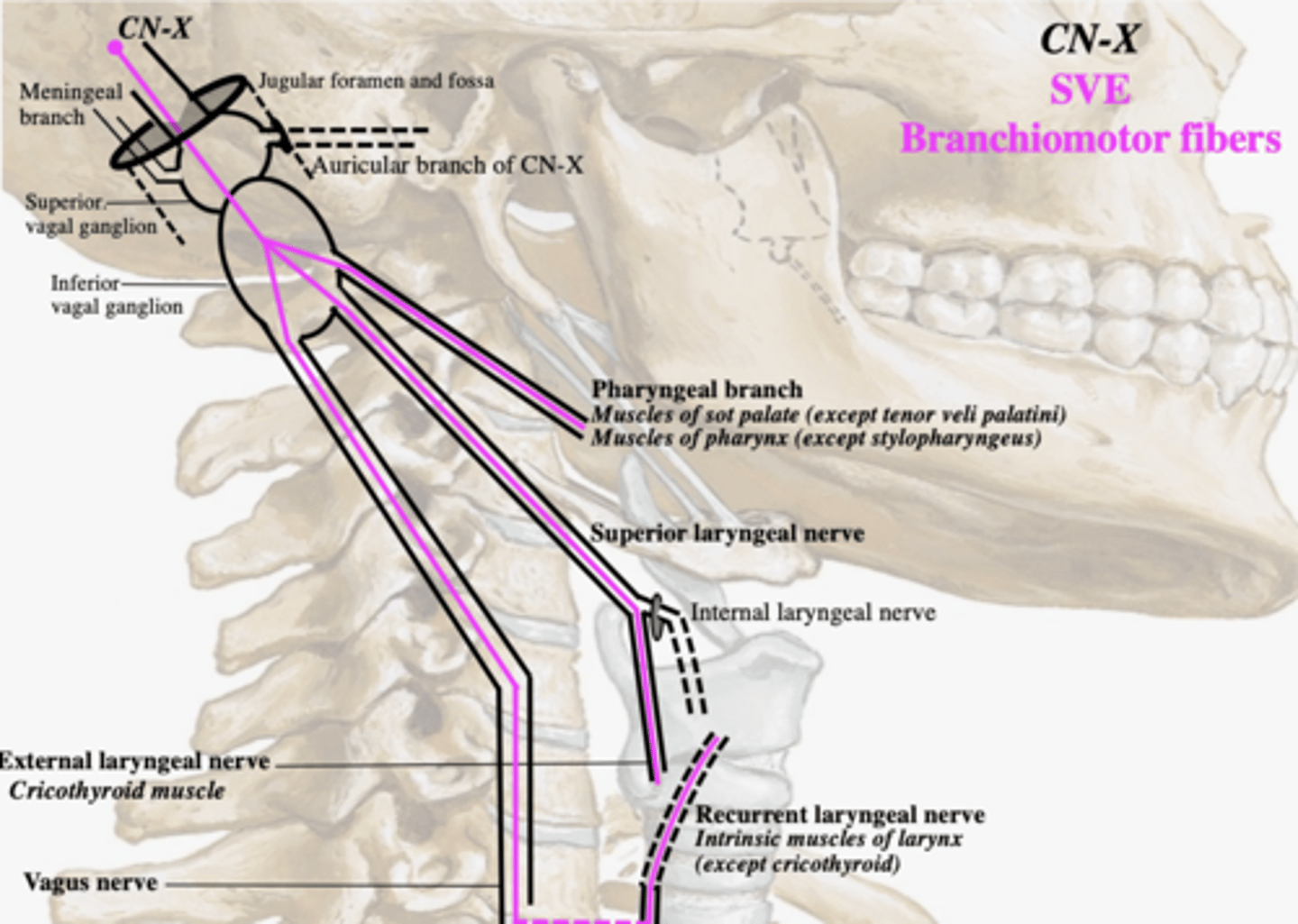
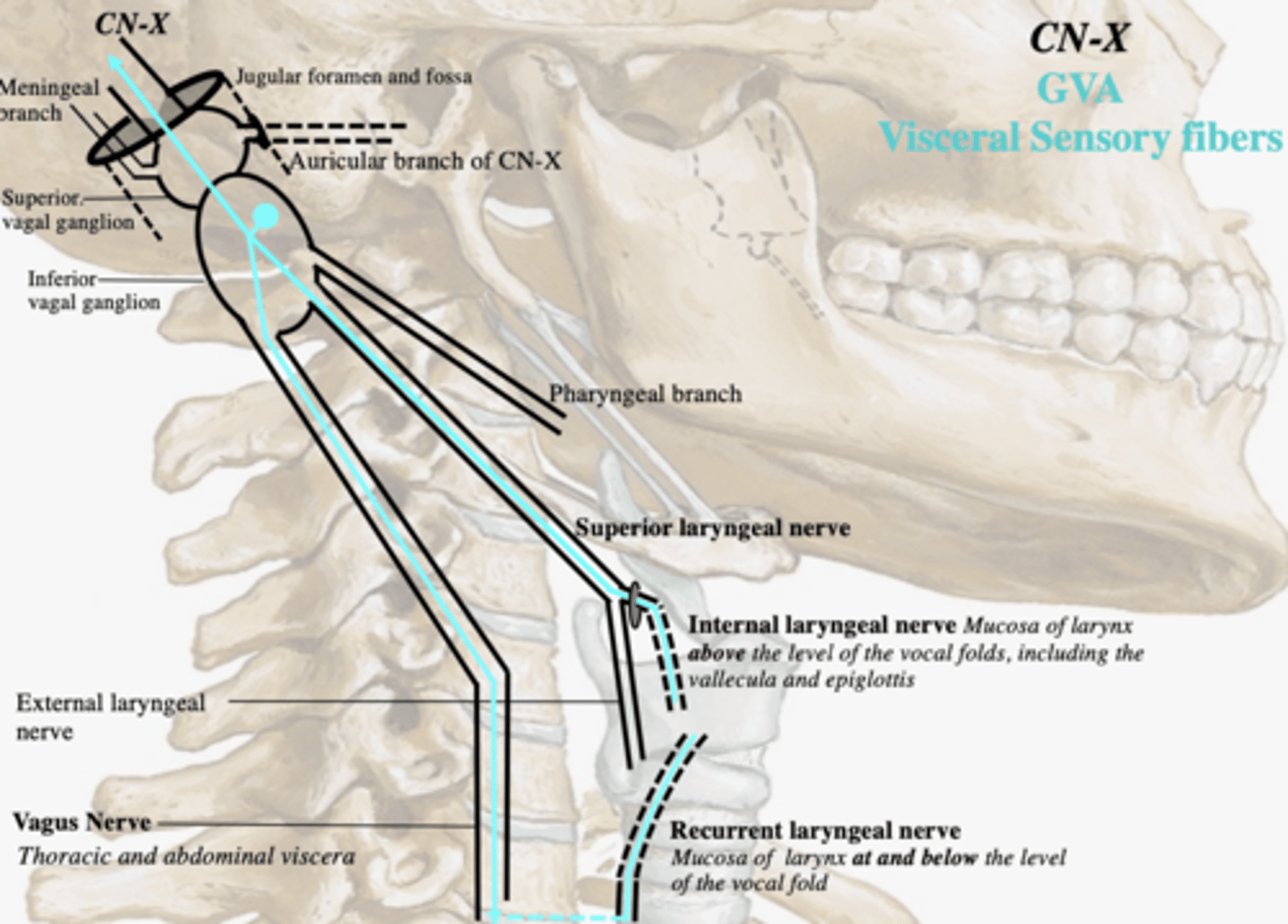
The internal laryngeal nerve gives VISCERAL SENSORY INERVATION to the mucosa of the larynx ____________ the level of the vocal folds, including the _______________ and ___________________.
above, vallecula and epiglottis
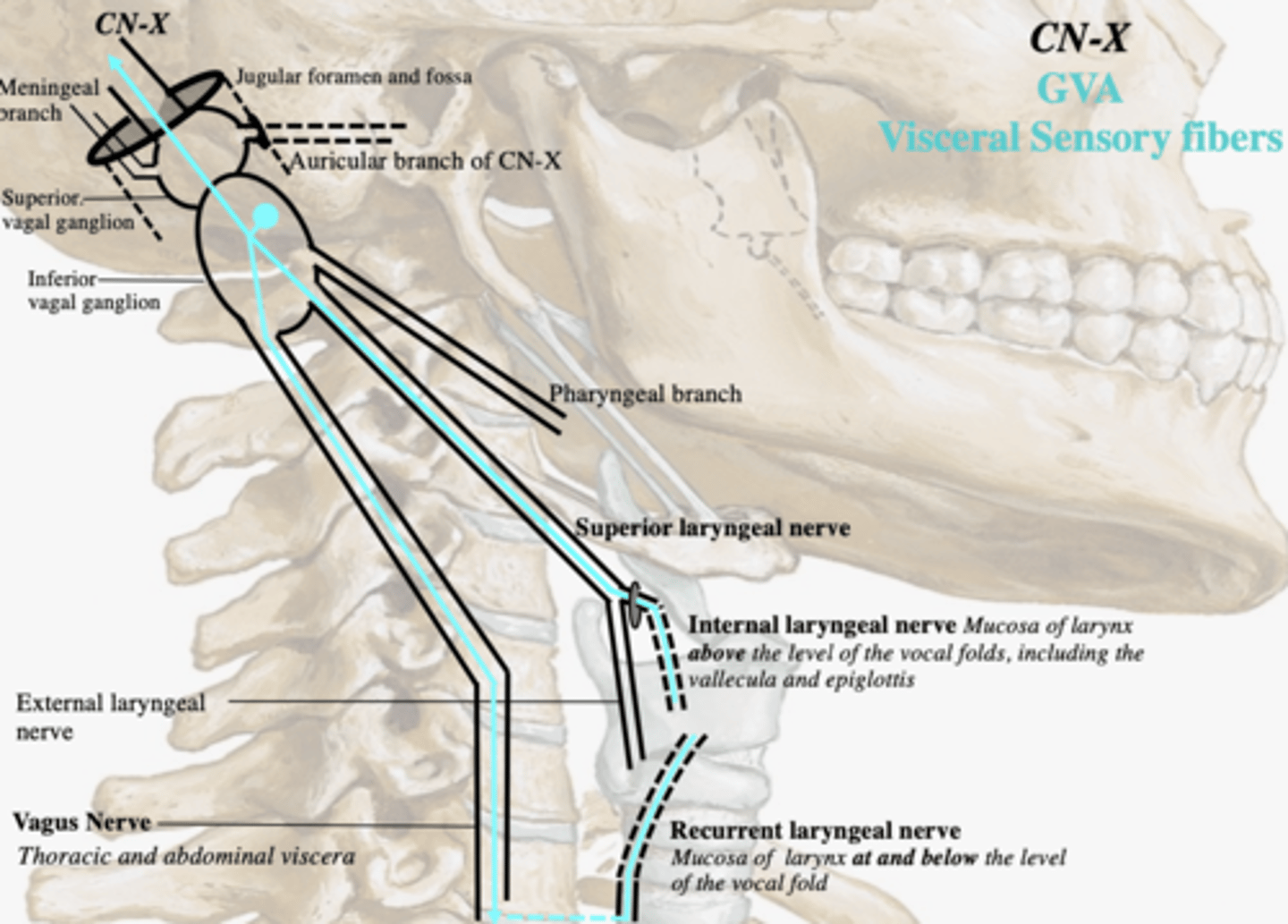
The recurrent laryngeal nerve gives VISCERAL SENSORY INERVATION to the mucosa of larynx _______________ the level of the vocal fold.
at and below
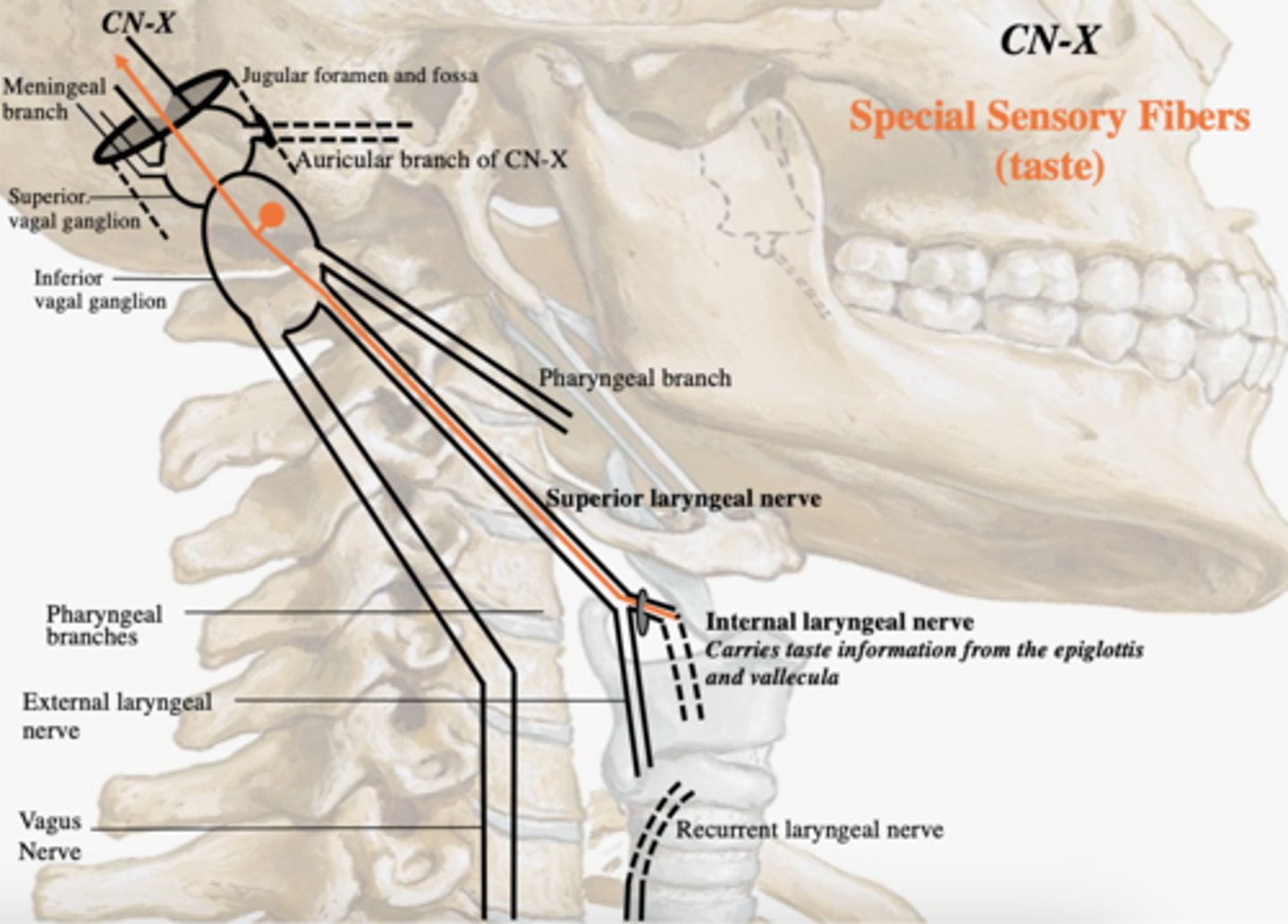
What nerve caries taste information from the epiglottis and vallecula?
internal laryngeal nerve
An 86-year-old man was referred to an ENT specialist because of recent hoarseness. Examination revealed a mass compressing the right recurrent laryngeal nerve. As a result of the compression there is potential loss of motor innervation to all of the following EXCEPT the ____________ muscle.
A) posterior thyroarytenoid
B) lateralthyroarytenoid
C) thyroarytenoid
D) crycothyroid
E) vocalis
A) posterior thyroarytenoid
B) lateralthyroarytenoid
C) thyroarytenoid
D) crycothyroid
E) vocalis
Your patient reports a history of oropharyngeal cancer. You read in her medical record that there was damage to the pharyngeal plexus during surgery and subsequent radiation therapy. You are concerned about dysphagia and the potential for aspiration pneumonia because the pharyngeal plexus includes fibers from the ________ nerve that carry somatosensory information from the pharynx and fibers from the ______ nerve that innervates most of the muscles of the pharynx and soft palate.
A) glossopharyngeal ; vagus
B) glossopharyngeal ; glossopharyngeal
C) vagus ; glossopharyngeal
D) vagus ; vagus
E) trigeminal ; vagus
A) glossopharyngeal ; vagus
B) glossopharyngeal ; glossopharyngeal
C) vagus ; glossopharyngeal
D) vagus ; vagus
E) trigeminal ; vagus