Biochem | Ch. 1 + Ch. 2
 Call Kai
 Learn
Learn Practice Test
 Spaced Repetition
 Match
Match Flashcards
 Knowt Play
1/138

There's no tags or description
Looks like no tags are added yet.
Name | Mastery | Learn | Test | Matching | Spaced | Call with Kai |
|---|
No analytics yet
Send a link to your students to track their progress
139 Terms
Major classes of Biological Molecules
Carbohydrates, Lipids, Proteins, and Nucleic Acids
Elements Found in Biological Systems
THE BIG FOUR (96% of Living Matter):
CHON: These four elements make up the core organic backbones of all the major macromolecules we just covered (nucleic acids, lipids, carbohydrates, and PROTEINS).
The Macro-Mineral Elements (Nearly 4% of Living Matter): To remember the remaining BULK elements highlighted in orange (Calcium, Phosphorus, Potassium, Sulfur, Sodium, Chlorine, and Magnesium):
Memory: Smart People Can Not Cook My Kale. Sulfur (important in amino acids and disulfide bonds that stabilize proteins), Phosphorus (Major component of DNA, RNA, phospholipids, ATP), Calcium (essential for bones, muscle contraction, and cell signaling), Na = Sodium (key extracellular anion for fluid balance and nerve impulses!), chlorine/chloride (major extracellular anion involved in osmotic balance and stomach acid), Magnesium (cofactor [a helper molecule or ion that an enzyme needs in order to function properly] for many enzymes, especially those involving ATP!! and nucleic acids), K = Potassium (primary INTRACELLULAR cation important for nerve and muscle function [think banana in salty sea!]).
So, 99% of our mass is just 11 elements, the remaining elements in biology are called “trace elements.” NOT EVERY organism contains every trace element!
Trace Elements (Transition Metals): The elements lightly shaded in beige at the bottom (like Fe, Cr, Mn ,Co, Ni, Cu, Zn, Mo, W). They’re ALL transition metals. Bio Role: Your body only need s them in tiny amounts, usually acting as sharp “metal teeth” at the active sites of metabolic enzymes (like Iron in hemoglobin or Zn in DNA polymerases).
![<p>THE BIG FOUR (<strong>96%</strong> of Living Matter): <br><strong>CHON</strong>: These four elements make up the core organic backbones of all the major <strong>macromolecules </strong>we just covered (nucleic acids, lipids, carbohydrates, and PROTEINS).</p><p>The Macro-Mineral Elements (Nearly 4% of Living Matter): To remember the remaining BULK elements highlighted in orange (Calcium, Phosphorus, Potassium, Sulfur, Sodium, Chlorine, and Magnesium):</p><p>Memory: <strong>Smart People Can Not Cook My Kale</strong>. <strong>Sulfur </strong>(important in amino acids and disulfide bonds that stabilize proteins), <strong>Phosphorus </strong>(Major component of DNA, RNA, phospholipids, ATP), <strong>Calcium </strong>(essential for bones, muscle contraction, and cell signaling), <strong>Na </strong>= Sodium (key extracellular anion for fluid balance and nerve impulses!), <strong>chlorine/chloride</strong> (<strong>major extracellular anion involved in osmotic balance and stomach acid</strong>), <strong>Magnesium </strong>(<strong>cofactor </strong>[a helper molecule or ion that an enzyme needs in order to function properly] for many enzymes, especially those involving <strong>ATP!! and nucleic acids</strong>), K<strong> </strong>= <strong>Potassium </strong>(primary INTRACELLULAR cation important for nerve and muscle function [think banana in salty sea!]).</p><p>So, 99% of our mass is just 11 elements, the remaining elements in biology are called “trace elements.” NOT EVERY organism contains every trace element!</p><p>Trace Elements (Transition Metals): The elements lightly shaded in beige at the bottom (like Fe, Cr, Mn ,Co, Ni, Cu, Zn, Mo, W). They’re ALL transition metals. Bio Role: Your body only need s them in tiny amounts, usually acting as sharp “metal teeth” at the active sites of metabolic enzymes (like Iron in hemoglobin or Zn in DNA polymerases).</p>](https://assets.knowt.com/user-attachments/30bc71bb-b340-4c4c-bbc7-f329db5c2a25.png)
Fluorine
Teeth! Your tooth ENAMEL is made of a crystalline calcium phosphate mineral called hydroxyapatite. When you brush with fluoride toothpaste or drink fluorinated water, the fluoride ions substitute for the hydroxyl groups within the crystal lattice. This chemical replacement transforms the surface mineral into fluoroapatite. Fluoroapatite is structurally superior: lower solubility in acid and tighter crystal packing.
Chlorine
Reminder: Major extracellular anion involved in osmotic balance and stomach acid.
Memory: Chlorine Chills Outside Cells: Chloride = extracellular ion (mostly outside cells). Helps maintain fluid/osmotic balance. For the stomach acid part: Cl makes HCl!!! Hydrogen + Chloride => hydrochloric acid in the stomach! Na & Cl = outside. K = inside!
Class: Component cells, blood, etc. Chloride is found in blood plasma, extracellular fluid, stomach acid. Main jobs: balances sodium (chloride is the major negative ion paired with sodium), maintains fluid balance (helps control water movement in blood and tissues), helps maintain pH (important in acid-base balance), forms stomach acid (HCl).
Fe and Oxidation States
Fe2+ and Fe3+ (abundant);
Iron switches between Fe2+ and Fe3+; this makes iron essential in hemoglobin, cytochromes, electron transport, and oxygen handling.
Fe2+ => Fe3+; oxidation; loses one electron. Fe3+ => Fe2+ => reduction => gains one electron.
In hemoglobin: oxygen binding NORMALLY involves Fe2+. IF iron becomes Fe3+, it forms METHEMOGLOBIN, which binds OXYGEN POORLY.
Fe2+ = ferrous = +2 = common active hemoglobin.
Fe3+ = ferric = +3 = oxidized form.
Br
Br = not one of the major essential elements of the human body. But: tiny amounts of bromine may occur naturally in tissues. Bromine compounds were historically used in medicine, including sedatives (bromides) and some older antimicrobial/antibiotic-related compounds. Also, many antibiotics contain halogens (Cl, F, Br) because halogens change drug properties.
Salt with Urine
Your body removes salt through urine. The kidneys regulate salts (electrolytes) such as sodium (Na+), Chloride (Cl-), and Potassium (K+). When you eat extra salt (NaCl); it enters the bloodstream, the kidneys filter the blood, excess sodium and chloride are EXCRETED into URINE, water follows the SALT, INCREASING URINE VOLUME.
More salt retained => more water retained. More salt excreted => more water lost in urine/ You also lose some SALT through sweat, tears, and feces. Kidneys/ urine are the main control system for salt balance.
Thyroid hormone. Main thyroid hormones are: T4 (thyroxine) and T3 (triiodothyronine). These are made by the thyroid gland and require iodine. Where urine comes in: Iodine balance: you get iodine from food (salt, seafood, etc.), your thyroid uses iodine to make T3 and T4, and EXCESS IODINE is REMOVED MAINLY THROUGH URINE. So urine is the body’s main way to control iodine levels. Doctors often check urine iodine levels to assess whether someone has enough iodine for thyroid hormone production. Thyroid uses iodine, kidneys remove extra iodine.
Iron Deficiency Anemia
When your body doesn’t have enough iron, it cannot make enough hemoglobin. Why Iron Matters: Iron is part of hemoglobin (in RBCs). Hemoglobin carries oxygen. Low iron => low hemoglobin => low oxygen delivery. Iron deficiency anemia => not enough iron intake or absorption.
Coordinated Iron
Just means an iron ion that is bonded to surrounding ligands (molecules or ions that donate electron pairs to it). In chemistry, this is common in coordination complexes, where ion is the central metal. Iron is typically in a charged state like Fe2+ or Fe3+. It is surrounded by ligands such as: water (H2O), ammonia (NH3), cyanide (CN-), etc. These ligands “coordinate” (attach) to iron using lone pairs => form coordinate covalent bonds. Ex. In hemoglobin, Iron is Fe2+. It is coordinated to a heme group (porphyrin ring) and also binds oxygen REVERSIBLY. That’s an example of biologically important coordinated iron.
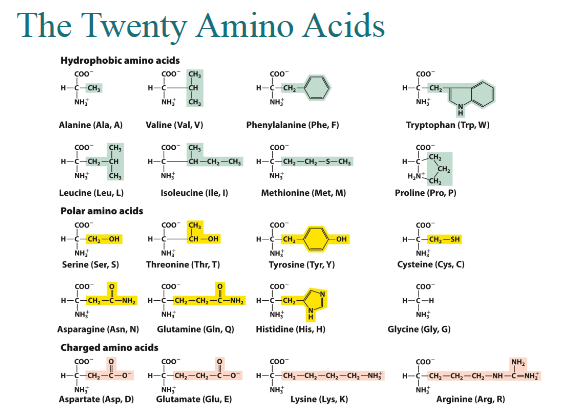
Know 20 Amino Acids!!
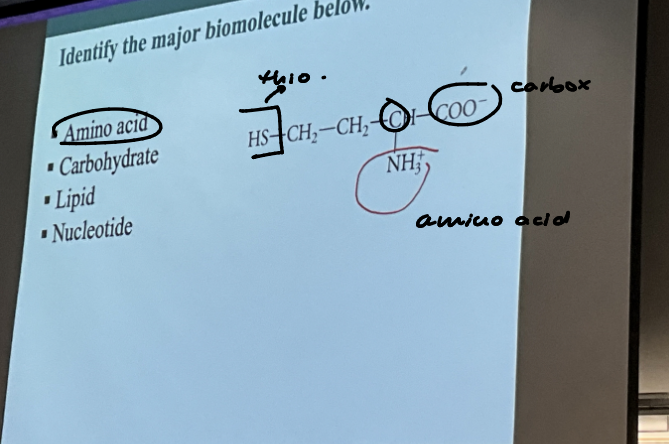
Compound name: thiol
Structure: RSH
Functional Group: -SH (sulfhydryl group).
Compound name: aldehyde
Functional group: carbonyl group, acyl group

Compound name: ketone
Functional group: carbonyl group, acycl group

Carboxylate
Negatively charged form of a carboxylic acid after it loses its hydrogen ion.
Functional Group: ester linkage
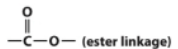
Compound name: ester

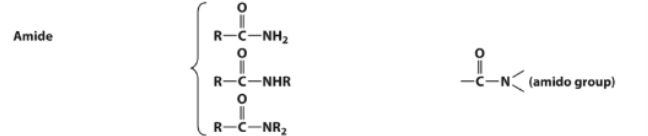
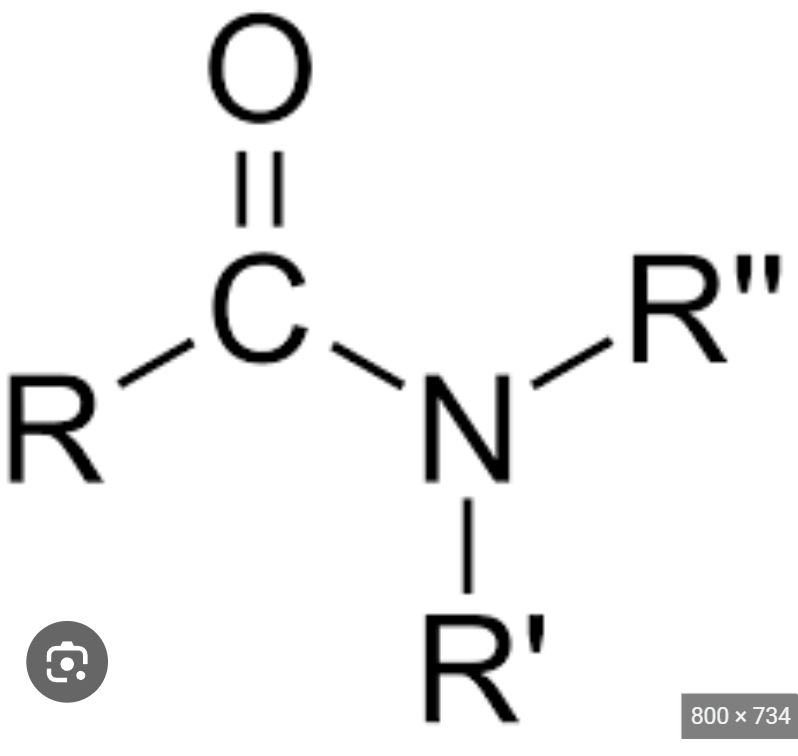
Compound name: amide
Functional group: amido group.
Compound name: imine
Functional group: imino group.

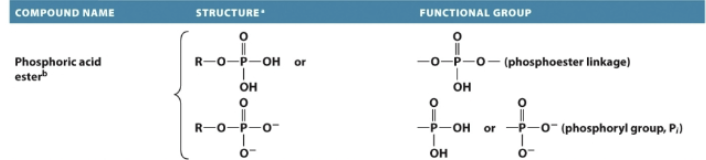
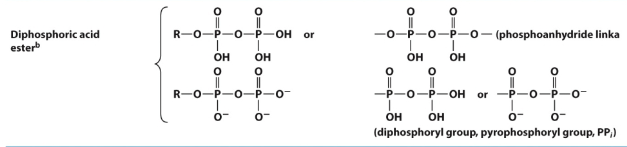
Compound name: Phosphoric acid ester
Functional group: phosphoester linkage.
Functional group: phosphoryl group, Pi.
Compound name: diphosphoric acid ester
Functional Group: phosphoanhydride linkage.
Functional Group: diphosphoryl group, pyrophosphoryl group, PPi).
Carbohydrates
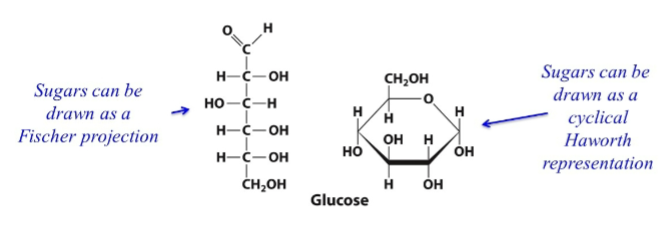
Carbohydrates are monosaccharides or sugars. General chemical formula: (CH2O)n where n >= 3.
Sugars CAN BE DRAWN AS A FISCHER PROJECTION.
SUGARS CAN BE DRAWN AS A CYCLICAL HAWORTH REPRESENTATION.
Zwitterion
A molecule that carries both a positive charge and a negative charge at the same time, but is overall electrically neutral. Under physiological conditions, both the amino acid and carboxylc acid groups are charged.
Sugar Polymers for Energy Storage and as Building Materials
Glucose: not a polymer, a monosaccharide (Single sugar unit), C6H12O6, it is the building block for larger carbohydrates.
Starch: a POLYMER of GLUCOSE, made by linking glucose units together, used by plants for energy storage, it’s a polysaccharide.
Cellulose: ALSO a polymer of glucose, made of long chains of glucose units, used in plant cell walls for structural support, also a polysaccharide.
Diff between starch and cellulose. Starch => glucose units linked in a way humans can digest. Cellulose => different linkage, so humans cannot digest it.
Sugar Polymers for Cellular Signaling
Cell surface glycan engineering = deliberate modification of the carbohydrate structures (glycans) displayed on the outer membrane of living cells. These glycans are part of the cell’s sugar coat, known as the glycocalyx, and they play key roles in cell signaling, immune recognition, adhesion, ad disease processes.
Nucleotides
Nucleotides are the building blocks of nucleic acids.
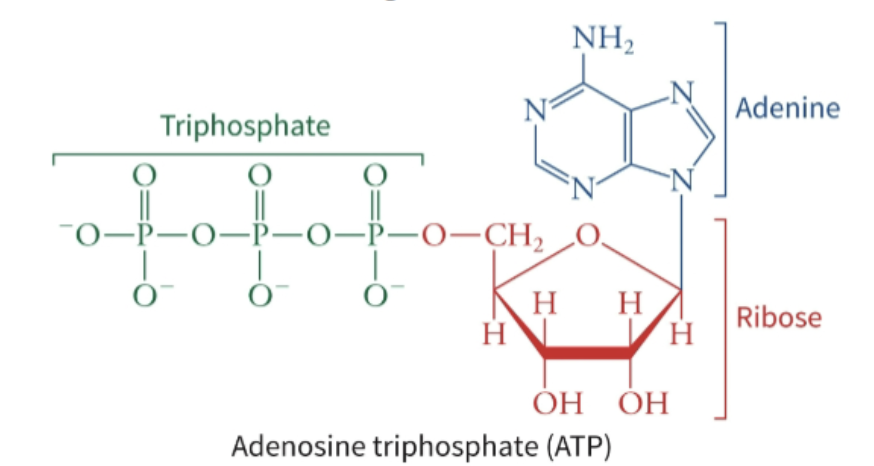
ATP!!! is an example of a nucleotide. It has the standard nucleotide structure: a nitrogenous base: adenine, a 5-carbon sugar: ribose, three phosphate groups: triphosphate chain. Because it contains a BASE, SUGAR, and a PHOSPHATE group, it fits the definition of a nucleotide.
3D Structure of Nucleotides
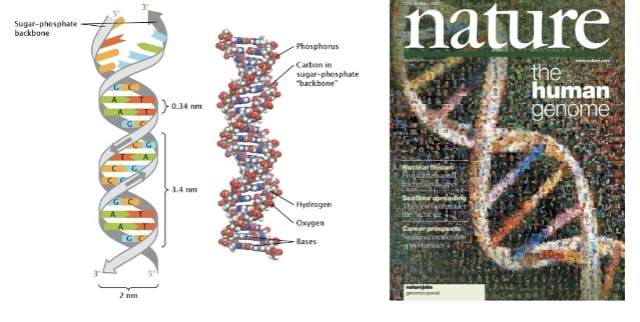
Sugar-phosphate backbone. CARBON IN SUGAR-PHOSPHATE backbone.
Where Hydrogen and Oxygen are in nucleotides: They are not confined to one single spot, but distributed across its three main parts: A nucleotide is made of a nitrogenous base, a pentose sugar (ribose or deoxyribose), and one or more phosphate groups.
1.) Pentose sugar (ribose/deoxyribose): OXYGEN (O) is built into the sugar ring itself (the RING contains one oxygen atom) and also in several -OH (hydroxyl) groups. Hydrogen (H) is attached to carbon atoms and hydroxyl groups (-OH). So, the sugar i rich in both H and O.
2.) Phosphate Group: Contains MULTIPLE oxygen atoms (O) bonded to phosphorus (P), forming P-O bonds. Some oxygens contain negative charge (O-) in physiological conditions. These oxygens can also be associated with hydrogen depending on protonation (-OH vs. -O-). So, phosphate is very oxygen-rich.
3.) Nitrogenous base (adenine, thymine, guanine, cytosine, uracil): contains some nitrogen (N) atoms, also contain hydrogen (H) attached to nitrogen and carbon. Oxygen appears in some bases (like thymine, cytosine, uracil), but not all (adenine and guanine have no oxygen in their base rings).
Simple Summary: Oxygen (O): mostly in the sugar and phosphate groups. Hydrogen (H): spread through sugar, base, and phosphate (especially -OH and N-H groups).
Lipids (fats) are a Major Type of Biological Molecule
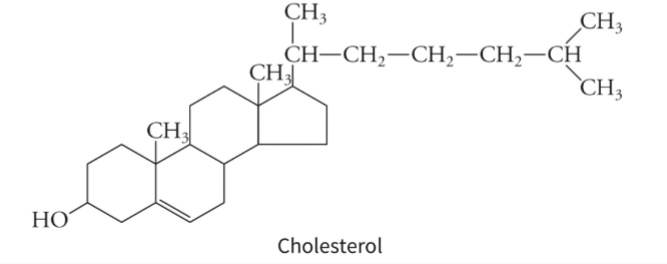
One of the most important lipids in human health is cholesterol.
Cholesterol makes hormones, vitamin D, and helps digest food. Cholesterol is the main sterol found in animals, while plants usually contain different sterols (called phytosterols).
Lipids are building blocks of membranes.
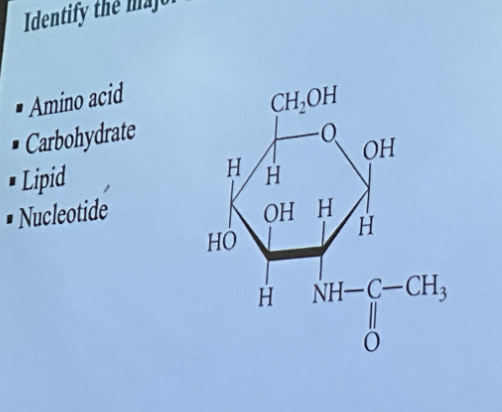
Identifying a carbohydrate.
(CH2O)n. Has many hydroxyl groups (-OH). Carbohydrates usually contain multiple alcohol (hydroxyl) groups attached to carbon atoms. These -OH groups make carbohydrates polar and water-soluble. Contains a carbonyl group (aldehyde or ketone group). Rings structures are common (5- and 6-membered rings).
Identify.
Residue
A residue is the part of a monomer that remains after monomers join together during polymerization. When monomers join together during polymerization. When monomers bond, small molecules such as water may be removed, The remaining incorporated unit inside the polymer chain is called a residue.
THREE major kinds of biological polymers
Polypeptides and proteins, nucleic acids, and polysaccharides.
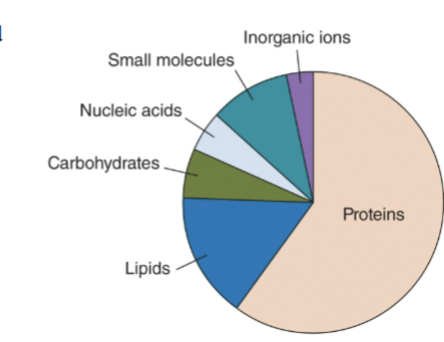
Pie chart = composition of biological molecules in a cell. The largest portion is PROTEINS (enzymes structure, transport). Lipids = membranes and energy storage. Carbs = energy and structural materials. Nucleic acids = DNA and RNA. Small molecules => metabolites like amino acids, sugars, ATP. Inorganic ions => ions such as Na+.
Amino Acid Links
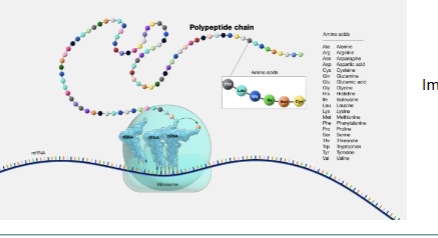
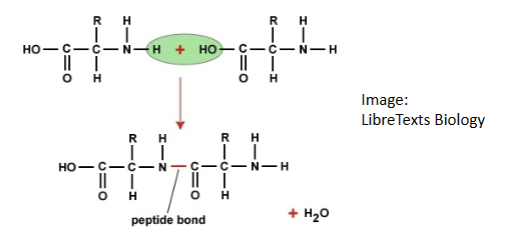
Amino acid residues are linked by PEPTIDE bond. Polypeptide sequences are always read from N (amino terminus) to the C (carboxyl terminus) terminus (this North or top to South or to C). During protein synthesis, ribosomes add amino acids only to the C- terminus.
Ribosome
The light blue. Ribosome = a small cellular structure that acts as the site of protein synthesis. It is where the cell builds proteins by linking amino acids together according to the instructions carried by mRNA. They: read mRNA, match it with tRNA carrying amino acids, form peptide bonds BETWEEN amino acids, and produce a polypeptide chain (protein).
Amide Linkage
Peptide Bond
PHOSPHODIESTER bonds link nucleotides.
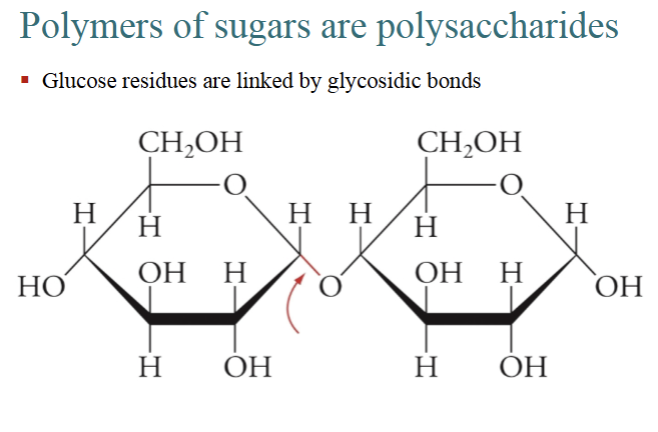
Polymers of sugars = polysaccacharides.
Glucose residues are linked by glycosidic bonds.
Enthalpy, H
Heat content of a system. Think H = Heat Content. Units = J * mol^-1.
Exothermic reaction (releases heart): deltaH = negative.
Endothermic reaction (absorbs heat): deltaH = positive.
Entropy, S
A measure of the system’s disorder or randomness. Units = H * K^-1 * mol^-1
Gibbs Free Energy, G
A measure of the free energy of a system based on H and S. Units = J * mol.
WHEN deltaG is negative
Reaction is spontaneous or EXERGONIC.
When deltaG is POSTIVE
Reaction is nonspontaneous or ENDERGONIC.
Inside Cells
Inside cells, energy is obtained from other METABOLITES through metabolic reactions. Cells don’t get energy directly from food as a single step. Instead, they: break down metabolites (small molecules from food or storage), capture the released energy, use it to MAKE ATP.
Why Care About Free Energies?
Synthesis of complex molecules requires energy (ENDERGONIC).
A reaction might be thermodynamically unfavorable (deltaG° > 0).
Creating order requires work and energy.
Reaction might have too high-energy barriers (G‡ > 0).
G‡ = activation energy barrier (more precisely, Gibbs free energy of activation). It is the energy needed for reactants => transition state => products.
Metabolite is kinetically stable. Clarification: A metabolite is kinetically stable when: it could react (thermodynamically possible) BUT it does not react quickly because the activation energy barrier is TOO HIGH). SO: kinetic stability = slow reaction due to high G‡.
Nucleotides
3 main components:
5-C sugar (here = ribose, can be deoxyribose).
To SUGAR, a nitrogenous cyclic base in blue.
AND ONE OR MORE phosphate (-PO3) groups (green) (1,2,3).
Lipids
Most diverse of biomolecules. ALL LIPIDS are AMPHIPATHIC (CONTAIN both POLAR and nonpolar components). Mostly non-POLAR due to SA.
Polar component of lipid = Polar region on right = carboxylate group and NONPOLAR region (long hydrocarbon chain).
Polar: Look at net charge OR an EW element LIKE OXYGEN.
ONE CLASS OF BIOLOGICAL molecules cannot form these polymeric molecules, likely lipids. No single common functional group to them all.

Polymers can be built to provide structure WITHIN or outside the cell OR CAN be used as a means of nutrient storage.
CONDENSATION reactions to form these polymers results in the LOSS or release of water.
PROTEIN polymers
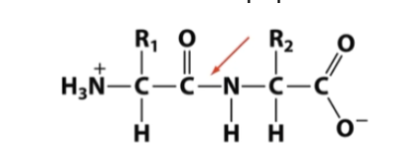
Polypetides. BECAUSE they contain many peptide = amide bonds. General structure of a dipeptide: (left). Red arrow = peptide = amide bond.
THIS bond = part of an amide group, that is a carbonyl group bound to an amine.
DIFFERENT combinations of amino acids produce different conformations. Think 3D.
Polysaccharides = POLYMERS of monosaccharides or polymers of carbohydrates!! the bond connecting carbohydrate MONOMERS =
glycosidic bond!!
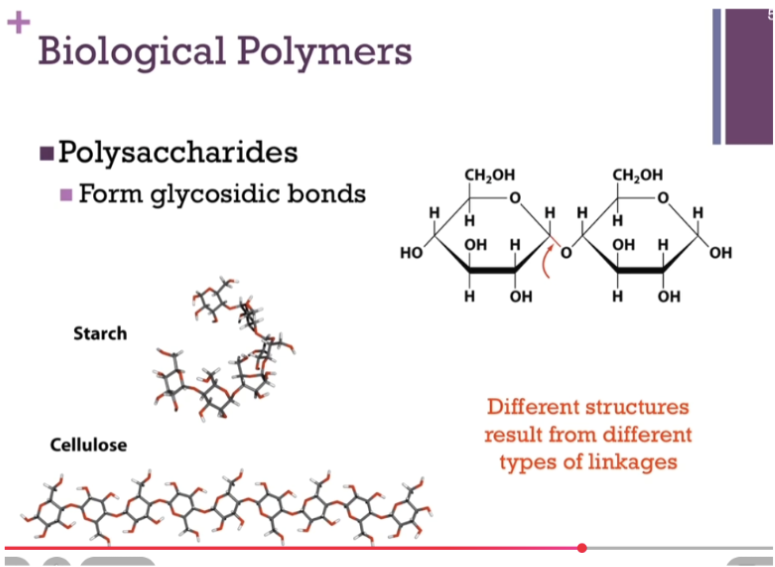
Starch and Cellulose
Starch and Cellulose = both 100% glucose RESIDUES. BUT THEIR STRUCTURES = very different.
deltaG = the final gibbs free energy of the system minus that of the initial.
IF CHEMICAL REACTION, THEN its the gibbs free energy of the products minus the gibbs free energy of the reactants. THUS, if the value of deltaG = positive, the final energy of the system is higher than the INITIAL; therefore, we had to put ENERGY INTO the system. This means the reaction costs us energy and THEREFORE ENDERGONIC (enderman = think = bad) or nonspontaneous.
BUT if deltaG is negative, ENERGY WAS RELEASED by the system, meaning the reaction is EXERGONIC (EXCITING, means reaction is spontaneous!) or spontaneous.
What Makes Life Possible?
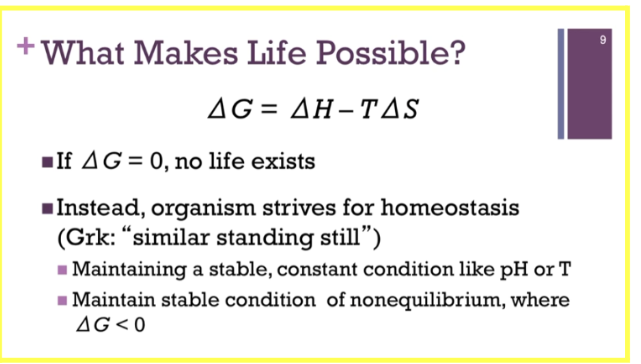
Metabolic = kinetically stable
Metabolite is kinetically stable=? it does not change or react quickly, even if converting into something else would be energetically favorable; the REACTION is SLOW because of a high ACTIVATION energy barrier.
Metabolic Reactions are Redox
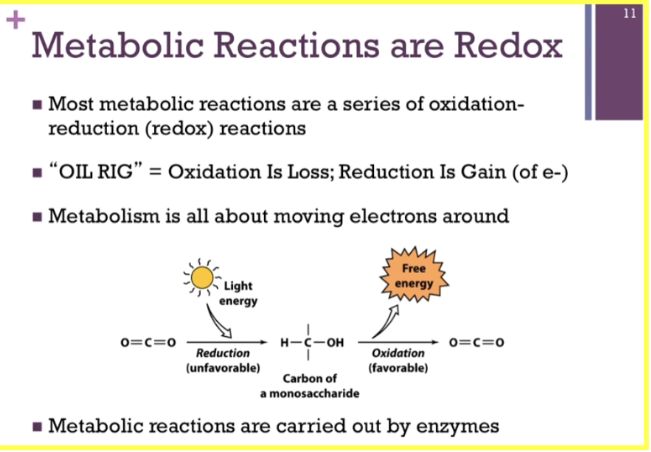
Plants
Plants can use the energy of sunlight to reduce carbon dioxide (think already has oxygen, so we reduce) TO a carbon compound like glucose!!
Prokaryote DNA
DNA = organized into a nucleoid (the irregularly shaped region inside a prokaryotic cell [such as bacteria and archaea] where the cell’s genetic material is located).
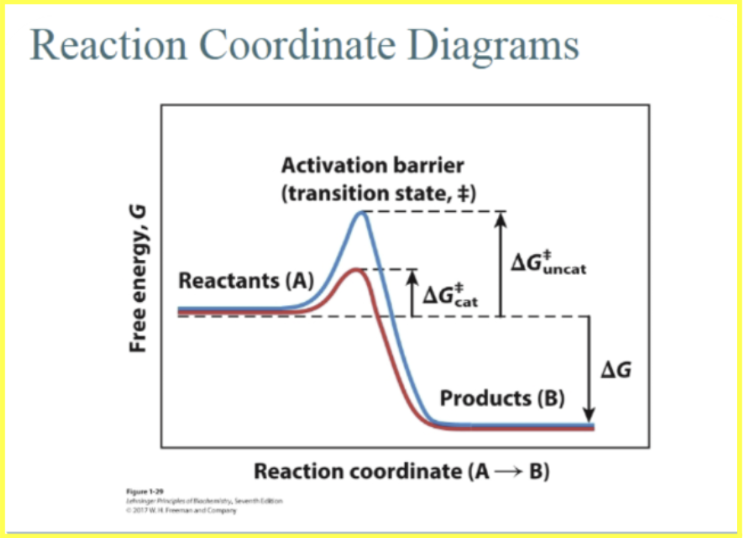
Reaction Coordinate Diagrams
This diagram shows how the energy of a reaction changes as reactants turn into products. Y- axis = higher up = higher energy = less stable. Lower down = lower energy = more stable. Top of the hill = the transition state (‡).
The activation energy is: ΔG‡. Big hill = slow reaction. Smaller hill = faster reaction.
Blue curve (uncatalyzed) = higher activation energy = reaction happens very slowly = deltaGdoublecorssuncat. Red curve = enzyme lower activation energy = reaction becomes faster. deltaGdoublecrosscat.
IMPORTANT POINT = deltaG does NOT change: the overall energy difference between reactants and products. Since products are lower in energy here: deltaG = negative, reaction is thermodynamically favorable, there is a release in free energy. BTW the enzyme does not change deltaG, does not change equilibrium, only changes the speed by lowering activation energy! Connection to kinetically stable: A metabolite can be kinetically stable if the activation barrier is HIGH. (metabolite is kinetically stable). Even if products are lower in energy (deltaG = negative): the molecule stays around; because climbing the activation hill is slow. Enzymes lower the hill and allow the reaction to proceed quickly.
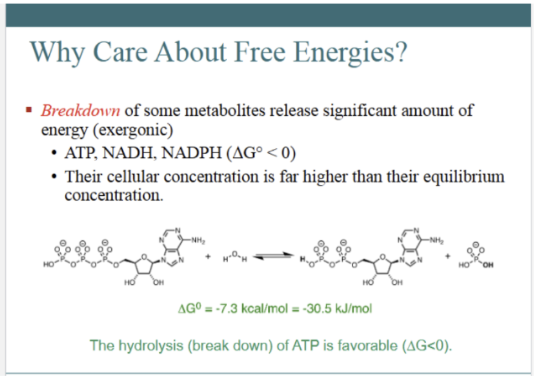
Breakdown of Some Metabolites (small molecule involved in metabolism)
Breakdown of some metabolites (small molecule involved in metabolism) release significant amount of energy (exergonic).
Breakdown of Metabolite Examples: ATP, NADH, NADPH (deltaG standard < 0).
Their cellular concentration is far higher than their equilibrium concentration? MEANING; inside the cell, the amount of metabolite is kept much higher than the amount PREDICTED at equilibrium. Normally, reactions move toward equilibrium - the balanced state where forward and reverse reactions occur equally. But cells are not at equilibrium. They constantly: make metabolites, consume them, transport them, and use energy to maintain concentrations. So, a metabolite may “want” thermodynamically to convert into products, yet it remains abundant because the reaction is kinetically slow OR the cell continuously replenishes it. Example: ATP exists in cells at concentrations FAR ABOVE equilibrium because cells continuously regenerate ATP using metabolism.
HYDROLYSIS (OR BREAKDOWN) of ATP is FAVORABLE!!
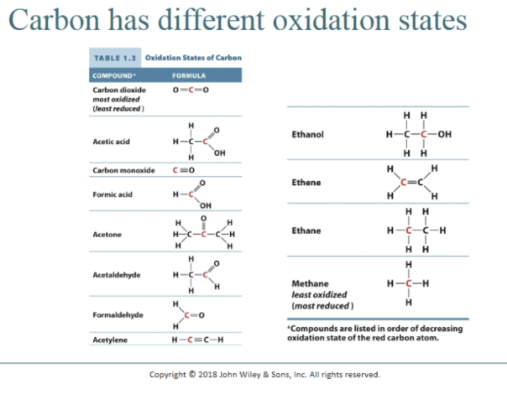
Carbon has Different Oxidation States
Chat: a carbon atom becomes; more oxidized => more bonds to oxygen (or EN atoms) or more reduced (more BONDS TO HYDROGEN). MOST oxidized (= top left) and most reduced = bottom right. MOST oxidized = carbon dioxide. Structure = O=C=O. Carbon is bonded only to oxygen is very EN => pulls electrons away. Carbon = at the highest oxidization state (+4)!!. This is a fully oxidized carbon.
Most reduced = methane = structure = CH4 = carbon bonded only to hydrogen. Hydrogen GIVES electron density relative to oxygen. Carbon is at lowest oxidation state (-4). This is a FULLY reduced carbon.
Life Originated
Theory: Life may have originated at “black smokers”: HIGH temperatures, H2S, and METAL sulfides might have stimulated the formation of biological molecules. Hydrothermal vents may be the first place biomolecules were synthesized!!
Hydrothermal vent: an opening in the seafloor (usually deep in the ocean) where superheated, mineral-rich water escapes from Earth’s crust.
Origin of Life: Life Derives From and Harvests Energy Gradients. => Life exists because it captures and uses energy differences (gradients) in its environment to do work and maintain itself! Living systems do not create energy; they tap into existing gradients and convert that energy into useful work.
Biomolecules
sugars, amino acids, organic acids, nucleotides.
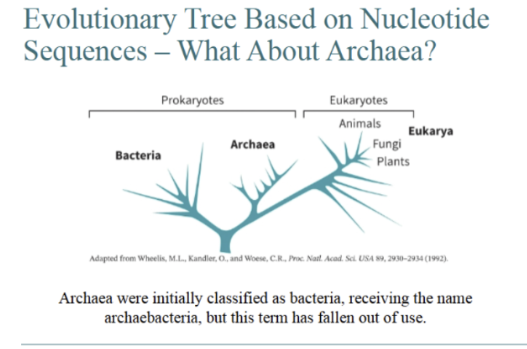
Evolutionary Tree
Evolutionary Tree Based on Nucleotide Sequences (rRNA) - Prokaryotes + Euks. Archaea = Extremophiles
This diagram reveals that the ancestors of archaea and bacteria separated before the eukarya emerged from an archaea-like ancestor. Note that the closely spaced fungi, plants, and animals are actually more similar to each other than are many groups of prokaryotes.
Bacteria = inhabit solids, surface water and tissues of other organisms.
Archaea: inhabit extreme environments (e.g. salt lakes, hot springs).
Cell Architecture Falls into Two Categories
Proks and Euks
Origin of Eukarya = Symbiosis?
Mitochondria or chloroblasts = from symbiosis with other organisms. Anaerobic = able to function without oxygen. Anaerobic metabolism is inefficient because FUEL is not COMPLETELY oxidized. Remember oxidized = glucose to CO2 => release of energy. Ancestral anaerobic euk. Bacteria is engulfed by ancestral euk, and MULTIPLIES within it. Aerobic metabolism is efficient because fuel is oxidized to CO2. Aerobic eukaryote. Symbiotic system can now carry out aerobic catabolism (the breakdown [catabolism] of molecules to release energy using oxygen [O2]). Some bacterial genes move to the nucleus!!, and the bacterial endosymbionts (organisms that live inside the body or cell where both partners benefit ot at least one benefits without harming the host) become mitochondria. => nonphotosynthetic eukaryote. OR: then photosynthetic cyanobacterium!! (light energy is used to synthesize biomolecules from CO2). Engulfed cyanobacterium becomes an endosymbiont and multiples; new cell can make ATP using energy from sunlight. LEADS to photosynthetic eukaryote. In time, some cyanobacterial genes move to the nucleus and endosymbionts become chloroplasts!
![<p><span style="background-color: transparent;">Mitochondria or chloroblasts = from symbiosis with other organisms. Anaerobic = able to function without oxygen. Anaerobic metabolism is inefficient because FUEL is <strong>not COMPLETELY oxidized</strong>. Remember oxidized = glucose to CO2 => release of energy. Ancestral anaerobic euk. Bacteria is engulfed by ancestral euk, and MULTIPLIES within it. Aerobic metabolism is efficient because fuel is <strong>oxidized </strong>to CO2. Aerobic eukaryote. Symbiotic system can now carry out aerobic catabolism (the breakdown [catabolism] of molecules to release energy using oxygen [O2]). Some bacterial genes move to the nucleus!!, and the bacterial endosymbionts (organisms that live inside the body or cell where both partners benefit ot at least one benefits without harming the host) become mitochondria. => nonphotosynthetic eukaryote. OR: then photosynthetic cyanobacterium!! (light energy is used to synthesize biomolecules from CO2). Engulfed cyanobacterium becomes an endosymbiont and multiples; new cell can make ATP using energy from sunlight. LEADS to photosynthetic eukaryote. In time, some cyanobacterial genes move to the nucleus and endosymbionts become chloroplasts!</span></p><p></p>](https://assets.knowt.com/user-attachments/b33a901f-4b34-42a8-8727-9d854bf47015.png)
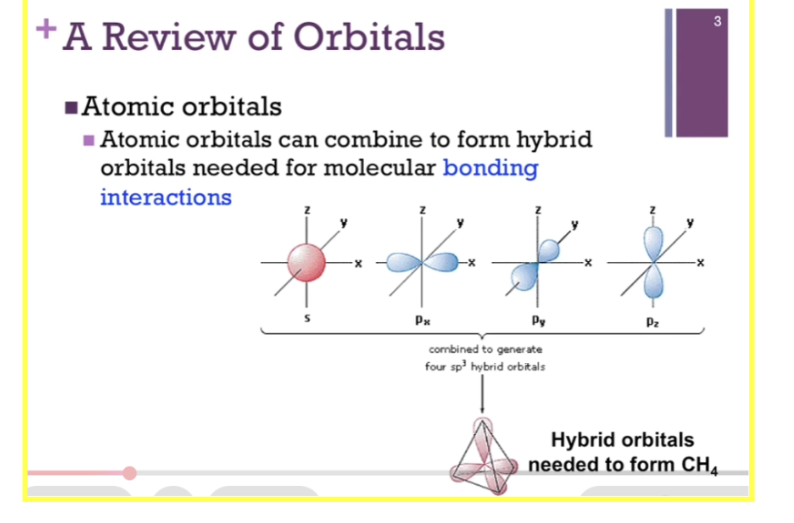
When form a molecule, atomic orbitals overlap, and we form hybrid orbitals.
HYBRID ORBITALS needed to form methane (CH4). FOUR CH bonds so FOUR hybrid orbitals. All same. FOUR BONDS, so our shape is TETRAHEDRAL.
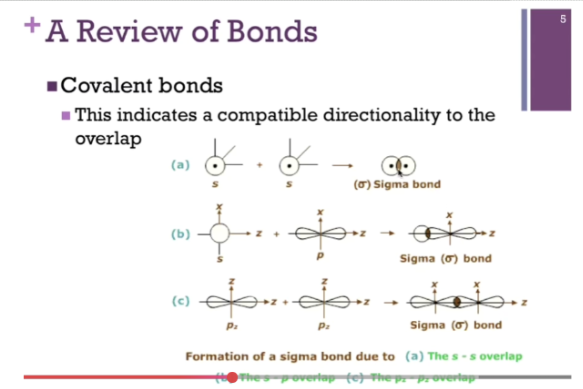
Types of bonds we see in biological systems. Start = with strongest to weakest. Strongest = covalent bond. Atomic orbitals are CLOSE ENOUGH to overlap (that’s the proximity feature AND MUST BE properly oriented).
Formation of SIGMA bond in one of THREE ways.
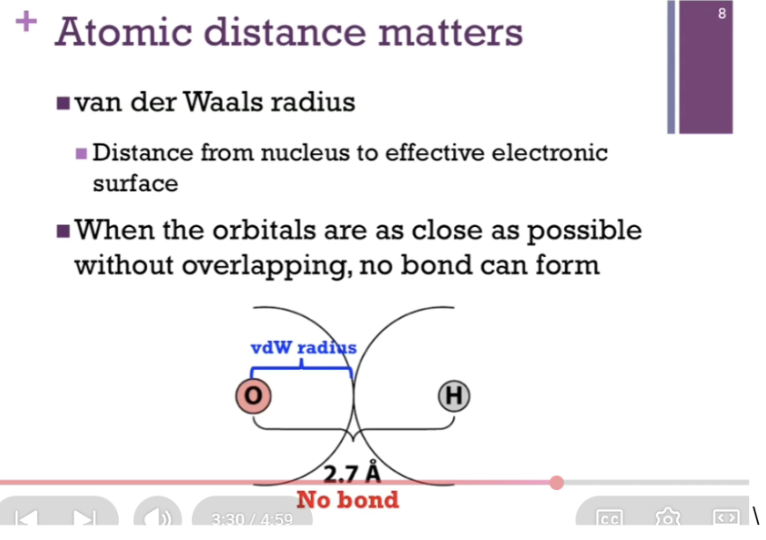
van der waals radius
Distance from nucleus to effective electronic surface (more commonly the effective surface area for electron transfer) (proton of a molecule or electrode surface that is actually available for electron exchange or chemical reaction).
Bracket: from center of the nucleus to the end of the outer shell of that electronic surface.
When no bond, the distance between the nuclei are simply the SUM of the van der waal’s radius!
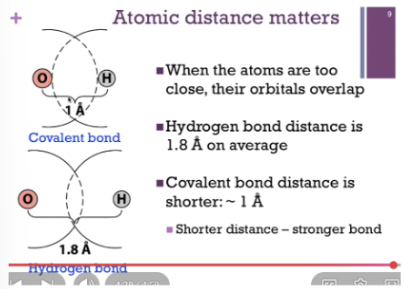
Atomic Distance Matters.
Compared to a hydrogen bond, for a covalent bond, there’s a greater degree of overlap, so the distance between the nuclei are about the order of 1 angstrom. RECALL SHORTER distance = stronger bond.
Biological Molecules.
AS far as our biological molecules, WE’RE more carbon than anything else!, but by MASS, we are mostly water.
60% water.
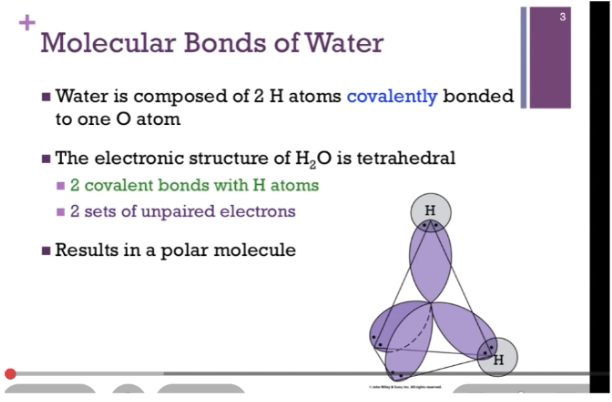
Molecular Bonds of Water
Even though only 2 covalent bonds, the structure of water = tetrahedral. Oxygen atom also carries two sets of unpaired electrons. Not a perfect tetrahedral since they are unshared. UNpaired =make water polar!
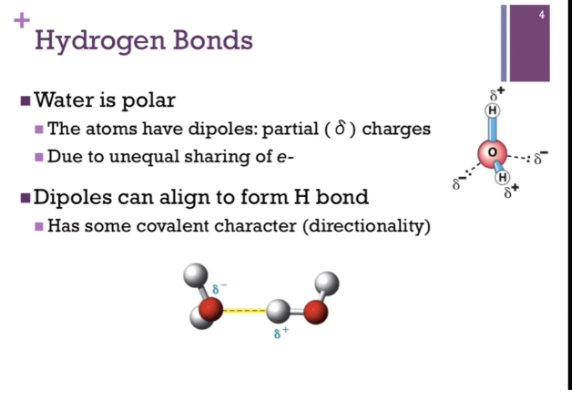
Hydrogen Bonds
Unpaired = carry a negative dipole. IN COVALENT bonds between oxygen and hydrogen, there is an UNEQUAL sharing of the electrons.
DIPOLES CAN ALIGN to form HYDROGEN bonds!!
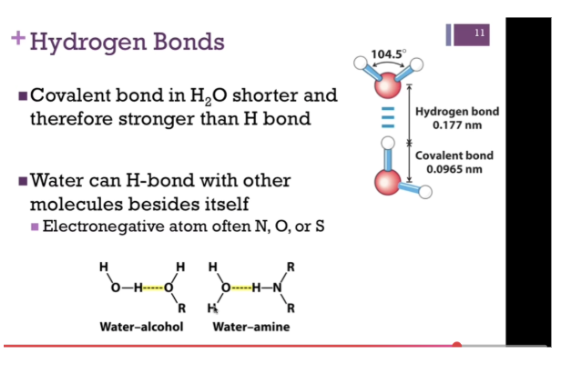
Bottom = ball and stick model => can see that the oxygen and hydrogen can come together to form a H bond (dashed and highlighted line). THE STICKS represent the covalent bonds.
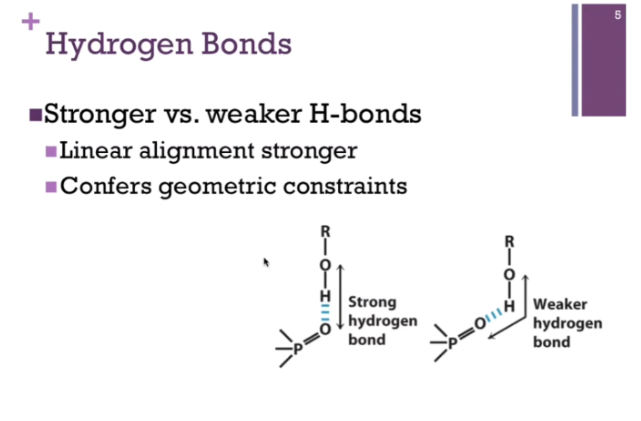
Strength of hydrogen bonds = an AVERAGE, can have stronger or weaker. To form any bond, need close together, proximity and orientation feature.
LINEAR ARRANGEMENT = maximum overlap of those orbitals => SHORTEST DISTANCE and STRONGEST BOND.
Property of Water
One property of water = its ability to form these hydrogen bonding interactions => meaning its highly cohesive.
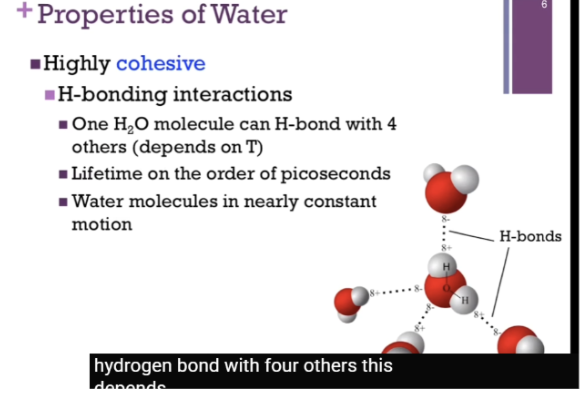
More on Hydrogen Bonding of Water
One water molecule can hydrogen bond with four others. DEPENDS some degree on temperature!! 2 partial negative dipoles (because unshared electrons) and TWO partial positive dipoles on those HYDROGEN atoms. EACH ONE OF THOSE CAN FORM A HYDROGEN BOND! NEARLY CONSTANT motion = dynamic.
Because of highly cohesive nature of water, it creates a high surface tension. SPHERES, one at the center of the screen, = water molecule surrounded 360 degrees by other water molecules so there’s a max degree of hydrogen bonding interactions. Surface molecules can form hydrogen bonds with one another or with molecules below BUT no water molecules above them to form hydrogen bonds. TO EQUALIZE The strength of the interactions with those within the body of the water, those molecules on the surface have a stronger interaction with one another => THAT CREATES a high level of surface TENSION.
Clarification: Molecules at the surface: experience fewer interactions, the attractive forces are unbalanced. Nature tries to make the surface molecules behave more like interior molecules. But they can’t fully do that, so instead: surface molecules pull more strongly on each other, and they form tighter interactions with neighboring surface molecules => creates a “tight skin” on the surface. This is the origin of surface tension: the surface behaves like a stretched elastic film, molecules minimize surface area to become more stable!
Water strider = weight of his body = less than the strength of the interactions of those SURFACE water molecules (less than strength of that elastic film [surface tension concept])!
Water: Solid Less Dense
BECAUSE of the hydrogen bonding interactions of water, it also means that water in the solid is less dense than the liquids. RECALL when form hydrogen bonds, we want that linear arrangement (STRONGEST!), so there’s a geometric constraint on how many we can form AND the order in which they form! IN solid, we have a very CAGELIKE structure, very porous molecule.
confers = gives.
Water solid EXPANDS when solidifies. LESS dense, why ice floats in beverages.
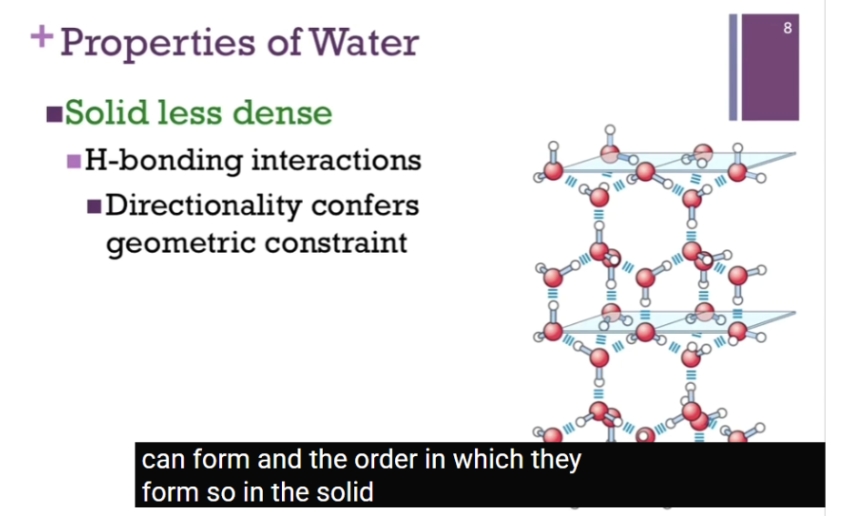
Even More on Hydrogen Bonds in Water
Hydrogen atom between two EN elements.
H Bond Donors/Acceptors
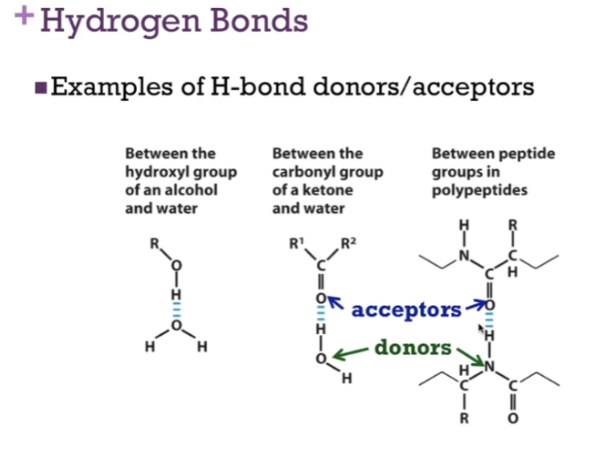
H-bond donors/acceptors. Blue arrow = H-bond acceptor = EN element (right of periodic), lone pairs of electrons to share. Here = both oxygen in a carbonyl group. Hydrogen bond donor would be an EN element that has a H atom to share. On left, water = our donor. ON the right, we have an amine group with a peptide bond as our donor.
van der Waals
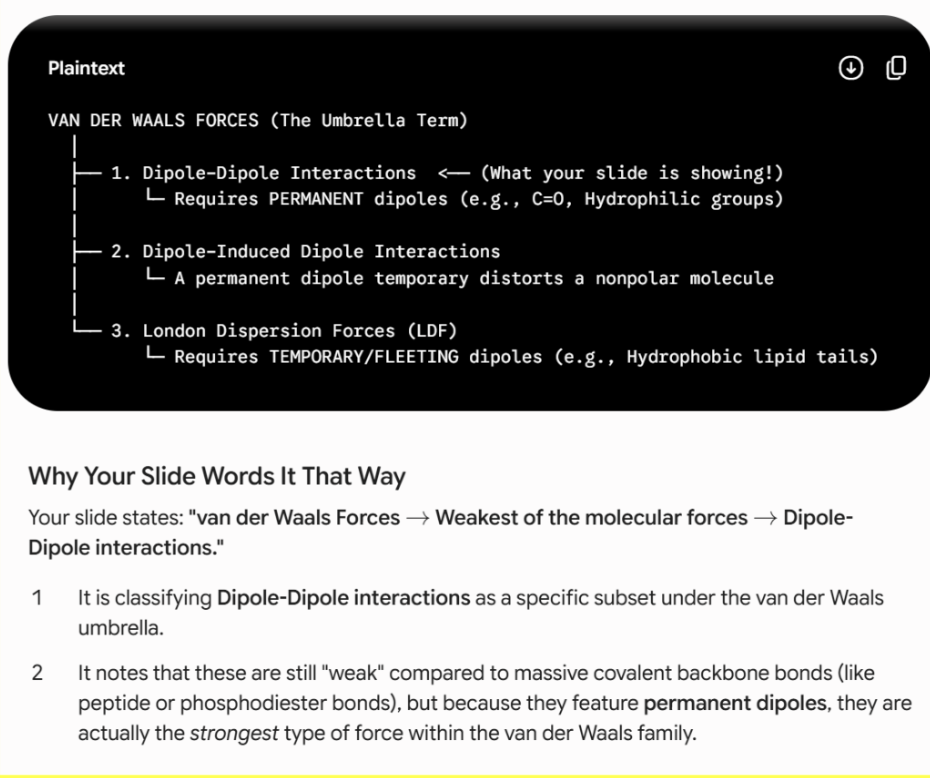
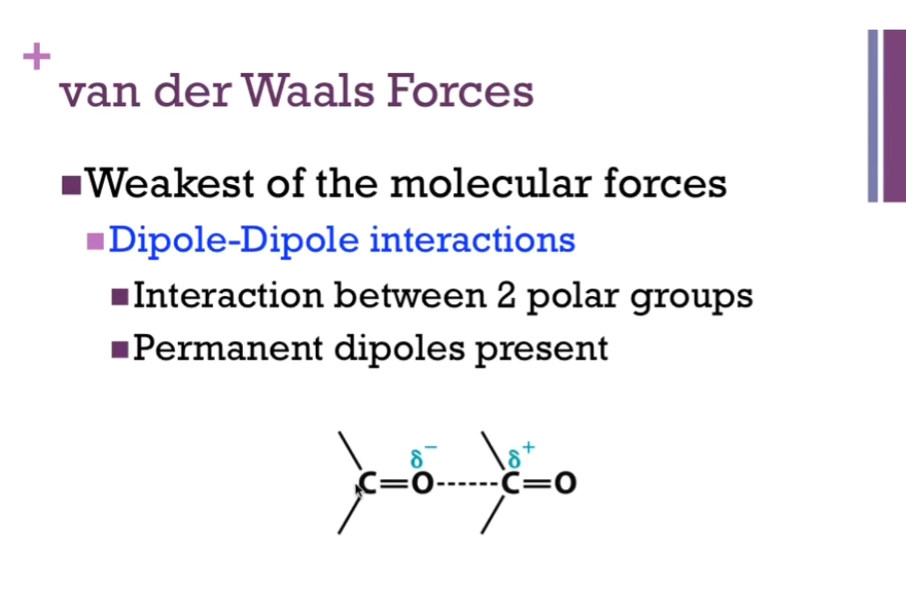
First = dipole-dipole interactions (between two POLAR groups)(like our carbonyl groups here): unequal sharing of those electrons in the bond because oxygen is more EN; it carries a partial negative dipole and the carbon a positive dipole. Those dipoles can align for this dipole dipole interaction. Notice in this case there are permanent dipoles present in the molecules. Clarification to LEFT.
Second: van der Waals Forces: Weakest of the molecular forces = London dispersion forces. Interaction between NONPOLAR molecules. Small fluctuations in e- distribution.
Water as a Dielectric
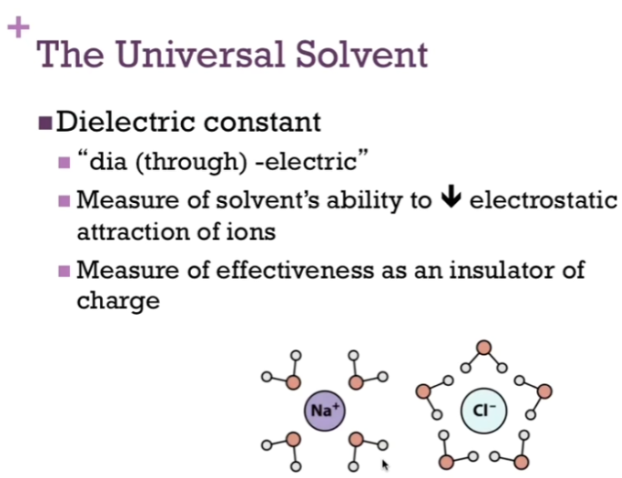
WATER as a DIELECTRIC (measure of solvent’s ability to decrease electrostatic ATTRACTION of ions)!!! Its ability to solvate ions! It prevents them from interacting with each other! MEASURE of effectiveness as an insulator of charge.
Na and Cl are solvated or coated with water molecules. Because of that, they are separated or isolated from one another. More attracted to water.
HIGHER dielectric constant = better insulator of charge! (the more polar the molecule) Formamide = polar. Benzene = nonpolar.
HIGH dielectric constant of water = better solvation by water = better hydration. OTHER solvents can solubilize ions (just need polarity!!). (polarity for better solvation<+? or surrounded by solvent). CALL it “SOLVATION” not HYDRATION.
Solvation or Hydration
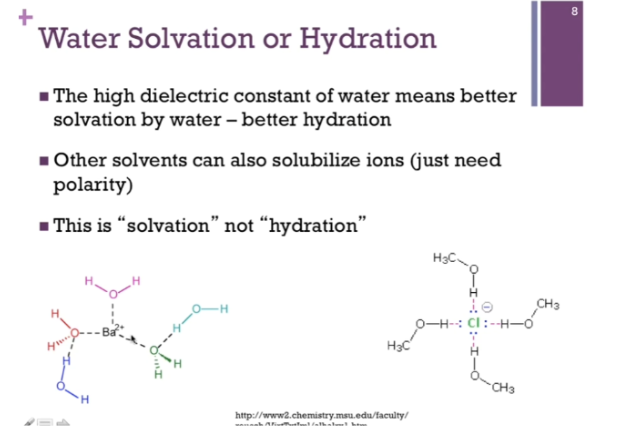
HIGH dielectric constant of water = better solvation by water = better hydration. OTHER solvents can solubilize ions (just need polarity!!). (polarity for better solvation or surrounded by solvent). CALL it “SOLVATION” not HYDRATION.
Left = hydrated with water. Right = solvated with methanol.
Water and Oil Don’t Mix: Entropy!
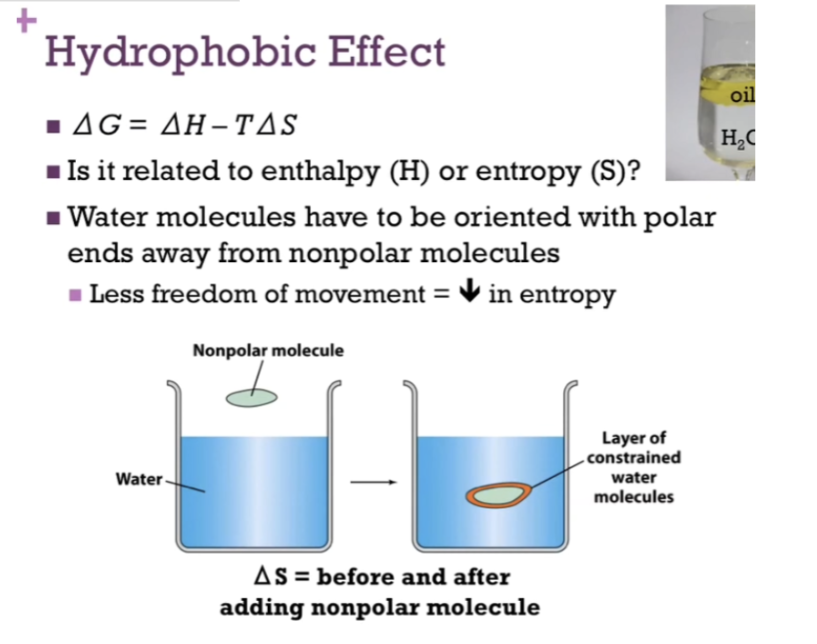
Water and oil don’t mix from a thermodynamic POV. Enthalpy or entropy. Elevate temp, we still see they don’t mix. SO more with ENTROPY (interesting??).
deltaG = deltaH - TdeltaS.
Chat: INTERESTING: The enthalpy change (ΔH): Is somewhat unfavorable because water-water H bonds are disrupted. BUT not enough alone to fully explain immiscibility. If enthalpy dominated: raising temperature could overcome it more easily.
Hydrophobic Effect
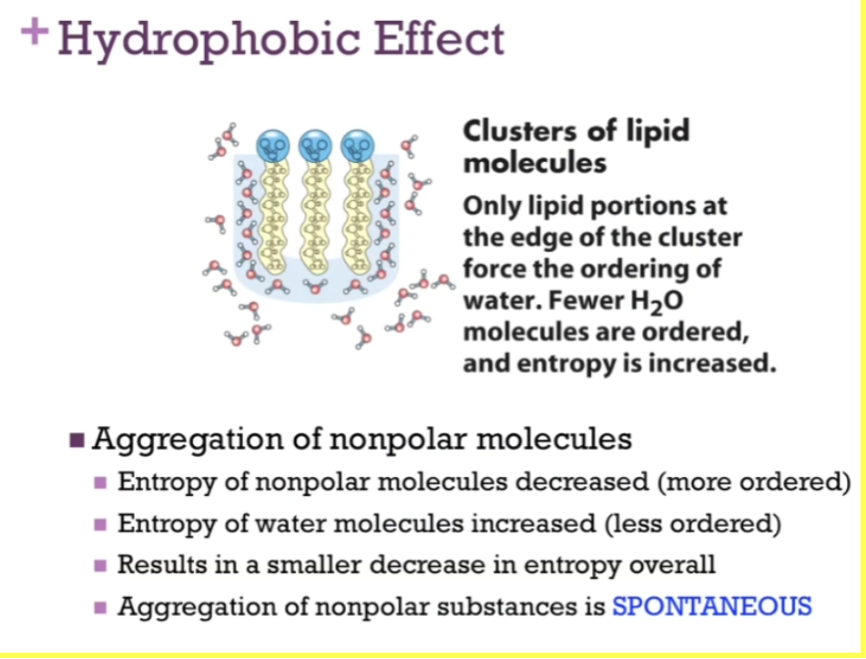
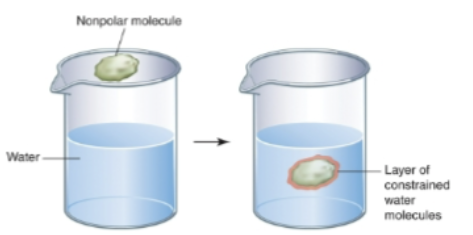
Layer of CONSTRAINED water molecules around NON-POLAR molecules = represents a DECREASE in ENTROPY!
BUT: Water around Na and Cl seemed to be ordered around THEM, they still had freedom of MOVEMENT to interact with one another to form and reform hydrogen bonds to associate and dissociate with those ions.
More on Hydrophobic Effect
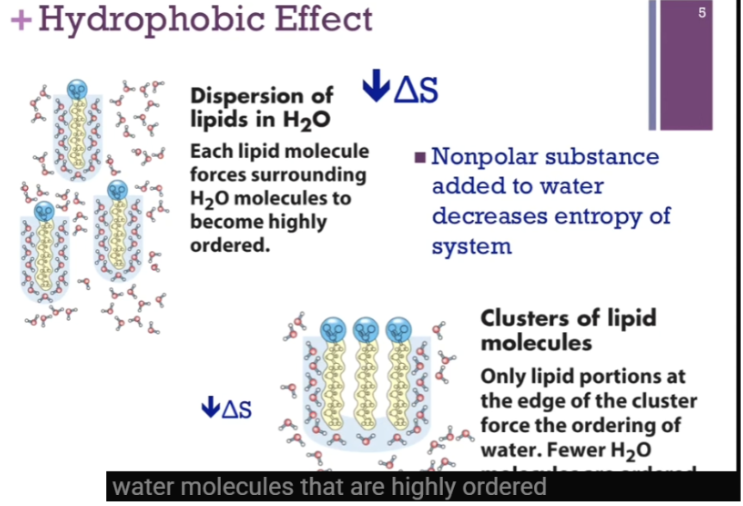
LEFT = Each lipid being solvated. Water molecules that are highly ordered around each IND lipid THUS VERY LARGE DECREASE IN ENTROPY. RIGHT = lipids clustered together: polar head groups associated together and non-polar tails. LOWER DECREASE IN ENTROPY (main point). ACTUALLY AN INCREASE IN ENTROPY (comparatively) compared to dispersion (makes sense but look next flashcard!).
Even More on Hydrophobic Effect
AGGREGATION of NONPOLAR molecules.
Even More and More on Hydrophobic Effect
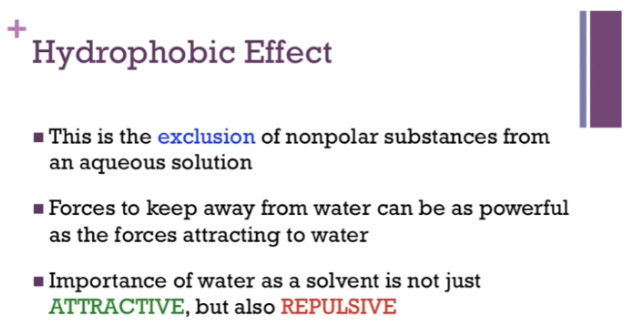
More with water driving away non-polar substances than nonpolar substances interacting with each other!
How lipids associate in water, depends on GEOMETRY of the lipid.
Fatty acid Palmitate. => form micelles.
2 hydrophobic tails => form lipid bilayer!
Free Protons Don’t Exist
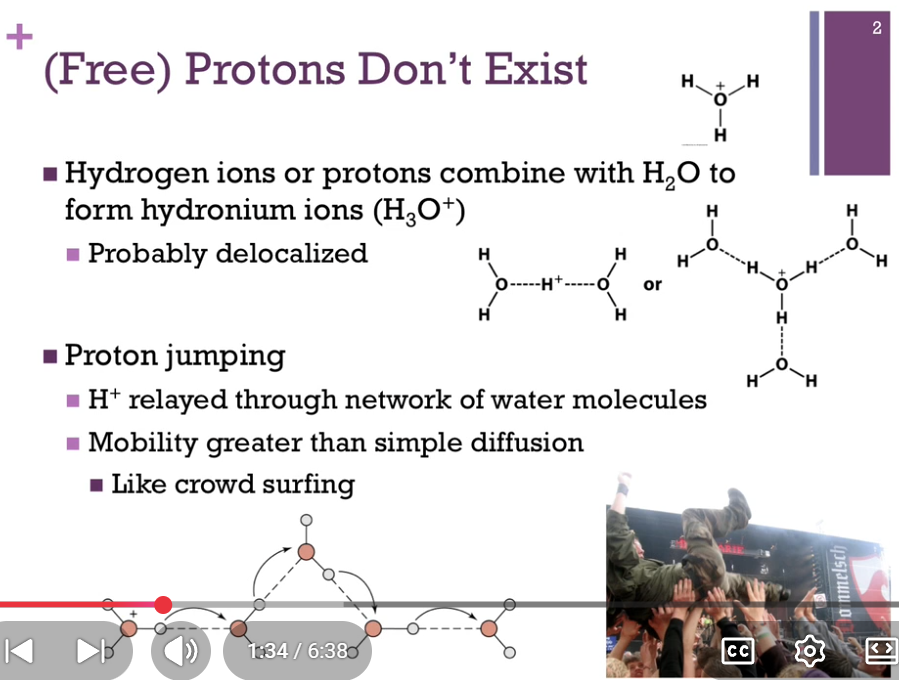
Instead, protons combine with water to form hydronium ions (H3O+).
Concentration of H+ = concentration of H3O+. H+ - relayed through network of water molecules (water = highly hydrogen bonded AND readily changes partners so that proton can move from one water molecule to another very rapidly; mobility is much greater than would be if simple diffusion). Protons crowd surf water molecules!
Hydrolytic bond
A bond that is broken by hydrolysis.
Water as an effective polar solvent.
Water = polar = has uneven distribution of charge. This polarity = key to liquid at RT, high cohesiveness, and LOWER density than other liquids.
Clarification => Water ‘s polarity causes its molecules to form strong hydrogen bonds with each other. Those H bonds are the key reason water behaves unusually compared with many liquids. Liquid water is not lower density than most liquids. What’s unusual is that solid water (ice) is LESS dense than liquid water.
Water H Bond
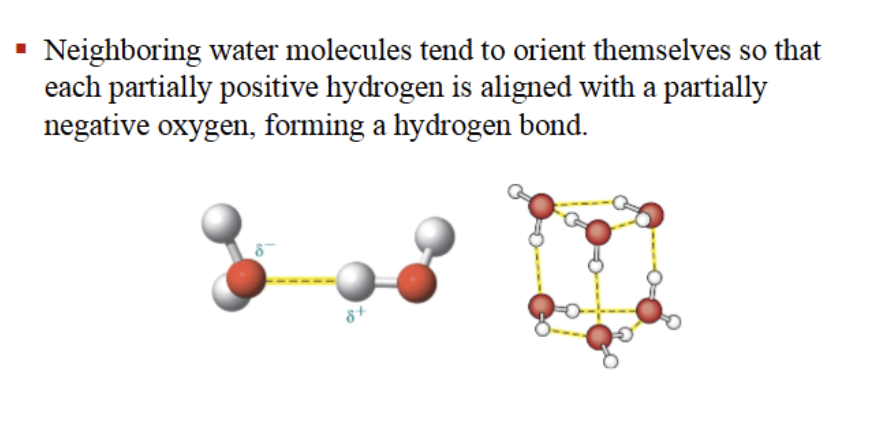
Neighboring water molecules tend to orient themselves so that each partially positive hydrogen is aligned with a partially negative oxygen!! FORMING a hydrogen bond.
4 hydrogen bonds!
Each water molecule can potentially participate in 4 H bonds with other water molecules, but each bond has a lifetime of ONLY 10^-12 secs, WHICH CAUSES the structure of water to constantly flicker as water molecules rotate, bend, and reorient themselves.
ALSO, H bonds CAN form between molecules other than 2 waters (makes sense). H bonds usually involve N-H and O-H groups as HYDROGEN donors!! and the ENEGATIVE N and O and occasionally S atoms as hydrogen acceptors (EN = a measure of an atom’s affinity for electrons).
Water can form H bonds not just with water molecules but with a variety of other compounds that bear N- and O-containing functional groups. Water-alcohol. Water-amine. (Water can be H-bond acceptor or donor).
Ex - H bonds in DNA!! H-bonds IN NUCLEOTIDES are weak attractions that hold complementary bases together in DNA and RNA.
H bonds in DNA
Nucleotides ex. = cytosine and guanine. Nucleotides = characterized by the SHAPE of their nitrogenous bases: pyrimidines (single-ring structure): cytosine (C), T and U. CUT the PyRamid. Pyramids have ONE sharp, single point, single rings.
PURINES = (double-ring structure): GUANINE and adenine. Mnemonic: “PURe As Gold”. Purines are Adenine and Guanine. ONLY two, DOUBLE-ring.
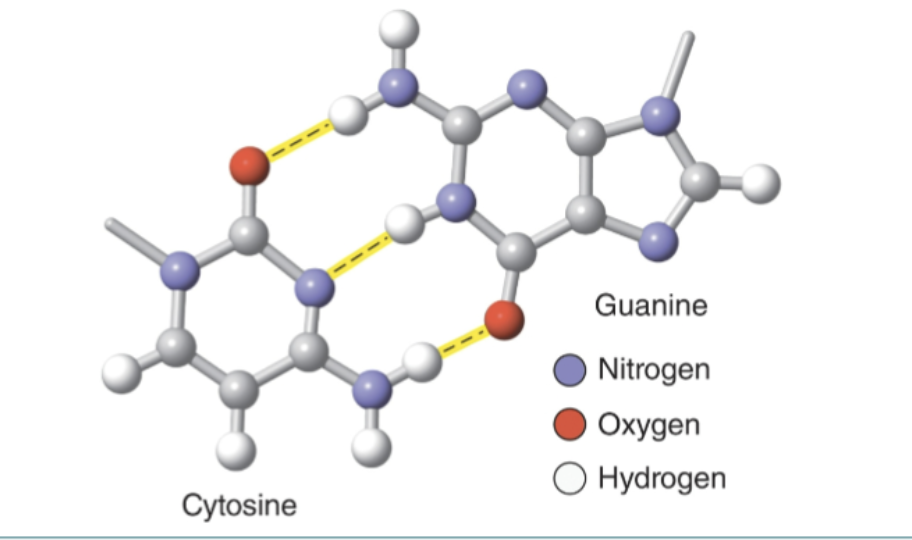
Other Types of Non-covalent Interactions
Electrostatic interactions between charged groups such as carboxylate (-COO-) and amino (-NH3+) groups are IONIC interactions and are intermediate in strength to covalent bonds (strongest) and hydrogen bonds.
Reminder: Strength of bonds: Covalent bonds > Ionic interaction > hydrogen bonds > van der Waals interaction.
The interactions between two strongly POLAR!!!!!!!! (but NOT charged [charged would be ionic] and not hydrogen bond [between EN and a hydrogen atom]) is known as a dipole-dipole interaction!! Clarification: van der waal force; permanent dipoles present; a dipole-dipole interaction is an attraction between two molecules that are POLAR.
London dispersion = weakest of the van der waals forces = occur between NONPOLAR molecules as a result of small fluctuations.
![<p>Electrostatic interactions between charged groups such as carboxylate (-COO-) and <strong>amino </strong>(-NH3+) groups are <strong>IONIC </strong>interactions and are <strong>intermediate </strong>in strength to covalent bonds (strongest) and hydrogen bonds.</p><p>Reminder: Strength of bonds: Covalent bonds > Ionic interaction > hydrogen bonds > van der Waals interaction.</p><p>The interactions between two strongly <strong>POLAR!!!!!!!! </strong>(<strong>but NOT charged [charged would be ionic] and not hydrogen bond [between EN and a hydrogen atom]</strong>) is known as a dipole-dipole interaction!! Clarification: van der waal force; permanent dipoles present; a dipole-dipole interaction is an attraction between two molecules that are POLAR. </p><p>London dispersion = weakest of the van der waals forces = occur between NONPOLAR molecules as a r<strong>esult of small fluctuations</strong>. </p>](https://assets.knowt.com/user-attachments/efb4094b-c287-4c70-9e39-cc5c34a6348e.png)
van der waals: one type = dipole-dipole interactions
The example = between two POLAR molecules (two carbonyl groups).
Ion-ion salt bridge.
An electrostatic attraction between two oppositely charged groups in a molecule, especially proteins. It forms between a positively charged ion (cation) and a negatively charged ion (anion). In proteins, common examples are lys or arg (positively charged). Asparate or glu => negatively charged. Example: NH3+ … COO-. The attraction between these oppositive charges is called a salt bridge. Salt bridges help: stabilize protein structure, hold different parts of a protein together, assist binding between molecules. They are stronger than ordinary dipole-dipole interactions (makes sense dipole-dipole is a van der waal interaction) because they involve dull charges, not partial charges.
Salt bridges can form both: within the same molecule (intramolecular) or between different molecules (intermolecular).
ALSO: even through non-covalent interactions are individually weak, many of them together can require a large amount of energy to break.
Cumulative Effect of Small Forces
Powerful Covalent bonds define basic molecular constitutions, but much weaker noncovalent bonds govern the final 3D shapes of molecules and how they interact with each other.
Water Dissolves Many Compounds
Water has a relatively high dielectric constant, which is a measure of a solvent’s ability to diminish the electrostatic attractions BETWEEN dissolved ions. The higher the dielectric constant of the solvent, the LESS able the ions are to associate with each other.
Each solute ion surrounded by water molecules is said to be solvated (or HYDRATED, to indicate that the solvent is water!).
Biological molecules that bear polar or ionic functional groups are readily SOLUBILIZED, in this case BECAUSE the groups can form hydrogen bond or form ion-dipole interactions with the solvent water molecules!
The environment inside the cell is crowded, but fluid.
There is a huge number of molecules inside the biological system. Inside a cell, the spaces between molecules may be only a few angstrom wide, enough room for only two water molecules to fit!! (aka crowded).
This THIN coating of water may be enough to keep molecules from coming into van der Waals contact (two types: dipole-dipole and the non-polar: LDFs), thereby helping maintain the cell’s contents in a CROWDED but fluid state.
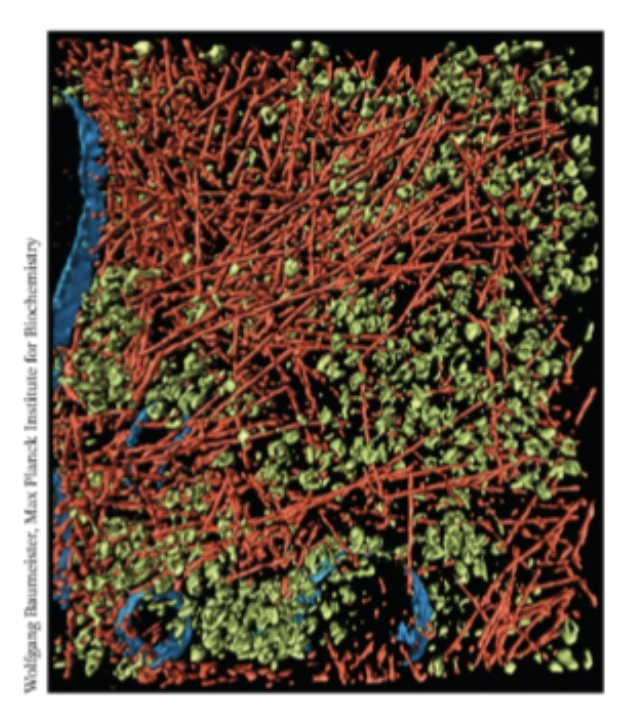
Hydrophobic Effect
Relate the solubility of substances to the hydrophobic effect: The hydrophobic effect REDDUCES the solubility of NONPOLAR molecules because water prefers to hydrogen-bond with itself rather than organize around substances it cannot interact with.
A molecule which lacks polar groups, is relatively insoluble in water and is said to be hydrophobic (water-fearing). Although pure hydrophobic molecules are rare in biological systems, many biological molecules contain hydrocarbon-like portions that are insoluble in water. Molecules with polar OR charged groups are said to be hydrophilic (water-loving).
When a nonpolar substance is added to water, it does not dissolve but forms a separate phase. In order for the water and oil to mix, FREE ENERGY must be ADDED to the system. ENTROPIC EFFORT.
“interact with hydrophobic molecule, can’t move” => Water does not interact well with hydrophobic molecules, so they can’t move or dissolve. “interact” => Hydrophobic molecules are nonpolar, so they cannot form H bonds with water, cannot form dipole-dipole interaction (between polar molecules) with water, only have VERY weak van der waals forces (LDFs!) (BTW! LDF exist between all molecules, meaning they DO occur between a polar molecule and a nonpolar molecule!).
Nonpolar molecules DO NOT DISPERSE in water OR become individually hydrated. INSTEAD, they are forced together, away from contact with water molecules!! The exclusion of nonpolar substances from an aqueous solution is known as the HYDROPHOBIC EFFECT.
T/F: The hydrophobic effect, resulting in the exclusion of nonpolar substances from an aqueous solution, is the result of strong, attractive forces between the nonpolar molecules
F! It’s mainly driven by water’s behavior. Water prefers to H bond with itself. Nonpolar molecules cannot interact favorably with water. Water forms ordered “cages” around nonpolar molecules, which is energetically UNFAVORABLE (low entropy). TO INCREASE entropy, water excludes nonpolar molecules, causing them to cluster together!
Nonpolar molecules experience a small attractive force due to:
van der waals (LDFs).
Ex. terminal methyl groups interact with each other by LDFs.