lecture 8: nuclease enzymes
 Call Kai
 Learn
Learn Practice Test
 Spaced Repetition
 Match
Match Flashcards
 Knowt Play
1/10

There's no tags or description
Looks like no tags are added yet.
Name | Mastery | Learn | Test | Matching | Spaced | Call with Kai |
|---|
No analytics yet
Send a link to your students to track their progress
11 Terms
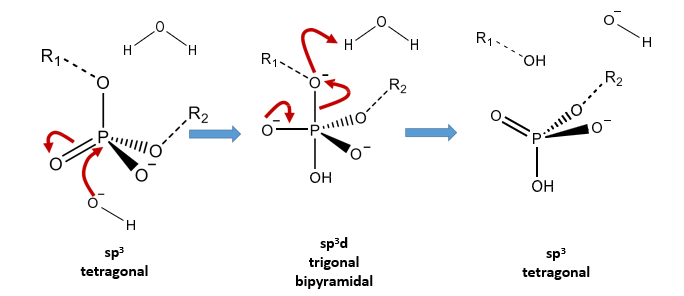
hydrolysis of the phosphodiester bond in an SN2 reaction:
Substitution: AB + C <=> AC + B
nucleophile: donates an electron lone pair
2 molecules: bimolecular
the general schemem for hydrolysis of nuceic acids mechanism
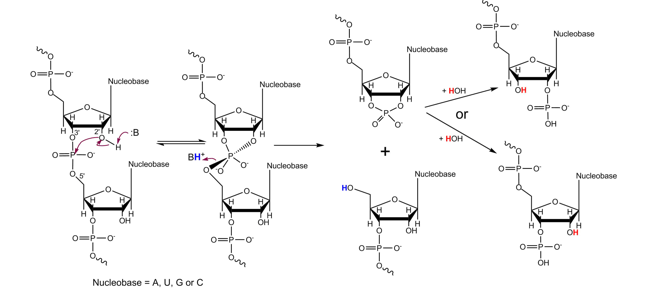
mechanism for which RNA phophodiester bond self-cleaves under alkaline conditions
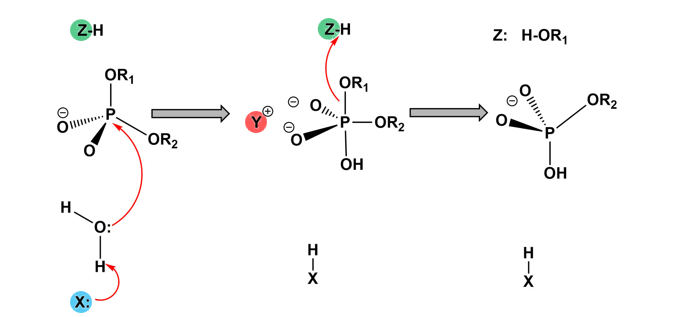
describe the general mode of action for restriction endonucelases
the enzyme non-specifically binds randomly onto the DNA strand
the active site aligns with the phosphodiester bond it is designed to cut
nucleophilic attack with water to break the bond
after both strands are cut, the enzyme is released
what are the 2 most well characterised type II restriction endonucleases (REases)
EcoRI and EcoRV
explain the signature motif in EcoRI and EcoRV
PD…D/ExK
the proline and aspartate are involved in positioning the backbone
the aspartate/glutamate and lysine coordinates the magnesium ion
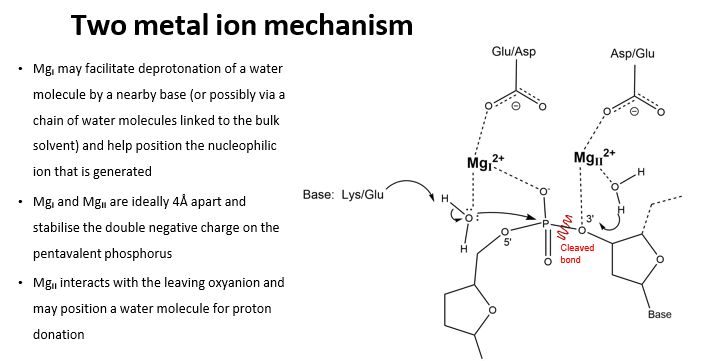
what are the reasons that REases need metal ions to enable the catalytic process?
enhance the deprotonation of the attacking water (nucleophile)
stabilises the negative charge on the pentavalent intermediate state of the phosphate
could provide some stabilisation to the leaving 3’ oxyanion
what metal ions can REases use?
Mg2+
Mn2+
Ca2+ (but could inhibit the enzyme)
one metal ion mechanism
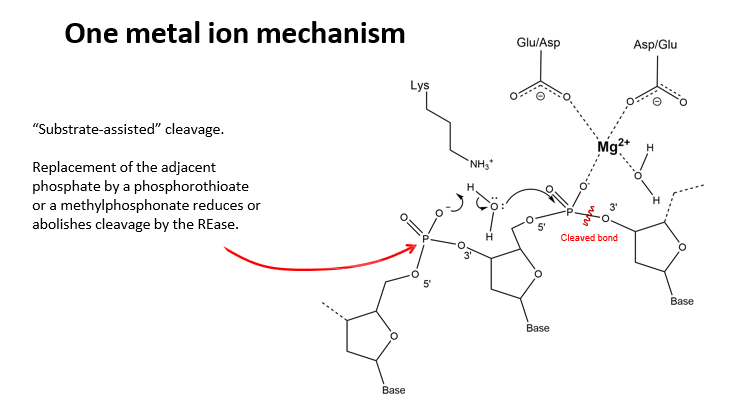
2 metal ion mechanism
HNH-family nucleases
contains a number of conserved histidine and asparagine residues
they use metal ions to faciliate the phosphodiester bond cleavage (can use Mg2+, Ni2+, Co2+, Zn2+)