SCM THEORY.
 Call Kai
 Learn
Learn Practice Test
 Spaced Repetition
 Match
Match Flashcards
 Knowt Play
1/322

Earn XP
Name | Mastery | Learn | Test | Matching | Spaced | Call with Kai | Chat |
|---|
No analytics yet
Send a link to your students to track their progress
323 Terms
SUPPLY CHAIN ?
Network of org. made of suppliers who collaborate to the manufacturing, the delivery and the sales of products and services to customers.
the 3 flows ?
materials
Information
Cash flows
Logistics ?
its focuses on the storage and distribution of products.
→its part of the supply chain
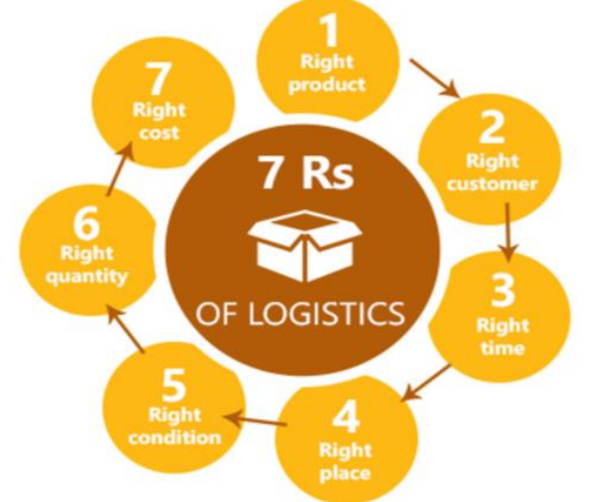
the 7 R’s of logistics ?
1. Right product
2. Right consumer
3. Right time
4. Right place
5. Right condition
6. Right quantity
7. Right cost
Supply Chain Management ?
It’s a global concept that associates several SC processes to obtain competitive advantage.
SC process ? (Business process)
activity that transforms ressource into another resource by adding value.
Efficient SC ?
makes the best use of its ressources.
minimise costs for materials
Reduce time waste
Only for High volume and low demand.
LEAN -> cost effective.
Effective SC ?
-> adapt quickly to change the specific needs of customers.
For high demand
For customized product offering
Responsive
The 3 V’s ?
Visibility (+).
- share end use the same infos across the SCM in real time. (Quick and accurate response)
Variability (-)
- eliminates the unwanted and unplanned variability of flows
(-> avoid customer delivery backlogs, bullwhip effect)
Velocity (+)
- speeds up SC flows to reduce delivery lead times
(reduce inventory needs)
Business strategy ?
It’s plan for choosing how to compete with product & services Focused on Lowest cost, différenciation
SC strategy ?
Plan on how SC’ll function to meet business strategy
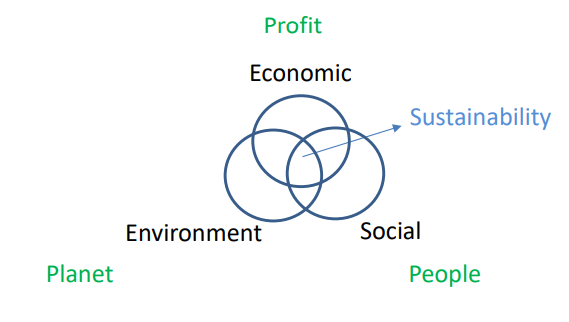
TBL ?
Triple Bottom Line :
1. Profit -> Economic
2. People -> Social
3.Planet -> Environment
Risks of the SCM ?
environmental, geopolitics, economics.
The business Strategy defines … ?
The order qualifiers and order winners.
Order qualifier ?
competitive characteristic to be viable competitor in the marketplace
Oder winner ?
competitive characteristic to be chosen by the customer
Direct shipments ?
its when the production site is near the customer location, that makes the shipment direct.
Distribution Centers ?
short delivery leadtime
transportation cost (truck, distance)
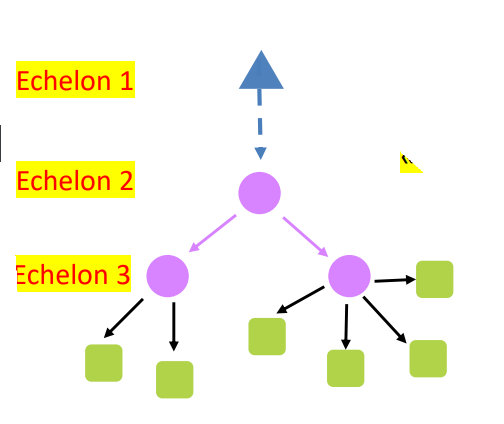
Distribution center ?
Hub
Distribution center close to customer ?
Spoke
Multi-echelon distribution network ?
They consolidate, distribute and store.
Push flow ?
products are moved to inventory based on forecasted demand.
Goal of the push flow ?
satisfy customer orders when they come in.
Pull flow ?
products are moved only at time a real order is placed
Goal of the pull flow ?
delivered to the customer once available
Stock ?
needed to decouple push and pull flows,
-> reduce leadtime and face supply & demand variation
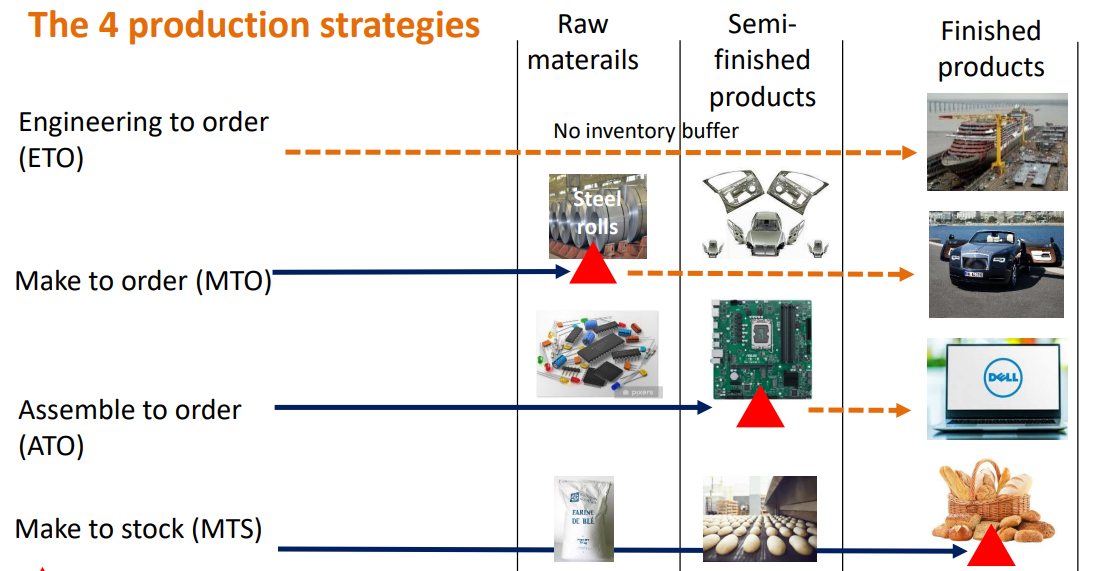
The 4 production strategies ?
1. ETO : Engineer To Order
2. MTO : Make To Order
3. ATO : Assemble to order
4. MTS : Make to stock
JIT ?
Just in Time → improve a business return on investment by reducing in-process inventory and associated carrying costs. It emphasizes producing only what is needed, when it is needed.
The SCOR model ?
The Supply Chain Operation Reference → detailled SC mapping methodology chains to describe, diagnose and improve supply. Focused on the 5 pillars
What’s the 3 steps that the SCOR model need ?
Mapping the Supply Chain,
Configuration of the flows (production strategies,…)
Detailed operation procedures
What’s the 5 basic processes of the SCOR model ?
1. Plan
2. Source
3. Make
4. Deliver
5. Return
Supply Chains are described according to 3 levels ?
1. Scope
2. Configuration
3. Business activities
maintenance Corrective ?
Carried out in the event of a malfunction
maintenance Corrective Palliative ?
immediate temporary repair of an equipment malfunction (“failure”)
maintenance Corrective Curative ?
Restore normal functioning of the equipment
maintenance Preventive ?
Planned maintenance to avoid malfunction
maintenance Preventive Systematic ?
planned at regular intervals (time based) or according to production volume (*)
maintenance Preventive Conditional ?
requested when a measurement reaches a threshold value (wear sensors, vibration or temperature measure,etc…)
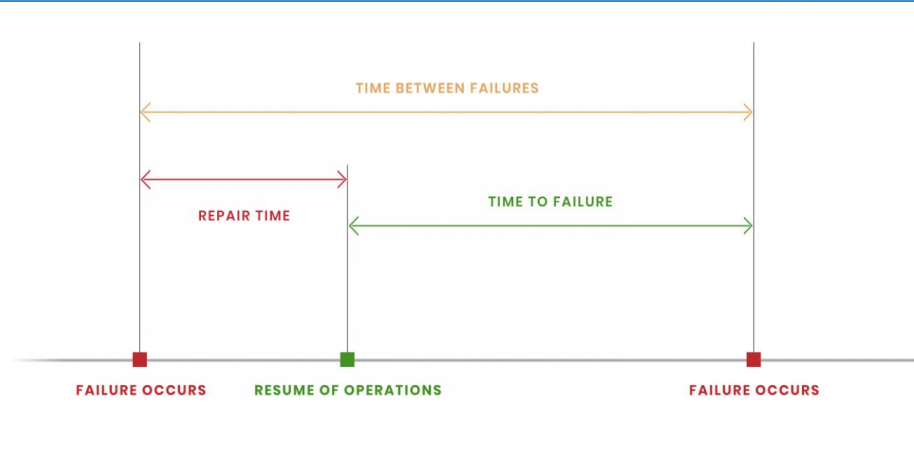
MTBF ?
Mean Time Between Failure → average time between 2 failures.
MTTR ?
Mean Time To Repair → average time to repair.
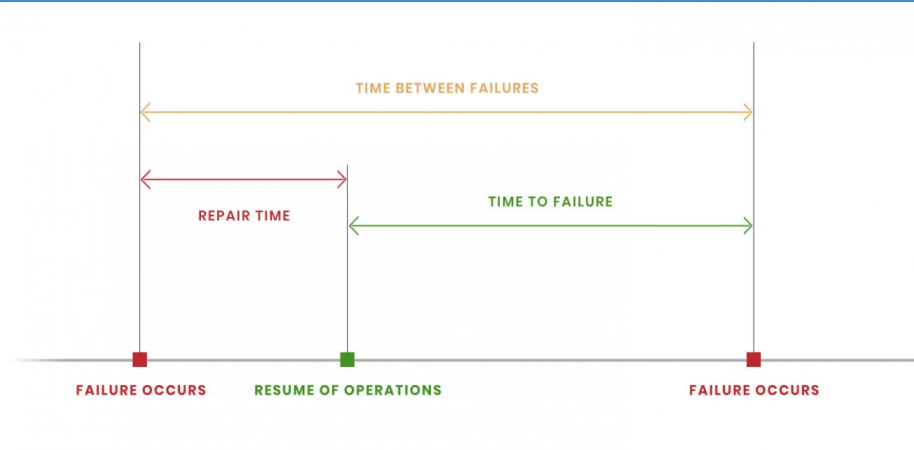
MTTR formula ?
Σ repair time / Number of stops due to failure.
KPI Reliability ?
Goal : no failure
Measure : MTBF
How to improve : correct usage, preventive maintenance
KPI Maintenability ?
Goal : Get quickly repaired
Measure : MTTR
How to improve : Documentation, after repair service, conception
KPI Availability (goal/measure/improve) ?
Goal : Always capable to operate
Measure : MTBF & MTTR
How to improve : All of above
OEE formula ?
Effective time / available time
By reducing lead times, we improve the … ?
→ SC velocity.
→ Customers can get new suitcase much faster.
Purchase/ Replenishment (approvisionnement) ?
-> Covers the act of ordering from suppliers.
Direct procurement ?
Its the materials (ingredients / components) that are needed to produce another product. And materials that are purchased for resale.
Indirect procurement ?
→ investment in equipments (machinery, building, truck,…) and, other spending required to operate (energy, spare parts, office supplies,…)
TCO ?
-> Sum of anticipated spending for a product over its entire life for a given use (visible cost + “invisible costs”)
Lease levers ?
Long-term, fixed agreements,
Lower cost over long period
Minimise risks
Rent levers ?
Short term, flexible agreement
Cost higher for prolonged use
High flexibility
Adaptability for businesses to manage resources effectively.
Buy levers ?
Capital expenditure (CAPEX)
What’s the types of set up contract ?
Purchase order : purchase transaction
Supply contract : legal agreement
Partnership : legal agreement
Working with the supplier for ?
improving the performance
Ensuring the supplier
Improve products for existing
How to work with the supplier ?
sharing KPI performance
Auditing the suppliers
Requesting the supplier to get certified
QMS ?
its a set of best practices regarding quality management.
ROP ?
Reorder point (point de commande)
→ Once a certain level of remaining inventory is reached.
SS ?
Safety Stock is an extra quantity of a product to prevent an out of stock situation.
→ If demand is stable and the supplier always delivers on time, it’s never consumed and therefore very small.
Periodic review ?
-> Purchase order are issued at fixed interval such as each week on Friday.
ETO ?
Engineering To Order : Conception is launched when an order has been received
MTO ?
Production strategy where items are manufactured only after a confirmed order is received, allowing for customization and minimizing excess inventory.
ATO ?
(PC components), the E have the components ready, and assemble them according to the commands.
MTS ?
Make To Stock : Material Production are launched Mass production, predictable demand, low storage costs, (→ toothpaste, cereals)
When a minimum quantity of stock is used, the flow is called ?
→ pull flow
PTO ?
Package To Order : les produits sont conditionnés après la réception des commandes clients.
Delivery with central hub?
Enables all customers to be delivered from a single site (→ reduces stock levels and improves delivery vehicle fill rates).
Delivery via decentralized platforms?
Each platform is responsible for delivering to customers in a given region.
delivery via a multi-level network of platforms?
→ Organised on several levels.
Ex: central platform & regional platforms. The central hub delivers to the regional hubs and the regional hubs in turn deliver to the distribution sites.→ Organised on several levels.
delivery via a crossdocking (CD) platform or just-in-time delivery?
Products are unloaded from inbound vehicles, sorted, then loaded into outbound vehicles without being put into storage. → reduces delivery times and stock levels.
delivery using a coordination center?
pools goods from several suppliers on a common platform to deliver to the same customers using the same trucks
Supply management processes ?
Planning delivery and inventory requirements, as well as the physical and administrative follow-up of deliveries and inventories of purchased products
direct purchases?
Production of a product/service that is produced.
- Often automated
- Replenishment method based on frequency and quantity
- Quantity and/or frequency can be fixed.
indirect purchasing ?
Management often difficult because:
Small amounts -> management costs more than the purchase amount?
Recurring
Scattered throughout the company
Orders often “manual
Matrix KRALJIC?
Define the purchasing strategy by category and divide the purchasing categories into 4 distinct groups according to 2 criteria (the category's impact on the E's business, and the E's influence on the supplier market).
Strategic dial?
High-tech products
Lever dial ? (Cadran)
Products that represent a significant proportion of the cost of the final product.
Critical products dial?
Products whose cost is low in relation to the cost of the finished product, but whose supply is critical to the E.
Single product dial ? (Cadran)
Relatively low-value products offered by a large number of suppliers
Pareto ?
Prioritize spending
Kraijic ?
Purchasing management model → classify products according to risk and impact on the bottom line. → Identifies 4 main categories: strategic, leverage, non-critical and bottleneck.
Information request (RFI) ?
To obtain information about the company and its products/services
Request for proposals (RFP) ?
Aim to receive a commercial and technical proposal that meets a set of specifications.
Request for quotation (RFQ) ?
Simple price requests for standard products
How to improve purchasing performance?
Cutting costs or reducing the environmental impact of purchasing
nomenclature ?
liste de tous les ingrédients / composants élémentaires entrant dans la composition d’un produit
Opening time ?
Total available - process cloture
Requested time ?
Opening time - planned maintenance
Available time (actual productive time)
requested time - quality rejects, cadence loss & machine breakdowns
Stoppages & “actual productive time ?
quality rejects, cadense loss & machine breakdowns
OEE ?
Manufacturing process productivity measure (KPI) which quantifies the % of unplanned lost time
the nominal rate (cadence nominale) ?
the quantity the process produce per unit of time TAKING into account stoppages or unplanned losses.
In this list of elements, which one IS NOT part of the BOM but belongs to the routing ?
The description and the sequencing of the operations
a multi-echelons distribution network has at least… ?
Two warehouses
The main focus of an effective & efficient SC is to … ?
Make the best use of its ressources (LEAN)
Company A offers a new product feature valued by customers and that competition doesn’t offer. This new feature is an … ?
”Order winner”
company A offers the same day delivery service to remain competitive with company B. This service is a … ?
”order qualifier”
Supply chain and logistics have exactly the same meaning ?
No
Logistics refers to :
movement of goods, storage and transport
The supply chain strategy … ?
is the plan on how the SC will operate