(Reactions) Carboxylic Acids
 Call Kai
 Learn
Learn Practice Test
 Spaced Repetition
 Match
Match Flashcards
 Knowt Play
1/19

There's no tags or description
Looks like no tags are added yet.
Name | Mastery | Learn | Test | Matching | Spaced | Call with Kai |
|---|
No analytics yet
Send a link to your students to track their progress
20 Terms
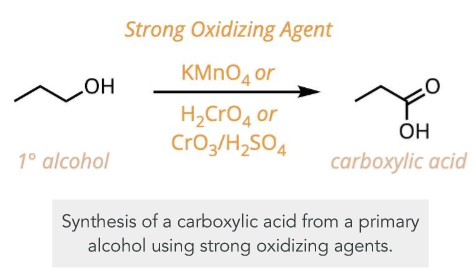
Carboxylic acids can be synthesized from primary alcohols via the use of:
strong oxidizing agent (KMnO4, H2CrO4, CrO3/H2SO4 (Jone’s reagent))
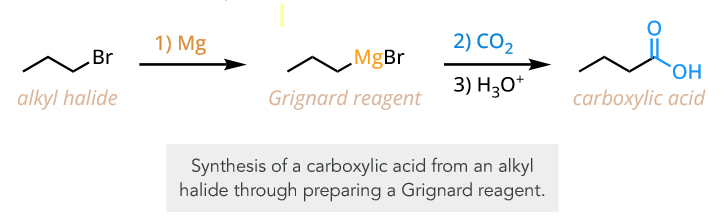
Carboxylic acids can be synthesized from alkyl halides, using ________ ________ and ________, followed by an acid workup.
Grignard reagent, and CO2
Carboxylic acid derivatives:
amide, ester, acid anhydride, acid halide
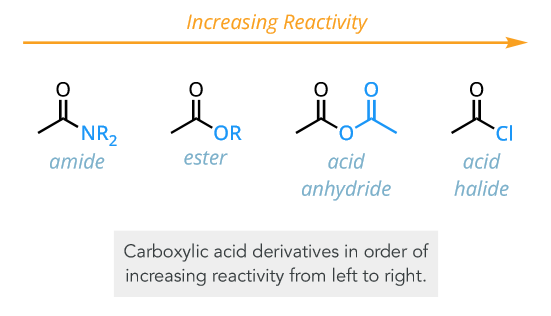
The relative reactivity of carboxylic acid derivatives is correlated with the:
stability of their leaving group.
The most reactive carboxylic acid derivative is:
acid halide
Carboxylic acid derivatives react via:
nucleophilic acyl substitution
Fischer esterification converts a carboxylic acid into an ________ in the presence of an ________ and a strong acid catalyst.
ester; alcohol.
Ester can be converted back into a carboxylic acid by reacting it with:
aqueous acid
Saponification can convert ________ into carboxylic acid, in the presence of ________.
ester; NaOH.
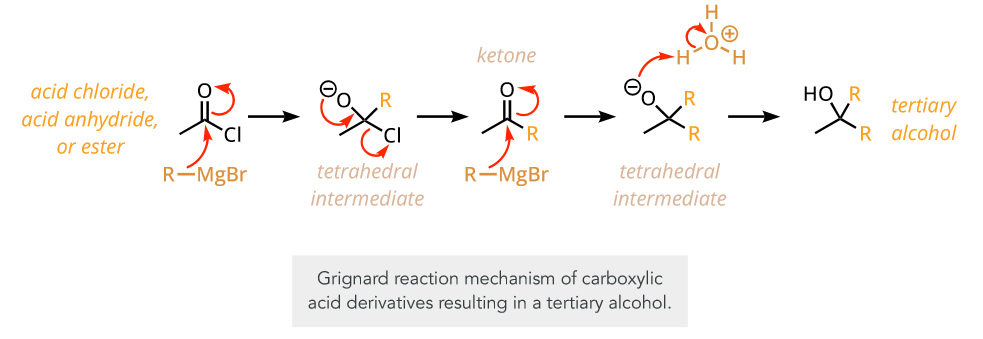
Two Grignard reagents can react with an acid chloride, acid anhydride, or ester to form a:
tertiary alcohol
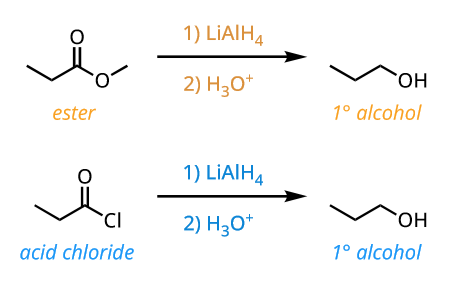
LiAlH4 is a strong reducing agent that reduces esters and acid chlorides to:
alcohols.
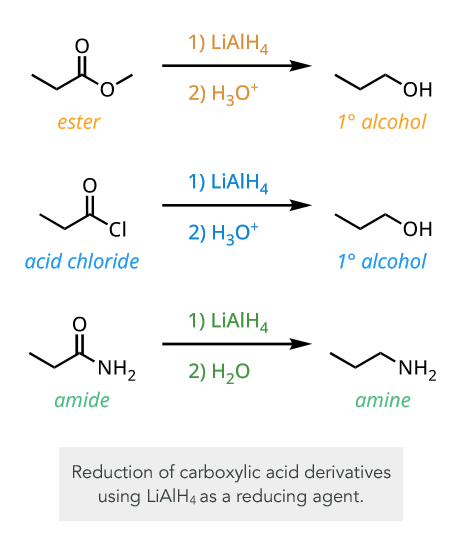
LiAlH4 can reduce amides to:
amines.
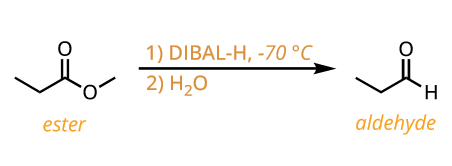
DIBAL-H is a mild reducing agent that, at low temperatures, can reduce ________ to an aldehyde.
ester
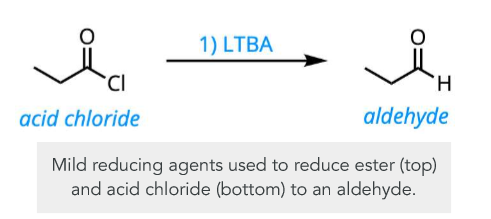
LTBA is a mild reducing agent that can reduce ______ _______ to an aldehyde.
acid chloride
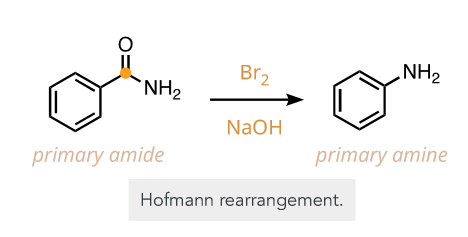
Primary amide reacted with molecular bromine (Br2) and hydroxide (OH-) produces:
primary amine
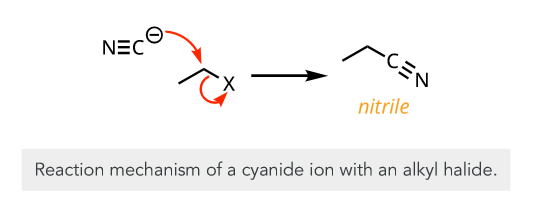
An alkyl halide reacting with a cyanide ion produces:
nitrile (C-N triple bond)
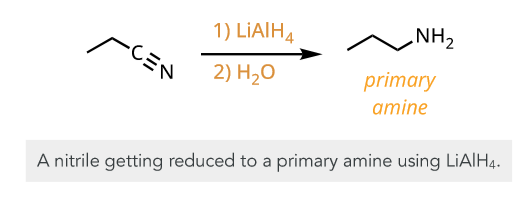
Nitriles can be reduced to primary amines with:
LiAlH4 (lithium aluminum hydride)
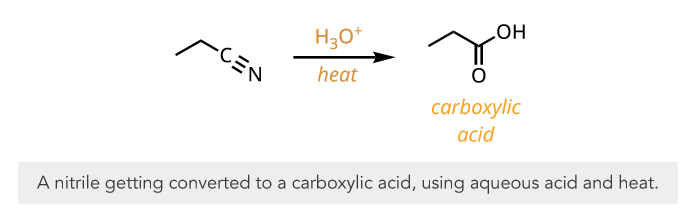
In nitrile hydrolysis reactions, nitrile reacts with aqueous acid and heat to produce:
carboxylic acid
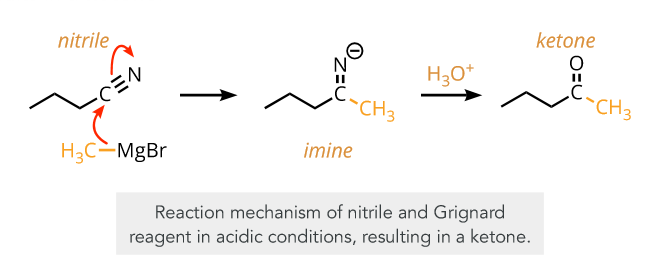
A nitrile reacting with a Grignard reagent, followed by an acid workup, produces a:
ketone
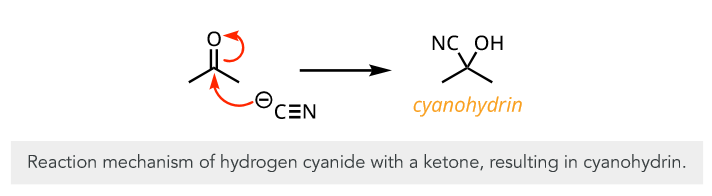
Hydrogen cyanide (HCN) can react with an aldehyde or ketone to form a:
cyanohydrin