Chapter 15: Dienes and Aromaticity
 Call Kai
 Learn
Learn Practice Test
 Spaced Repetition
 Match
Match Flashcards
 Knowt Play
1/37

There's no tags or description
Looks like no tags are added yet.
Name | Mastery | Learn | Test | Matching | Spaced | Call with Kai |
|---|
No analytics yet
Send a link to your students to track their progress
38 Terms
conjugated dienes
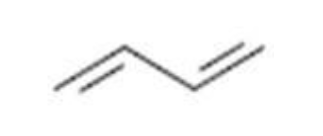
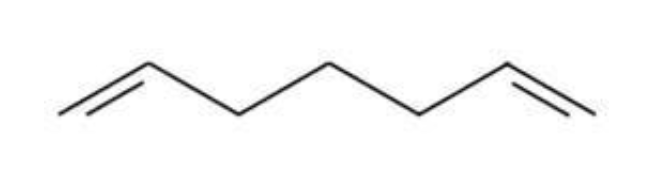
cumulenes
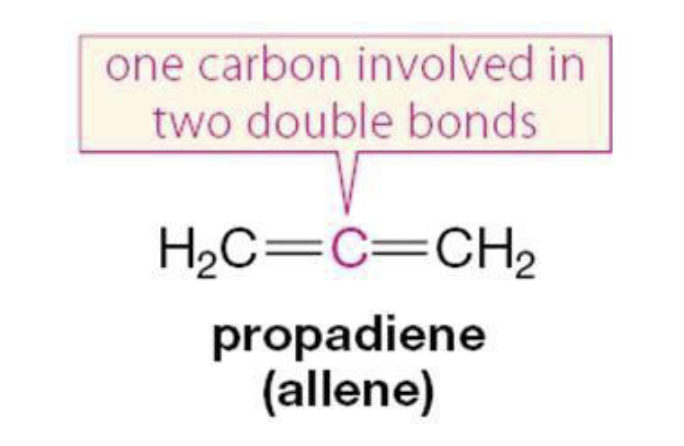
non-conjugated dienes
Conjugated dienes have (higher/lower) energies and (higher/lower) heats of formation, thus are (more/less) stable than isolated or cumulated dienes.
lower, lower, more
More nodes → (more/less) destructive interference
more
In a conjugated diene, four adjacent p orbitals overlap to form…
four π molecular orbitals (two bonding and two antibonding)
Resonance structures symbolize electron…
delocalization
Why is electron delocalization stabilizing?
it results in additional bonding via low-energy bonding MOs
Resonance is a ____ effect.
stabilizing
The most stable conformation of dienes is…
s-trans conformation
The second most stable conformation of dienes is…
gauche/skew conformation
The least stable conformation of dienes is…
s-cis conformation, due to van der Waals repulsions
The two π bonds of cumulated dienes are…
mutually perpendicular
Some allenes are chiral even though they lack…
an asymmetric carbon atom
Dienes and ordinary alkenes display similar…
IR and NMR spectra
UV-vis light can probe the extent of conjugation in conjugated systems using…
UV-vis spectroscopy
UV-vis spectrum
graph of radiation absorption by the substance vs the wavelength of radiation
chromophore
the structural feature (atom or group of atoms) of a molecule responsible for its UV-vis absorption
absorbance
measure of the amount of radiant energy absorbed
What is the equation for absorbance?
A = log (I0÷I)
where I0 is intensity of radiation entering a sample, I is the intensity of light emerging from the sample
λmax
wavelength at the maximum of an absorption peak
Beer’s Law
relates the amount of light absorbed by a substance to its concentration
A = Elc
where E is molar extinction coefficient, l is path length, and c is concentration
Larger values of molar extinction coefficients → (greater/lesser) absorbances at a given concentration and path length
greater
Typical alkenes absorb UV at very (large/small) wavelengths.
small (<200 nm)
Conjugated double/triple bonds absorb at wavelengths ____
>200 nm
What is most useful for diagnosis of…
conjugated systems
UV/visible light energy causes an _____ ______ between HOMO and LUMO.
electronic transition
UV (___ - ____ nm) and visible radiations (___ - ____ nm) have enough energy to cause electronic transition from n → π* and π → π*.
UV → 190 - 400 nm
vis → 400 - 800 nm
What is the most important part of the UV-vis spectrum?
λmax
The more consecutive conjugated multiple bonds there are, the (higher/lower) λmax is.
higher
π-electron promotion occurs from (HOMO/LUMO) to (HOMO/LUMO).
HOMO → LUMO
The HOMO-LUMO gap becomes (bigger/smaller) as the number of conjugated double bonds increases.
smaller
Longer π-system → (higher/lower) λmax
higher
Each additional conjugated double bond increases λmax by…
30 - 50 nm
What other factors affect λmax besides conjugation?
substituents
conformation
Dienes locked into ____ conformation have higher λmax
s-cis
Each additional alkyl group increases λmax by…
5 nm