Intro to Neuro Ch 4 Textbook
 Call Kai
 Learn
Learn Practice Test
 Spaced Repetition
 Match
Match Flashcards
 Knowt Play
1/79

There's no tags or description
Looks like no tags are added yet.
Name | Mastery | Learn | Test | Matching | Spaced | Call with Kai |
|---|
No analytics yet
Send a link to your students to track their progress
80 Terms
A person who has had limbic stem cell transplantation surgery to repair a damaged limbic stem may still have difficulties _____.
seeing something from different points of view
Brain computation takes place in ____.
the gray matter
A person who is missing many responses in _____ will have difficulties with reading and recognition of fine patterns.
the center of the visual field
The embryo undergoes rapid cell division resulting in the development of three distinct cell layers. The nervous system will develop from the ____ .
ectoderm
The correct order of the stages of neural development are _____.
neurogenesis, cell migration, cell differentiation, synaptogenesis, cell death, synapse rearrangement
According to the prevailing theory, nearly half the neurons that form during prenatal development go on to die because _____.
they did not make appropriate synaptic connections
The ____ stage of neural development includes the growth of dendrites.
cell differentiation
Neurons do not divide, but the cells that will give rise to neurons begin as a single layer of cells along the inner surface of the neural tube. These cells divide in a process called mitosis, which takes place within the _____ inside the neural tube. Eventually, some cells migrate and begin transforming into either neurons or glial cells.
ventricular zone
As the nervous system grows, cell migration follows, as the cells _____ to fill out the brain.
move over relatively long distances
The postnatal increase of human brain weight is due primarily to growth in the size of neurons, branching of dendrites, elaboration of synapses, increase in myelin, and _____.
addition of glial cells
The outer cellular layer of the developing embryo that gives rise to the nervous system is called the __________.
ectoderm
Which of the following occurs during cell differentiation?
Cells acquire distinctive characteristics as a result of expressing specific genes.
The general process during development in which one cell affects the differentiation of other, usually neighboring, cells is called __________.
cell-cell interaction
A cell that is undifferentiated and therefore can take on the fate of any cell that a donor organism can produce is called a(n) __________
stem cell
Which division of the vertebrate brain gives rise to the cerebellum?
Hindbrain
Which of the following arise from the forebrain? (Select all that apply.)
Thalamus
Hypothalamus
Cerebral hemispheres
A target-derived chemical that acts as if it "feeds" certain neurons to help them survive is called a(n) __________ factor.
Trophic
True or False: The establishment of synaptic connections as axons and dendrites grow is called synaptogenesis.
True
The developing human is called a(n) __________ during the first 10 weeks after fertilization and a(n) __________ thereafter.
Embryo; fetus
Which of the following terms refers to the development process during which surplus cells die?
Apoptosis
The last stage in the development of the nervous system is __________.
synaptic remodeling
Which of the following factors most likely determine the synapses that are retained in the brain and those that are removed? (Select all that apply.)
Neural activity
Intellectual stimulation
Which of the following is typical of people with fragile X syndrome? (Select all that apply.)
A prominent chin
An elongated face
Large prominent ears
Reduced visual acuity of one eye that is not caused by optical or retinal impairments is called __________.
amblyopia
A graph that portrays the strength of response of a brain neuron to stimuli presented to either the left eye or the right eye is called a(n) __________ histogram.
ocular dominance
Samantha is an adult who is deprived of light in the right eye for two years from the age of 30 to 32. How is this deprivation likely to affect Samantha's vision?
The temporary deprivation will have no permanent impact on Samantha's vision.
True or False: Findings suggest that fragile X syndrome blocks the normal elimination of synapses after birth, which causes intellectual disability.
TRUE
True or False: The period during development in which an organism can be permanently altered by a particular experience or treatment is called a sensitive period.
True
Synapses that grow stronger or weaker depending on their effectiveness in driving their target cell are known as __________ synapses.
Hebbian
Which of the following is true of children born with an eye turned inward or outward?
They see a double image rather than a single fused image.
Identify a true statement about phenotypes.
They are influenced by extrinsic factors such as experience.
Identify the true statements about genotype. (Select all that apply.)
It remains constant throughout life.
It is determined at the moment of fertilization.
__________ is the study of factors that affect gene expression without making any changes in the nucleotide sequence of the genes.
Epigenetics
Identify the true statements about methylation. (Select all that apply.)
It shows the influence of mothering on gene expression.
It is a chemical modification of DNA that reduces the expression of a gene.
The sum of all the genetic information that an individual inherits is its __________.
genotype
True or False: The sum of all the anatomical, physiological, and behavioral characteristics that make up an individual is its phenotype.
True
Which of the following statements about phenylketonuria (PKU) is/are correct? (Select all that apply.)
It causes intellectual disability if not addressed with a change in diet.
It is an inherited disorder in which the absence of an enzyme leads to a toxic buildup of phenylalanine metabolites.
The basic defect in phenylketonuria is the absence of an enzyme necessary to metabolize __________, an amino acid that is present in many foods.
phenylalanine
True or False: Asexually produced organisms that are genetically identical are called clones.
True
Identical twins that are reared by different parents and exhibit different physical characteristics and behaviors is an example of how genotype is fixed but __________ can vary based on extrinsic experiences.
phenotype
Research shows that when effects of sex, age, IQ, and overall brain atrophy were eliminated statistically, __________ was the only brain measure that correlated significantly with memory.
hippocampal formation volume
True or False: PET scans of elderly people without disease reveal that cerebral metabolism normally decreases as we age.
False
True or False; Extensive use of the brain makes Alzheimer's less likely.
True
Which of the following is a form of dementia that may appear in middle age but is more frequent among the aged?
Alzheimer's disease
A(n) __________ is a small area of the brain that has abnormal cellular and chemical patterns.
amyloid plaque
Which of the following statements are true of amyloid plaques? (Select all that apply.)
They correlate with dementia.
They appear in the cortex, hippocampus, and associated limbic system sites.
They are formed by the buildup of beta-amyloid.
Which of the following are neurologists likely to observe after studying the brains of people with Alzheimer's? (Select all that apply.)
Cortical atrophy, especially in the frontal, temporal, and parietal areas
Marked reduction of metabolism in posterior parietal cortex and some portions of the temporal lobe
True or False: The number of neurofibrillary tangles within nerve cells is directly related to the magnitude of cognitive impairment.
True
Abnormal whorls of neurofilaments within nerve cells that are seen in Alzheimer’s disease are known as __________.
neurofibrillary tangles
True or False: There is no need to increase research in the area of Alzheimer's disease because the frequency of the disease is quite low and restricted to a small population of individuals.
False: The large number of individuals worldwide that are afflicted with Alzheimer's diseases, combined with the progressive aging of our population, means that continued research in this area is crucial.
When neurons extend their axons and dendrites to form many different connections, or synapses, with one another
Synaptogenesis
The miotic division of nonneuronal cells in the ventricular zone to produce neurons
Neurogenesis
When cells express different genes to take on the appearance and functions of neurons characteristic to their particular region
Cell differentiation
A sculpting process in which neurons that are not needed are killed in a very orderly, programmed way
Apoptosis
A process that lasts through adulthood in which some synapses are lost and new ones are formed
Synapse rearrangement
When cells leave the ventricular zone and move to their appropriate targets
Cell migration
In human cerebral cortex there is a net loss of synapses from late childhood until mid-adolescence that is evident in the thinning of cortical grey matter. In which direction does this thinning process occur?
Caudal to rostral
This delayed maturation in the cortex that results from synaptic pruning may contribute to what?
Impulsivity and relative lack of control
The genetic disorder fragile X syndrome causes what issue with respect to brain development?
An excess of small, immature dendritic spines and too many ineffectual synapses due to lack of synaptic pruning.
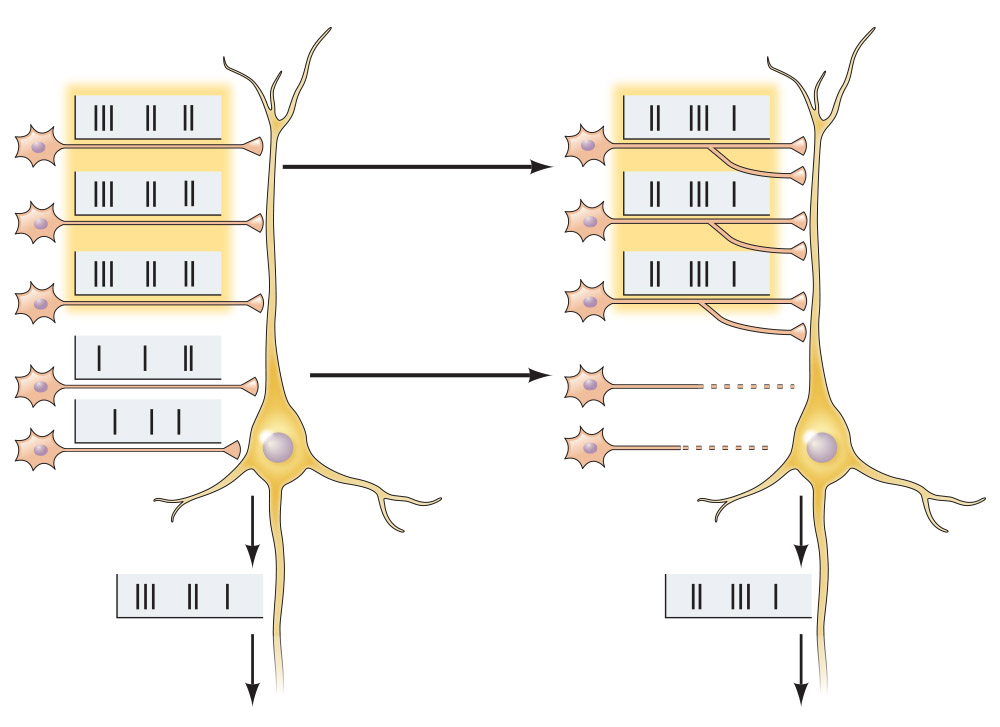
Based on what you learned in this section about Hebbian synapses, why do the bottom two inputs near the cell body pull away from the postsynaptic neuron?
The inputs aren’t effective at causing the postsynaptic neuron to fire.
Which of the following occurs after neurogenesis in the ventricular zone?
Cells begin transforming into either neurons or glial cells.
Identify an important consequence of the system of cell-cell interactions that determines how brain cells develop.
Cells that have not differentiated extensively can be obtained and placed in a specific brain region to allow them to differentiate appropriately and become integrated into that region.
In the context of cell death, do neurotrophic factors play a role in brain development?
Yes, neurotrophic factors play a role in cell death since neurons that do not manage to gather sufficient amounts of the appropriate trophic factor die.
Which of the following choices below places the six stages of neural development in the correct order?
Neurogenesis, cell migration, cell differentiation, synaptogenesis, cell death, synapse rearrangement
How does gene expression affect cell differentiation?
Cells begin to express specific genes in order to make the proteins that are required by the cell type in that region.
Which of the following statements are true of binocular deprivation? (Select all that apply.)
Binocular deprivation leads to a reduction in synapses in visual cortical neurons.
It leads to a loss of dendritic spines in visual cortical neurons.
Which of the following statements are true of monocular deprivation? (Select all that apply.)
Monocular deprivation in development leads to structural changes in the thalamus.
Monocular deprivation during the sensitive period leads to functional changes in the visual cortex.
Monocular deprivation in development can lead to blindness in that eye.
Why does the prefrontal cortex mature last in the brain?
The thinning of the cortical gray matter that occurs as a result of synaptic remodeling takes place in a caudal-to-rostral direction during maturation.
Farah and George are college students who are discussing the process of synaptic remodeling. Farah says that trophic factors most likely affect synaptic remodeling, but George disagrees and says that only intellectual stimulation determines which synapses are retained and which are removed. Who is correct and why?
Farah, because active synapses take up some trophic factor that maintains the synapse, while inactive synapses get too little trophic factor to remain stable and are lost.
When Kunal, a neurologist, diagnoses 3-year-old Denver as having fragile X syndrome, Kunal tells Denver's parents that the syndrome will likely affect Denver's mental development. When Denver's parents ask how the syndrome can affect intellectual development, which of the following answers is Kunal most likely to give?
By blocking the normal elimination of synapses after birth
Kevin, an ophthalmologist, has conducted several tests on a person who is unable to see forms clearly with their left eye. The test results show that the person's left eye is intact and that a sharp image is focused on the retina. Which of the following diagnoses is Kevin most likely to give?
Amblyopia
Michael had normal vision for the first three-and-a-half years of life until an accident damaged both his eyes. Despite having the damage to one eye surgically repaired as an adult, why was Michael unable to distinguish between objects?
Synaptic connections within Michael's developing visual cortex did not receive patterned stimulation and consequently disappeared.
True or False: Rodent pups subjected to inattentive maternal care are likely to have low stress hormone levels and low anxiety as adults.
False: Rodent pups subjected to inattentive maternal care are likely to have high stress hormone levels and high anxiety as adults.
When several kids between the ages of one and five are detected with phenylketonuria (PKU), their parents become worried that they will have intellectual disability. Which of the following steps, if taken, will prevent brain impairment in these kids?
Reducing the amount of phenylalanine in their diet
How does childhood abuse affect gene expression in adults?
By inducing methylation of the glucocorticoid receptor gene in the brain, making them hyperresponsive to stress as adults
Andy and Dave are identical twins who were raised by different families. Despite being identical twins, they behave very differently from one another. Identify a reason for this.
Their gene expression is affected by their different social experiences.
According to research, which of the following can postpone the appearance of Alzheimer's disease? (Select all that apply.)
Adequate sleep
Mental activity
Physical activity
Sasha and Ramon are first-year medical students who are discussing Alzheimer's disease. Sasha states that Alzheimer's is simply the result of wear and tear in the brain. Ramon disagrees with her and states that Alzheimer's is a disease and not a result of the brain “wearing out” with age. Who is correct and why?
Ramon, because people who reach the age of 90 without symptoms of Alzheimer's become increasingly less likely ever to develop them.
Anik is a neurologist who is studying the PET scan of an elderly person. Which of the following changes, if found, would indicate that the person has Alzheimer's?
There will be a significant decrease in metabolism in posterior parietal cortex and some portions of the temporal lobe.
Lucas, a medical intern, is being quizzed by a supervisor as part of medical training. When the supervisor asks Lucas to state two markers that would predict a diagnosis of Alzheimer's disease, which of the following statements could Lucas include in a correct answer? (Select all that apply.)
Levels of amyloid in the brain, as revealed by Pittsburgh Blue imaging, give an indication of Alzheimer's.
People with Alzheimer's gradually lose many neurons in the basal forebrain, which make the transmitter acetylcholine.