Urinary System (in progress)
 Call Kai
 Learn
Learn Practice Test
 Spaced Repetition
 Match
Match Flashcards
 Knowt Play
1/32

Earn XP
Description and Tags
SBI4U - Howes
Name | Mastery | Learn | Test | Matching | Spaced | Call with Kai |
|---|
No analytics yet
Send a link to your students to track their progress
33 Terms
The ________ is the major organ involved in ________ ___________
Kidney, waste removal
Deamination occurs where?
The liver
in the liver, the amino group is converted into ________, then quickly converted into _____, where it enters the ____ and is removed by the kidney
ammonia, urea, blood
function of the excretory system
to filter the body’s blood!
what else is the excretory system critical in?
removing nitrogenous waste
balancing blood pH
maintaining water balance
nutrient recovery
the goal of urine formation is to:
get rid of toxic and excess substances while keeping as much water, ions, and nutrients as possible
Filtration
blood moves to glomerulus and dissolved solutes (small molecules) pass through into Bowman’s capsule
plasma, platelets, and blood cells are too big to move into Bowman’s capsule (stay in the blood)
Driven by high blood pressure across a selectively permeable membrane
Secretion
the movement of wastes from blood ➠ the nephron
Secretion involves _____ transport
active
Secretion occurs mainly in the _____ __________ ____
distal convoluted tubule
Reabsorption
ions and molecuiles move OUT of nephron (into interstitial fluid)
purpose of reabsorption
to get rid of urea, excess molecules, toxins, and keep water, important salts, and nutrients
reabsorption involves both ______ & ______ transport
passive, active
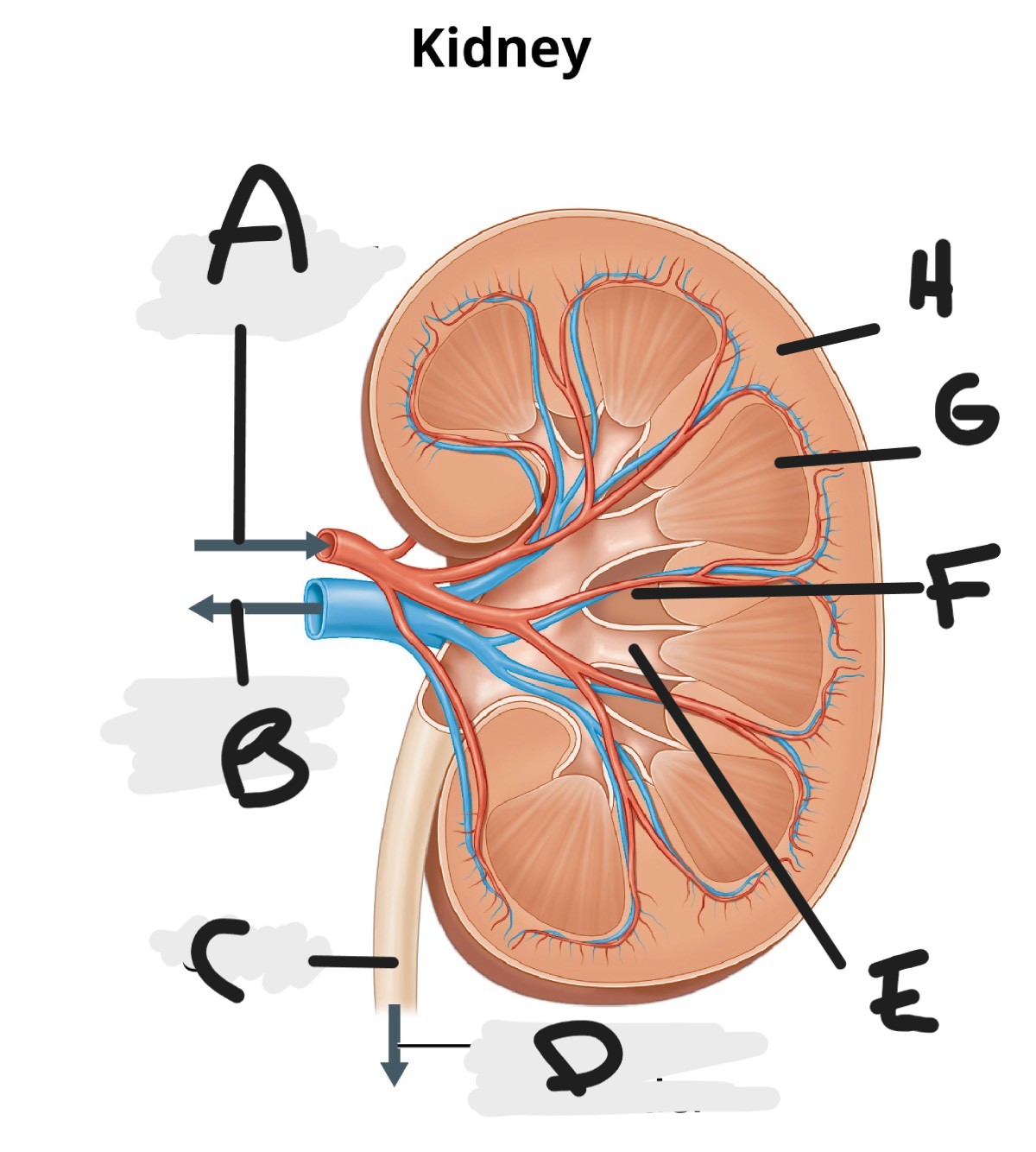
label the kidney
A: Renal Artery
B: Renal Vein
C: Ureter
D: Towards bladder
E: Calyces
F: Renal Pelvis
G: Renal Medulla
H: Renal Cortex
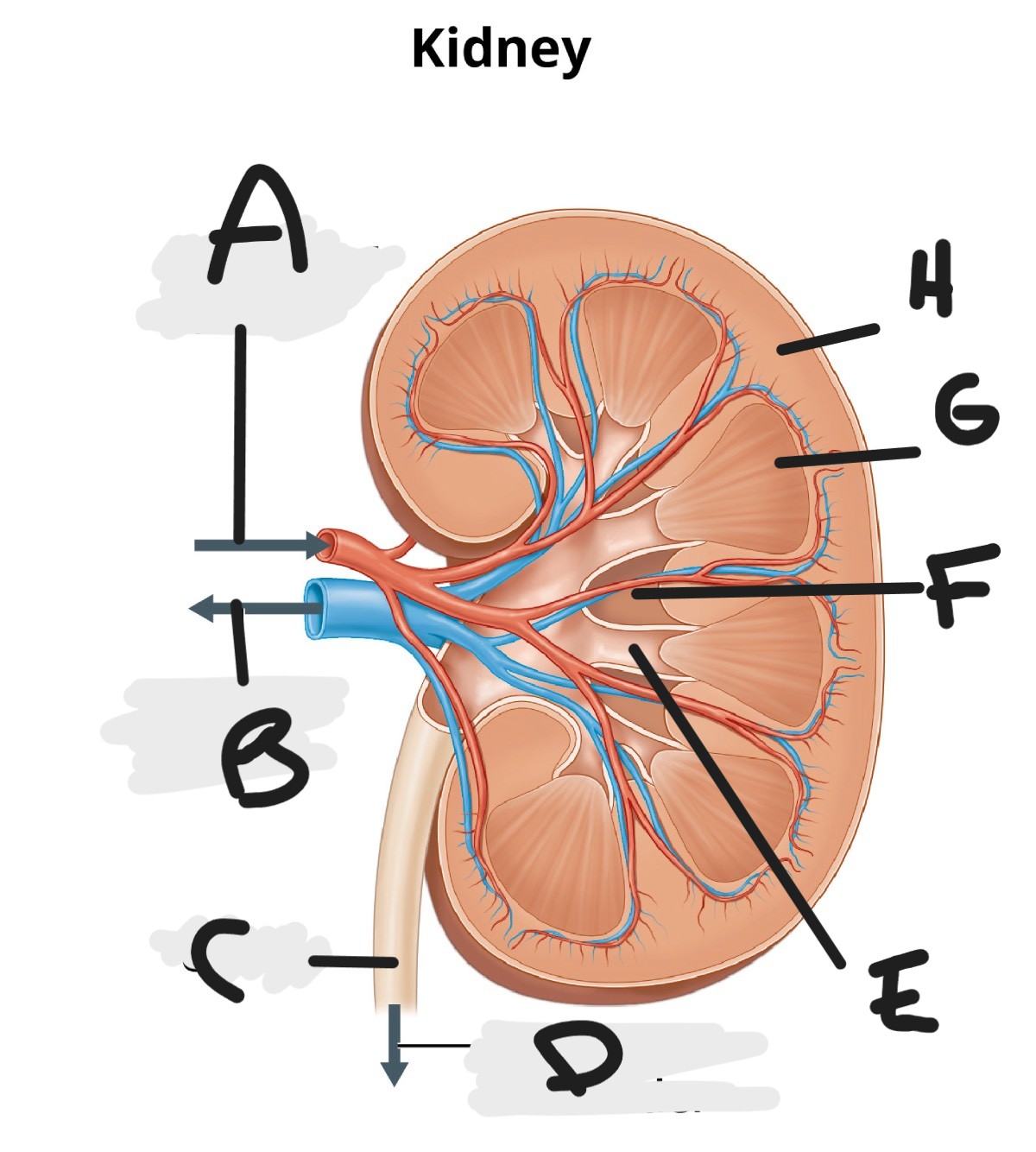
Renal Artery vs Renal Vein
Artery is smaller: thicker walls = high pressure
Vein is wider: thinner walls
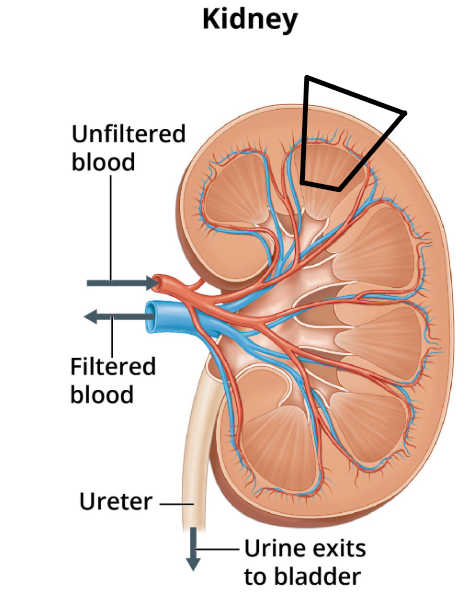
Identify
nephron!
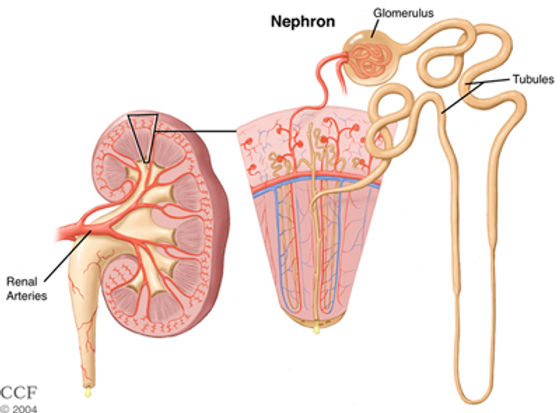
Each kidney contains about ____________ nephrons — the _________ ___ of the kidney
1 million, functional unit
Glomerulus
a network of capillaries inside the bowman’s capsule
⇨ performs first steps of filtration
The glomerulus has very _____ ________, which forces the liquid portion of ______ into the _________
high pressure, blood, nephron
Bowman’s Capsule
a small folded structure that encircles the glomerulus
⇨ during the first steps of filtration, small molecules enter bowman’s capsule from the glomerulus
Blood is supplied to the glomerulus via the ______ ________ and exits via the ________ _________
Afferent Arteriole, Efferent Artiole
the efferent arteriole carries blood to the ______________ ______________
peritubular capillaries
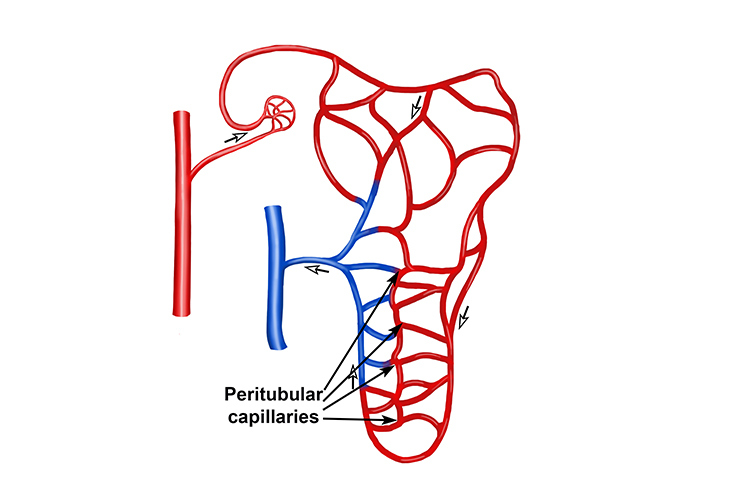
Peritubular Capillaries
a net of capillaries that allow for reabsorbtion of ions and minerals back kinto bloodstream
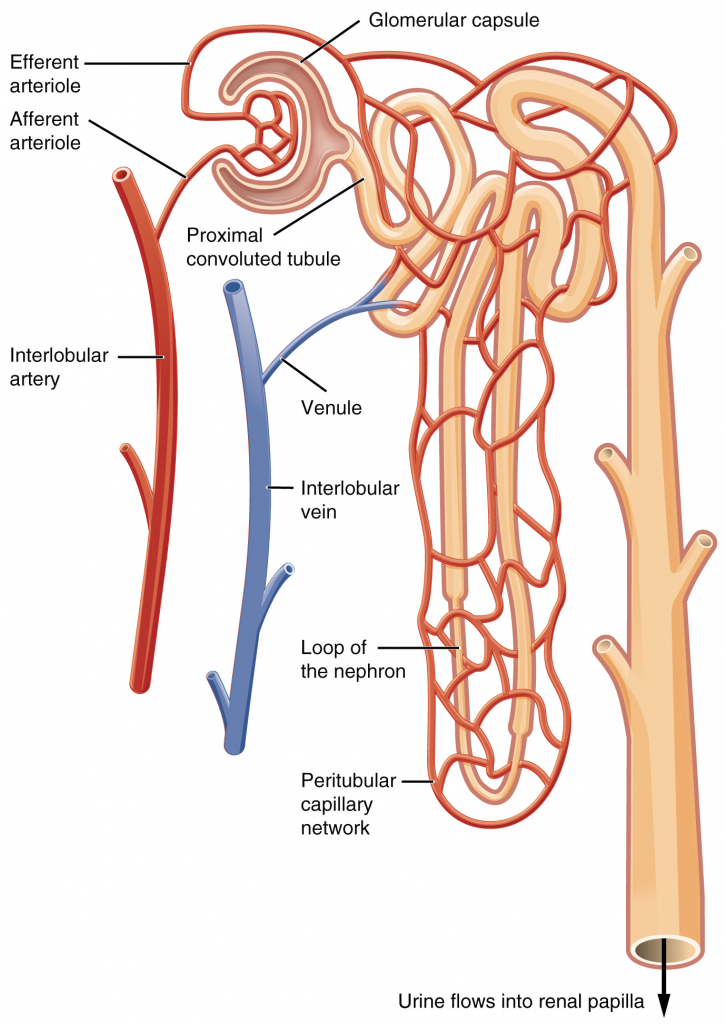
After the Bowman’s capsule, the _______ (product of filtration) enters the ________ __________ ______, which is within the ______ ______
filtrate, proximal convoluted tubule, renal cortex
After the PCT, the tubule descends into the _______, forming the _________ __ _______
medulla, loop of henle
After ascending the loop of henle, the urine enters the _____ __________ _______, which drains it into a system of __________ ______
distal convoluted tubule, collecting ducts
The collecting ducts lead to the ______ ____, which then leads to the _______
renal pelvis, ureter
What molecules enter the nephron during filtration? Which ones remain in the blood?
water
NaCl
glucose
urea
🩸 large molecules like blood cells, platelets, plasma, and proteins remain in the blood
What molecules get reabsorbed in the PCT? Which are active and which are passive?
bicarbonate
glucose (active)
Na+ and Cl- (active)
water (passive)
Besides reabsorption, ________ also occurs in the PCT: the _______ transport of ___ ions
secretion, active, H+
The descending loop of Henle is permeable to _____, meaning it is reabsorbed via ______ transport
water, passive
The start of the ascending loop of Henle is permeable to ______, meaning it is reabsorbed via ________ transport
NaCl, passive
At the top of the _________ loop of Henle, it is no longer permeable — therefore NaCl must be reabsorbed via ________ transport
ascending, active