Math 119 - Week 2
 Call Kai
 Learn
Learn Practice Test
 Spaced Repetition
 Match
Match Flashcards
 Knowt Play
1/11

There's no tags or description
Looks like no tags are added yet.
Name | Mastery | Learn | Test | Matching | Spaced | Call with Kai |
|---|
No analytics yet
Send a link to your students to track their progress
12 Terms
Gradient vector =
A vector with all single order partial derivatives, acts as the derivative for multi-variable functions
Given function f :
∇f = [∂f/∂x, ∂f/∂y]
Multi variate chain rule equation =
∇f(r(t))*r'(t)
or
dz/dt = ∂z/∂x(dx/dt) + ∂z/∂y(dy/dt)
What does parametrizing curves do =
Allows curves to be split up into multiple single-variable functions, expressed as a path travelled over time instead of a static curve
Tangent plane approximation =
To approximate (x, y, z)
df = f_x(x_0, y_0)dx + f_y(x_0, y_0)dy
Where (x_0, y_0, z_0) is the centre of approx (easy value to calculate)
dx = (x - x0) and dy = (y - y0)
z = z_0 + df
How to calculate greatest percentage error =
Given V = πr^2h and r has max 2% error and h has max 0.5% error
Calculate dV/V and sub in dr/r and dh/h error values into the inequality for maximum
dV/V = 2dr/r + dh/h <= 0.045 or 4.5% error max
differential formula =
Let f(x,y) be the function and with the point (a, b)
df = f_x(a, b)dx + f_y(a, b)dy
what is relative change of X =
dX/X
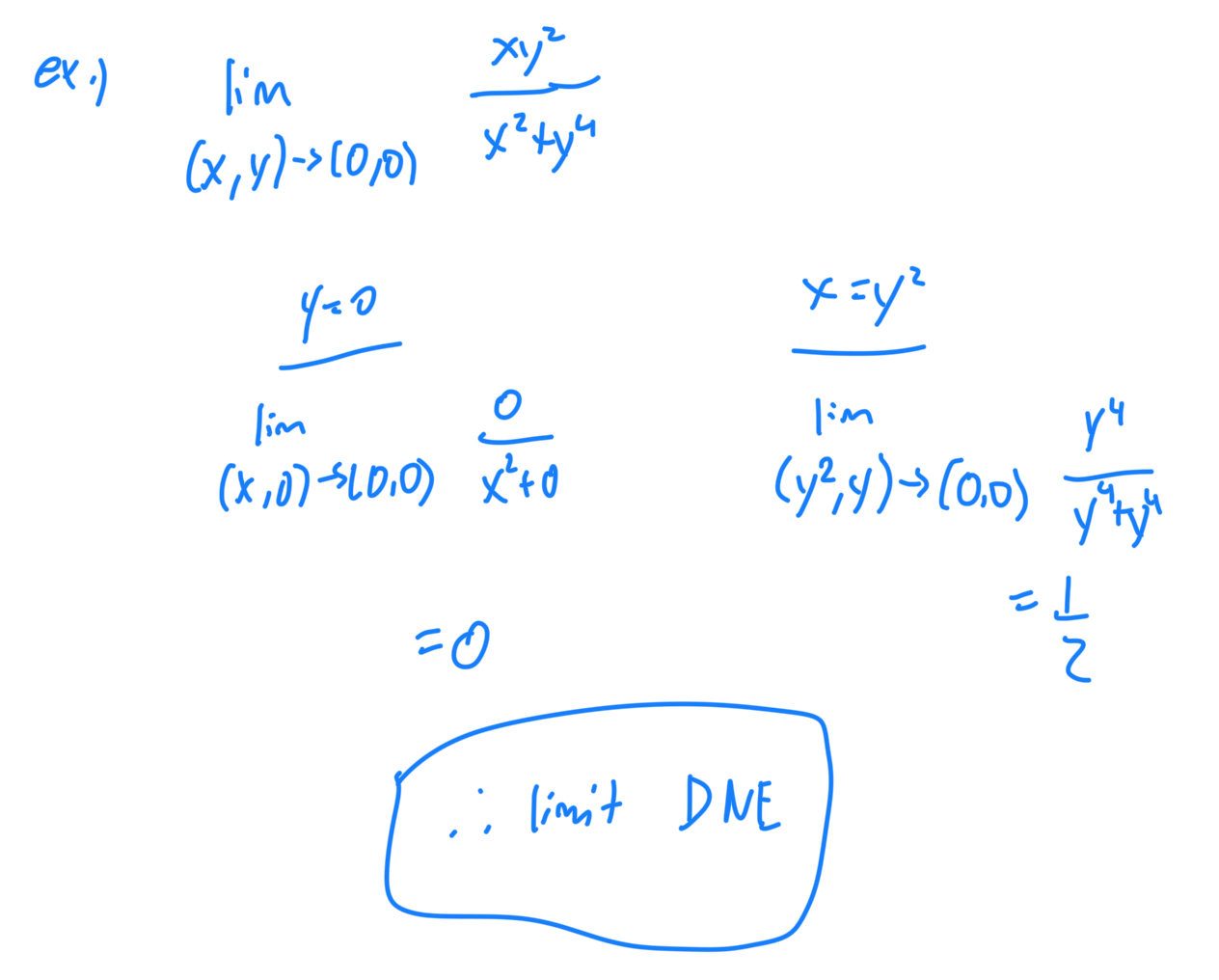
how to prove limits EXIST/DNE =
DNE = show that the limit gives different values through different paths
EXISTS = algebra or squeeze theorem
3 step process for sketching parametric curves =
Find intercepts (x = 0 or y = 0)
Find points where curve is horizontal/vertical
Take dy/dt / dx/dt
horizontal when numerator = 0
vertical when denominator = 0
Get test points
HAVE ARROWS TO LABEL DIRECTION
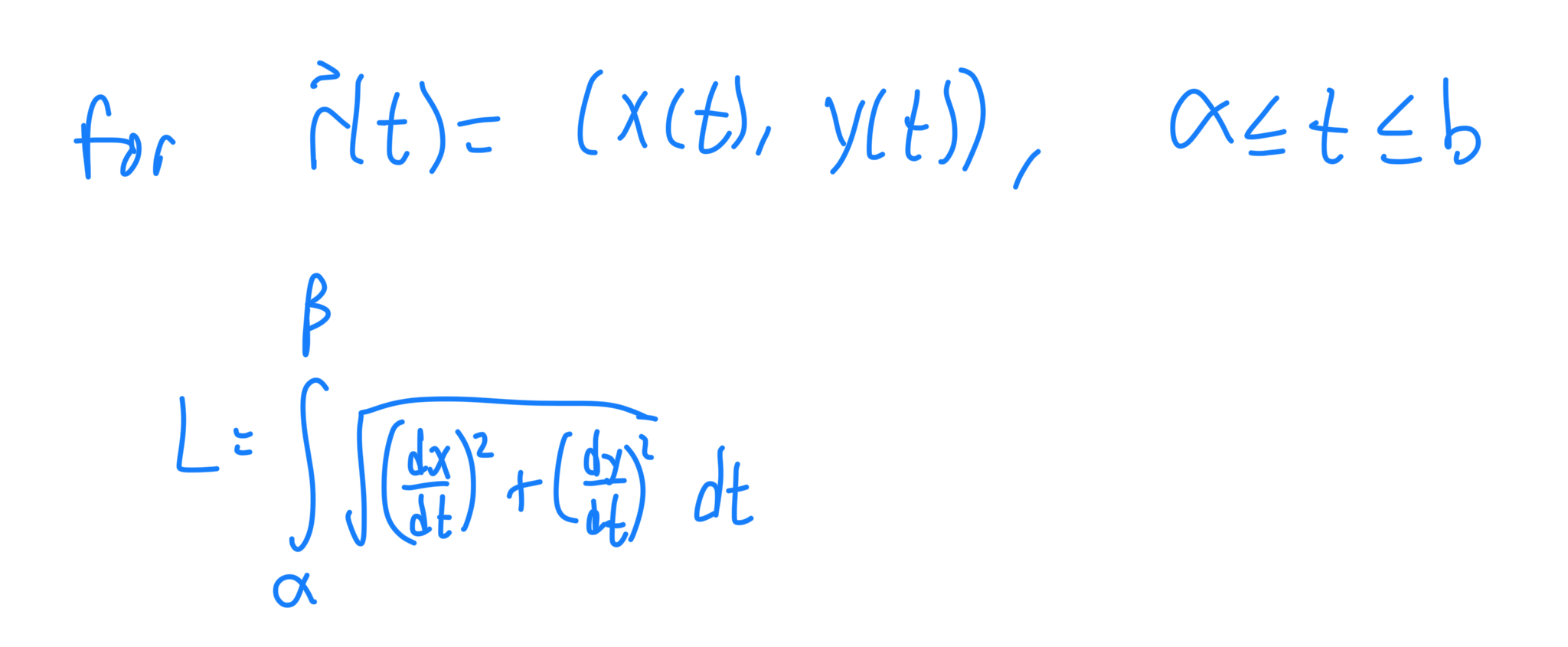
length of a parametric arc formula =
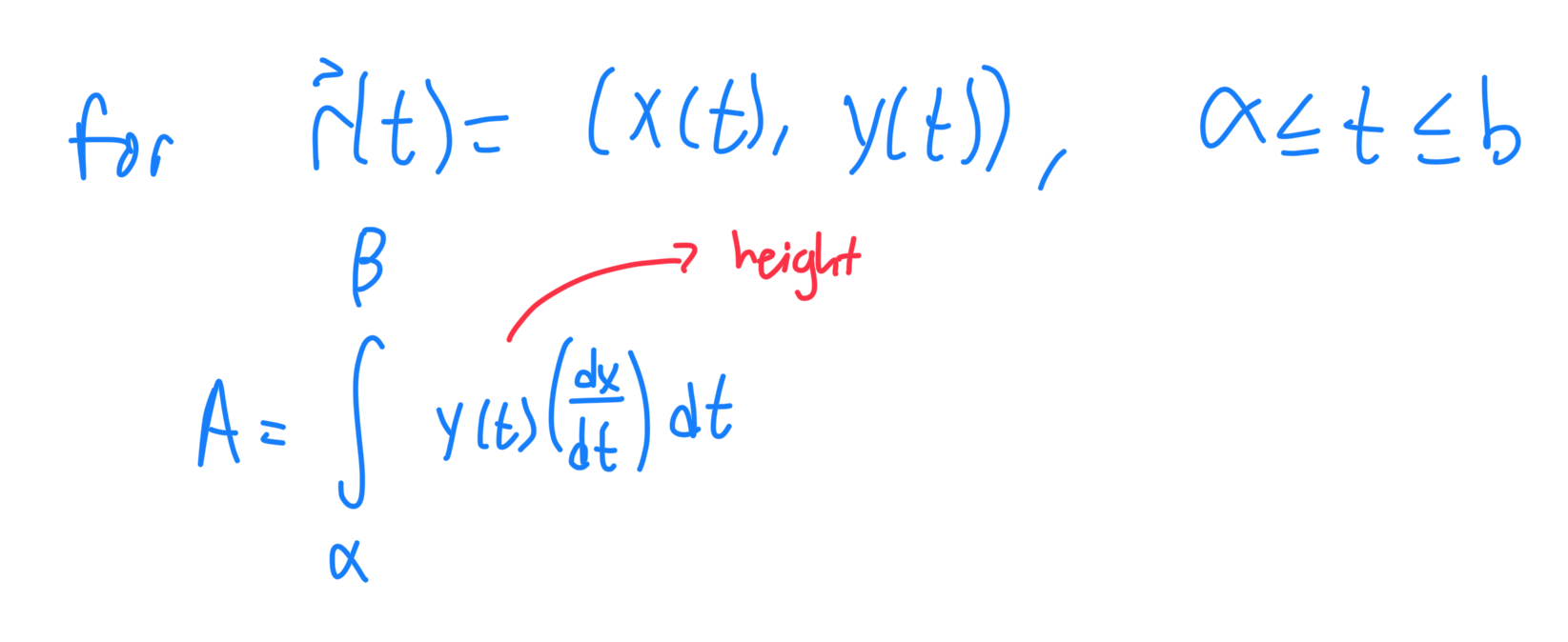
area under a parametric curve formula =
given ax + by + cz = n, what is the normal vector to the plane =
<a, b, c>