Unit 12 - Writing Empirical Research and Becoming a Researcher
 Call Kai
 Learn
Learn Practice Test
 Spaced Repetition
 Match
Match Flashcards
 Knowt Play
1/31

Earn XP
Description and Tags
Name | Mastery | Learn | Test | Matching | Spaced | Call with Kai |
|---|
No analytics yet
Send a link to your students to track their progress
32 Terms
Steps before empirical report
Select your research design
Choose reliable + valid measures
Receive ethics approval
Hire a research assistant
Gather data from participants
Analyze data/PSYC 305
Now you have to write up your findings
Purpose of empirical report
“Your overriding purpose is to tell the world what you have learned from your study” (Bem, 2003) He wrote a paper on how to write an empirical paper.
Steps OF an empirical report
Write simply and directly
Direct your writing to your grandmother
Follow the standard journal article format:
Intro
Method
Results
Discussion
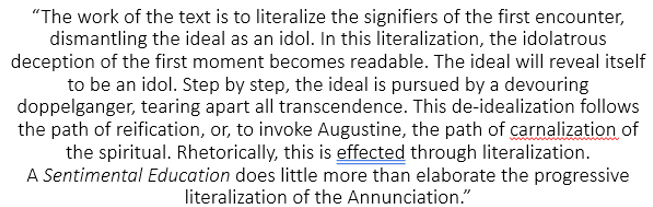
An Hourglass
the introduction is very broad, then method and results are specific, then broaden it out in the discussion section
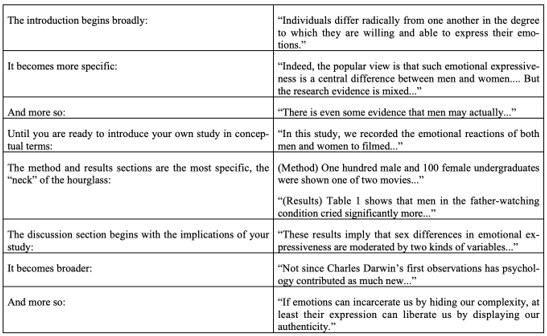
Intro begins broadly
Becomes more specific
And more so
Until you're ready to introduce you're own study in conceptual terms
The method and results section are MOST specific
Discussion begins with implications of your study
It becomes broader
And more so
Writing an intro
Write in English prose, not psychological jargon.
Do not plunge unprepared readers into the problem. Take them step by step.
Use examples to illustrate theoretical points or to introduce unfamiliar conceptual or technical terms. The more abstract the material, the more important such examples become.
Whenever possible, try to open with a statement about people (or animals), not psychologists or their research (This rule is almost always violated. Don’t use journals as a model here.)
Bad examples
“Several years ago, Ekman (1972), Izard (1977), Tomkins (1980) and Zajonc (1980) pointed to psychology’s neglect of the affects and their expression.”
“Research in the forced-compliance paradigm has focused on the effects of predecisional alternatives and incentive magnitude.”
“Festinger’s theory of cognitive dissonance received a great deal of attention during the latter part of the twentieth century.”
Good examples
“The individual who holds two beliefs that are inconsistent with one another may feel uncomfortable.”
“For example, the person who knows that he or she enjoys smoking but believes it to be unhealthy may experience discomfort arising from the inconsistency.”
“This feeling of discomfort was called cognitive dissonance by Leon Festinger (1957) who suggested that individuals will be motivated to remove this dissonance.”
The literature review
Summarize the current state of knowledge in the area. (done in intro)
What previous research has been done on the problem?
What are the pertinent theories of the phenomenon?
Citing + references
If the idea is more important, use A. If the people MAKING the claim are more important, use B. Either works, just depends where you want put the emphasis
If the SPECIFIC words are more important, you can quote more specifically.

Direct Quotes
If there’s nothing you could say that’s better than what they said use a this:
In their words “Blah, blah, blah…” In their words, “Blah, blah, blah, blah, blah” (Sangster & Lawson, 2014, p. 490)
3 or more authors
et al.
(Couture et al., 2016)
Couture et al. (2016) suggest…
Ref. an online research article
Author (year of publication). Title of the paper: Caps for subtitle. Where they published it, Volume no. (Issue no.), page no. / range, DOI URL.

Ref. a book
Author, A. A. (Year of publication). Title of work: Capital letter also for subtitle. Publisher Name. DOI (if available)

Ref. a book chapter
Author, A. A., & Author, B. B. (Year of publication). Title of chapter. In E. E. Editor & F. F. Editor (Eds.), Title of work: Capital letter also for subtitle (pp. pages of chapter). Publisher. DOI (if available)

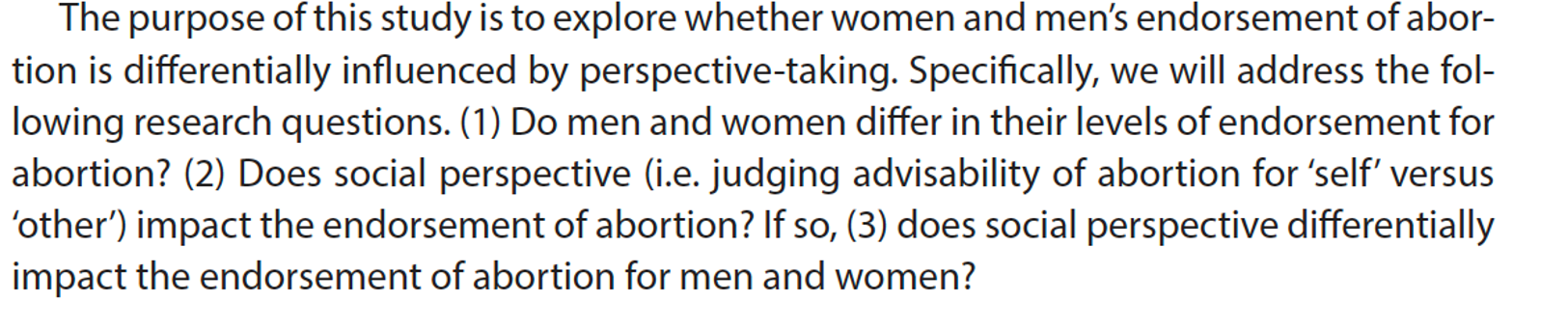
Hypothesis or research question
End the introduction with…
Sufficient detail for replication
The Methods section should provide…
Methods Overview of the study example
Sixty male undergraduates were randomly assigned to three conditions.
In the $1 condition, the participant was first required to perform repetitive laboratory tasks in an individual experimental session
The participant was then hired by the experimenter as an “assistant” and paid $1 to tell a waiting fellow student that the task was fun and interesting.
In the $20 condition, each participant was hired for $20 to do the same thing.
In the control condition, participants simply engaged in the tasks.
After the experiment, each participant indicated how much he had enjoyed each task
Methods section
Provide an overview of study
Then:
Provide summaries or excerpts of what was actually said to the participant, including any rationale or “cover story”
Describe the relevant aspects of the room.
Show sample items from questionnaires and/or questionnaires themselves
Copies of stimulus materials or pictures of apparatus.
Participants
Materials
Procedure
Provide information on reliability and validity of measures
Report on ethical issues
Results section
1) Explain what happened
Example: The $1 participants rated the tasks as more enjoyable than did the $20 participants who did not differ from control participants.
The _________ section should (also) tell a story…
2) Remind us of the hypothesis…
Remind us of the method and measures: Men should show more tears than women while watching the film
Tell us the answer to the hypothesis in English: Men did cry more profusely than women
3) Then (and only then) report the statistics
Example: The men produced an average of 1.4cc more tears than the women, F (1,112) = 5.79, p < .025, Effect size/d = .45.
Discussion section
Tell us what you learned
Point out the…
limitations
implications
avenues for future research
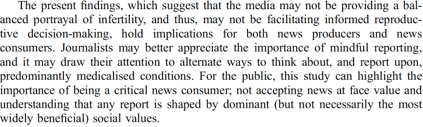
Go out with a bang!
find a conclusion that captures the audience!
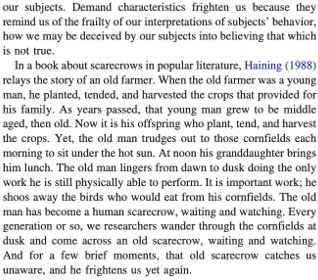
Ending with a story, that was hinted at in the introduction (Sharpe)
Title
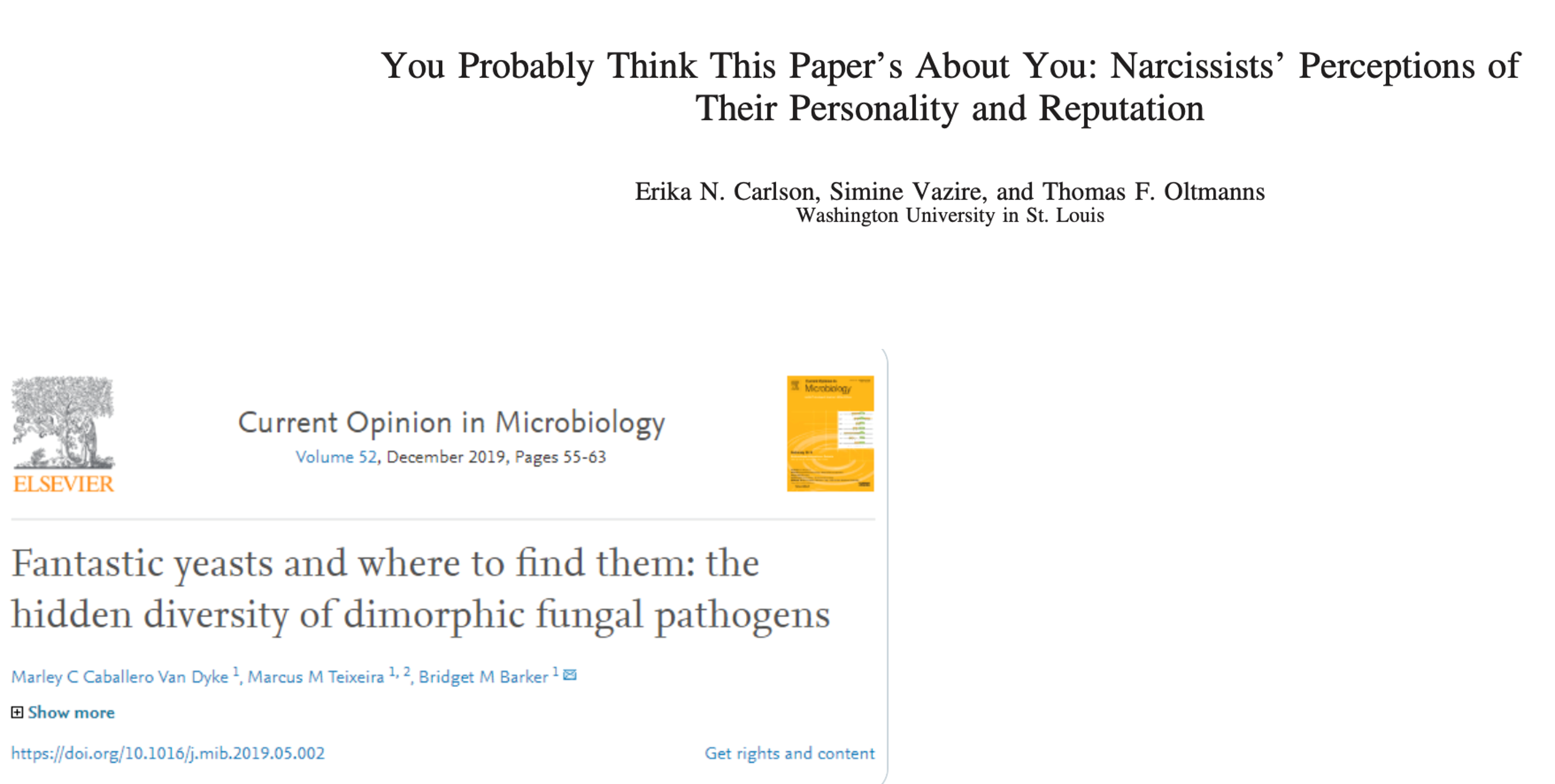
10-12 words
Should be fully explanatory when standing alone
Should identify the theoretical issues or the variables under investigation.
Can be fun!
Fantastic yeasts and where to find them: the hidden diversity of dimorphic fungal pathogens
You Probably Think This Paper’s About You: Narcissists’ Perceptions of Their Personality and Reputation
Abstract
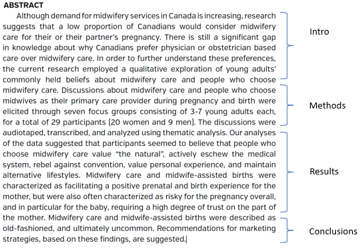
_______________ - Very important, a brief version of the paper, people may decide to read it based on the title and the abstract
Include in order:
Intr
Methods
Results
Conclusions
Omit needless words
Writing advice
_____________ - excessive words gets confusing and is a waste of time

Avoid meta-comments
Writing advice
“Now that I have discussed the three theories of emotion, we can turn to the empirical work on each of them. I will begin with the psychoanalytic account of affect...” → “Each of these three theories has been tested empirically. Thus, the psychoanalytic account of affect has received support in studies that...”
“I am writing to discuss how I believe climate change is a major problem.” → “
I am writing to discuss how I believeClimate change is a major problem.”
‘Data’ is plural
Writing advice
“The data are…”
“These data…”
Bias
Writing advice
Avoid ________ in your language as it makes it not objective
Steps to become a researcher
Steps are…
Get a bachelor’s degree → Honours (to be researcher or psychologist)
BSC or BA in psych
Develop honours thesis
Attend honours Impose
Grad school → Master’s degree
Figure out: clinical or experimental psych?
Finish MA thesis
Grad school → PHD
Finish comp exam
Get a JOB!!!!!!
Bachelors Honors
Apply to the Faculties of Arts or Science to be in honors
GPA: 70% overall, 75% in Psychology…
Psyc 405 (Research Methods), Psyc 408 (History the old 406 or 407) and…
Apply to register in PSYC 400 in FEBRUARY of your 3rd year·
The application for honors is competitive; you need to prepare for this before that February. Look through the website to see what faculty do for their research interests. Think about those you’ve taken classes from, but also those you haven’t.
Think about volunteering with those professors to help them in their labs
With luck, you will become an honors student, working with a professor, and developing an honors thesis
You will present results at the honors symposium
Grad School
If you’re thinking about grad school, you must at that point make a decision if you’ll apply to a clinical program or experimental program
Experimental: work doing experiments in a particular area related to that of your supervisor
Clinical: will also do research but focus on helping and treating people
What you’re seeking at that point is a Masters Degree in Psychology
The application for graduate school is similar in some ways to that of honors: Certain GPA, write the GRE, talk about what your research interests are. Think broadly, not just Saskatchewan.
Also think what sets you apart, a good writer? Stats? Work ethic?
Good news is graduate school can take a number of years for the Masters and for the PhD, but the classes are much smaller like a seminar, spend a lot of time in the library.
Once you have your masters you may even have the opportunity to teach. A fun part is attending conferences with fellow grad students, and one day you finish your masters thesis.
PhD
Involves more classes, research, therapy applications. At the end do a big comprehensive exam, then regarded as ABD (all but dissertation)
Dissertation: a big research study, involving perhaps many studies. Then graduate!
Getting a Job
Work with other colleagues in applying for a job. Getting a job in academia is very difficult. If you go the academic route, do even more teaching, more research, and attend fun meeting
Many with a PhD don’t go into academia, if they’re experimental going to legal work for the government. Clinical they practice.