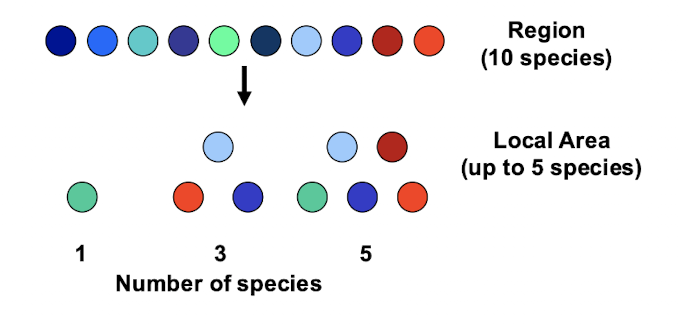
E106 Quiz 4 (Lec 11-12)
 Call Kai
 Learn
Learn Practice Test
 Spaced Repetition
 Match
Match Flashcards
 Knowt Play
1/36

There's no tags or description
Looks like no tags are added yet.
Name | Mastery | Learn | Test | Matching | Spaced | Call with Kai |
|---|
No analytics yet
Send a link to your students to track their progress
37 Terms
Aging
Age-related loss of physiological integrity, impaired function, and increased vulnerability to death
Growing older in some cases decreases vulnerability to death (young mortality as offspring)
Hallmarks of aging
Genomic instability
Telomere attrition
Epigenetic alterations
Loss of protein homeostasis
Deregulated nutrient sensing
Mitochondrial dysfunction
Cellular senescence
Stem cell exhaustion
Altered intercellular communiction
Genomic instability
Accumulation of DNA damage & mutations
As you age —> more DNA damages as it divides —> adverse effects
Telomere attrition
Telomere shortening each time cell divides/DNA replicated —> DNA Damage
Epigenetic alterations
Modifications that alter activity without changing DNA sequence
Age —> epigenetic disruption disrupted —> changes in gene expression —> cells don’t function as well as before
Loss of protein homeostasis
Protein synthesis folding/degradation
Age —> accumulate misfolded protein —> less protein quality
Deregulated nutrient sensing
Diff ways for cells to detect nutrient availabililty, regulation
Systems break down —> metabolic imbalance
Mitochondria dysfunction
Aging declines function with mDNA —> decreased energy production and cell function
Cellular senescence
Cells enter G0 state (quiescence) —> no longer divides
Issues with regeneration and healing
Stem cell exhaustion
Helps with tissue repair and regeneration
Decline in function over time —> slow healing
Altered intercellular communication
Cells and tissues constantly communicate with each other —> less effective as we age
Impair physiological responses (stimuli, wound healing, body)
Trade-offs
Live fast and die young vs. live slow and die old
Rates of process = rate of chance
Faster an organism lives/reproduce — > faster it gains damage that leads to aging
Age of reproduction can be selected for
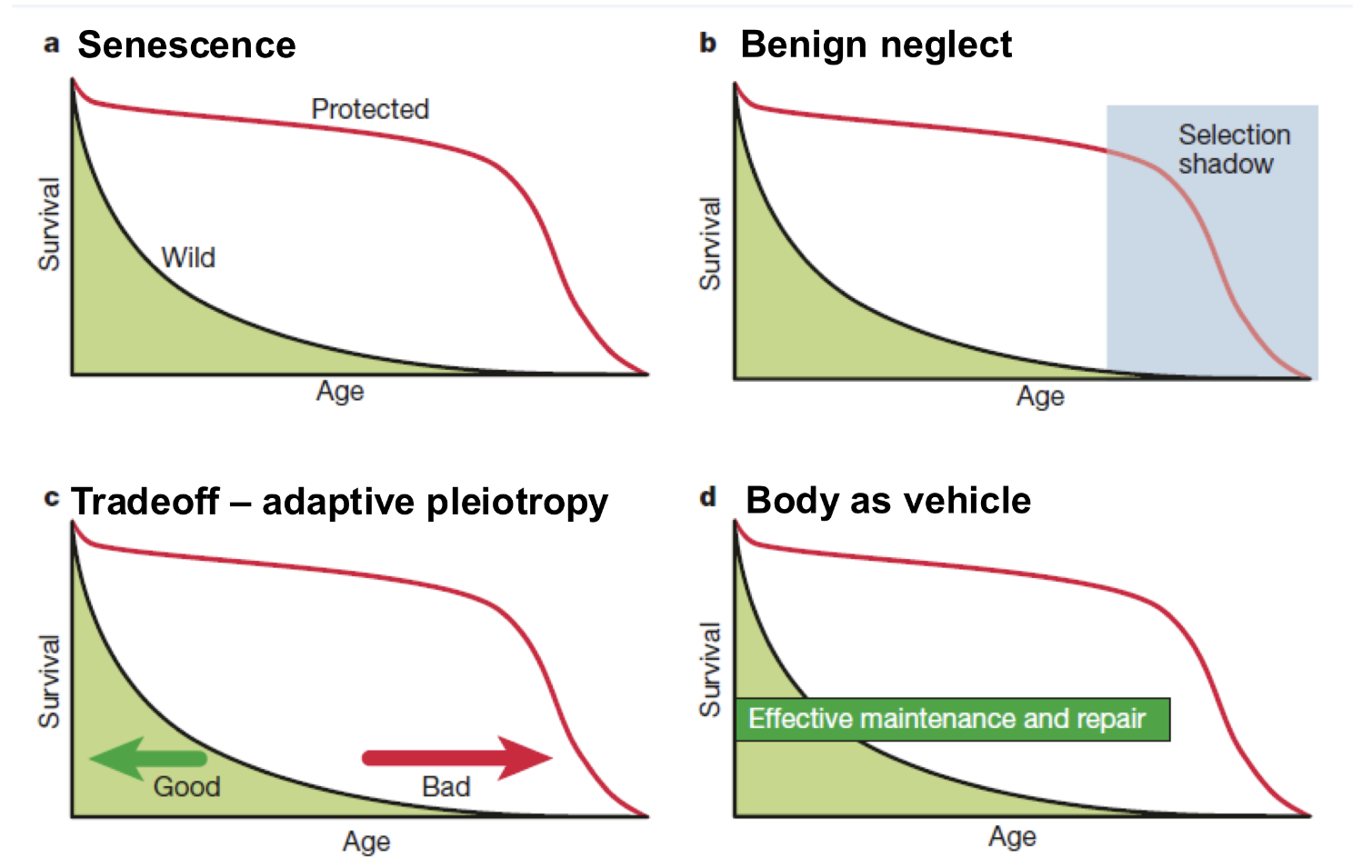
4 Evolutionary explanations for aging
Senescence allows for new generations to thrive
Benign neglect - selection overlooks the old
Trade-off - live now, pay later
Body as a vehicle for reproduction
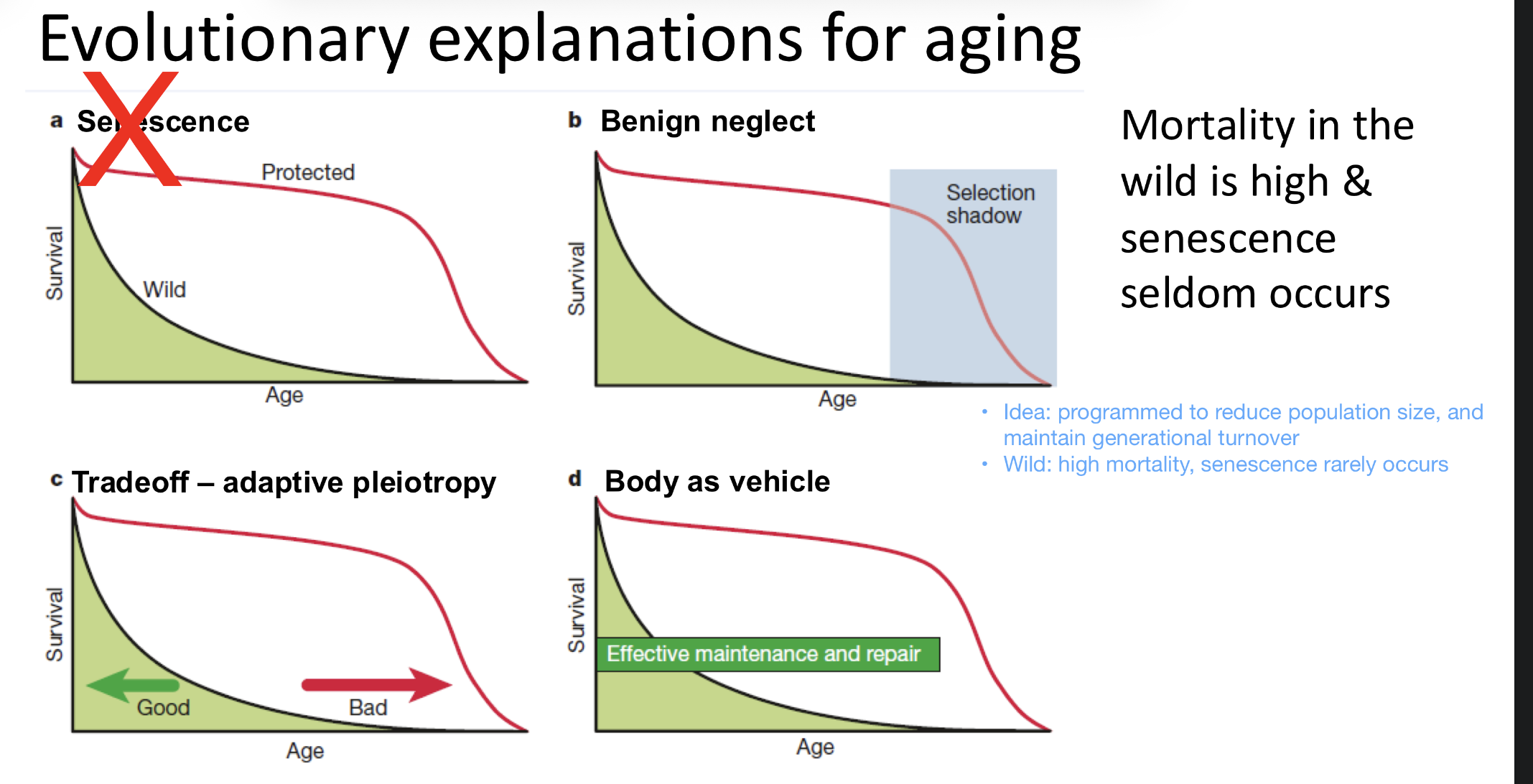
Senescence allows new generations to thrive (NOT EXPLANATION)
Senescence: biological process of aging
Early explanation
Programmed
Limits population size, accelerates generational turnover
Old ones have to die for the new ones to open up more resources for younger generations
Senescence doesn’t contribute to mortality (external factors) - most species don’t die of old age
REASON: Mortality in wild is high & senescence rarelly occurs
Programmed to reduce population size and maintain generational tunrover
Enhance survival of relatives
Adaptive suicide: older adults sacrifice themselves for the good of the rest of their lineage
Senescent/diseased indvls leave the group
E. coli, bees, aphids
Prevents infection
Post-reproductive caregivers: indvls no longer can reproduce —> takes care of offspring/relatives
Intergenerational care
Enhances fitness of related indvls
genes shouldn’t enhance aging (loss of function) through maintaining non-reproductive indvls can be beneficial, especially for humans
Adaptive suicide
older adults sacrifice themselves for the good of the rest of their lineage
Senescent/diseased indvls leave the group
E. coli, bees, aphids
Prevents infection
Post-reproductive caregivers
indvls no longer can reproduce —> takes care of offspring/relatives
Intergenerational care
Enhances fitness of related indvls
Benign neglect - selection overlooks the old
Selection maximizes reproductive output
Weak selection on post-reproductive indvls —> so intensity of selection declines with age
Once indvls are post-reproduce —> things that kill them at old age not going to impact their fitness (reproduce)
Selection shadow: Selection can’t see/affect deleterious mutations whose effects are confined to later ages
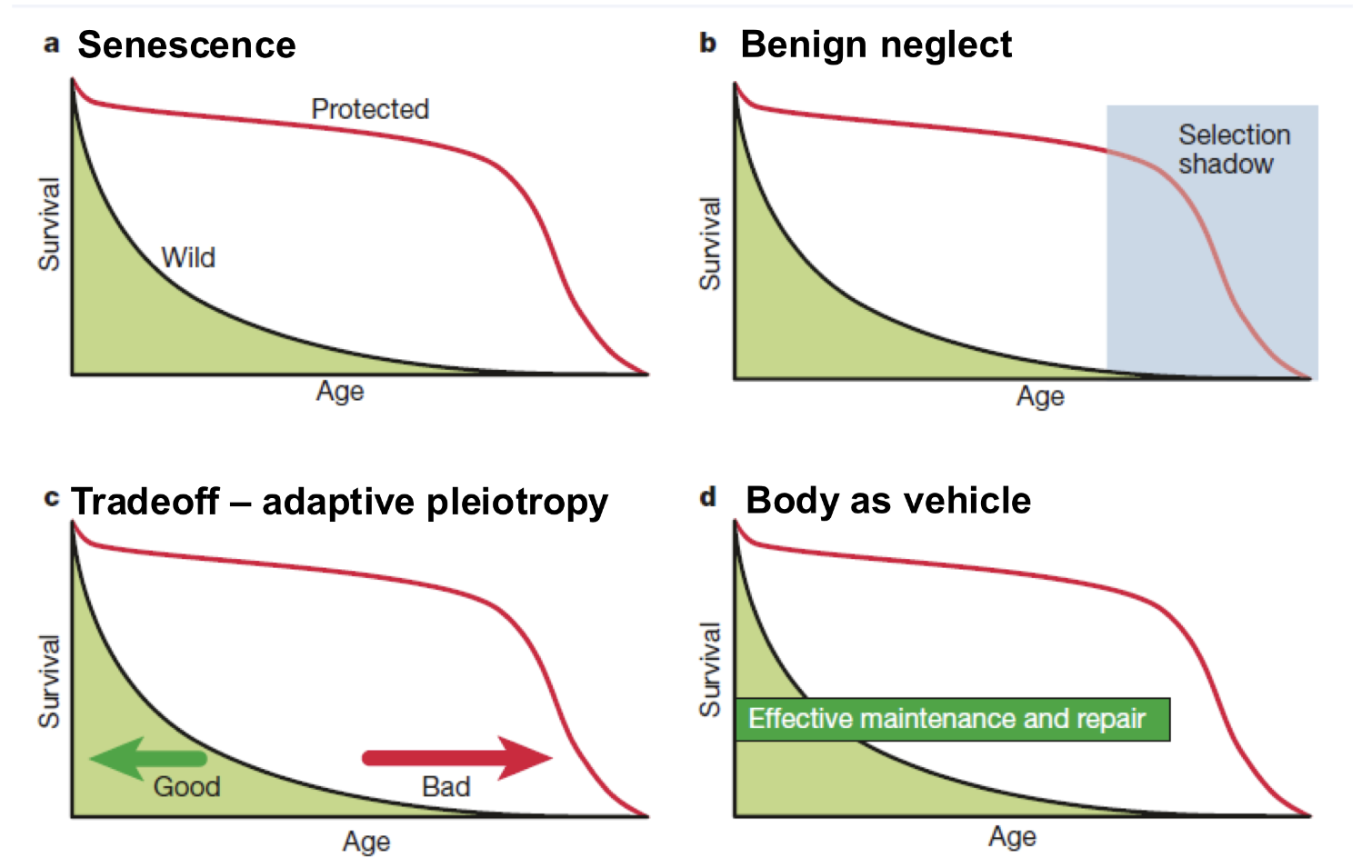
Selection shadow
Selection can’t see/affect deleterious mutations whose effects are confined to later ages
Tradeoff - live now, pay later
Genes favor early survival and reproduction
Early reproductive success at the cost of later success
Not just different selective pressures for early vs. late reproduction - actual cost later in life related to early success
Adaptive pleiotropy: a gene affecting more than one trait
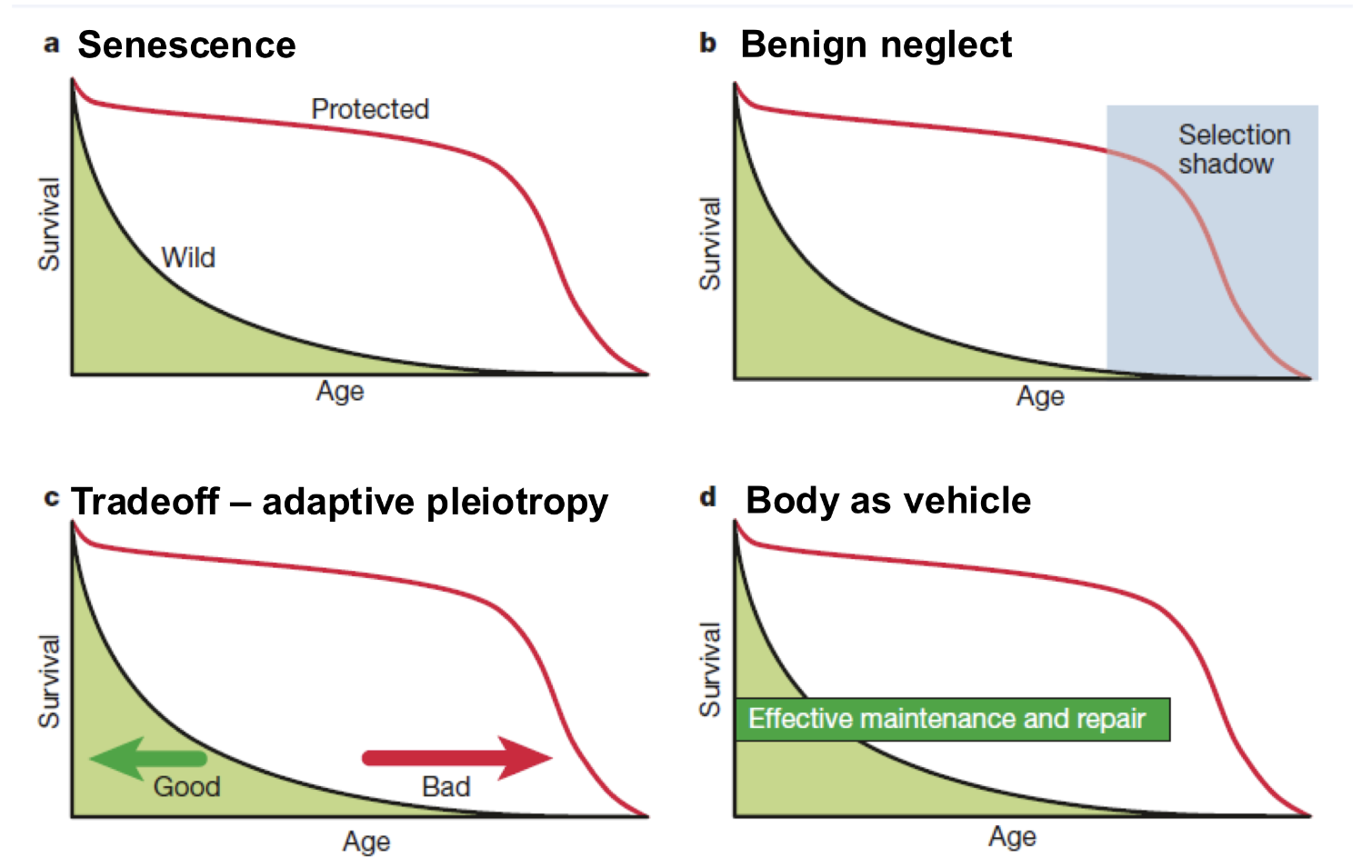
Adaptive pleiotropy
a gene affecting more than one trait
Ex. calcium helpful for developing bones when young but harmful for old in arteries
Body as a vehicle for reproduction
Goal of evolution is to pass on genetic material
Fitness: the reproductive capability of an organism and its contribution to the gene pool
Germ (reproductive) cells are what matter —> the body (somatic) is just a vehicle
Meiosis: process that produces 4 haploid (N) cells from a diploid cell (2n)
Allocation of energy/ resources towards reproductive, not maintenance of the body (DNA repair, radical oxygen species)
Resource allocation: Decline of DNA repair —> more mutations —> aging —> accumulation of mutations, genomic arrangements —> de-regulation of transcription impaired stress response
Meiosis
process that produces 4 haploid (N) cells from a diploid cell (2n)
Biodiversity
A contraction of biological diversity: variety of live at all levels of biological organization
Ecosystem —> species —> genetic —> molecular
Biodiversity hotspots
Covers only 2.3% of Earth’s surface
Home to 42% of terrestrial vertebrate species and 50% of plants
Quantifying biodiversity
Species richness (S)
Evenness (J)
Shannon diversity index (H’) combines S & J (0 < H’ < ln[S])
Species richness (S)
number of species
Evenness (J)
Distribution of abundance across species (0 < J < 1)
Ex) Forest A: Contains 10 oaks, 10 maples, 10 birches, 10 pines, and 10 willows. This area has high species evenness because all species are represented equally.
Forest B: Contains 46 oaks, 1 maple, 1 birch, 1 pine, and 1 willow. This area has low species evenness because the oak is heavily dominant, making the other species rare.
Shannon diversity index (H’)
combines species richness and evenness
Why are there so many species?
Consumers and trophic relationships
Plant diversity drives animal diversity
Complex food webs confer stability
Changes in diversity with latitude
Species-area relationships
Niche differences between species
Niche partitioning - how it affects biodiversity
Competitive exclusion: species use the same resources
Coexistence: can occur when species use different resources
Disturbance - how it affects biodiversity
Any relatively discrete event in time that disrupts ecosystem, community, or population structure and changes resources, substrate availability, or the physical environment
ex) big boulders don’t roll as much as small ones —> crush species like se anemones, urchins
Consumers - how it affects biodiversity
Starfish (keystone species)
Remove —> mussels accumulate —> less of other species
Productivity - how it affects biodiversity
Rate of generation of biomass in an ecosystem
Productivity increase/more species can coexist (plant —> herbivores —> carnivores)
Diversity within trophic levels
Relationship between nutrients and diversity
Diversity affects productivity
Changes in biodiversity affect ecosystem processes such as biomass accumulation and resource use
Ex) Plant root depth: Diff plant species have roots that reach diff depths. (Grass roots shallow + Dandelion roots deep)
Help reach nitrate
Complementarity: species complement each other with respect to their ecological roles
Sampling effect/ species identity effect: a more diverse community has a greater chance of containing a species with a big effect
Complementarity
species complement each other with respect to their ecological roles
Sampling effect/ species identity effect
a more diverse community has a greater chance of containing a species with a big effect