Thẻ ghi nhớ: IGCSE Physics- Thermal Physics | Quizlet
 Call Kai
 Learn
Learn Practice Test
 Spaced Repetition
 Match
Match Flashcards
 Knowt Play
1/71

There's no tags or description
Looks like no tags are added yet.
Name | Mastery | Learn | Test | Matching | Spaced | Call with Kai |
|---|
No analytics yet
Send a link to your students to track their progress
72 Terms
properties of solids
-retain fixed volume and shape
-not easily compressible
-does not flow easily
properties of liquids
-assumes the shape of the container it occupies as particles can move/ slide over each other
-not easily compressible due to little free space between particles.
-flows easily
properties of gases
-assumes the shape and volume of its container as particles can move past one another
-compressible due to lots of free space between particles
-flows easily as particles can move past one another
melting
solid to liquid
boiling
Liquid to gas
condensing
Gas to liquid
freezing
liquid to solid
when do solids change into liquid
when the particles achieve their maximum vibrational energy
explain what happens to the pressure in a container as it temperature increases and volume stays constant
-the particles gain more kinetic energy and move faster
-they hit/collide with the walls of the container harder and more frequently
-force per unit area is higher hence pressure of gas INCREASES
Brownian motion
The random motion of small particles suspended in a liquid or gas due to the bombardment of the gas or liquid particles which are much smaller than the suspended particles.
smoke grain experiment
a microscope is used to observe a smoke cell containing air with a small amount of smoke. the cell is lit from the side and the smoke grains show up as tiny specks of light. Each speck follows an erratic and random path due to the repeated collisions with air molecules.
To convert degrees celsius to Kelvin (K)
add 273 to the given degrees celsius temperature
To convert Kelvin (K) to degrees celsius
subtract 273 from the given Kelvin temperature
pressure law
The pressure of a fixed mass of gas at constant volume is directly proportional to the absolute temperature.
Explain how a change of temperature in a gas affects its pressure at constant volume
- a gas is heated
- its temperature rises and the molecules convert thermal energy to kinetic energy, increasing their speed
- the molecules hit the walls of the container harder and more frequently thereby increasing the pressure of the gas
*this only occurs if volume is kept constant
Boyle's Law
The pressure of a fixed mass of a gas is inversely proportional to its volume at constant temperature
Explain Boyle's Law
when the volume of a gas increases, the molecules take a longer time to collide with the walls of the container i.e less number of collisions per unit time. This causes pressure to fall.
P=
constant* 1/v
PV=
Constant, K
Explain in terms of molecules, how a gas causes a pressure on the walls of its containers
-Molecules are moving and therefore have kinetic energy
-the molecules collide with the walls of the container and therefore exert a force on the container over an area resulting in pressure.
A fixed amount of dry gas is exerting a pressure on its container.
In terms of molecules, explain what causes the pressure.
The molecules contain kinetic energy because they are in motion. They collide with the wall of the container over an area resulting in pressure
Question: A gas occupies a volume of 600 m^3 when pressure is 9000 Pa. What is the new volume if the pressure rises to 14,500 Pa? Assume temperature remains constant. (3 mks)
1. Constant= PV
2. = 9000 Pa* 600 m^3
3. =5,400,000 N
Volume= PV (K)/P
=5,400,000/14500
=372.4 m^3
question: calculate the volume occupied by a gas at 600 Pa if it has a volume of 10 m^3 at 1500 Pa and temp remains constant
1. p2v2=p1v1
2. 600v2/600= 150010/600
v2= 25 m^3
Boyle's Law Equation
P1V1=P2V2
When does evaporation occur?
when more energetic molecules near the surface of a liquid have enough energy to escape.
What happens when the energy is lost from the liquid?
1. The average energy of the remaining molecules decreases
2. This means that the temperature of the remaining liquid will also decrease
Factors affecting evaporation
1. The temperature of the liquid - At higher temperatures, more molecules have enough energy to escape
2. The surface area of the liquid - If the liquid has a greater surface area there will be more area from which the molecules can escape
3. The movement of air across the surface of the liquid - The presence of a draft can help to remove less energetic molecules (which might not have quite enough energy to escape) from the liquid
some uses of evaporation:
-The process of evaporation can be used to cool things down: If an object is in contact with an evaporating liquid, as the liquid cools the solid will cool as well
-This process is used in refrigerators and air conditioning units
Applications of thermal expansion
1. The expansion of a liquid in a thermometer can be used to measure temperature
2. A bimetallic strip, consisting of two metals that expand at different rates, can be made to bend at a given temperature, forming a temperature-activated switch
Consequences of thermal expansion
1. The expansion of solid materials can cause them to buckle if they get too hot
This could include: Metal railway tracksRoad surfacesBridges
2. Things that are prone to buckling in this way often have gaps built into them providing some room for them to expand into
Types of thermometer
1. Liquid in glass thermometer
2. Thermocouple
3. Infra Red Thermometer
4 Bi- metallic thermometer
5. Gas thermometer
When constructing a thermometer:
1. choose a physical property which changes continuously with temperature (volume of a fixed mass of liquid, electrical resistance of a metal wire, electromotive force, pressure of a fixed mass of gas at a constant volume)
2. Choose two fixed points. The upper fixed point (steam point 100 degrees celsius) and lower fixed point- (ice point, 0 degrees celsius)
3. Divide the temperature between two fixed points into many equal divisions
liquid in glass thermometers
-Volume of a fixed mass of liquid- liquid expansionists when heated e.g mercury
-Electrical resistance- resistance increases as temp rises
-EMF- voltage developed as temp changes
- Pressure- increases as temp rises
To calibrate a thermometer:
fixed points must be chosen.
for a liquid in glass thermometer, these points are the melting and boiling points of the liquid
Two common liquids used in thermometers
mercury and alcohol
mercury benefits
- freezes at 39 degrees celsius
- boils at 357 degrees celsius
- low specific heat capacity- not much energy needed to change the temperature
-expands uniformly when heated
-doesn't stick to the glass
Alcohol benefits
-freezes at -115 degrees celsius
-It boils at 78 degrees celsius
- it is suitable for low range temperatures
- it is ideal for measuring atmospheric pressure
- it expansionists uniformly when heated
limits with using alcohol
-lower boiling point means it cant be used for very hight temperatures
-Is colourless hence needs to be coloured
limits with using mercury
can't be used to measure temperatures less than -39 degrees celsius
Issues with using water
-sticks to glass
-freezes at 0 degrees celsius and hence cant measure lower temperatures
- has higher thermal capacity
-has non uniform expansion
- low boiling point, 100 degrees celsius so cant be used to measure higher temperatures
range
the difference between the highest and lowest temperatures a thermometer measures
sensitivity
a measure of how fast a thermometer responds per unit change in temperature
To increase sensitivity in a liquid glass thermometer:
1. Use thinner capillary tubes
2. Use bulb with thinner wall
*these give rise to a greater expansion (length) per unit degree
linearity
the uniform expansion of the liquid to temperature with the range.
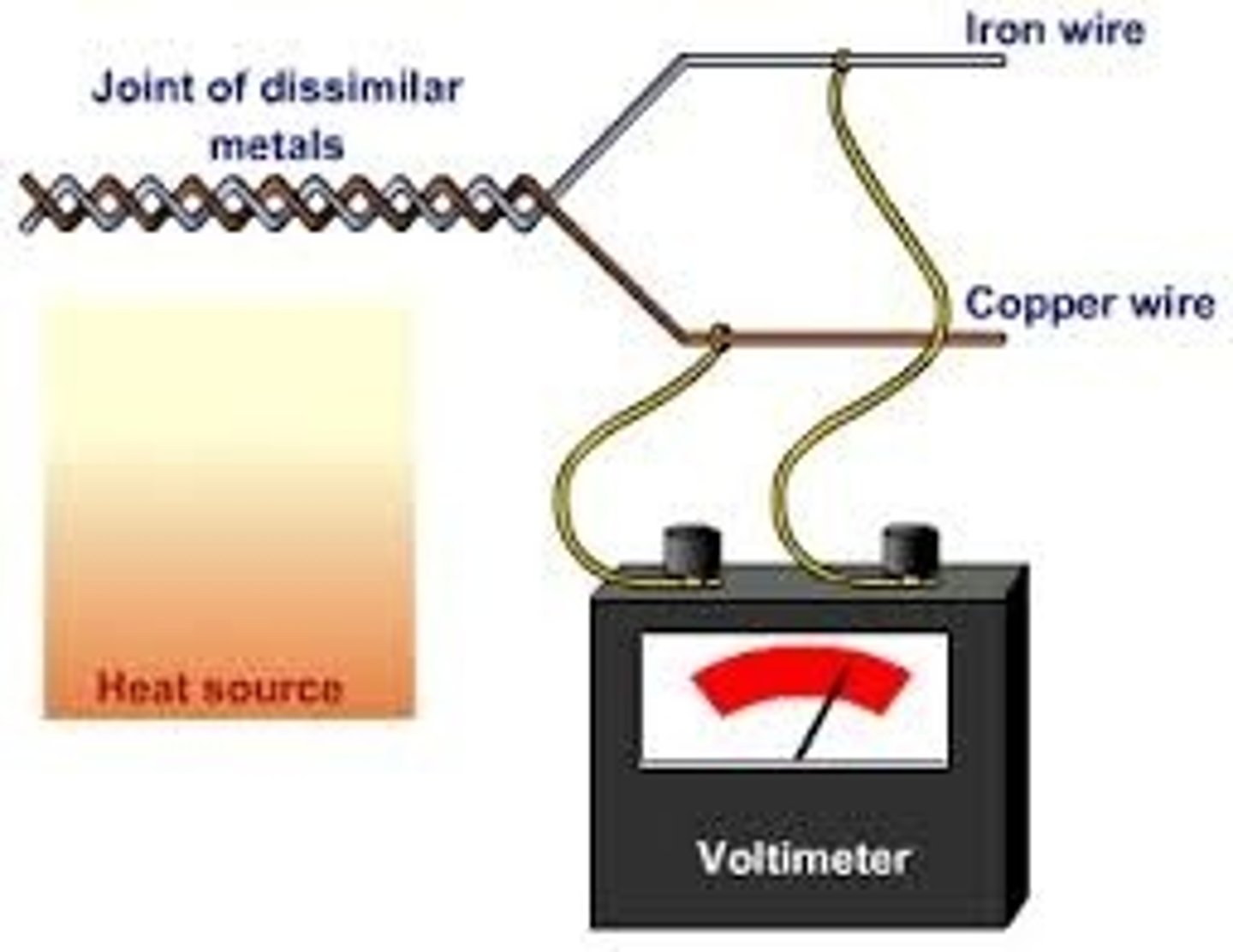
thermocouple thermometer
-very common electrical thermometer
-used widely in industry
- made from two different metals
-consists of two wires of different metals joined together at the ends to form two junctions
-junctions are placed in different temperatures
-If the junctions are at different temperatures, a small electromotive force is produced.
linear scales
one which shows equal expansion per unit temperature in the whole change
Boiling
the change of state of a substance from liquid to vapour at the boiling point
Evaporation
the change of state go a substance from liquid to vapour at any temperature
what happens during evaporation?
only the most energetic molecules escape from the liquid. They get their energy from the molecules left in the liquid
characteristics of boiling
-external heating needed
-visible and rigorous process
-occurs throughout the liquid
-does not cause calling effect
characteristics of evaporation
-no external heating needed
- slow and invisible
-occurs at the surface only
-causes cooling effect.
Thermal capacity
the amount of heat energy needed to raise the temperature of a substance by 1 Kelvin
Specific heat capacity
The amount of heat energy needed to raise the temperature of 1 kg of a substance by 1 kelvin.
(J/kgK)
apparatus needed to determine the specific heat capacity of a liquid
stirrer, heating coil, AC voltage source, thermometer, voltmeter, calorimeter, ammeter
procedure:
1. Place a beaker on a balance and press zero
2. add the oil to the beaker and record the mass of the oil
3. read the starting temperature of the oil
4. connect a joule meter to the immersion heater
5. time for thirty minutes
6. read the number of joules of energy that passes into the immersion heater
7. read the final temperature of the oil
8. use the following formula to calculate the specific heat capacity (c=energy/mass*temp change)
specific heat capacity formula
Specific heat capacity, c = Energy (J)/ mass (kg) * temp rise(degrees celsius)
Sources of inaccuracy
1. Thermal energy passing out of the beaker into the air- use an insulator with a lower thermal conductivity
2. Not all thermal energy is passed into the oil- ensure that the immersion heater js fully submerged
3. incorrect reading of the thermometer- use an electronic temperature probe
4. Thermal energy not being spread through the oil- stir the oil
Thermal conduction
The process of heat transfer through a solid by transmitting kinetic energy from one molecule to the next.
How does thermal conduction take place?
- when a substance such as a metal is heated heated the atoms nearest to the heat will begin to vibrate faster as they gain kinetic energy because of the temperature increase.
-As the atoms vibrate, they transfer thermal energy to the atoms around them causing the metal to heat up
Thermal convection
Heat transmission by the circulation of a liquid or a heated gas or air.
How does thermal convection take place?
-when a liquid or gas is heated, the molecules push each other apart causing the liquid or gas to expand
-this makes the liquid/gas denser than its surroundings
- the hot liquid/gas rises while the cooler liquid replaces it
- the hot liquid/ gas eventually cools and sinks back down causing a convection current.
Thermal radiation
transfer of thermal energy by waves that can travel through air or across space
How does thermal radiation take place?
-it is caused by electromagnetic waves
-as objects absorb these waves, they absorb energy and heat up.
-the hotter an object is, the more infrared radiation it gives out
-black and dull objects are good absorbers and emitters of thermal radiation while white or shiny objects are poor absorbers and emitters of thermal radiation as they reflect not absorb it.
-the greater the surface area of an object, the more radiation emitted from it
Specific latent heat of fusion Lf
The amount of thermal energy needed to change the state of 1 kg of a substance from solid into liquid state at constant temperature.
experiment to find the specific parent heat of fusion of ice
apparatus: funnel, retort stand, electronic balance, joulemeter, immersion heater.
steps:
1. add 100 g of the ice cubes to the funnel and fasten it using a retort stand
2. measure the mass of the empty beaker using a balance
3. place the beaker below the tip of the funnel to collect the melted water
4. insert the immersion heater into the funnel to melt the ice cubes
5. the joule meter records the entry given off by the immersion heater
6. Measure the mass of the beaker with the melted ice
7. calculate the mass of melted water (mass of beakers with water- mass of empty beaker)
8. Specific later heat of fusion of ice is calculates by dividing the energy by the mass of water collected in the beaker
equation
p*t= mLf
energy= mass* latent heat, Lf
Specific. latent heat of vaporization
the energy required to change 1 kg of a substance from a liquid to vapour with no change in temperature
equation for specific latent heat of vaporisation
E= m*Lf
experiment to determine the latent heat of vaporisation of water
apparatus:beaker containing water, beam balance, thermometer, stop watch, heater
steps:
1. heat a volume of water to boiling point
2. measure the mass of water (m1)
3. boil the water for 3 minutes (t=180 s)
4. Measure the final mass (m2) and calculate the mass turned to has= m1-m2
energy transferred E= P*t
Lv
Pt/m
experiment to show the best thermal conductor
set up apparatus
1. heat metals equally at the centre
2. check from which metal the pin drops first= best conductor
convection in air