Reading Quiz 2
 Call Kai
 Learn
Learn Practice Test
 Spaced Repetition
 Match
Match Flashcards
 Knowt Play
1/18

There's no tags or description
Looks like no tags are added yet.
Name | Mastery | Learn | Test | Matching | Spaced | Call with Kai |
|---|
No analytics yet
Send a link to your students to track their progress
19 Terms
What enzyme catalyzes the process of transcription in eukaryotes?
a) Restriction enzyme
b) DNA polymerase
c) RNA polymerase
d) RNA transcriptase
e) Reverse transcriptase
RNA polymerase
The base pair that would be found in RNA is:
a) A-U
b) U-C
c) U-U
d) A-C
e) G-U
A-U
Which statement is true regarding the sugar component in nucleic acids?
a) Both RNA and DNA contain deoxyribose
b) RNA contains deoxyribose, while DNA contains ribose
c) Both RNA and DNA contain ribose
d) RNA contains ribose, while DNA contains deoxyribose
RNA contains ribose, while DNA contains deoxyribose
What is the melting temperature (Tm) of DNA?
a) The temperature at which all the hydrogen bonds in the DNA are intact
b) The temperature at which DNA becomes RNA
c) The temperature at which half of the DNA strands are in the double-helix state and half are in the single-strand state
d) The temperature at which DNA synthesis occurs most efficiently
e) The temperature at which DNA becomes fully denatured
The temperature at which half of the DNA strands are in the double-helix state and half are in the single-strand state
In which type of organism would you find ribose as the sugar in the genetic material (store and transmit genetic information)?
a) None of the answers
b) Both eukaryotes and prokaryotes
c) Viruses
d) Prokaryotes
e) Eukaryotes
Viruses
Which of the following is true about the specificity of monoclonal antibodies?
a) They can cross-react with multiple antigens
b) They are less specific than polyclonal antibodies
c) They only recognize the Fc portion of antibodies
d) They are a combination of multiple antibodies from different immune cell lineages
e) They recognize a single epitope with high specificity
They recognize a single epitope with high specificity
What is a limitation of X-ray diffraction compared to cryo-electron microscopy?
a) Inability to visualize protein structures
b) Limited to studying small proteins
c) Requires the formation of large protein crystals
d) Inability to use biological samples
e) Limited to studying quaternary structures
Requires the formation of large protein crystals
What is the structure of DNA composed of?
a) Nucleosides
b) Nucleotides
c) Carbohydrates
d) Proteins
e) Lipids
Nucleotides
Why is RNA more susceptible to hydrolysis (degradation) than DNA?
a) Presence of uracyl
b) Presence of the 2’ hydrogen
c) Presence of the 2’ hydroxyl group
d) Presence of thymine
e) Absence of the 2’ hydroxyl group
Presence of the 2’ hydroxyl group
Which region of the IgG molecule is most variable and contributes the most to antigen specificity?
a) Fcab region
b) Hinge region
c) Fab region
d) Y domain of the Fc portion
e) Fc region
Fab region
You have a protein with a net positive charge at physiological pH, and you want to purify it using ion-exchange chromatography, a technique that separates molecules based on charge.
Cation-exchange chromatography uses a negatively charged stationary phase (column) to bind positively charged proteins.
Anion-exchange chromatography uses a positively charged stationary phase (column) to bind negatively charged proteins.
Which type of ion-exchange chromatography should you use to bind your positively charged protein?
a) Neither cation- nor anion-exchange chromatography will work
b) Either cation- or anion-exchange chromatography will work
c) None of the alternatives are possible
d) Anion-exchange chromatography (positively charged stationary phase)
e) Cation-exchange chromatography (negatively charged stationary phase)
Cation-exchange chromatography (negatively charged stationary phase)
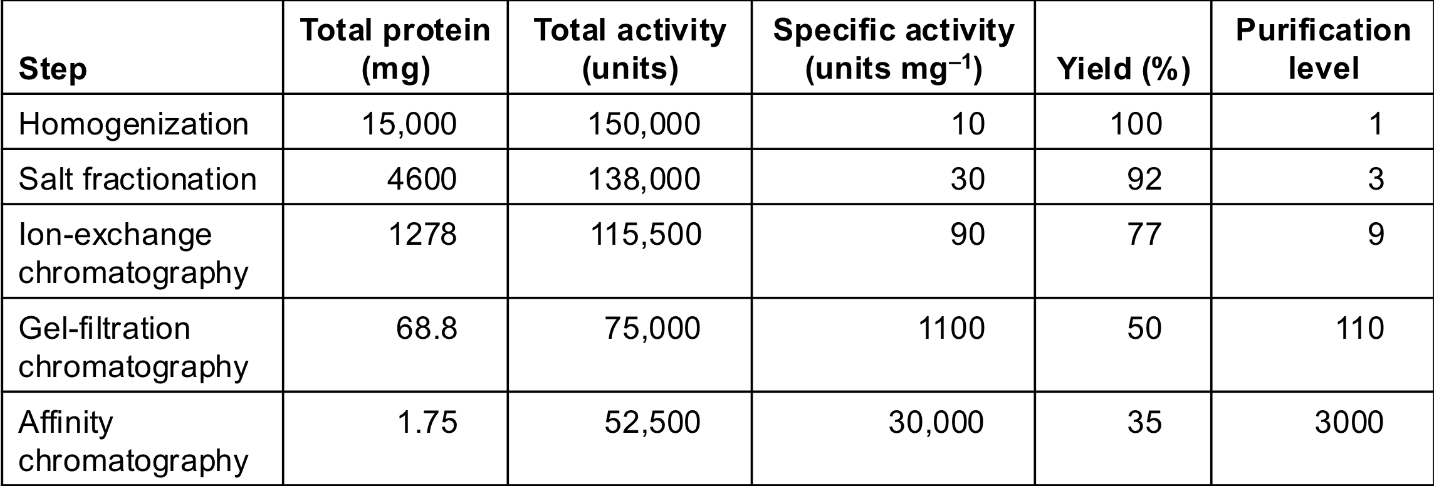
The table shows a protein purification process. Ideally, specific activity should increase as purification progresses, while total protein decreases.
Which of the following observations would indicate that the purification is not working properly?
a) The purification level increases as expected, indicating effective purification
b) Specific activity increases significantly at each step, while total protein decreases
c) Total activity remains stable, and yield is high throughout the purification process
d) Total protein is decreasing, but specific activity remains constant or decreases
Total protein is decreasing, but specific activity remains constant or decreases
What does a decrease in total protein across purification steps indicate?
a) Inactivation of all the enzymes
b) Loss of target protein
c) None of the alternatives
d) Increase in yield
e) Removal of impurities as other proteins
Removal of impurities as other proteins
In isoelectric focusing, proteins migrate until they reach a point where:
a) They are completely denatured
b) They are completely digested by the gel
c) Their net charge is neutral
d) They have the highest net charge
e) They bind to the gel matrix
Their net charge is neutral
In Western blotting, what is the purpose of the primary antibody?
a) None of the alternatives
b) To bind specifically to the target protein
c) To label the secondary antibody
d) To block nonspecific binding sites
e) To visualize the target protein directly
To bind specifically to the target protein
What primary information does the mass-to-charge ratio provide in mass spectrometry?
a) The identity of the ions present
b) The purity of the sample
c) The temperature of the sample
d) The concentration of the sample
The identity of the ions present
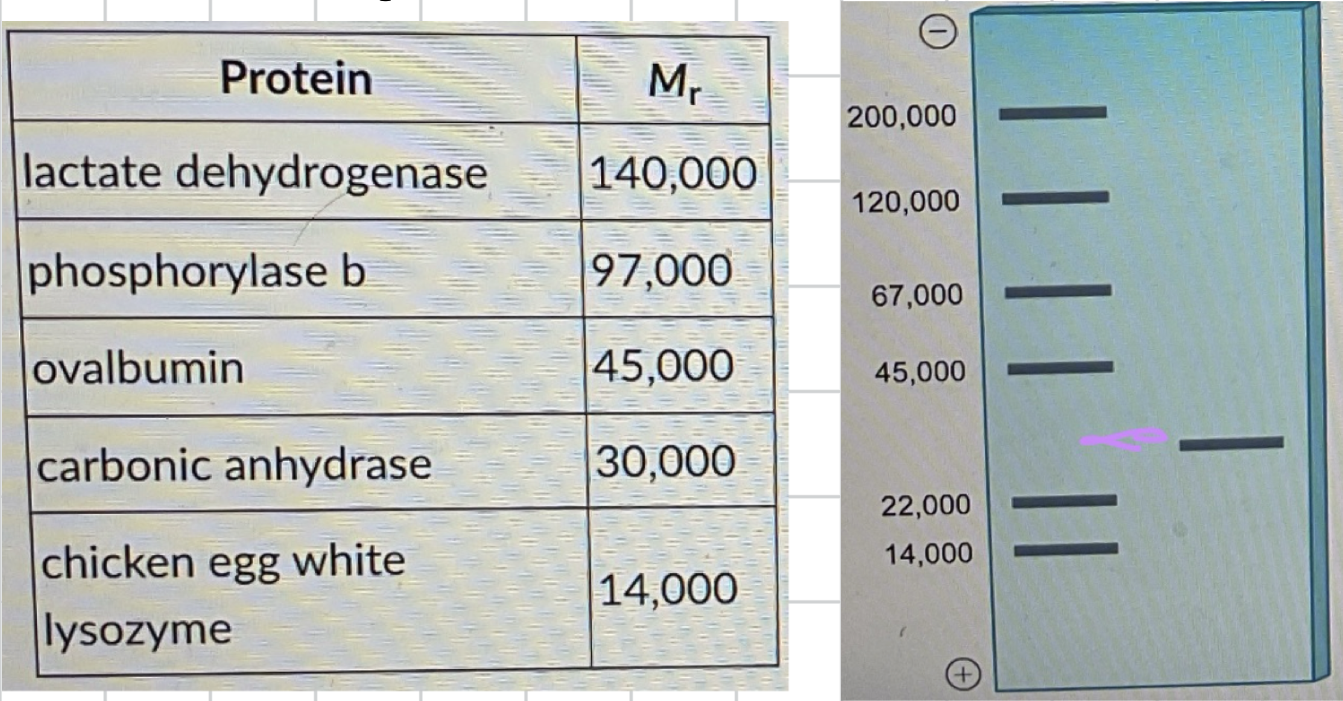
As part of a practical exam, an instructor gives you a purified protein sample and asks you to tentatively identify it using SDS-PAGE. The resulting gel is shown. The left lane shows standards of known molecular weight (Mr). The right lane shows the unidentified protein represented as a single band. Use the table and the gel result to determine the identity of the purified protein.
Note that the functional unit of lactate dehydrogenase is a tetramer of four identical subunits with a total molecular weight of approximately 140,000 Da.
a) Ovalbumin
b) Phosphorylase b
c) Carbonic anhydrase or lactate dehydrogenase
d) Lactate dehydrogenase or Ovalbumin
Carbonic anhydrase or lactate dehydrogenase
Which step in the Western blotting process involves separating proteins based on their molecular weight?
a) Incubation step
b) Extraction step
c) Transfer step
d) Electrophoresis (SDS-PAGE step)
e) Detection step
Electrophoresis (SDS-PAGE step)
What is the primary principle behind the salting out method for protein purification?
a) Increasing solubility of proteins in a solution
b) Using organic solvents to precipitate proteins out of solution
c) Charging the temperature of the solution to precipitate proteins
d) Decreasing solubility of proteins by adding high concentrations of salts
e) Maintaining the pH of the solution at a constant level
Decreasing solubility of proteins by adding high concentrations of salts