physical properties of dental materials
 Call Kai
 Learn
Learn Practice Test
 Spaced Repetition
 Match
Match Flashcards
 Knowt Play
1/47

Earn XP
Description and Tags
lecture given 3/12/2026
Name | Mastery | Learn | Test | Matching | Spaced | Call with Kai |
|---|
No analytics yet
Send a link to your students to track their progress
48 Terms
ionic bond
very strong electrostatic force
covalent bond and metallic bond
strong electrostatic force
hydrogen bond
weak electrostatic force
van der waals forces
very weak electrostatic force
what are bulk material properties?
basic physics- mass, volume, state, density, porosity, phases
liquid- solution
solid- bulk, foam, grains, powder, particulate
multiple phases- paste, slurry, suspension, hydrogel, composite, IPN
optical- translucency, gloss, refractive index
solid mechanics- strength, toughness, resilience, hardness, ductility, brittleness
fluid mechanics- viscosity, viscoelasticity (creep, relaxation)
electric: resistance, electrochemical potential
thermal: melting point, boiling point, thermal conductivity, thermal expansion, glass transition point, thermal diffusivity
solubility: solvent resistance, water sorption
durability: color stability, resistance to thermal cycling, chemical cycling, permeability
color is NOT a real physical property
what are thermal properties?
thermal expasion: CTE (coefficient of thermal expansion)
thermal diffusivity, thermal conductivity: rates of conducting heat
thermal capacity: heat the material needs for elevated temperature
thermal expansion of different layer of materials can cause interfacial stress, leading to bonding failure
thermal expansion and shrinkage leads to…
internal stress, and decreased mechanical properties
list dental materials in order of thermal expansion, from highest to lowest
wax (250-400 or higher), acrylics, dental composite, amalgam, alumina, gold, dental cement / enamel, emax CAD, zirconia, feldspar, dentin (8.3)
list dental materials in order of thermal conductivity, from highest to lowest
gold (710), amalgam, alumina, feldspar, enamel, zirconia, dental cement / dental composite, dentin, wax, acrylics (0.5)
Tm
melting point, temperature of a crystalline material changes from solid to liquid
Tg
glass transition point- temperature of amorphous material becomes rubbery
t/f semi-crystalline material shows both Tm and Tg
true
viscosity
measure of the resistance of a fluid which is being deformed by either shear stress or tensile stress
what is the viscosity coefficient?
η
dynamic (absolute) viscosity
μ or η, the SI physical unit of dyamic viscosity is the pascal second (Pa*s)
1cP = 1mPa*s = 0.001 Pa*s
kinematic viscosity (v)
μ/ρ
SI unit: m²/s, stoke (St)
the ratio of the intertial force of the viscous force
what is viscosity of a fluid highly dependent on?
temperature
shear stress (K)
(shear rate)^n
pseudoplastic (shear thinning)
n>1
newtonian (ideal liquids)
n=1
dilatant (shear thickening)
n<1
what are examples of bingham (plastic fluids)?
toothpaste, mayonnaise, tomato ketchup
what is an example of a newtonian (ideal) liquid in dentistry?
newly prepared zinc phosphate cement
what is an example of a bingham plastic (viscoplastic) in dentistry?
tooth paste
what are examples of psuedoplastic (shear thinning) liquids in dentistry?
polycarboxylate cements, non-water mixed glass ionomer cements, dental porcelain slurry, vinyl polysiloxane (PVS) impression paste, flowable composite, pit and fissure filling composite
what are examples of dilatant (shear thickening) liquids in dentistry?
traditional resin composites, liquid denture base resin, 3DP resin
what are examples of thixotropic liquids in dentistry?
they become less viscous when subjected to repeated pressure
prophy paste, some light-cure nano-particle filled composite resins, APF and topical fluoride gels, impression material
thixotropic is also pseudoplastic, but…
pseudoplastic is not also thixotropic
what are some surface properties?
adhesion, bonding, wettability, surface roughness, most cell interaction to biomaterials
related with bulk materials- hardness, color, gloss, roughness, wear
surface energy
the unique character of interfaces occurs because atoms at interfaces possess energies and reactivities significantly different from those of the same species in the bulk
liquid surface tension
a property of the surface of a liquid that allows it to resist and external force
occurs at the interface between liquid-gas, liquid-solid, immiscible liquids
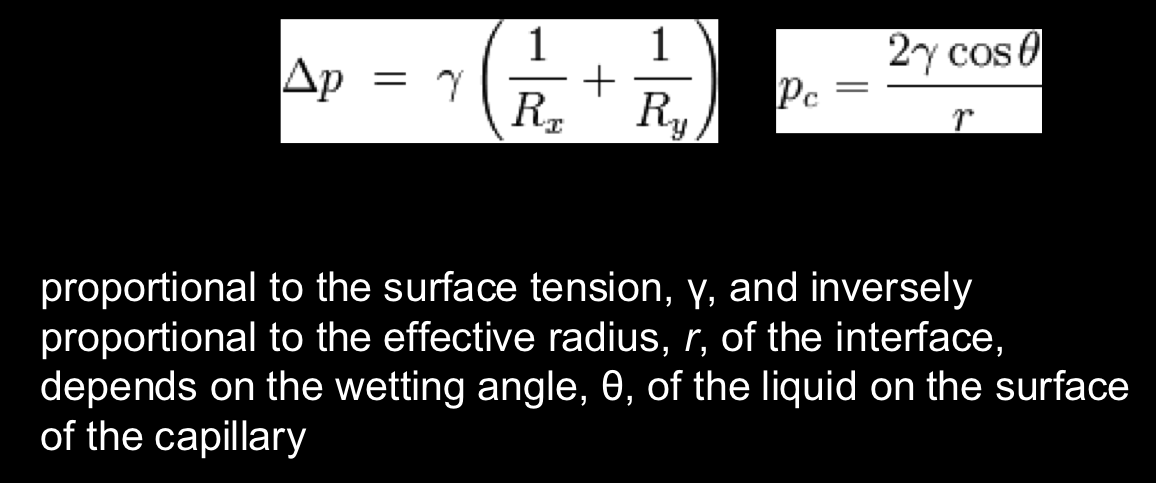
what equation is used with capillary pressure?
young-laplace
contact angle (θ)
a quantitative measure of the wetting of a solid by a liquid
hydrophilicity is indicated by smaller contact angles and higher surface energy
static contact angle
static sessile drop method
dynamic contact angle
dynamic sessile drop method, so there is advancing and receding angle
surface free energy (SFE)
the work required to increase the area of a substance by 1m²
is the result of cohesive forces of a material
strong, hard solids usually have ____ surface free energy and are ____ easily wetted (metals, teeth, ceramics)
high, more
materials that are more hydrophobic with have better…
color stability and stain resistance
restorative materials with low surface energy will be better able to resist …
plaque formation
adhesive material requires good wetting of tooth surfaces to achieve ____
adhesion
surface treatment
improves surface wettability of resin and promotes bonding strength
silane
contains silicon-alkoxyl and methacrylic group
good for silicate and metal based
10-MDP
contains phosphate and methacrylic group
good for alumina and zirconia based, also for HAP (containing Ca)
surface roughness (Ra)
arithmetic surface roughness
tested by profilometer (contact or optical)
*solubility of polymer based restorative material
dry material weight loss of a dental material after soaking for 7 days at 37 C, unit μg/mm³ . <7.5 (ISO 4049)
the testing baseline must be dried dental material, for both ceramic and polymer based dental material
water sorption of polymer based restorative material
water intake of a dental material after soaking for 7 days at 37 C, unit μg/cm³ . <40 (ISO 4049)
the testing baseline must be dried dental material, for both ceramic and polymer based dental material
chemical solubility of ceramics based restorative material
immerse in 4% acetic acid for 16 hr at 80C, unit μg/cm² . <100 (ISO 6872 and 3696)
the testing baseline must be dried dental material, for both ceramic and polymer based dental material
which fundamental force is responsible for a material’s mechanical and physical properties?
electromagnetic force