Patho - Development Disorders
 Call Kai
 Learn
Learn Practice Test
 Spaced Repetition
 Match
Match Flashcards
 Knowt Play
1/152

There's no tags or description
Looks like no tags are added yet.
Name | Mastery | Learn | Test | Matching | Spaced | Call with Kai |
|---|
No analytics yet
Send a link to your students to track their progress
153 Terms
Scoliosis is best described as
abnormal LAT curvature of the spine
A scoliosis curve to the right is more common in
thoracic spine
A scoliosis curve to the left is more common in
lumbar spine
A scoliosis curve that rotates around the axis of the spine can cause
rib cage deformity
Scoliosis is typically associated with
kyphosis / lordosis
Functional Scoliosis aka
Postural Scoliosis
Functional (postural) scoliosis is secondary to factors other than
vertebral involvement
Which of the following is not a secondary factor of functional (postural) scoliosis?
good posture
A functional (postural) scoliosis is straighten when paced in ______ or ______ to side of ________.
forward bend; IPSA FLX; VEXITY
Structural scoliosis is FIXED curvature associated with
vertebral ROT &
asymmetry of ligamentous support
Which of the following is not associated with structural scoliosis?
unwedged vertebrae
Which of the following is most commonly associated with structural scoliosis?
idiopathic
Structural scoliosis maintain position irrespective of whether the spine is
upright, forward bend, or IPSA FLX → side of CONVEXITY
The lumbar curve corrects as the patient bends to the right, this is considered
a nonstructural curve
The thoracic curve persists as the patient bends to the left, this is considered
a structural curve
The direction of the scoliosis curve is based on the direction of the
convexity of the curve
The top vertebrae are those who surface is
most tilted
The bottom vertebrae are those who surface tilts
most toward the curvatures concave side
Scoliosis is typically seen with
one primary curve + secondary curve to balance the body
For scoliosis can exist with 2 _______ curves (R thoracic/L lumbar)
primary
Scoliosis involved with rotational deformity occur on the
convex side
Scoliosis involved with rotational deformity may not be observed in _________ but is always apparent in _______.
standing; forward bend
What are the four classifications of scoliosis?
idio-, osteo-, myo-, and neuro-
What percentage of children present with scoliosis?
0.4-5.5%
What percentage of children present with scoliosis require some type of treatment?
25%
33% of scoliosis occurs in the context of
a primary neuromuscular disorder
Neuromuscular scoliosis often secondary to
imbalance or asymmetry of muscle thru trunk / spine
Which of the following is not a pathological change caused by a scoliosis?
lig/tissue lengthening on concave
What method is used to measure scoliosis?
Cobb method
Which of the following statements is not true about the cobb method?
angle formed by two parallel lines
_______ scoliosis is defined as a curve <20 and is rarely symptomatic.
mild
______ scoliosis is defined as a curve >60 and is associated with pulmonary insufficiency, degenerative spinal arthritis, disk disease, vertebral subluxation, sciatica.
severe
Which of the following is not true about back pain associated with scoliosis?
Less frequent in adults.
Which of the following is not a factor of back pain in scoliosis?
muscle instability / calf imbalance
What are common characteristics of scoliosis?
asymmetric shoulder/pelvic positioning
Scoliosis can be diagnosed either by
imaging or cllinician
What angle must the curve be in order to be considered scoliotic?
>10
10º scoliotic curve =
mild and rarely symptomatic
60º scoliotic curve =
severe
What is the Adam’s Forward Bend Test?
patient bend forward, assess for symmetry.
Which of the following statements is not true about the scoliometer?
Measure angle of trunk flexion
What is the key for treatment of scoliosis?
prevention (slow down curve progression)
If the curve is <25,
observe/monitor every 4-6m
A curve 25-45 involves
spinal orthoses
What is the goal of spinal orthoses?
prevent further or reduced current amount of curvature
Spinal orthoses serves as a passive restraint system to maintain
curvatures w/in 5 degrees of the curve measurement at time of initial applications
A curve > 45 involves
surgery (spinal rods)
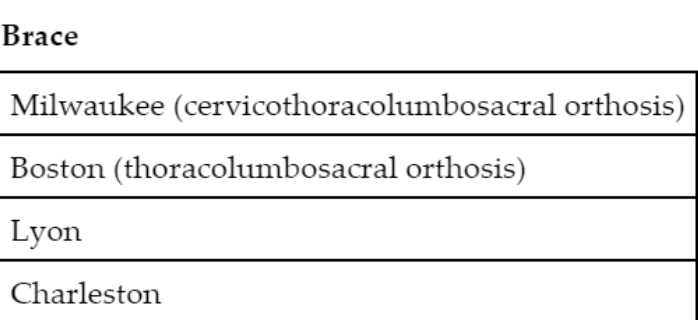
Match these braces with the following uses
best with curvature apex lower thenT9/10
For idiopathic scoliosis with thoracic hypokyphosis
Best with curvature at T8 or above
For idiopathic curves fabricated in maximum SB correction
3, 1. 2, 4
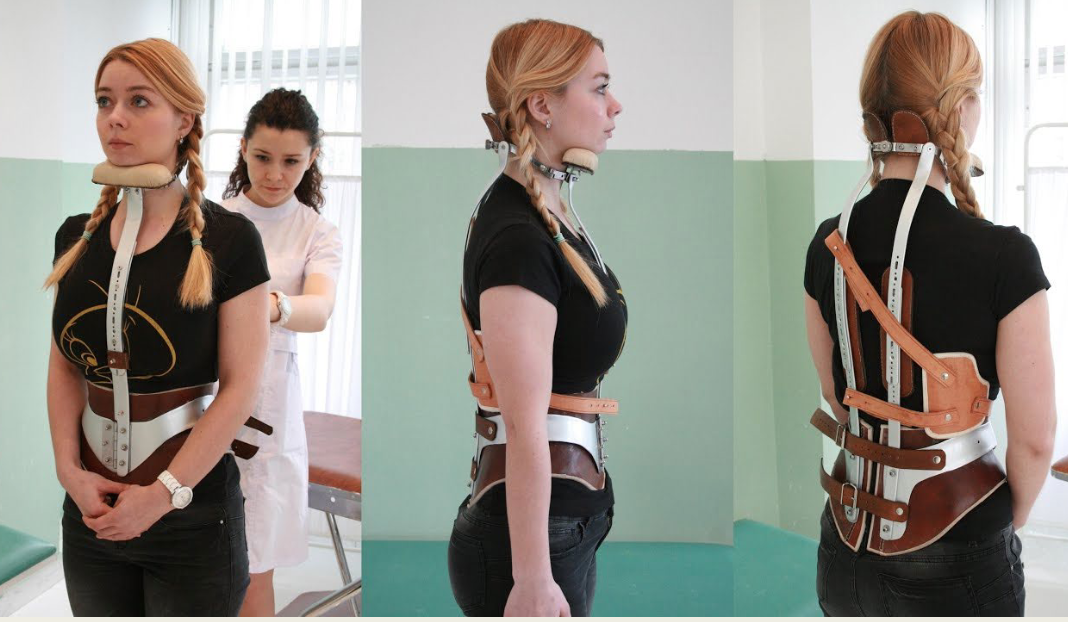
milwaukee brace
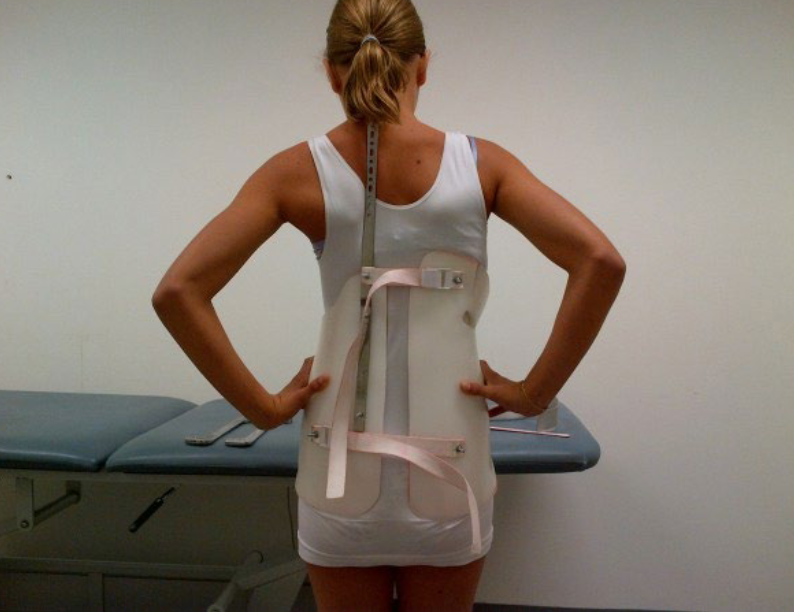
Boston brace
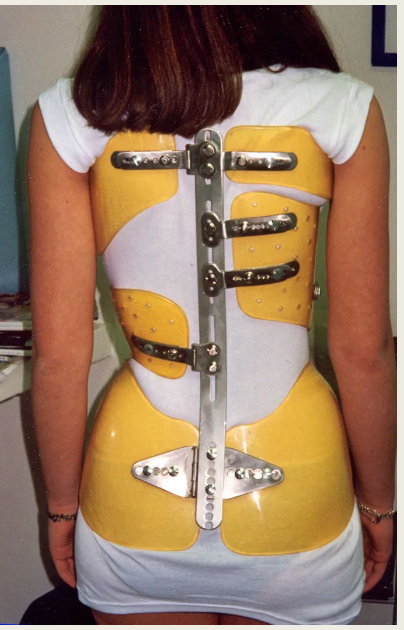
Lyon brace
Surgery for scoliosis involves
Fusion w/ POST seg spinal instrumentation
Postural scoliosis resolve as soon as
the primary problem is addressed
If the structural scoliosis curvature is less than 40’ the risk of progression is
small
If the structural scoliosis curvature is greater than 50 the spine is
biomechanically unstable
In structural scoliosis curvature will increase at rate of
1º/yr without treatment
Spina Bifida is a(n)
a congenital defect where there is a closure failing of the neural tube
What are the three categories spina bifida is typically broken down into?
Spina bifida occulta, Meningocele, Myelomeningocele
Spina bifida occulta =
Incomplete fusion of the posterior vertebral arch
Meningocele =
External protrusion of the meninges
Myelomeningocele =
Protrusion of the meninges and spinal cord
Spina Bifida typically occur in
lumbosacral area
What is the incidence rate of Spina Bifida?
3.4 per 10,000 live births (has been declining)
Why has overall incidence of spina bifida have been declining?
Prenatal screening / Improved nutrition (folic acid)
Need increased folic acid during at least
the first 6 weeks of pregnancy
Which of the following is not a factor of spina bifida?
Social status
Neural groove starts to develop about
20 days after conception
By day 23 the formation of
neural tube is compete EXCEPT opening at each end
By day 27, both ends of the neural tube are
closed off
Any closing failure of neural tube thru/out this time period
can result in
a NTD of some sort
In spina bifida, 75% of vertebral defects are located in
lumbosacral region at L5-S1
In spina bifida, motor dysfunction depends on
level of involvement / not evenly distributed
Spina Bifida Occulta does not
protrude through the skin
Spina Bifida Occulta is NOT accompanied by
Hard fatty deposits
Spina bifida occulta typically has no neuromuscular dysfunction except for
bowel/bladder disturbances or foot weakness
Meningocele is rarely associated with
neurological impairment
Myelomeningocele is almost always associated with
neurological impairment
Which of the following is not a characteristic of myelomeningocele?
Hypertonia
Which of the following characteristics is present in ~90% of children born with a myelomeningocele?
Hydrocephalus

Which motor spinal cord segment is involved
≤ T10

Which motor spinal cord segment is involved
T12

Which motor spinal cord segment is involved
L1-L2

Which motor spinal cord segment is involved
L3-L4

Which motor spinal cord segment is involved
L5

Which motor spinal cord segment is involved
S1

Which motor spinal cord segment is involved
S2-S3
Meningocele and Myelomeningocele is typically detected prenatally with
US and serum AFP (alpha-fetoprotein) testing
Spina bifida occulta is generally detected at
birth
In utero Spina bifida occulta is
Not detectable
Postnatally Meningocele and Myelomeningocele is obvious on
physical examination
transillumination of the protruding sac
Prenatal surgery for Meningocele and Myelomeningocele involves a
Closure of the tube reduces risk of hydrocephalus from 90% to 59%.
Other than surgery, what other treatments are used for spina bifida?
Bowel and bladder management / Addressing individual symptoms
The prognosis of spina bifida varies with degree of accompanying neurologic deficit. The higher the ___________ the worse the prognosis.
Myelomeningocele
Approximately 2/3 children with myelomeningocele have an IQ that falls in
normal range (after shunting for hydrocephalus)
Children with myelomeningocele typically have a delay in achieving ambulation is
normal (but goal is ambulation by 7 years old)
Developmental Dysplasia of the Hip (DDH) is a common disorder affecting
infants and children
DDH can be U/L or B/L and occur in which 3 forms?
Unstable hip dysplasia, Subluxation, Complete dislocation
Unstable hip dysplasia
Hip is positioned normally but can be dislocated by manipulation
Subluxation
Femoral head remains in contact with acetabulum
Complete dislocation
Femoral head is totally outside the acetabulum