[SPECON] Principles of Geriatric Rehabilitation
 Call Kai
 Learn
Learn Practice Test
 Spaced Repetition
 Match
Match Flashcards
 Knowt Play
1/48

There's no tags or description
Looks like no tags are added yet.
Name | Mastery | Learn | Test | Matching | Spaced | Call with Kai |
|---|
No analytics yet
Send a link to your students to track their progress
49 Terms
This age group is expected to have the greatest increase in population.
Follow Up Question: Because of this, what is the population pyramid expected to look like in the future?
Oldest-old bracket (85+ y/o)
An inverted pyramid
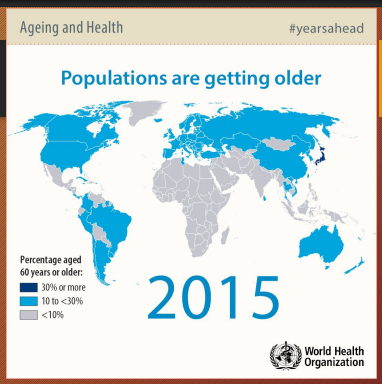
Currently, how many percent of the elderly live in the community and not in nursing homes?
70-80%
This term refers to the bias against elderly based solely on chronological age.
Follow Up Question: Who coined this term?
Ageism
Robert Butler
What is the age of forceful retirement in the Philippines due to declining capacity to perform?
65 y/o
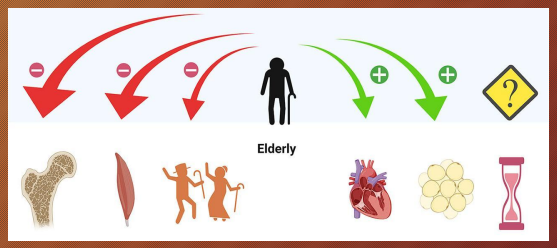
This theory of aging implies that aging is regulated by biological clocks operating throughout the life span. This regulation would depend on changes in gene expression that affect the systems responsible for maintenance, repair and defense responses.
Programmed theory
Based on the Programmed Theory of Aging, these extensions of genetic material get shorter as we age, leading to the actual genes being affected and being unable to do their function.
Follow Up Question: What is the main implication of this theory?
Telomeres
There is nothing we can do to stop aging.
This theory of aging states that aging is a consequence of unrepaired DNA damage accumulation (i.e. finances, psychological, environmental, metabolic). It states that although there are normally parts that repair the damage, their abilities begin to decline as we age.
Stress theory
This theory of aging states that aging is a nonadaptive trait because natural selection is negligent of events that occur in a few long-lived animals that provide little additional contribution to offspring numbers.
Mutation theory
This theory of aging states that organisms age because cells accumulate free radical damage over time.
Free radical theory
This is any atom or molecule that has a single unpaired electron in an outer shell. They are highly reactive cells that accumulate as we age, leading to damage.
Follow Up Question: What should we use to combat this?
Free radical
Anti-oxidants
What are the psychological issues in aging?
Limited and fragile support system
Socially isolated
Multiple sources of stress
“Devalued” by themselves and others (due to the loss or shift of roles that occurs with aging [i.e. family not letting her help around the house due to her age])
What are the physiologic characteristics of aging?
Decreased reserve capacity of organ system
Decreased internal homeostatic control
Decreased ability to adapt in response to different environments
Decreased capacity to respond to stress
[Body Composition] Determine if the following will increase or decrease with age.
Lean tissue
Muscle Mass
Fat
Muscle fiber number and area
Bone density
Increase:
Fat (up to 30% of BW by 80 y/o)
Decrease:
Gradual loss lean tissue
Muscle Mass
Limb muscle volume
Muscle fiber number and area
Bone Density
[Respiratory System] Determine if the following will increase or decrease with age.
Residual volume
Lung dead space
VO2 max
Functional residual capacity
Vital capacity
Maximal breathing capacity
Force and volume air flow
Minute volume with exercise
Sleep related disorders
Increase:
Residual volume
Functional residual capacity
Lung dead space
Sleep related disorder
Minute volume with exercise
Decrease:
VO2 Max
Vital capacity
Maximal breathing capacity
Force and volume air flow
This is an indicator of a longer lifespan due to more oxygen used during an activity, leading to a higher cardiovascular endurance.
High VO2 max
[Cardiovascular System] Determine if the following will increase or decrease with age.
Cardiac Output
Orthostatic Hypotension
Maximal exercise HR
Serum Lipid
Contractile function
Cardiac Reserve
Increase:
Orthostatic Hypotension (inability of our body to adjust to positional changes)
Serum Lipid
Decrease:
Cardiac Output
Maximal exercise HR
Contractile function
Cardiac Reserve
[Cardiovascular System] Determine if the following will increase or decrease with age.
Orthostatic tolerance
Thrombosis
Arterial elasticity
Systolic and diastolic BP
Capacity to work
HD lipoproteins
Maximal O2 consumption
Increase:
Systolic and diastolic BP
Thrombosis
HD lipoproteins
Decrease:
Orthostatic tolerance
Maximal O2 consumption
Capacity to work
Arterial elasticity
[Musculoskeletal System] Determine if the following will increase or decrease with age.
Osteoporosis
Degenerative diseases
Muscle strength
Calcium
Poor posture
Work rate or power output
Increase:
Osteoporosis
Degenerative Diseases
Poor Posture
Decreases:
Muscle strength (20-30%)
Work rate or power output
Calcium
What is the role of calcium in the elderly?
Calcium is important for the sliding filaments and hypokalemic patient can develop low heart rate. Its role is considerably more important than sodium and potassium.
[Neurological System] Determine if the following will increase or decrease with age.
Fluid intelligence
Ability for new learning
Coordination and balance
Choice of reaction time
Nerve conduction velocity
Increase:
Choice of reaction time
Decrease:
Fluid intelligence (ability to feel that he is thirsty)
Ability for new learning
Nerve conduction velocity
Coordination and balance (coordination — knowing the timing of contraction of certain muscles to do fluid movement like walking)
[Sensory System] Determine if the following will increase or decrease with age.
Vision
Hearing
Vibratory perception
Touch and pain sensitivity
All of these will decrease.
[Skin] Determine if the following will increase or decrease with age.
Moisture content
Elasticity
Susceptibility to pressure sores and infection
Epidermal renewal
Blood supply
Increase:
Susceptibility to pressure sores and infections
Decrease:
Moisture content
Epidermal renewal (slower healing)
Elasticity
Blood supply
[Others] Determine if the following will increase or decrease with age.
Risk of dehydration
Thirst perception
Febrile response to infection
Susceptibility to hyper or hypothermia
Lean body mass
Glucose tolerance
Body water
Increase:
Risk of dehydration
Susceptibility to hyper or hypothermia
Decrease:
Thirst perception
Febrile response to infection
Lean body mass
Body water
Glucose tolerance
Enumerate the postural changes seen in the elderly:
Head
Shoulder
Scapula
Elbow
Wrist
Finger
Thorax
Lumbar spine
Hip and knee
Ankle
Follow Up Question: Upon seeing these postural deviations, what should we determine?
Forward headed
Shoulder extended
Scapula protracted
Elbow flexion
Wrist ulnar deviation
Finger flexion
Increased thoracic kyphosis
Lumbar spine straightening
Hip and knee flexion
Ankle decreased dorsiflexion
Determine if they are due to habit or a condition.
Aside from aging, what else contributes to a decline in physiological function?
Inactivity (lack of exercise)
What are the minimal ROM values for the following:
Shoulder
Forearm
Wrist
Finger
Hip
Knee
Shoulder: 90° shoulder abduction with sufficient ER/IR
Forearm: 45° pronation and supination
Wrist: 45° wrist flexion, 30° wrist extension
Finger: finger flexion within 1 in of palm
Hip: normal hip extension, 90° hip flexion
Knee: normal knee extension, 110° knee flexion
The geriatric population are more sensitive to medicine effects. How much medication do the elderly drink on average?
Follow Up Question: What is the relationship between the dosage of medication and the incidence of adverse reactions?
An average of 5 Meds. per day.
↑ dosage of meds ↑ incidence of adverse reactions
This medication slows down heart rate.
Follow Up Question: Because of this, patients who are taking this medication do not show an substantial increase in heart rate. To ensure accuracy in the monitoring of the patient, what other monitors for exercise intensity can be used?
Beta-blockers
Borg’s RPE, Talk Test, etc.
How often do falls or near-falls occur in the elderly?
~1/3 of the elderly
What percentage of falls result to a fracture?
Follow Up Question: 90% of falls occur as fractures to which areas of the bodies?
3-5%
Hip, pelvis, and forearm
What are the environmental and psychological factors of falls in the elderly?
Follow Up Question: What is the main social risk factor for falls in the elderly?
Environmental Factors: inclement weather, unfamiliar surroundings
Psychological Factors: inattention, depression, cognitive impairment
Living alone
Upon learning that the patient has history of falls, what should be done?
Follow Up Question: Upon learning that the patient will be discharged by his doctor and you see that the patient in not fit to return home yet, what should you do?
Check the patient’s fall risk (BBS, Romberg, TUG, etc.)
Explain the interpretation of the OMTs, their fall risk, the necessary precautions, and the interventions to be done
Can also recommend the patient for home visit and assessment to assess the home environment
You can argue with the doctor.
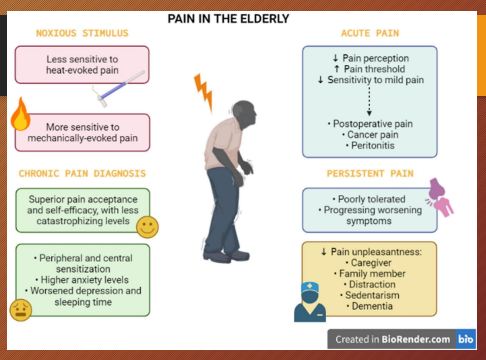
How much percent of nursing home patients have pain?
Follow Up Question: Why are physical measures an important part of the rehabilitation management of the elderly?
~75%
Elderly are more sensitive to meds and are at a higher risk for polypharmacy
When do spondylitic changes present?
Present after the 6th decade in 82%
At what level is surgical disc degeneration common?
Common in C5-C6, followed by C6-C7 and C4-C5
This impairment affects the motor function of the lips and tongue and masticatory muscles, which slow down with aging. It also leads to a decreased amplitude of esophageal contractions.
Follow Up Question: Due to the inability to eat and swallow that occurs due to this condition, what does this lead to for the patient?
Dysphagia
Improper nutrition; can affect motility, other body systems, and immunity
Read: other causes include meds side effects, feeding dependency, neurologic disorder, inflammatory muscle disease, scleroderma, cervical spine disorder, cancer, and tracheostomy
What are the precautions to take in a patient who has undergone a hemiarthroplasty?
Avoid >90° hip flexion, adduction beyond neutral, and internal rotation
Do we need to restore full range of motion at all times for the elderly (especially those with arthritis)?
No, just know the functional ranges and the specific ranges that he needs for his BADLs and IADLs.
What is the most common cause of TBI in the elderly population?
Falls
What are the motor neuron conditions common in the elderly?
Parkinson’s Disease and Multiple Sclerosis
What are the peripheral nervous system impairments seen in the elderly?
↓ or lost vibratory sense (up to 82%)
↓ ankle stretch reflexes
This visual impairment leads to social isolation, decreased morale, and decreased sense of well-being. This can stem from cataracts, age-related macular degeneration, glaucoma, and diabetic neuropathy.
Poor vision
What is the incidence of hearing loss in the elderly?
25-50% in >65 y/o
What is the proper preventive measure for ischemic foot ulceration?
Proper foot care and wearing proper shoes
What is the intervention for chronic venous insufficiency and lymphedema?
Use compressive garments
What affects sexual function in the elderly?
Age-related hormonal changes
Other Factor: vision, hearing & smell alterations, (-) social attitudes in elderly sexuality, erectile & ejaculatory changes, vaginal dryness, dyspareunia, urinary stress incontinence, ↓ mm strength, endurance & LOM
30-40 years after an acute episode of this condition, 50% of the elderly report having excessive fatigue, progressive weakness, pain, loss of function & atrophy.
Follow Up Question: Specifically what condition is this referring to?
Poliomyelitis
Post-polio syndrome
For patients with an SCI, what is the primary limiting factor?
Motor function (rather than age)
This condition in the elderly presents with hyperthermia, decreased skin sensation and special senses, impaired genitourinary and gastrointestinal systems, and cognitive and affective disorders.
Multiple Sclerosis