Y9 EOY Science test (Chemistry)
 Call Kai
 Learn
Learn Practice Test
 Spaced Repetition
 Match
Match Flashcards
 Knowt Play
1/43

There's no tags or description
Looks like no tags are added yet.
Name | Mastery | Learn | Test | Matching | Spaced | Call with Kai |
|---|
No analytics yet
Send a link to your students to track their progress
44 Terms
What is everything made up of?
Atoms
Structure of an atom
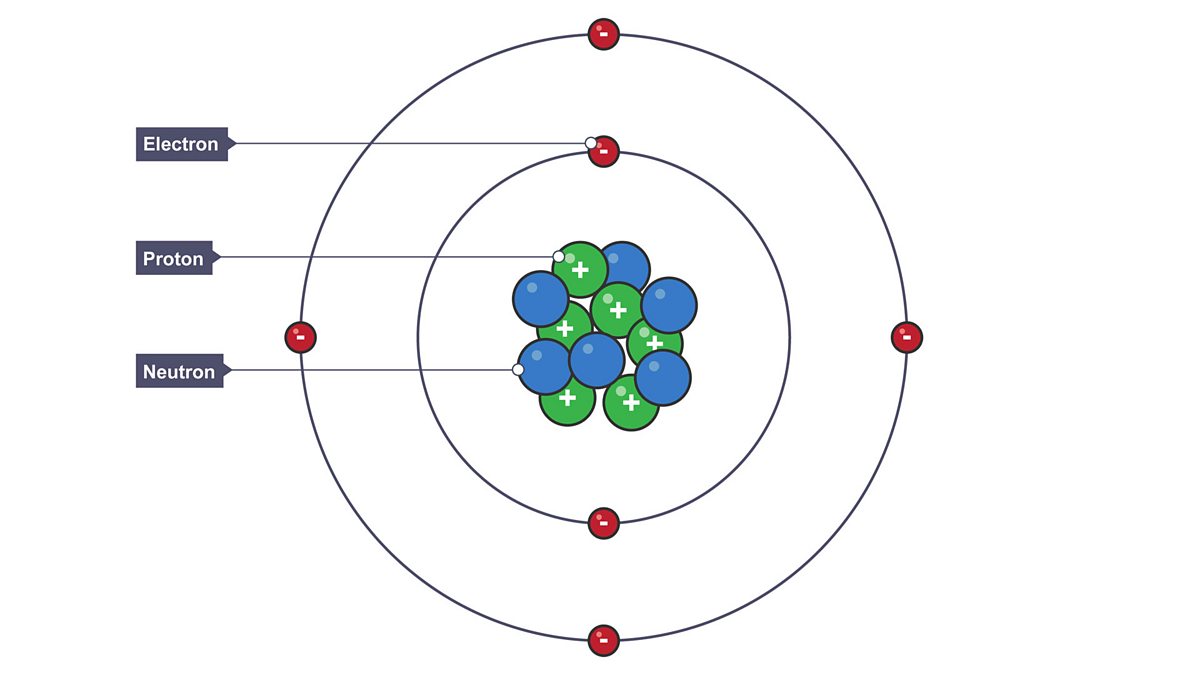
Radius of an atom
0.1nm
Radius of a nucleus (in an atom)
Around 1/10000 the radius of an atom
Relative mass of a proton
1
Relative charge of a proton
+1
Relative mass of a neutron
1
Relative charge of a neutron
0
Relative mass of an electron
5.4 × 10(to the power of -4)
Relative charge of an electron
-1
What is the charge of an atom and why?
Atoms have a neutral charge because they have an equal number of protons and electrons
What is an element?
An element is a substance made of one type of atom
Atoms of an element have the _____ number of protons. Atoms of different elements have a ______ number of protons
1.same
2.different
Relative atomic mass of an element
The average mass all of the isotopes of the element
State how many different types of elements there are
Around 100
Compound
Made of atoms of different elements that are chemically bonded to each other
Which of these formulas are a compound:
.H₂O or S?
H₂O
What is needed to separate compounds back into elements?
A chemical reaction
What is a molecule made up of?
Atoms chemically bonded to each other
Made of atoms of different elements that are chemically bonded to each other
Compound
Atoms chemically bonded to each other
What is a molecule made up of?
What are made during chemical reactions?
New substances
Conversation of mass
mass of products = mass of reactants
How is an ion formed?
When an atom loses or gains an electron
Metal ions become…
Positive ions
Non-metal ions become…
Negative ions
Charge of ions in Group 1
Positive
Charge of ions in Group 2
Positive
Charge of ions in Group 6
Negative
Charge of ions in Group 7
Negative
Before the discovery of the electron, what did scientists think atoms were?
Solid spheres
Isotopes
Atoms with the same number of protons but a different number of neutrons
How do you calculate the relative atomic mass of an element?
total mass of atoms/ total number of atoms (and need some example questions)
There are two isotopes of chlorine, ³⁵Cl and ³⁷Cl. 75% of all chlorine atoms are ³⁵C and the remaining 25% are ³⁷Cl. Find the relative atomic mass of chlorine.
Cl - 35 = 75%
Cl - 37 = 25%
Average mass = total mass of atoms/ total number of atoms
Average mass = (35 × 75) + (37 × 25) / 75 + 25
Average mass = 2625 + 925 / 100
Average mass = 3550 / 100
Average mass = 35.5
There are two isotopes of boron, ¹⁰B and ¹¹B. 20% of all chlorine atoms are ¹⁰B and the remaining 80% are ¹¹B. Find the relative atomic mass of boron rounded to the nearest whole.
B - 10 = 20%
B - 11 = 80%
Average mass = total mass of atoms/ total number of atoms
Average mass = (10 × 20) + (11 × 80) / 20 + 80
Average mass = 200 + 880 / 100
Average mass = 1080 / 100
Average mass = 10.8
= 11 (Rounded to the nearest whole)
There are two isotopes of neon, ²⁰Ne and ²²Ne. 90% of all neon atoms are ²⁰Ne and the remaining 10% are ²²Ne. Find the relative atomic mass of neon to the nearest whole.
Ne - 20 = 90%
Ne - 22 = 10%
Average mass = total mass of atoms/ total number of atoms
Average mass = (20 × 90) + (22 × 10) / 90 + 10
Average mass = 1800 + 220 / 100
Average mass = 2020 / 100
Average mass = 20.2
= 20 (Rounded to the nearest whole)
What is the plum pudding model?
A model made by Thomson which had the atom as a ball of positive charge with electrons randomly embedded in it
Why was the plum pudding model proposed?
Because the electron was just discovered
Explain how the results from Rutherford scattering experiments disproved the plum pudding model
Unlike the plum pudding model, electrons orbit around the nucleus
What is the nuclear model?
A model made by Rutherford which had a very small, charged nucleus at the atom’s centre. Electrons orbit the nucleus and the atom is shown to be mostly empty space
Describe the differences between the plum pudding model and the nuclear model in terms of the arrangement of the subatomic particles (4)
.Plum pudding model has no nucleus but the nuclear model does
.Plum pudding model has electrons randomly scattered around but electrons orbit the nucleus in the nuclear model
.Plum pudding model has no protons but the nuclear model does
.Plum pudding model has no neutrons but the nuclear model does
.The positive charge in the plum pudding model is spread out but the positive charge remains in the nucleus in the nuclear model
What does Bohr’s model have?
Electrons orbiting the nucleus in shells
What needs to happen in order for a reaction to take place?
Reacting particles must collide with enough/sufficient energy
What increases the ROR?
.Increasing the temperature
.Increasing the concentration
.Increasing the surface area
.Increasing pressure