1BO3 Finals Unit 9-12
 Call Kai
 Learn
Learn Practice Test
 Spaced Repetition
 Match
Match Flashcards
 Knowt Play
1/118

There's no tags or description
Looks like no tags are added yet.
Name | Mastery | Learn | Test | Matching | Spaced | Call with Kai |
|---|
No analytics yet
Send a link to your students to track their progress
119 Terms
Unit 9 Product Differentiation
Refers to the features of one firms product that make it different from the offerings of other firms
When products are differentiated, the output from different firms are not perfect substitutes
Sources
Actual or perceived difference in materials, quality, etc.
Brand name or reputation
Location and Convenience
Transaction costs, lock in, switching costs
Incomplete information
Unit 9 Monopolistic Competition
Monoply is a term we use for a firm that dominates a market.
Monopolistic competitive firms do face competiton, but they will dominate their own little segment of the market
There are many buyers and each buyer is small relative to the overall market size, so they cannot affect the market price with their own actions
There are many sellers and each seller is small relative to the overall market size, but each produces a differentiated good. Sellers therefor have some control over the price they charge, and they can charge prices different from competitors
Firms can easily enter or exit market
MOST MARKETS ARE THIS KIND OF MARKET
Unit 9 Product Demand in Monopolistic Competiton
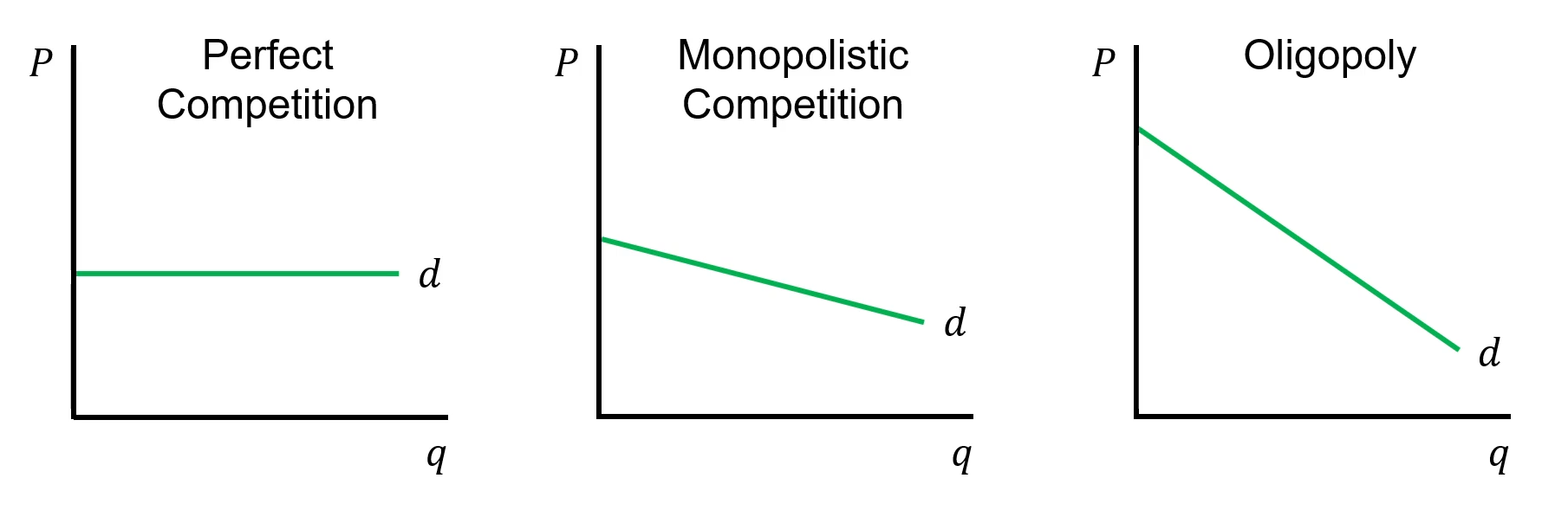
Monopolistically competitive firms product differentiated goods, so they appeal to different segments of the overall market and face downward sloping demand within their own segment or locale
Unit 9 Perfect Competiton vs Monopolistic Competiton
In perfect competition, firms are price takers, so marginal revenue equals market price (MR = P).
In monopolistic competition, firms face a downward-sloping demand curve, so marginal revenue is less than price (MR < P).
Unit 9 Marginal Revenue in Monopolistic Competiton
Because a monopolistically compettive firm has control over its price, we call it a price setter
To increase sales, it must lower its price
Marginal revenue is less than price
Marginal revenue is always less than the market price
For a linear demand curve, the slope of the marginal revenue curve will be exactly double the slope of the demand curveU
Unit 9 Marginal Revenue and Total Revenue
Because the price chanegs each time we change output, the marginal revenue per unit is less than the market price
Because P changes, total revenue is a non linear function: TR = Pq
Unit 9 Profit Maximization
Profit = TR - TC
When TR < TC, our profits are negative
When TR = TC, our firm breaks even
When TR > TC, our profits are positive
When profits are maximied, the total revenue curve and the total cost curve have the same slope
Therefor, when profits are maximized MR=MC
Unit 9 Monopolistic Competition Analyzing MR and MC
When MR > MC, revenues grow faster than costs and profits will increase
All units up to qMC will gain profit
When MR < MC, costs grow faster than revenues and profits will decrease
All units after qMC will lose profit
Profits reach their maximum point when MR = MC
Unit 9 Monopolisti Competition P and MC
For a monopolistically competitive firm
P > MC
The price consumers pay is higher than the marginal cost to make the good. We call this difference a markup price
Unit 9 Perfect Comp vs Monopolistic Comp RECAP
Perfect Competition
Firms sell homogenous goods so goods from different firms are perfect substitutes
Firms are price takers so price equals marginal revenue
Price equals marginal cost so there is no markup
Monopolistic Competition
Firms sell differentiated goods so goods from different firms are no perfect substitutes leading to customers may prefer one firm over another
Firms are price setters so price is greater than marginal revenue
Price is greater than marginal cost so consumer pay a price market
Unit 9 Price Elasticity and Marginal Revenue
When demand is elastic, lowering price increases total revenue.
When MR = 0, total revenue is at its maximum, demand is unit elastic.
When MR < 0, lowering price reduces total revenue, demand is inelastic.
Unit 9 MR and MC + Firms Operation
Marginal cost is always positive (MC > 0), meaning producing one more unit always adds some cost
Since firms maximize profit where MR = MC, marginal revenue must also be positive at the chosen output
Price-setting firms operate only where demand is elastic, because in the inelastic range MR is negative
The profit-maximizing quantity is lower than the revenue-maximizing quantity, since revenue is maximized where MR = 0 but profit requires MR = MC > 0
Unit 9 Price and Quantity in Monopolistic Competiton
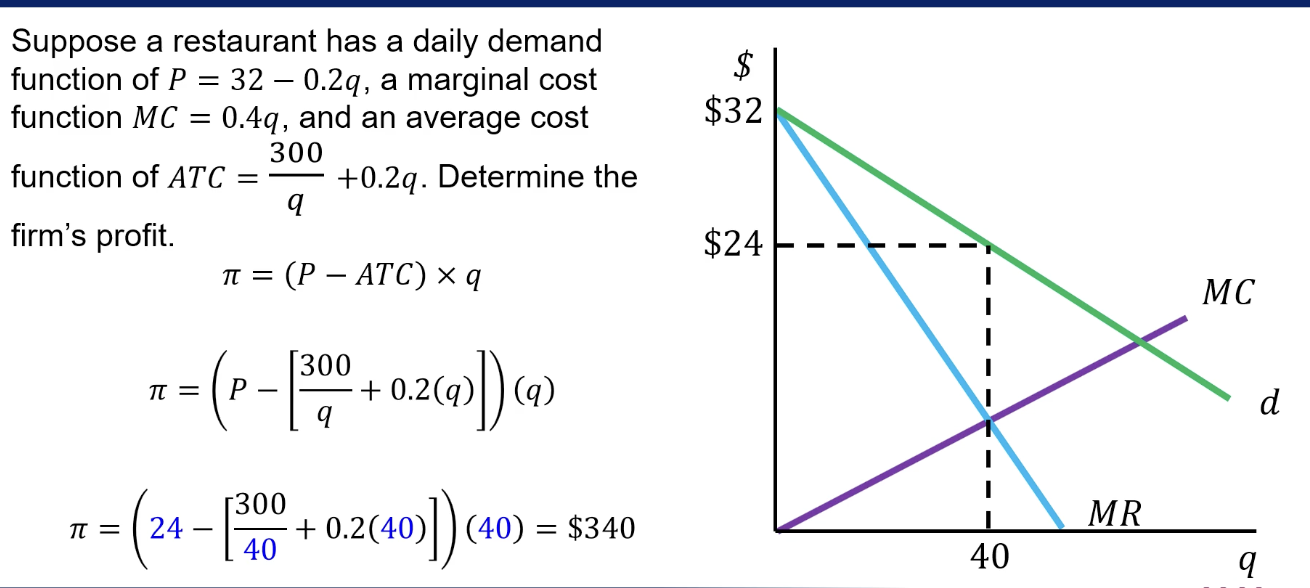
Suppose restaurant has a daily demand function of P = 32 - 0.2q and a marginal cost function MC = 0.4q
Determine the profit maximizing quantity and price
Multiply the slope of demand curve by 2 for the MR curve
Set MR = MC then drag the line from that point up to the demand curve
Equate lines that intersected to find Q
Unit 9 ATC and Profit
ATC reaches a minimum when its equal to MC
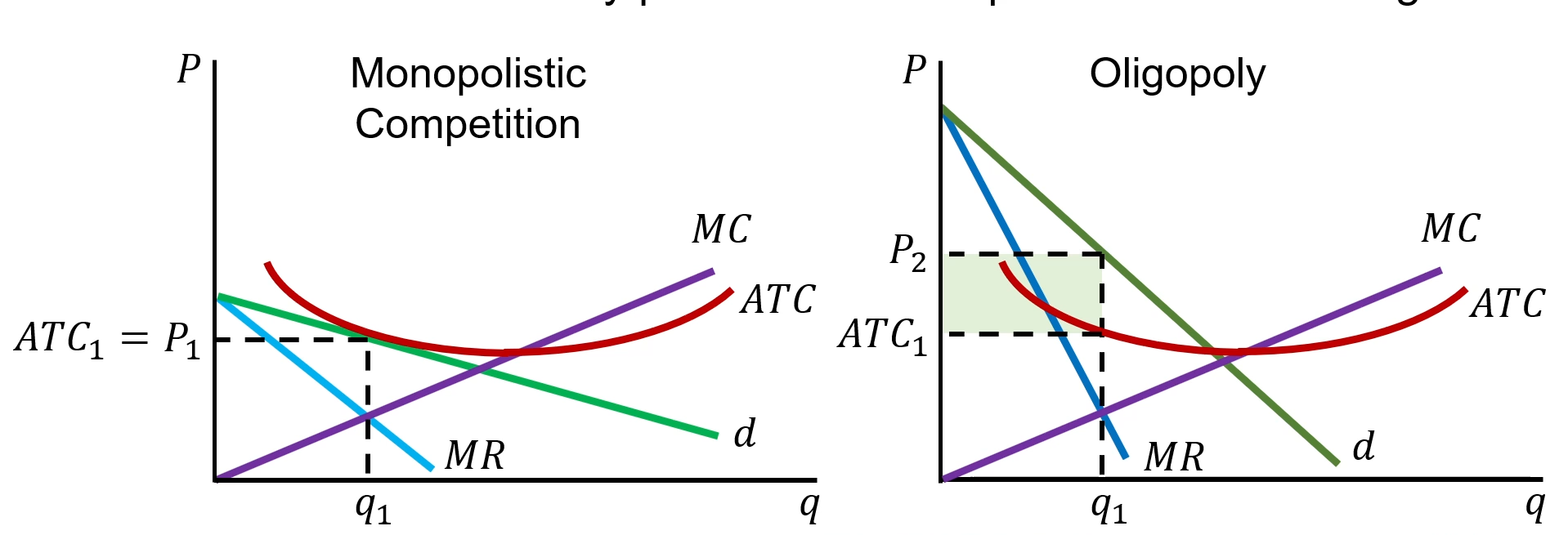
When P > ATC, the firm earns a profit per unit
Total profit is difference between production cost and price times q
When P < ATC, the firm earns a loss per unit
qMC is the loss minimizing quantity
Unit 9 Short Run Losses
If a firm continues to operate it must pay fixed and variable costs, but it also receives some revenue
If a firm shuts down temporarily, its must pay fixed cost, but it has no variable costs or revenues
Therefor, if revenue > variable cost (there is a producer surplus) then total loss < fixed cost because the producer surplus covers some portion of the fixed cost, in this case the firm will operate
IF revenue < variable cost, total cost > fixed cost and the firm cannot pay its variable cost and must also pay the fixed cost as well, in this case the firm will shut down
Seen often and is why restaurants close for certain hours of the day
Unit 9 Profits in Monopolistic Competition
Suppose a restaurant has a daily demand function of P = 32 - 0.2q, a marginal cost function of MC = 0.4q and an average cost function of 300 over q. Determine the firms profit
Profit = (P-ATC) x q
Unit 9 Long Run Profits and Entry
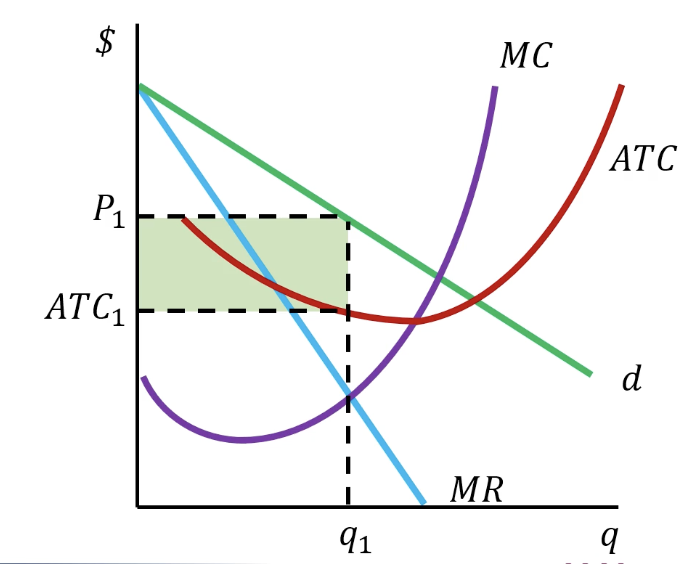
Economic profits encourage new firms to enter
As new competition enters, demand for an existing firms output falls
Demand will fall until price equals average total cost
P = ATC
Unit 9 Long Run Losses and Exit
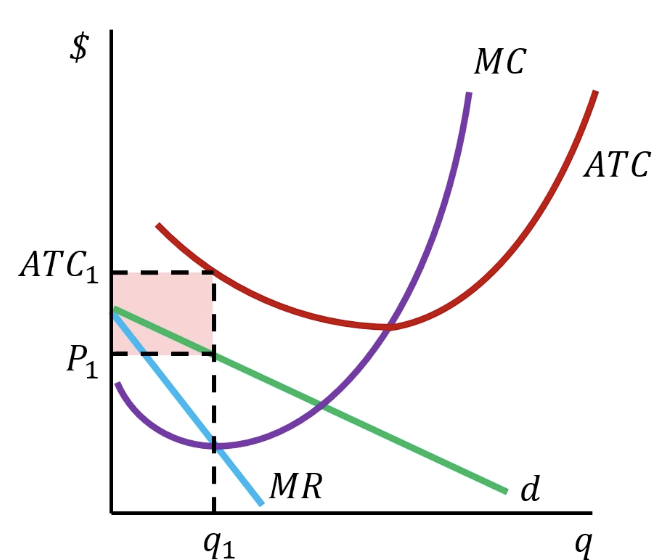
Economic losses encourage firms to exit the market
As competitors leave demand for a remaining firms output rises
Demand will rise until price equals average total cost
P = ATC
Unit 9 Monopolistic Competition in the Long Run
In the long run, P = ATC, meaning that capital is allocated efficiently
There is no benefit to either investing in or withdrawing from this industry because firms earn an accounting profit equal to investors risk adjusted expected rate or return (zero economic profit or normal profit
However, P > MC, therefore: ATC > MC. Under monopolistic competition, production is not efficient
Unit 9 Welfare Effects of Competition
With perfect competition, producers would charge a price equal to marginal cost
Because they face downward sloping marginal revenue, they charge a price greater than the marginal cost
The price is higher than it would be under perfect competition, while the quantity sold is lower
Consumer surplus is lower than under perfect competition
In the long run, producer surplus is the same as it would be in perfect competition
Since P = ATC (Producer Surplus = Total Fixed Cost)
Monopolistic Competition creates a deadweight loss, these markets are less efficient than perfectly competitive markets
Unit 10 Oligopoly
An oligopoly is a market with only a few dominant firms
Each firm has market power, meaning it faces a downward sloping demand curve
Barriers to entry limit or prevent new firms from entering the market
Unit 10 Homogenous and Differentiated
In a homogenous oligopoly, the firms product undifferentiated goods and only compete on price.
In a differentiated oligopoly, the firms produce differentiated goods and will compete on both price and quality
Unit 10 Duopoly
At the most extreme case, there are only two firms which is called a duopoly. Because there are only a few firms, each will have a large market share.
Unit 10 Barriers to Entry
A barrier to entry is any phenomenon that prevents new firms from entering. This includes:
Economies of Scale
Government Regulations
Limited Ownership of a resource
Operating history and brand recognition
Unit 10 Economies of Scale
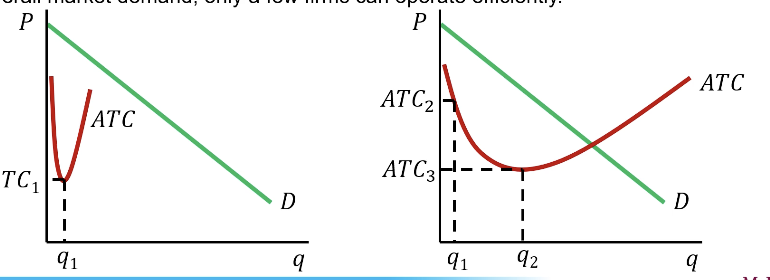
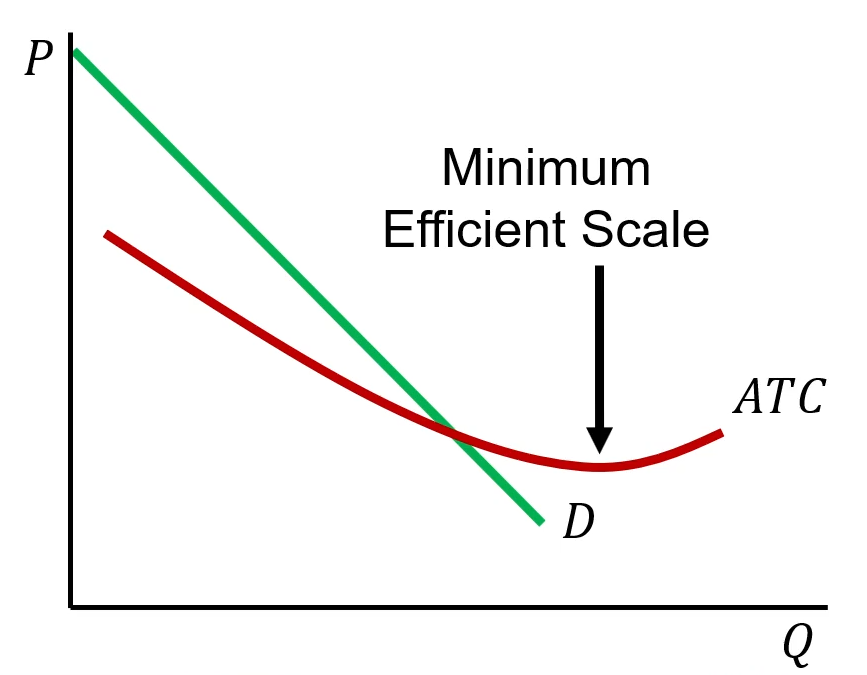
If the minimum efficient scale occurs at a level of output that is small relative to overall market demand, there will be room in the market for many firms to operate efficiently, so the market will be competitive
However, if the minimum efficient scale occurs at a level of output that is large relative to overall market demand, only a few firms can operate efficiently
Unit 10 Government Regulations
Governments can restrict market entry through licenses
In some industries, a license is required to operate. The government can restrict the number of licenses available.
Unit 10 Government Regulations Copyrights & Patents
Governments can also restrict market entry through patents and copyrights
A patent provides the inventor of a product the exclusive right to make that product for 20 years
A copyright provides the creator of.a creative work the exclusive right to copy, distribute, and profit from that work for the life of the creator plus an additional 70 years
These policies encourage creators by protecting the investment they make in creating these works
Unit 10 Ownership of a Resource
When production requires a specific input that is not widely available, new firms may have difficulty entering the market
The resource could be a natural resource, a human resource, or a knowledge resource.
Brand value can also be an important resource
Unit 10 Why Oligopolies Examples
Car Manufacturers
High capital costs
High research and development costs
Telecommunications Companies
High capital costs
Government restrictions on wireless and broadcast signals
Airlines
High capital costs
High knowledge costs
Airport landing fees and restrictions
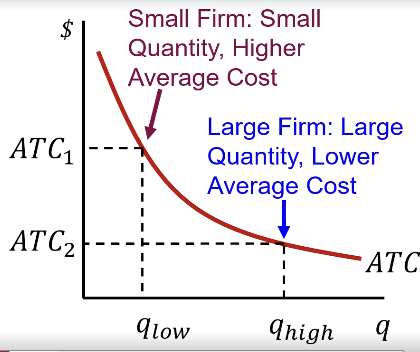
Unit 10 Why Oligopolies
Brand name, reputation, and operating history can represent a significant barrier to entry.
Unit 10 Oligopoly Graphs
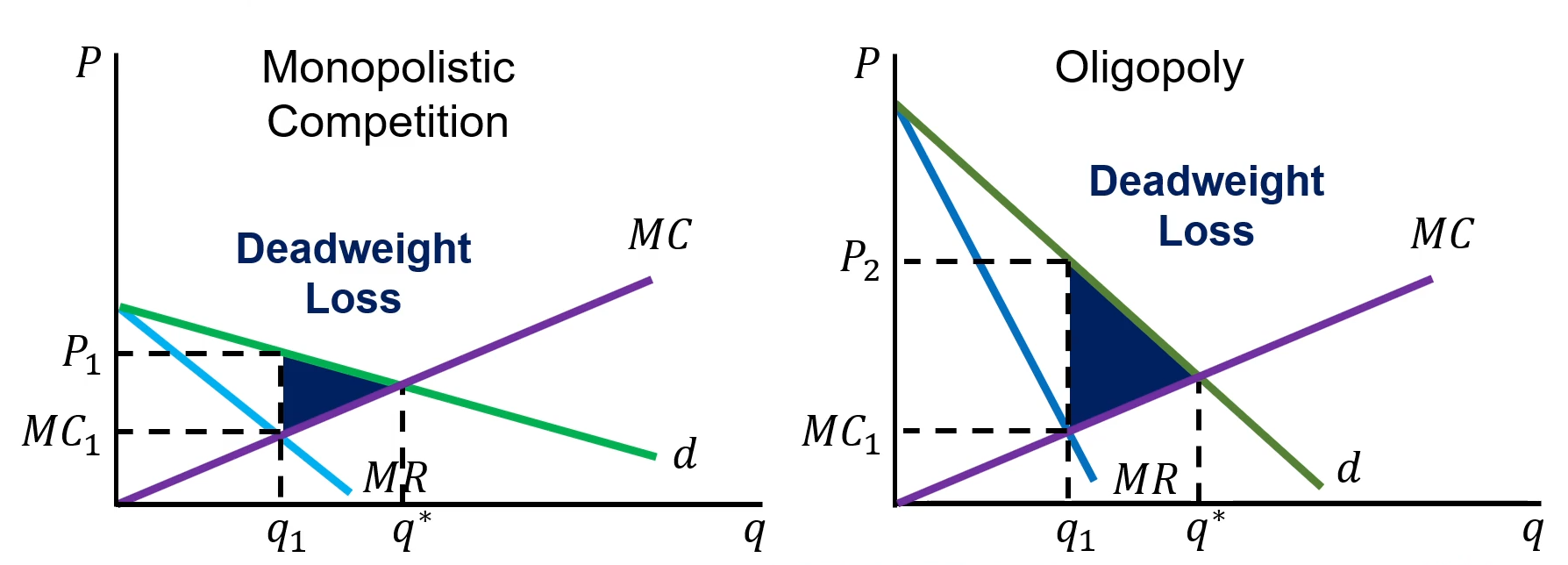
When MR > MC, revenues grow faster than costs and profits will increase
When MR < MC, costs grow faster than revenues and profits will decrease
Our profits will reach their maximum level at MR = MC
For an oligopoly firm P > MC
The price consumers pay is higher than the marginal cost to make the good. We call this a difference of a price markup
Unit 10 Profits in an Oligopoly
Profit Per Unit = Profit / Quantity = Profit - ATC
When P > ATC, the firm earns a profit per unit
What is different about an oligopoly through is that this profit could be sustainable in the long run because new firms cannot enter to compete it away
Unit 10 Losses in an Oligopoly
When P < ATC, the firm earns a loss per unit
Qo is the loss minimizing quantity
A firm might go out of business which would increase demand for other firms goods as customers move over to them
Alternatively the firm could try to reduce its average total cost over the long run
Unit 10 Oligopoly Behaviour
Because oligopolies have large market share and face few competitors, they must think carefully about their own actions and the actions of their competitor
Oligopolies will behave more strategically than monopolistically competitive firms
Unit 10 Profit Maximization in an Oligopoly
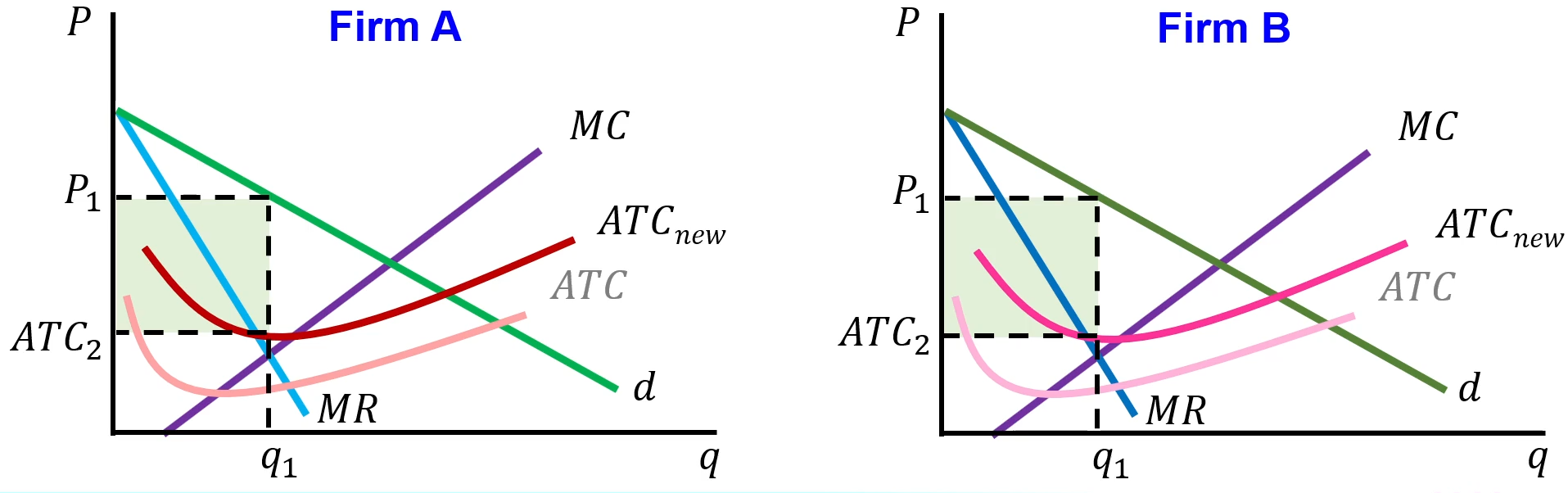
In an oligopoly, there are few firms, each with a large market share. We can consider two firms ( a duopoly)
Suppose Firm B decides to spend more on advertising
Its ATC will rise, but so will demand for its product. It will then get more customers and earn more profits.
Where did the customers come from? …. Some will come from Firm A
Firm A will see falling demand and will face pressure to cut its price. Its profit will fall.
Unit 10 Strategic Behaviour in an Oligopoly
Will Firm A just accept having a lower market share, lower price, and reduced profit? … Maybe… Maybe not.
Because there are only a few firms, each with a large market share, we say there is mutual interdependence - A firms profit level depends not just on its own decisions, but also on the decisions made by its rivals
When making any business decision, an oligopolist must consider how rivals will react
Unit 10 Game Theory
Game Theory is an analytical tool economists use to predict the actions of agents in different scenarios.
John Von Neumann
Oskar Morgenstern
Merrill M Flood
Melvin Dresher
Albert W Tucker
John Nash
Unit 10 Game Theory Terms
A conjecture is what a player believes a competitor will do.
A strategy is a choice from the available actions.
A best response is the choice that gives the highest profit based on that belief.
A dominant strategy gives the highest profit no matter what others choose.
Unit 10 Game Theory Responses
Rational players will identify a best response for every scenario they face
If their best response is the same for all scenarios (i.e., they would always make the same choice no matter what a competitor does), then the choice is a Dominant Strategy
If both players choose a best response, we have a Nash Equilibrium - the players will be satisfied with their own choice after seeing their opponents choice
If both players choose a Dominant Strategy, we have a Dominant Strategy Equilibrium - dominant strategies do not always exist so this outcome will not occur in all games
Unit 10 Making Decisions
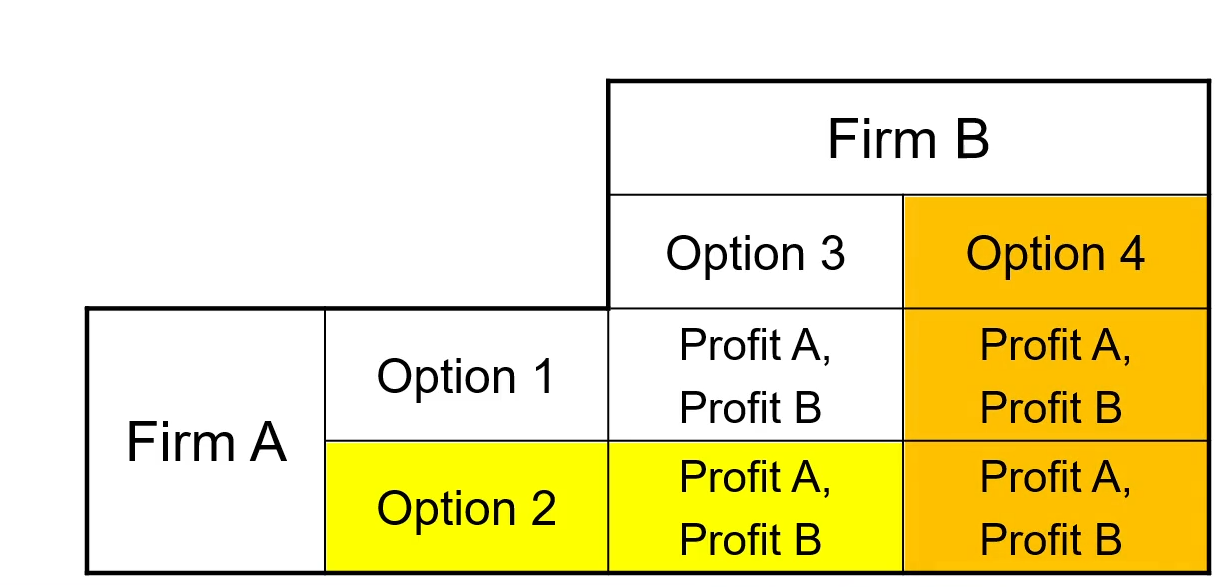
We can use a matrix to map out prospective decisions and profits
Unit 10 The Advertising Game
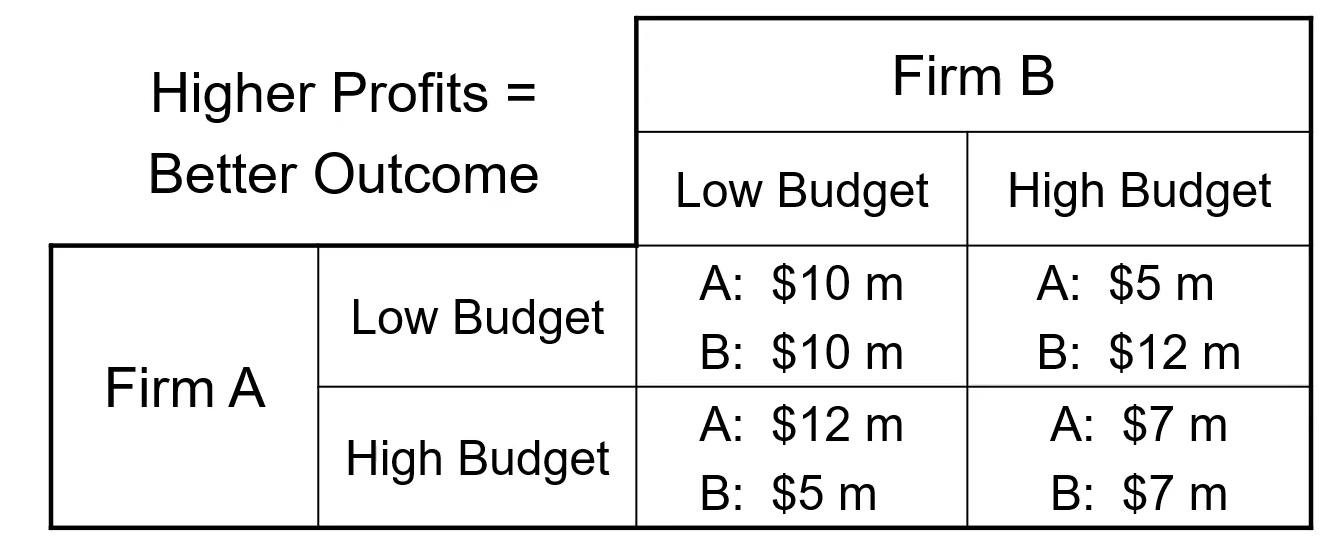
Two oligopolists (i.e., a duopoly) must choose their advertising budgets
Each can choose a Low Budget or a High Budget
If they both choose the same budget, they share the consumer market evenly. But, if one chooses High and the other chooses Low, the one who choose a High Budget gets most of the customers
Highlights an important aspect of economic behavior: Individual agents working in their own self interest can naturally end up in a situation that is not socially optimal
Unit 10 The Advertising Game Matrix
We cab examine the profits they each make in Millions of Dollars
We can make a conjecture about behavior and identify best responses
Dominant strategy is when a firm makes the same decision no matter the others actions
Unit 10 Nash Equilibrium
Since Firm A and Firm B both choose a High Budget, that will be our outcome. Both players outcomes are circled (i.e., both are playing best response)
We know it is this because no player would want to change their decision after seeing the other players choice
Unit 10 Dominant Strategy Equilibrium
Since both firms play a Dominant Strategy, it is also this
Unit 10 Strategic Behavior in an Oligopoly
Firm B is going to increase its advertising. But it will not get to keep the profits
Firm A will increase its advertising in response and retain (or take back) its customers
Before the change, both firms had lower costs, and therefore higher profits
But now they have higher costs, and lower profits, and they were not able to take customers away from their competitor
Unit 10 Could They Just Agree NOT to Compete
Clearly it would be better for them if neither increased their advertising expenditure
Other situations where they might prefer not to compete with each other include:
Charge higher prices and do not lower price to steal customers from competitors
Pay low wages and do not raise wages to lure talented workers from competitors
If they do this though, it is called collusion and we say they are operating as a cartel
Unit 10 Collusion
When firms coordinate their actions to increase prices above the competitive level or reduce cost below the level that would occur with competition. Firms participating are known as a trust or a cartel
Collusion is illegal in developed countries because it harms consumers, workers or both. Anti trust laws have been enforced since the late 19t century to prevent collusion
Unit 10 Why Collusion Does Not Work
Collusion can work for a short time, but firms have an incentive to cheat
If firms believe the agreement will not last forever, they have an incentive to be the first one to abort it
Confession brings lesser penalties for the individuals involved, so there is an incentive for individual managers / employees of a company to alert competition authorities to anti competitive actions
Whistleblower legislation protects employees of a company who reports illegal activities
Unit 10 The Front Page Game
Two local newspapers compete for readers and must decide each day what type of headline story to run on their front page
Each newspaper can either choose a story about politics or a story about business and the economy
Among the population of potential readers, more people prefer stories about politics to stories about business and the economy
Unit 10 Signaling and Updating
If a game without dominant strategies is played only once, there is no opportunity to learn from your opponents actions
However, if a game is repeated, players have the ability to learn from their opponents actions or to send signals to their opponent through their own actions
Rational players should consider all information available wen making strategic choices
Unit 10 The Price Elasticity of Demand
In Unit 5, we learned that one of the main determinants of the price elasticity of demand was the availability of substitute goods
Unit 10 Oligopoly and Deadweight Loss
The price markup is larger in an oligopoly, so the deadweight loss in an oligo
Unit 10 Oligopoly and Profit
Oligopolies can earn excess economic profits over the long run because barriers to entry prevent new competitors from entering
Unit 10 Oligopoly and Inequality
Income and consumption inequality are a major disadvantage of market economies
Since oligopoly firms can earn excess profits and can grow to become very large enterprises, the owners of these firms can accumulate a disproportionately large share of wealth and associated income in market economies.
Unit 10 Are Oligopolies That Bad
Oligopolies are innovative so they aren’t entirely bad
They have advantages and also disadvantages
The benefits only occur when oligopolies compete against each other, so governments must actively encourage competition and prevent collusion
Unit 10 Oligopolies and Innovation
Joseph Schumpeter argued that oligopoly was the most beneficial form of market structure so long as oligopolists compete rather than collude
Innovation requires research and development expenditure, but perfect competition and monopolistic competition do not generate any excess profit that can be invested into R&D.
Only oligopolies can generate:
The excess profits needed initially to fund R&D
The excess profits needed to provide a return on that investment (remember patents!)
Because oligopoly firms compete against each other for market share, they have an incentive to continually innovate
Failure to innovate will mean that, eventually your rivals will overtake you
Any firm that does not innovate will eventually go out of business
Process is known as creative destruction (major feature of market economics)
Unit 10 Types of Innovation
Product Innovation
Creates new goods and therefore new markets which society can draw economic surplus. The creation of new markets therefore leads to an increase in social welfare
Process innovation
New production process improve productive efficiency. new methods of producing allow for greater output with fewer inputs
Both types of innovations can be protected by patents
Unit 11 Monopoly
A monopoly is the only seller of a good or service that does not have a close substitute
Barriers to entry prevent other firms from entering
Because there is only one firm, the firms demand curve is the same as the market demand curve
Unit 11 Barriers to Entry
Prevent new firms from entering the market
Economies of scale
Government regulations
Ownership of a resource
Unit 11 Economies of Scale
If the minimum efficient scale occurs at a level of output that is larger than the quantity demanded by consumers, a single firm supplying the entire market can produce at a lower cost than multiple smaller firms.
This situation is called a natural monopoly
Electrical company
Water company
Unit 11 Government Regulations
In Unit 10, we learned about licenses, patents, and copyrights as government created barriers to entry.
The government may also grant a public franchise which gives a firm the sole right to provide a good or service. In some cases, the government may grant this franchise to itself and establish a state-owned enterprise (SEO)
Inc Canada we often refer to SEO as a crown corporation
Public Transit
Canada Post
Unit 11 Ownership of a Resource
In unit 10 we learned about ownership of natural resources, human resources, and knowledge resources as barriers to entry
Ownership of a physical premises is a common source of monopoly power
Amusement park and movie theatre concessions
Stadium merchandise and concessions
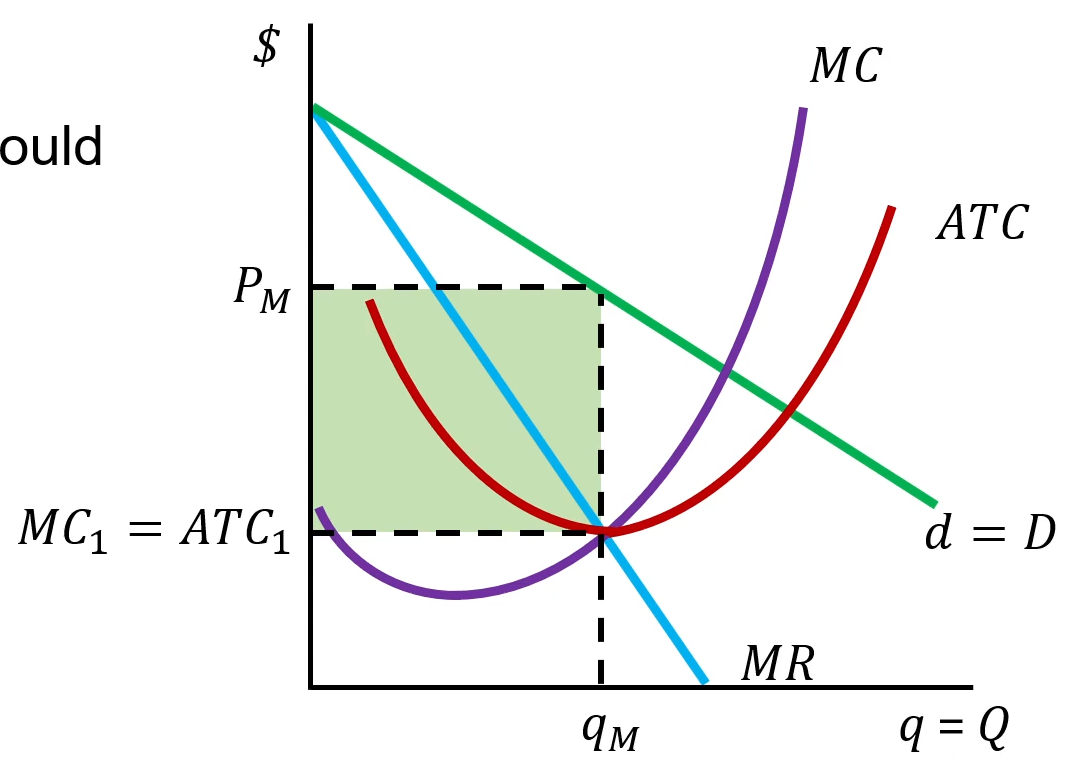
Unit 11 Monopoly MR & D Graph
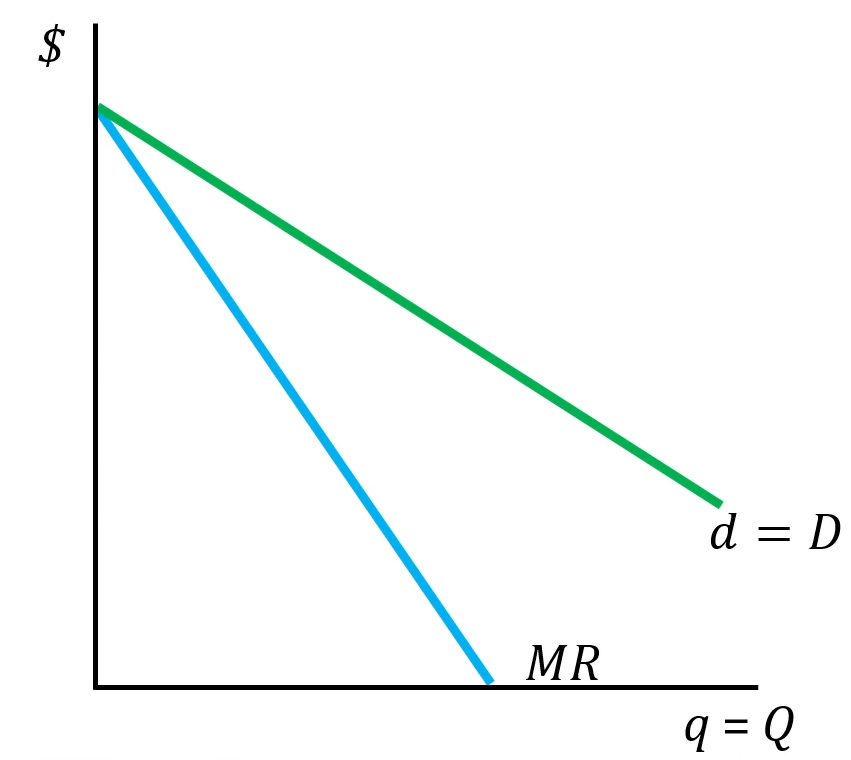
Because a monopoly serves the whole market, its individual product demand (d) is equal to the total market demand (D). Similarly, since it is the only firm, the monopoly’s quantity (q) is the same as the total market quantity (Q)
We know from units 9 and 10 that marginal revenue for firms with market power is always less than the price they charge.
Unit 11 Monopoly MR & MC & D Graph
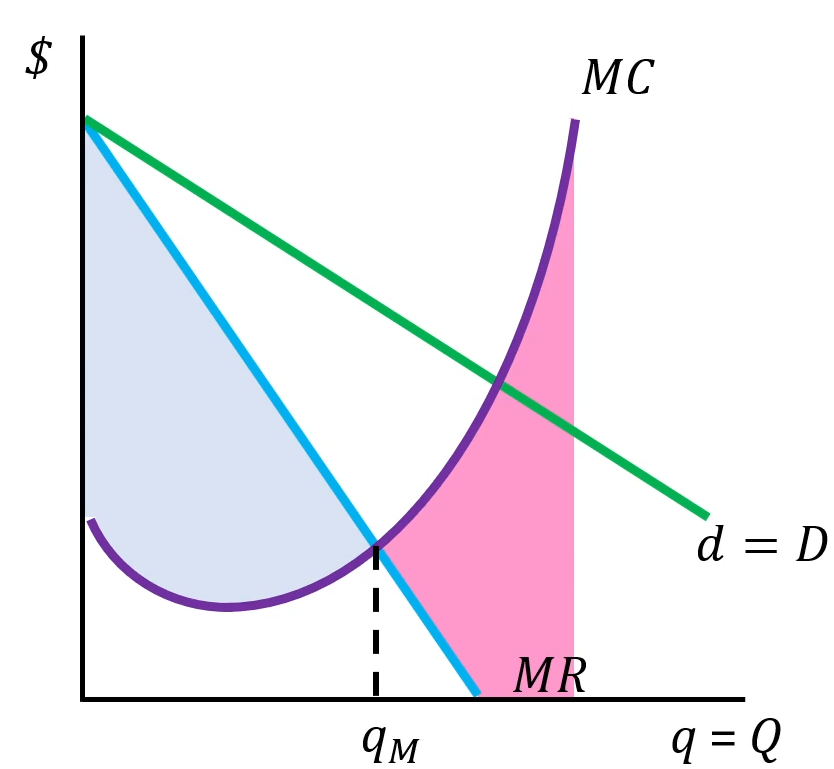
When MR > MC, revenues grow faster than costs and profits will increase
When MR < MC, costs grow faster than revenues and profits will decrease
Our profits reach their maximum level at MR = MC
Unit 11 Markup
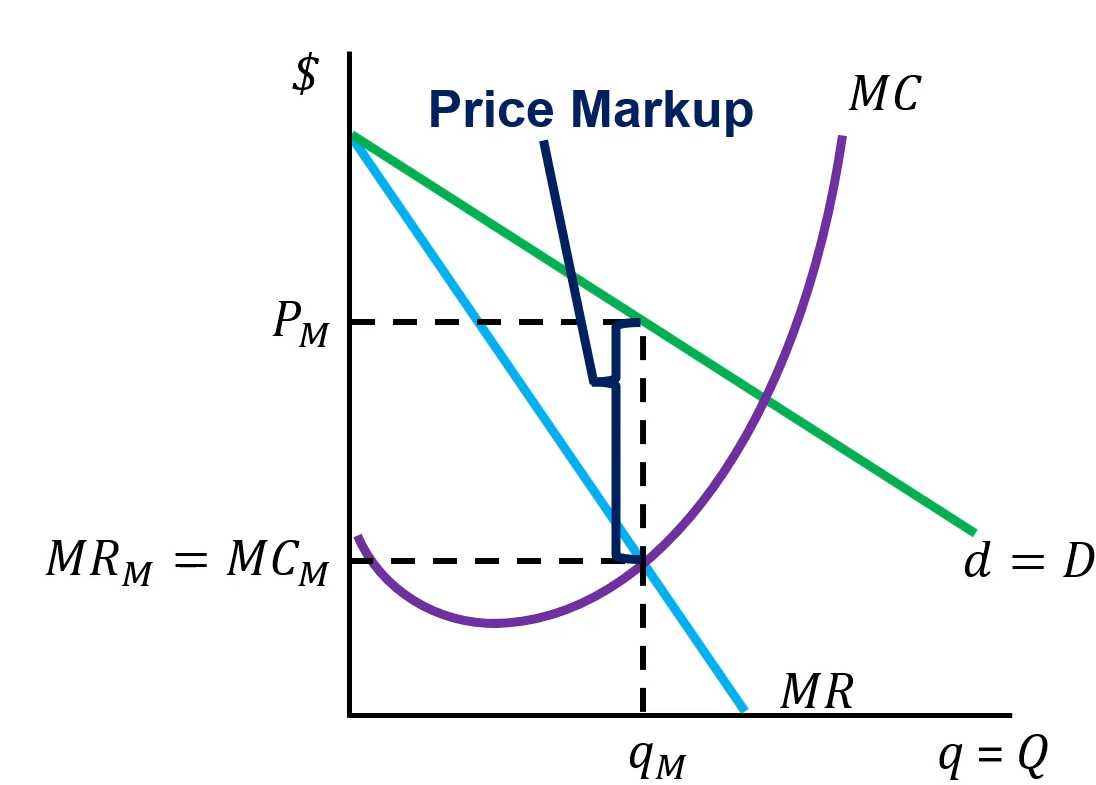
For a monopoly: P > MC
The price consumers pay is higher than the marginal cost to make the good. We call this difference a price markup.
Markup = P - MC
Unit 11 Profits in a Monopoly
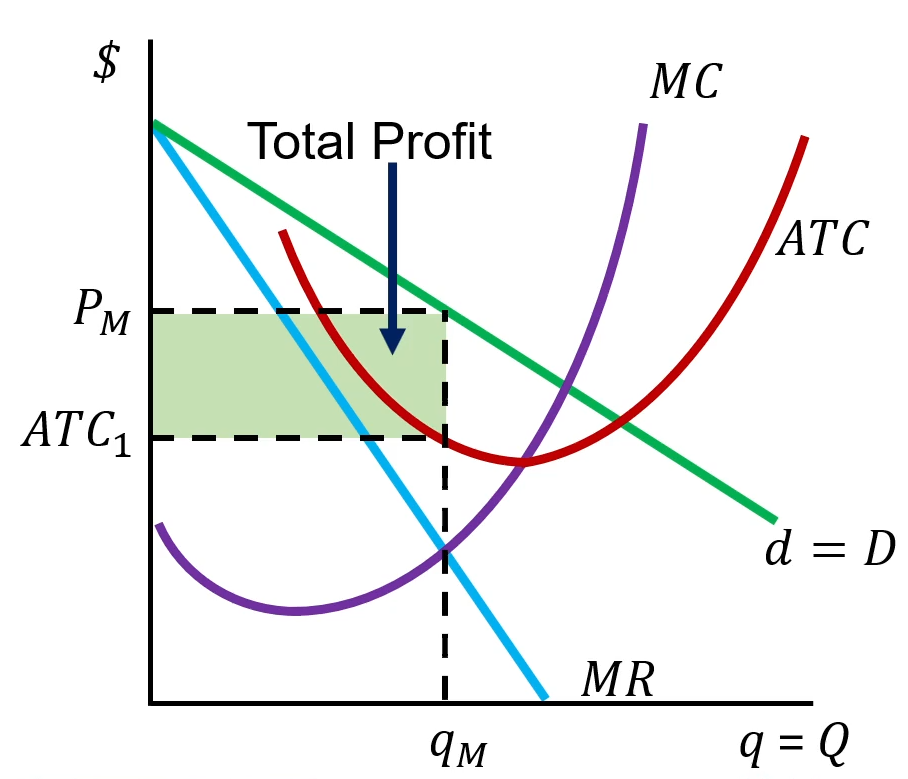
Profit per unit = total profit ÷ quantity = price − average total cost (P − ATC)
When P > ATC, the firm earns a profit per unit
For a monopoly, this profit could be sustainable in the long run because new firms cannot enter to compete it away
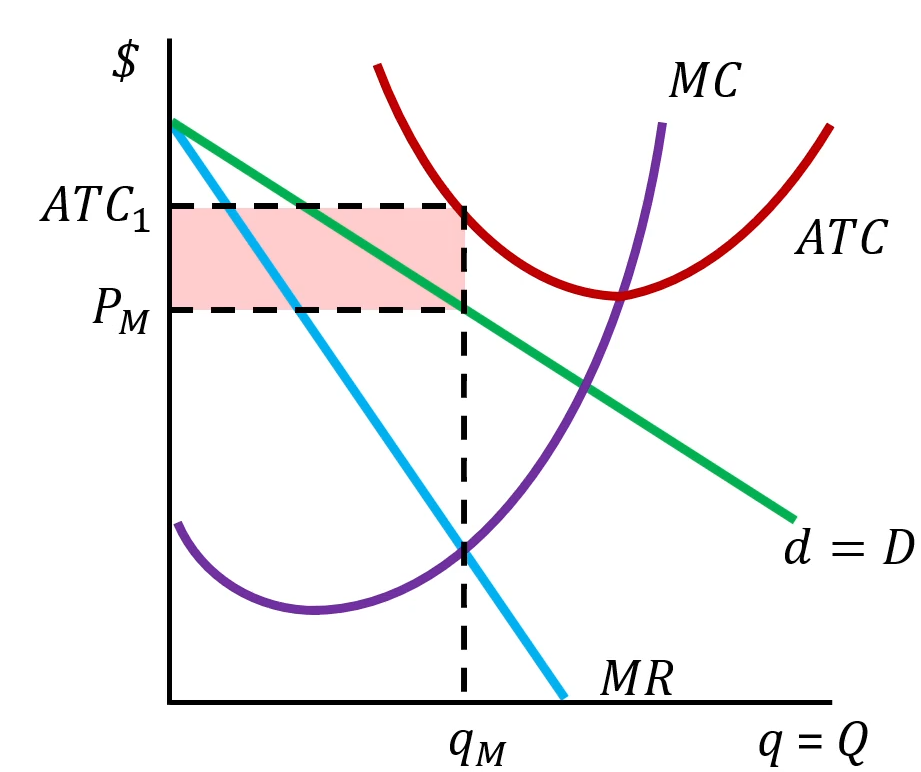
Unit 11 Losses in a Monopoly
Profit per Unit = profit / quantity = P - ATC
When P < ATC, the firm earns a loss per unit
qM is the loss minimizing quantity
The firm must try to reduce its average total cost over the long-run
Unit 11 Price and Quantity in Monopoly
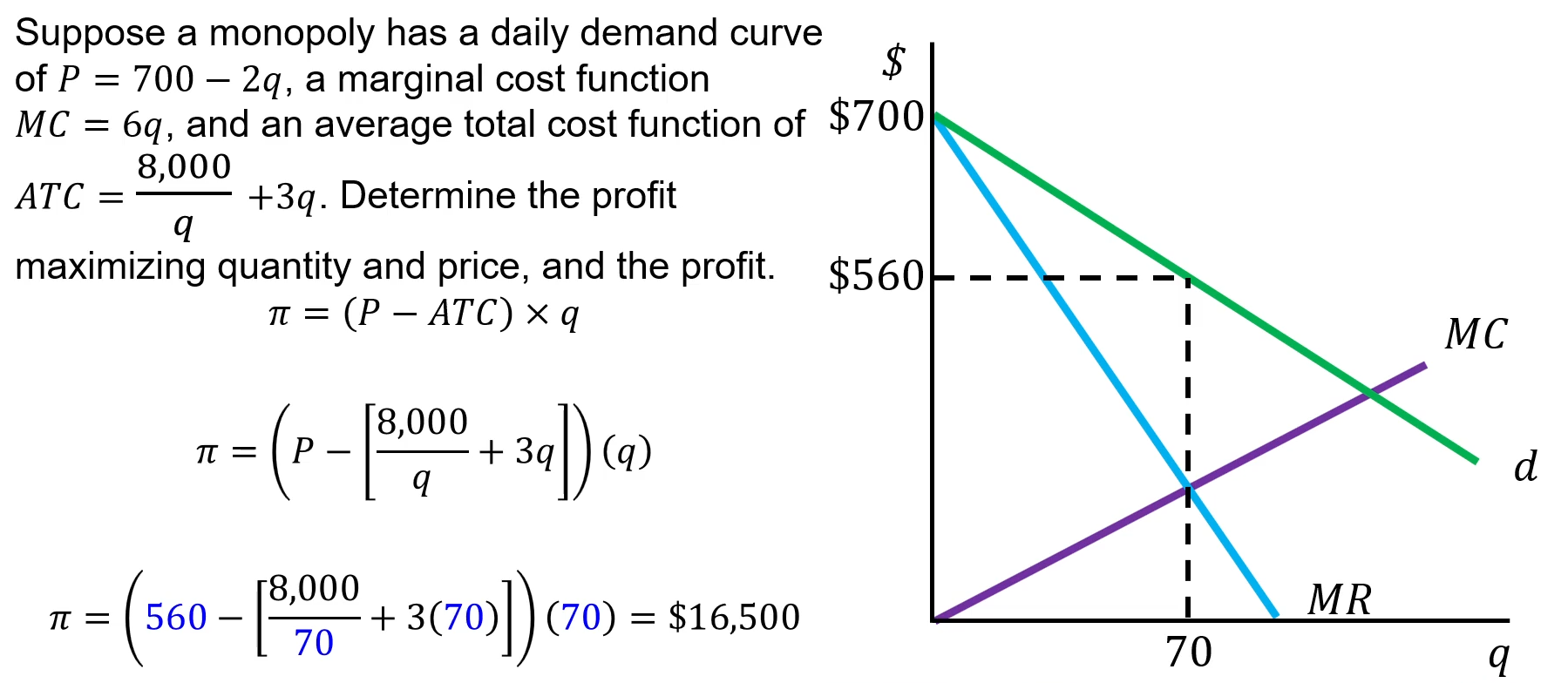
Suppose a monopoly has a daily demand curve of P = 700 -2q, a marginal cost function MC = 6q, and an average total cost function of ATC = 8000/q + 3q
Determine the profit maximizing quantity and price, and the profit
Unit 11 The Price Elasticity of Demand
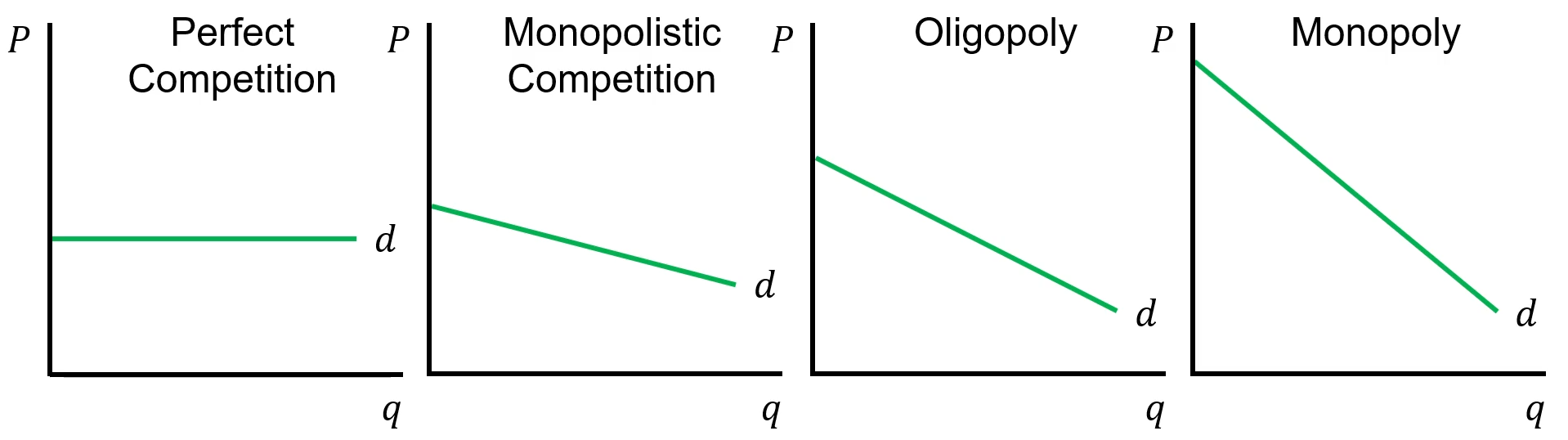
In unit 5, we learned that one of the main determinants of the price elasticity of demand was the availability of substitute goods
Unit 11 Monopoly and Deadweight Loss
The price markup is even larger in a monopoly than in monopolistic competition or oligopoly, so the deadweight loss in a monopoly will also be larger than in any situation with any amount of competition
Unit 11 Profits and Production Efficiency in a Monopoly
Monopolies typically earn an economic profit, which is also called a monopoly rent
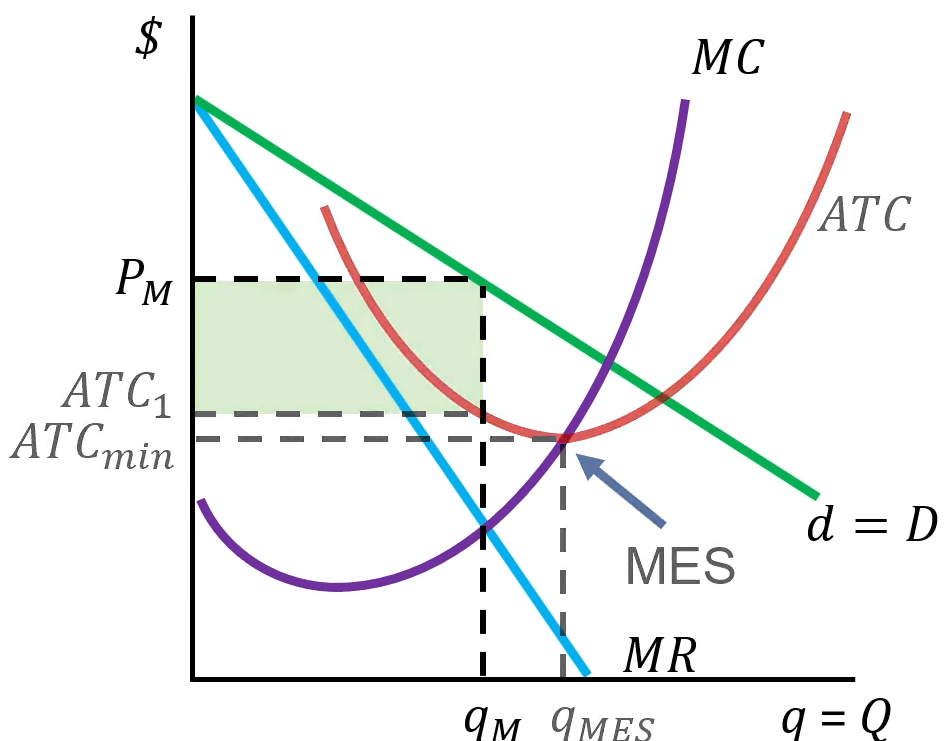
The profit maximizing quantity is usually not the minimum efficient scale
Monopolies generally do not achieve productive efficiency
Unit 11 Profits and Production Efficiency in a Monopoly
It is possible the monopoly could profit maximize right at the minimum efficient scale quantity
But is NOT likely
Unit 11 Monopoly Inefficiency
Monopolies are inefficient for three main reasons:
Allocative inefficiency
A monopoly sets price above marginal cost (P > MC).
This means some consumers value additional units more than the cost to produce them, but those units are not produced.Productive inefficiency
The firm does not produce at the lowest possible cost.
At the profit-maximizing output, marginal cost does not equal average total cost (MC ≠ ATC), so it is not operating at minimum efficient scale.Inefficient allocation of capital
Barriers to entry let the monopoly earn long-run economic profit (P > ATC).
In a competitive market, profits would attract new firms and push price down to ATC.
Without entry, capital stays in the monopoly instead of flowing to more efficient uses.
Unit 11 Competition Policy
Because monopolies are inefficient, raising prices and making consumers worse off, antitrust laws that we learned about in Unit 10 are designed to prevent competing firms from merging to form monopolies.
When two competing firms in the same industry merge it is called horizontal integration. The federal governments competition bureau typically prevents mergers when the new firm would have more than 35% market share or when the four largest firms in an industry have more than 65% combined market share.
Unit 11 Regulating Monopolies and Oligopolies (Licensing)
Because monopolies and oligopolies can charge high markups and make consumers worse off, governments regularly intervene in these markets.
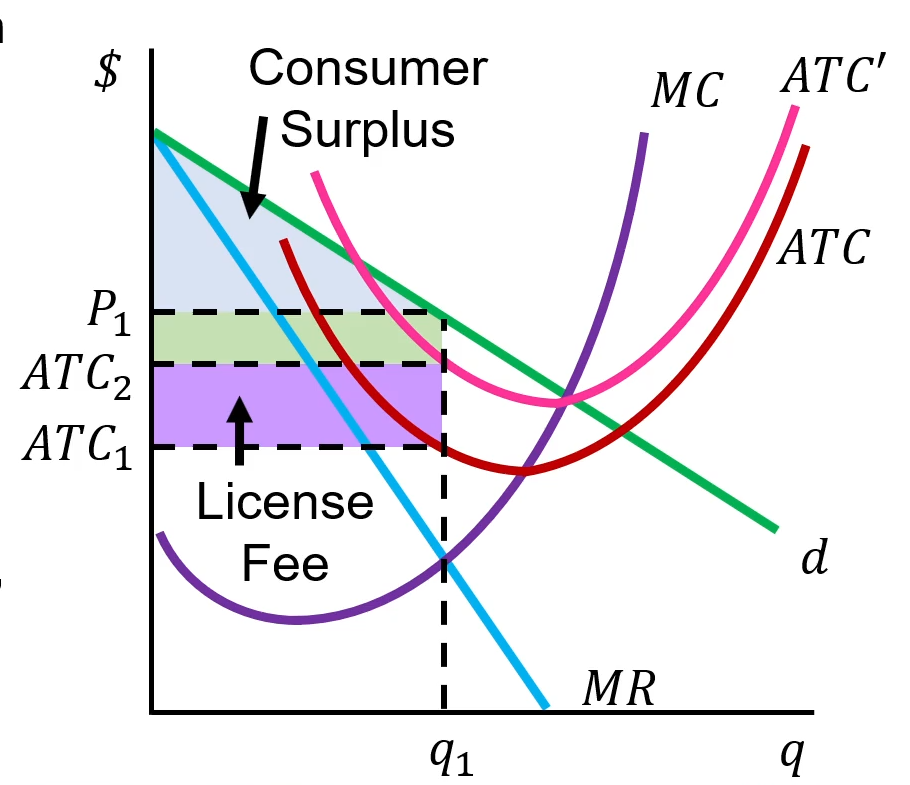
Government can charge a licensing fee which strips away some of the economic profit. A licensing fee is a fixed cost so it changes ATC but not MC
Since MC is unchanged, q is unchanged, but profit is reduced. The money raised from the market means the government can reduce taxes in other markets.
Consumer surplus increases. The market is more efficient!
Unit 11 Regulating Monopolies and Oligopolies (Price Ceiling)
Because monopolies and oligopolies can charge high markups and make consumers worse off, governments regularly intervene in these markets.
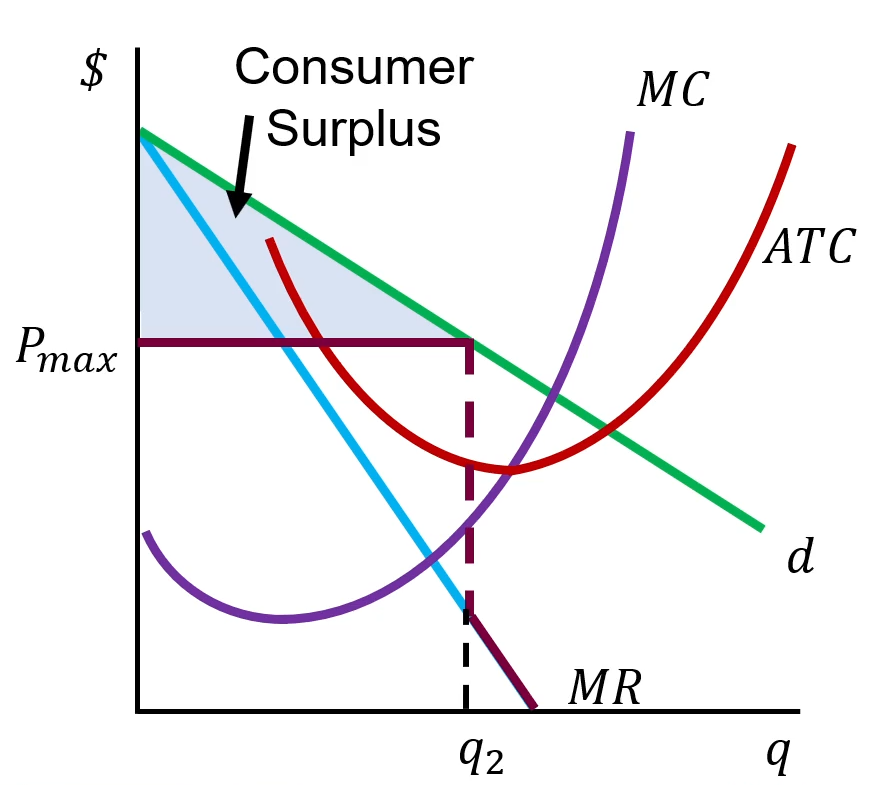
Sometimes governments will impose price ceilings on oligopoly and monopoly firms.
A price ceiling actually makes MR = P because the firm cannot raise its price (just like in perfect competition)
If the government gets the price ceiling just right, it might even be able to replicate the perfectly competitive outcome!
In practice though, this outcome may be difficult to achieve
Unit 11 Monopolies and Government Decision
Because monopolies and oligopolies can charge high markups and make consumers worse off, governments regularly intervene in these markets.
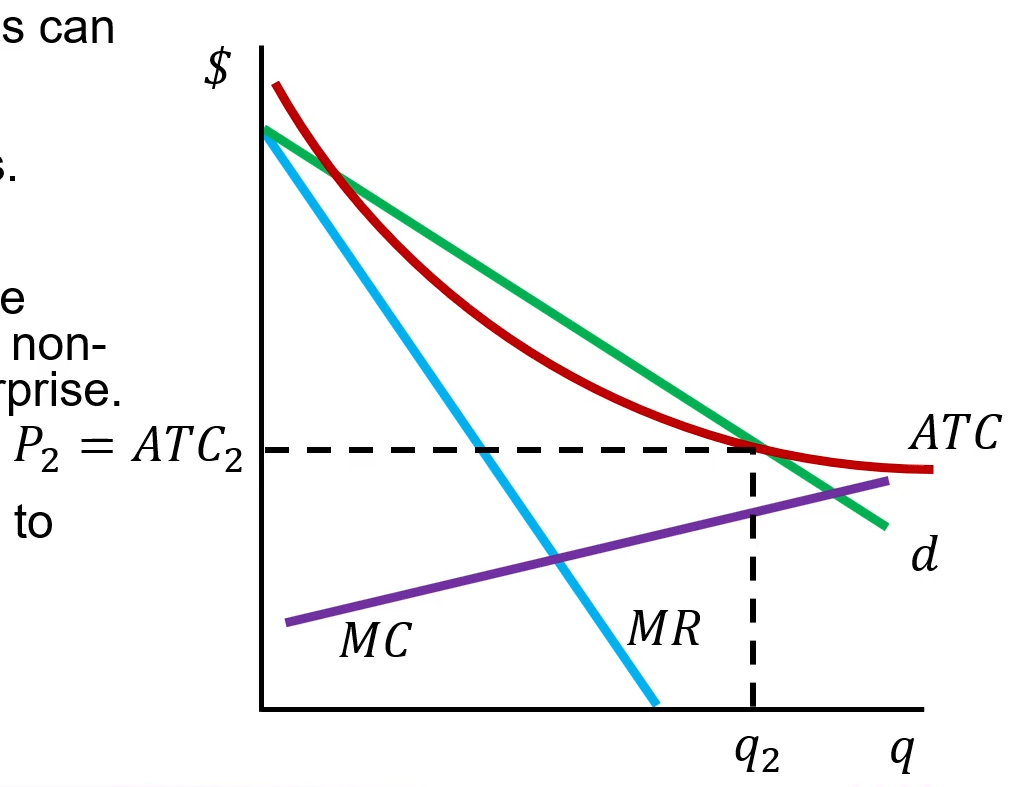
In situations of natural monopoly, the government may decide to create a non-profit maximizing state-owned enterprise.
The government will set price equal to average total cost
Unit 11 Federally Regulated Industries
Rail
SEO with a near monopoly on intercity (non commuter) passenger travel
License fee for freight operators and railway owners
Air travel
License fee for all airlines carrying passengers and/or cargo
Telecommunications
Licenses and price ceilings on phone, data/internet, and cable/satellite television
Banking and Lending Services
Price ceilings on service charges and interest payments
Unit 11 Provincially Regulated Industry
Electricity
Some provinces have a state owned monopoly; others have competitive producers; all have some form of price controls
Natural gas
Price ceiling
Water
State-owned monopolies at the municipal level
Public transportation
Price ceiling
College and Universities
Price ceiling
Unit 11 Price Discrimination
Price discrimination is the act of charging different prices to different customers for the same good or service. It is a legal business practice
Only works if
The firm has market power
The firm can identify customers who are willing to pay more than others
The firm can prevent resale
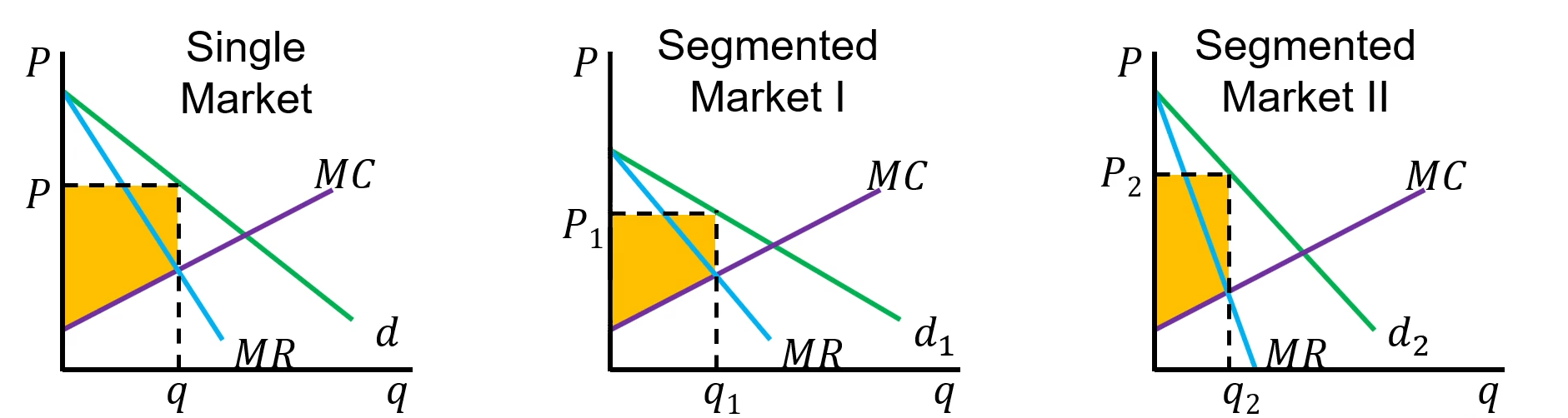
Unit 11 Multi Market Price Discrimination
Third Degree
Charges different prices to different market segments
Could be segmented by geography, age, student status, etc
Overall, output will be higher and producer surplus larger
Unit 11 Quantity Based Price Discrimination
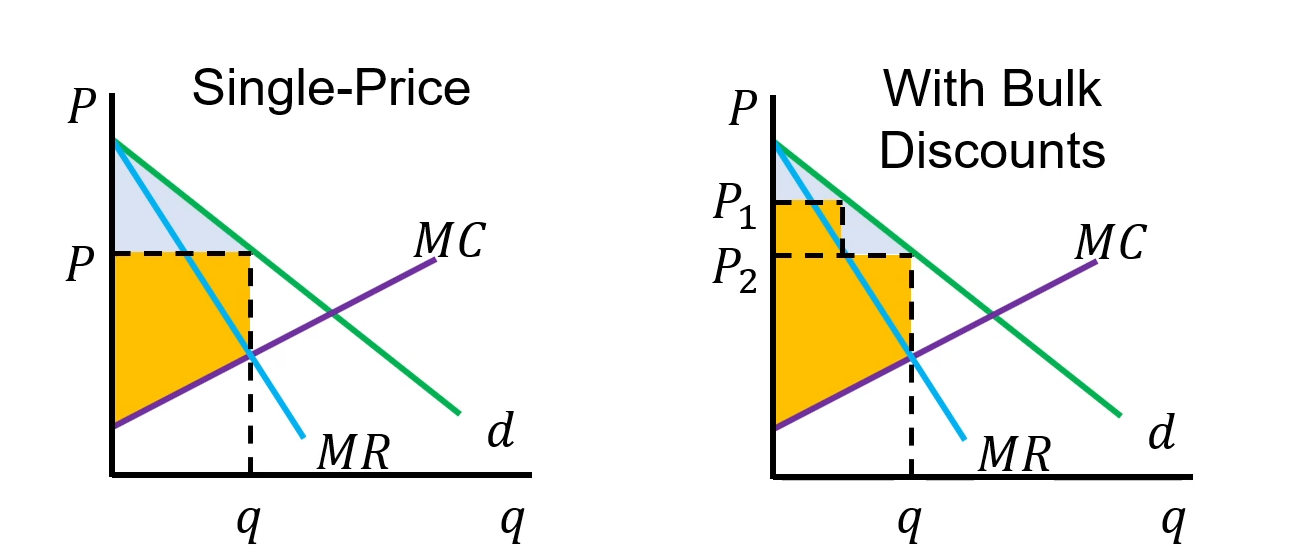
Second Degree
Offer bulk discounts
Those wanting to buy a small quantity must pay a higher price
Unit 11 Perfect Price Discrimination
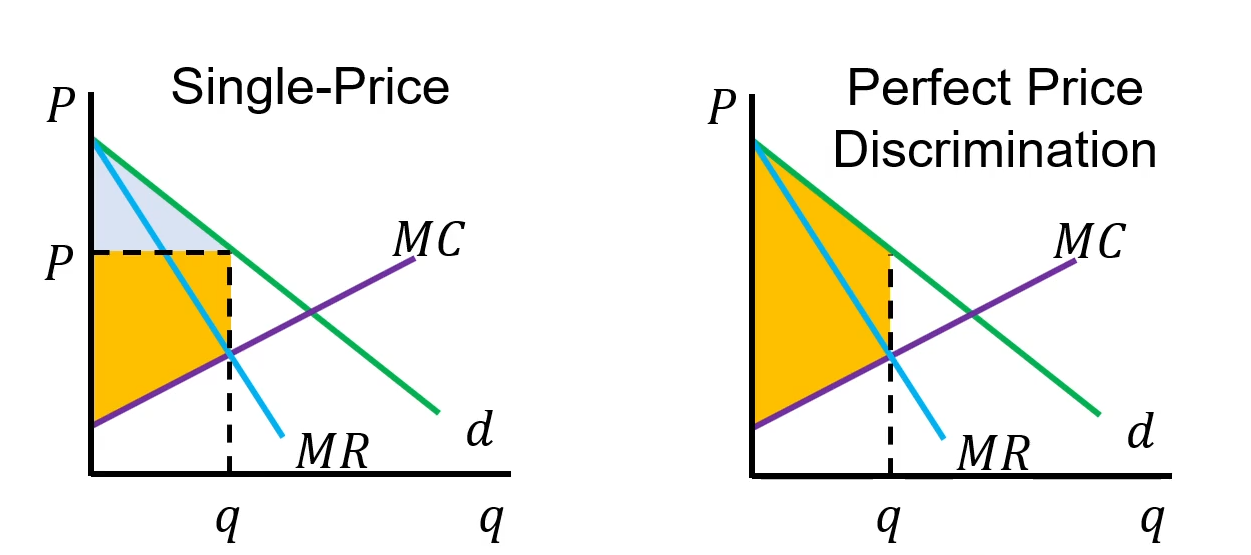
First Degree
Charge each consumer their exact willingness to pay
It is almost impossible in practice, but auctions and negotiations attempt to replicate this outcome
Unit 11 Two Part Tariffs and Junk Fees
With a two part tariff, the firm charges a membership or entrance fee as well as a fee for use, for example a gym charging a monthly fee plus per class charges
With a junk fee, the firm adds a processing or administrative charge on top of the listed price, for example a ticket site adding a service fee at checkout
These fees capture part of the consumer surplus by extracting extra payment beyond the base price
Optimal pricing depends on differences in consumer preferences and willingness to pay, firms set higher fees when consumers value the product more or have fewer alternatives
Unit 11 Price Matching (Low Price Guarantee)
LPGs are good for firm reputation and profits
LPGs can enforce collusion in markets with strong price competition (if your rival lowers its price, you will match them and vice versa so there is no benefit to lowering price)
It also means you do not have to monitor rivals because if they lower their price, your customers will let you know
It allows you to price discriminate by charging a higher price to customers who do not realize there are cheaper prices available
Unit 11 Challenges with Price Matching
You cannot just take your customers word for it; there must be some way to verify that a rival is charging lower prices
Depending on your rivals cost function, they may be able to sell at a lower price which you cannot match profitably. Often, firms will limit this strategy to regular prices and will not match discounted prices
Unit 11 Loss Leaders
For retail firms that sell many products, one of the biggest challenges is getting customers to choose your store over a competitor
A loss leader is an item sold below cost and typically advertised as being on sale. It guarantees the seller will make a loss on this item but also ensures that rivals will not have the same price initially. Rivals may be unwilling to match this price as it guarantees a loss.
Once the customer is in your store to get the discounted item, hopefully they will buy other things as well, the profits from which will make up for the loss taken on the loss leader
Unit 12 Market Failures
Throughout the course, we have learned that free markets and perfect competition should produce the most efficient outcome
However, many markets suffer from market failures, a characteristic of a market that makes it depart from perfect competition and therefore leads to an inefficient outcome
Market failures provide an opportunity for government intervention to improve efficiency and/or correct undesirable outcomes
Unit 12 Common Market Failures
Market power
Externalities
Incomplete information
Unit 12 Market Power
As we saw in units 9, 10, and 11, any firm with market power will charge a price markup and the market will be inefficient
In the case of monopolistic competition, the inefficiency is usually small since the firms are small, but in the case of oligopoly and monopoly, the inefficiency may be large, and the government may become concerned with the impact on consumers
Refer to units 10, and 11 for more information on government regulation of oligopoly and monopoly firms
Unit 12 Externalities
An externality is a benefit or a cost falling on other people not directly involved in a market transaction
Arthur Cecil Pigou - Studied this
The existence of externalities means that the social costs and/or social benefits are not the same as the private costs or private benefits experienced by the private parties involved in the transaction
Unit 12 Negative Externalities
Occur any time one agents actions have negative effects on other people
e.g. pollution and traffic
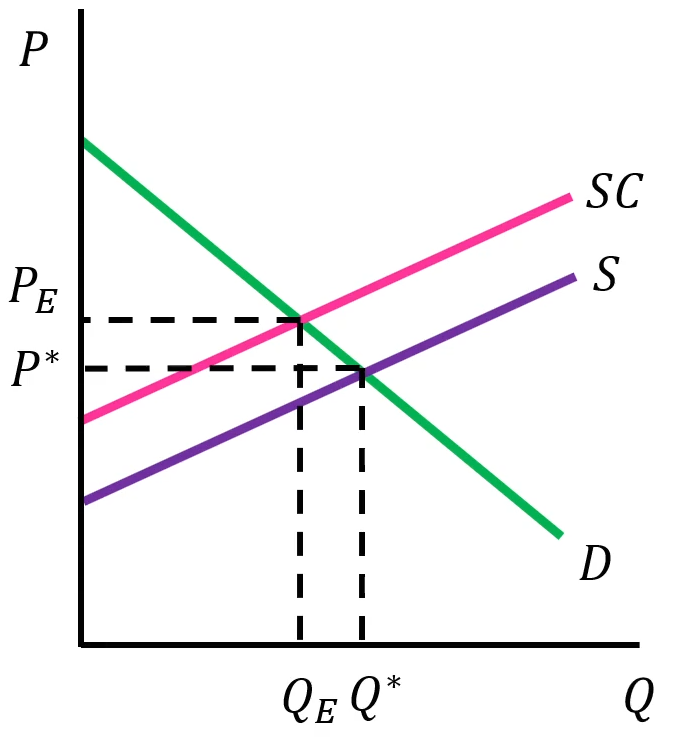
Unit 12 Negative Externalities Graph Effect
When a negative externality is present, the social cost (SC) of producing a good is higher than the private cost as represented by the supply curve
The socially optimal quantity (Qe) is less than Q*, but usually not zero. Goods with negative externalities are overproduced in a free market
Unit 12 Correcting for Negative Externalities
The government has multiple policy options to correct for negative externalities:
Impose regulations to limit the quantity (quota)
Impose a tax that raises the cost to consumers and reduces consumption (Pigouvian Tax)
Unit 12 Positive Externalities
Positive externalities occur any time one agents actions have positive effects on other people
e.g. research, volunteering, university
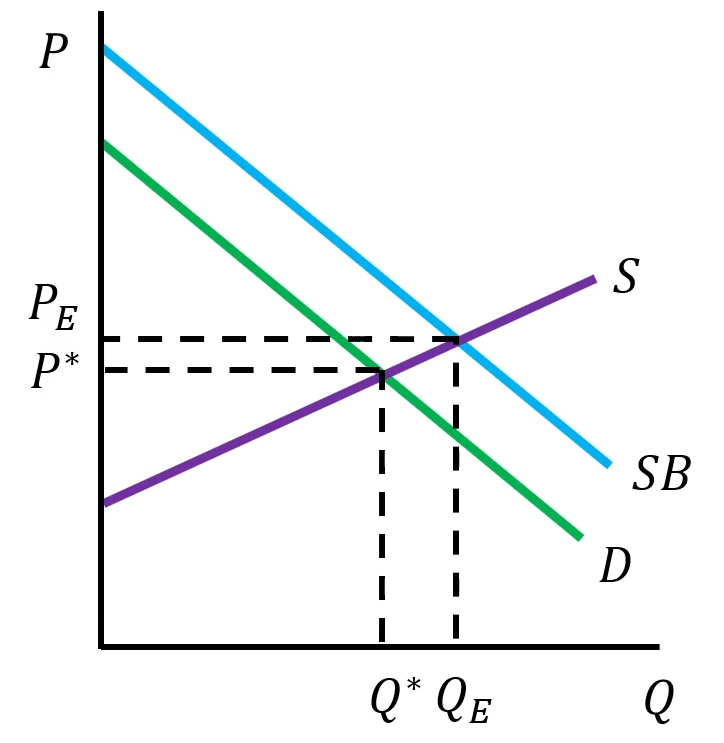
Unit 12 Positive Externalities Graph Effect
When a positive externality is present, the social benefit (SB) of consuming a good is higher than the private benefit as represented by the demand curve
The socially optimal quantity (Qe) is more than Q*. Goods with positive externalities are underprovided in a free market
Unit 12 Correcting for Positive Externalities
The government has multiple policy options to correct for positive externalities
Provide subsidies to firms to lower their costs
Provide subsidies to consumers to increase demand
Provide the good itself, either in competition with or by replacing private firms
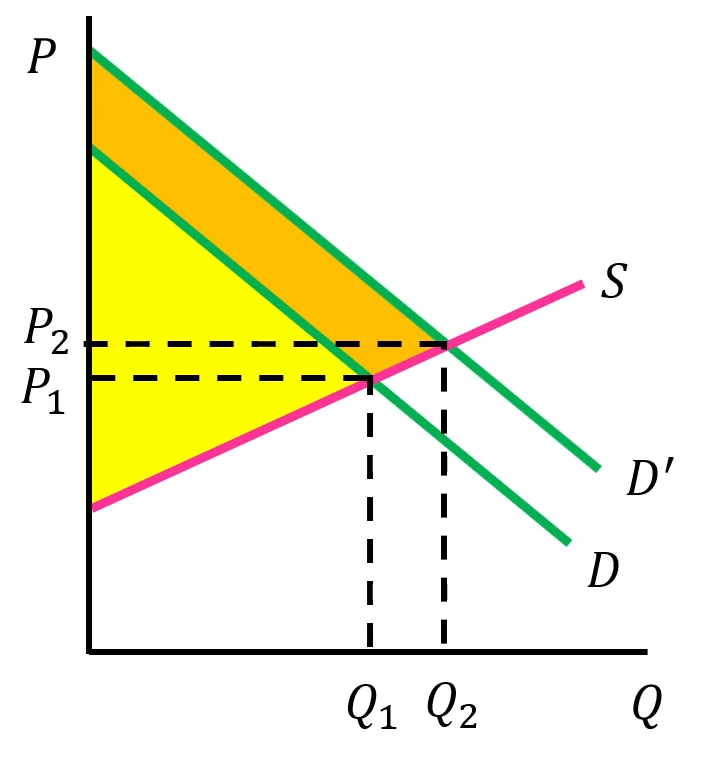
Unit 12 Incomplete Information
Many markets suffer from incomplete information regarding product standards and quality. Increased risk and uncertainty can make consumers more hesitant to buy a product or service and can depress market demand
Unit 12 Correcting for Incomplete Information
When the government enforces standardizing regulations, it can reduce consumers uncertainty. Reducing uncertainty increases consumer demand and therefore increases total market surplus
e.g. food regulations, cigarette regulations, etc.
This happens more often than we notice
Unit 12 The Classification of Goods
Rivalry
A good is rivalrous if one person’s use reduces how much is left for others.
A good is non-rivalrous if one person’s use does not affect others.Examples
Rivalrous vs Non-rivalrousPizza vs Car radio signal
Bottle of water vs Streetlight
Laptop vs GPS satellite signal
Seat on a bus vs Public Wi-Fi (light use)
Excludability
A good is excludable if people can be prevented from using it unless they pay.
A good is non-excludable if it is hard or impossible to stop people from using it.Examples
Excludable vs Non-excludableNetflix subscription vs National defense
Toll highway vs Public road (no toll)
Private park vs Public park
Concert ticket vs Fireworks display