Water Fall, Interlocking Spurs and Rapids
 Call Kai
 Learn
Learn Practice Test
 Spaced Repetition
 Match
Match Flashcards
 Knowt Play
1/4

There's no tags or description
Looks like no tags are added yet.
Name | Mastery | Learn | Test | Matching | Spaced | Call with Kai |
|---|
No analytics yet
Send a link to your students to track their progress
5 Terms
Water Fall
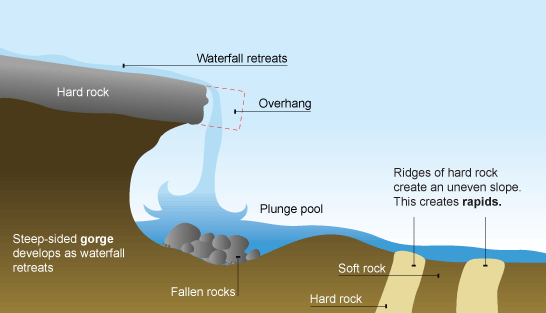
A waterfall is a landform formed in the upper course of a river. It is formed when a river runs over alternating layers of hard and soft rock, especially when it flows over a resistant band of hard rock on top of less resistant soft rock. This enables processes of erosion such as hydraulic action and abrasion to take place, subsequently causing the soft rock to erode. This undercuts the hard rock situated above the soft rock, also forming a gorge. Eventually, the hard rock is unable to support its own weight and gravity - this allows vertical erosion to take place, forming a plunge pool whereby hard rock collapses into the plunge pool formed at the bed of the river. This allows the waterfall to retreat upstream, leaving a gorge behind at the same time.
Rapids
Rapids are formed when water flows past river beds that are made of both hard rocks and soft rocks, whereas the soft rocks and hard rocks are placed parallel to each other. Since soft rocks are easier to erode than hard rocks, a small pothole is formed due to the recurring vertical erosion, causing a stone to be stuck within. The stone continues to erode the soft rock vertically, causing an eddy where water flows circularly downwards. This deepens the pothole that was created, leading to an uneven slope. Eventually, a rapid is formed.
Interlocking Spur
Interlocking spurs are a type of erosion found in the upper course of the river. When the river has low discharge and unable to produce sufficient hydraulic power to erode through resistance rocks, it winds around hard rocks and only erodes through soft rocks. The continuous vertical erosion leads to the formation of V-shaped valleys resulting in a zig-zag pattern where land interlocks with each other
Diagram
what affect amount of erosion in waterfall
height greatere, faster the flow, more hydraulic power
suze of drainage basin
discharge leels
load in plunge pool (cause abrasion)