Chapter 7: Quality
0.0(0)
Studied by 3 people Call Kai
 Learn
Learn Practice Test
 Spaced Repetition
 Match
Match Flashcards
 Knowt Play
Card Sorting
1/74

Earn XP
Last updated 11:40 PM on 3/21/23
Name | Mastery | Learn | Test | Matching | Spaced | Call with Kai |
|---|
No analytics yet
Send a link to your students to track their progress
75 Terms
1
New cards
when did 6 Sigma become famous
1995. reported to save General Electric 200 million
2
New cards
What is this chapters definition of **Quality**
–Ability of supplier to provide goods and services in conformance with specifications
–Item or service performs per original requirements
–Item or service performs per original requirements
3
New cards
What is this chapters definition of **Function**
What is the item or service designed to perform?
4
New cards
Suitability and what it refers to
–Ability of material to meet its intended function
–Refers to fitness for use
–Refers to fitness for use
5
New cards
Reliability and what its useful for
–The probability of failure within a given amount of time
–Useful to recognize varying reliabilities of components and products acquired
–Useful to recognize varying reliabilities of components and products acquired
6
New cards
What are the 8 Dimensions of Quality
Performance
Features
Reliability
Durability
Conformance
Serviceability
Aesthetics
Percieved Quality
Features
Reliability
Durability
Conformance
Serviceability
Aesthetics
Percieved Quality
7
New cards
Dimension of Quality: Performance
The primary function of a product or service
8
New cards
Dimension of Quality: Features
The bells and whistles
9
New cards
Dimension of Quality: Reliability
The probability of failure within a specified time period.
10
New cards
Durability
The Life expectancy
11
New cards
Conformance
The meeting of specifications
12
New cards
Serviceability
the maintenance and ease of fixing
13
New cards
Aesthetics
the look, smell, feel and sound
14
New cards
Percieved Quality
the image in the eyes of the customer
15
New cards
What are the 5 major costs of quality that supply can influence
Prevention Costs
Appraisal costs
Internal Failure Costs
External Failure Costs
Morale Costs
Appraisal costs
Internal Failure Costs
External Failure Costs
Morale Costs
16
New cards
What qualifies as costs of **Good Quality**
Appraisal Costs
Prevention Costs
Prevention Costs
17
New cards
Cost of Good Quality: whats involved in Appraisal Costs
Associated with evaluation of materials, processes, products
Quality Assessment and approval of suppliers
Performing audits on quality system to make sure they work
Quality Assessment and approval of suppliers
Performing audits on quality system to make sure they work
18
New cards
Cost of Good Quality: What’re Prevention Costs related to
related to design, implementation and maintenance of quality management system
19
New cards
When are prevention measures planned to happen
before product/material acquired
20
New cards
What are the specific steps to help implement Prevention measures
establish specifications
creation of quality plans
Development, preparation and maintenance of quality training
creation of quality plans
Development, preparation and maintenance of quality training
21
New cards
Cost of Poor Quality: Whats involved in **Internal Failure** costs
occur
Costs:
Costs:
22
New cards
What’re the costs of Internal Failures?
Defective Products/materials that can’t be used, sold or repaired
costs with fixing those defects
Unnecesary work/inv resulting from errors
finding root causes
costs with fixing those defects
Unnecesary work/inv resulting from errors
finding root causes
23
New cards
Cost of Poor Quality: When do Internal Failures happen?
when product or service doesn’t measure up to standards, identified **before product/service delivered to customer**
24
New cards
When is a problem considered an External Failure?
**after** the product/service is delivered to customer
25
New cards
What’s Included in External Costs
1. Responding to Customer Complaints
2. Failed Products that have to be replaced, Services to be repeated
3. Repair of Returned Products and Products still in the field
4. Handling & Investigating Rejected/Recalled Products, Including transport costs.
26
New cards
What’re the 7 Tools of Quality Control
1. Check Sheets
2. Histograms
3. Pareto Analysis
4. Cause & Effect Diagrams
5. Flow Diagram
6. Control Charts
7. Scatter Diagrams
27
New cards
When and where did the concept of Six Sigma originate
1980’s by Motarola
28
New cards
Who made 6 Sigma famous
Jack Welch
29
New cards
When did Lean first start. Who started it
1910’s With Henry Fords Mass Production line using **Continuous Assembly systems**
30
New cards
Who and when was Lean further implemented
1940’s. Taichi Ohno Shigeo Shingo
**Toyota Production system**
incorporated ford system and others to start LEAN
**Toyota Production system**
incorporated ford system and others to start LEAN
31
New cards
who coined the term LEAN
John Krafcik. 1988
expanded in 1990 book “The Machine that changed the world.”
expanded in 1990 book “The Machine that changed the world.”
32
New cards
What concepts have emerged as LEAN practices and philosophies
Quick Response
Efficient Consumer Response(ECR)
Just In Time(JIT)
Keiretsu Relationships
Efficient Consumer Response(ECR)
Just In Time(JIT)
Keiretsu Relationships
33
New cards
What’re necessary traits to assure good Service Quality
Reliability
Responsibility
Assurance
Empathy
Tangibles
Responsibility
Assurance
Empathy
Tangibles
34
New cards
Reliability
Ability to perform the promised service dependably and accurately
35
New cards
Quality Service: Reliability
Willingness to help customers and provide prompt service
36
New cards
Quality Service: Assurance
Knowledge and courtesy of employees and their ability to inspire trust and confidence
37
New cards
Quality Service: Empathy
Caring, individualized attention the firm provides its customers
38
New cards
Quality Service: Tangibles
Physical facilities, equipment and appearance of personnel
39
New cards
LEAN: Quick Response
the rapid replenishment of a customer's stock by a supplier with direct access to data from the customer's point of sale.
40
New cards
Lean: Efficient Consumer Response (ECR)
a strategy to increase the level of services to consumers through close cooperation among retailers, wholesalers, and manufacturers.
41
New cards
LEAN: Just in Time (JIT)
an inventory strategy to decrease waste by receiving materials only when and as needed in the production process, thereby reducing inventory costs.
42
New cards
LEAN: Keiretsu Relationships
involves companies both upstream and downstream \n of a manufacturing process, remaining independent but working closely together.
43
New cards
What is Lean? What is it **not**?
Lean is a philosophy/culture
Lean isn’t a box of methods, idea, or tools
Lean isn’t a box of methods, idea, or tools
44
New cards
What does Lean usually result in
Large cost reductions
Improved quality
Increased customer service
Improved quality
Increased customer service
45
New cards
What Qualifies as Cost of Poor Quality
Internal Failure Costs
External Failure Costs
External Failure Costs
46
New cards
What’re the 4 Integrated Stages of Quality Function Deployment
Product Planning
Parts deployment
Process Planning
Production Planning
Parts deployment
Process Planning
Production Planning
47
New cards
Product Planning
To determine design req’s
48
New cards
Parts Deployment
To determine parts characteristics
49
New cards
Process Planning
to determine manufacturing requirements
50
New cards
Production Planning
To determine Production Requirements
51
New cards
Whats the Six Sigma Acronym
Define
Measure
Analyze
Improve
Control
Measure
Analyze
Improve
Control
52
New cards
Define
Describe the problem quantifiably and the underlying process to determine how performance will be measured
53
New cards
Measure
Use measure or metrics to understand performance and the improvement opportunity
54
New cards
Analyze
Identify the true root cause of the underlying problem
55
New cards
Improve
Identify and test the best improvements that address the root cause
56
New cards
Control
Identify sustainment strategies that ensure process performance maintains the improved state
57
New cards
What is the Goal of Six Sigma
attain less than 3.4 defects per million
58
New cards
How does the process of six sigma attain its goal.
Removing Causes of Defect
Minimizing Variability
Minimizing Variability
59
New cards
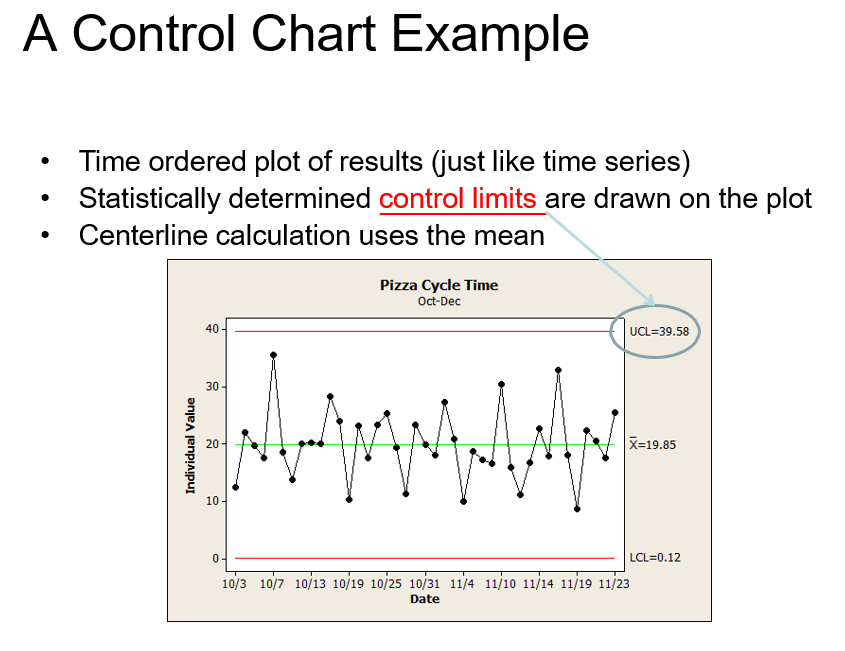
Control Chart
A graph used to study how a process changes over time
60
New cards
What types of Variation are there
Common Cause Variation
Special Cause Variation
Special Cause Variation
61
New cards
Common Cause Variation
always present to some degree in the process
62
New cards
Special Cause Variation
outside, non-random problems – e.g. machine breakdown
63
New cards
What types of special Cause variations are there on statistical graphs?
Out of Control
Trend
Process Shift
Trend
Process Shift
64
New cards
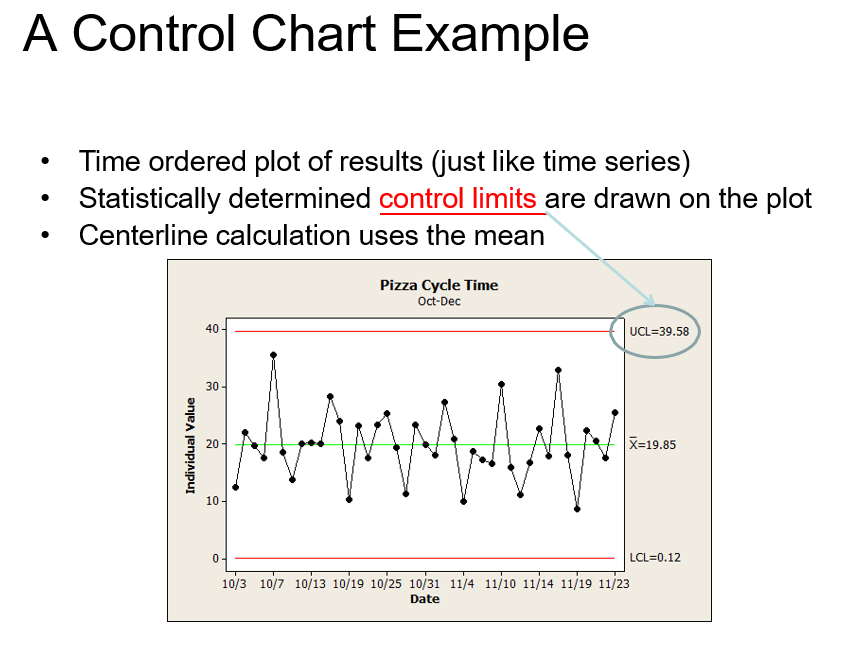
Out of Control Special Variation
1 or more points above or below 3-standard deviations from the centerline
65
New cards
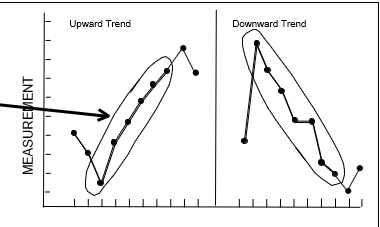
Trends Special Variation
6 or more points in a row increasing or decreasing
66
New cards
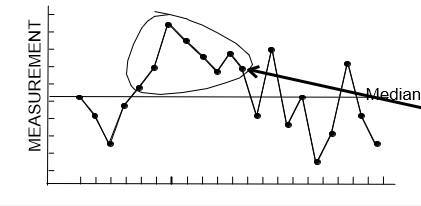
Process Shift Special Variation
8 or more points in a row above or below the centerline
67
New cards
Special Process Control (SPC)
A technique that involves testing a random sample \n of output from a process in order to detect if \n nonrandom changes in the process are \n occurring
68
New cards
What kind of causes are there for Special Process Control(SPC)
Common causes versus special/ Nonrandom Causes
69
New cards
What does ISO stand for
International Organization for Standardization
70
New cards
What are the benefits of having ISO certification
Greater market potential
Compliance to procurement bids
Improved efficiency and cost savings
Higher level of customer service
Heightened staff moral and motivation
Compliance to procurement bids
Improved efficiency and cost savings
Higher level of customer service
Heightened staff moral and motivation
71
New cards
What kind of Award is the ISO 9000
–International consensus on good quality management practices regarding Process control.
72
New cards
What’s Process Capbility
The ability of the process to meet specifications consistently
73
New cards
What kind of award is the ISO 14000
–Similar to ISO 9000 in management principles. Focuses on environmental issues
74
New cards
What’s the The Malcolm Baldrige National Quality Award
Annual award for U.S. organizations in business, health care, education and nonprofit.
Recognizes Quality Achievement and Management
Recognizes Quality Achievement and Management
75
New cards
Total Quality Management: Demings 14 points
1\. Create constancy of purpose for improving products and services.
2\. Adopt the new philosophy.
3\. Cease dependence on inspection to achieve quality.
4\. End the practice of awarding business on price alone; instead, minimize total cost by working with a single supplier. 5. Improve constantly and forever every process for planning, production, and service.
6\. Institute training on the job.
7\. Adopt and institute leadership.
8\. Drive out fear.
9\. Break down barriers between staff areas.
10\. Eliminate slogans, exhortations, and targets for the workforce.
11\. Eliminate numerical quotas for the workforce and numerical goals for management.
12\. Remove barriers that rob people of pride in workmanship, and eliminate the annual rating or merit system.
13\. Institute a vigorous program of education and self-improvement for everyone.
14\. Put everybody in the company to work accomplishing the transformation.
2\. Adopt the new philosophy.
3\. Cease dependence on inspection to achieve quality.
4\. End the practice of awarding business on price alone; instead, minimize total cost by working with a single supplier. 5. Improve constantly and forever every process for planning, production, and service.
6\. Institute training on the job.
7\. Adopt and institute leadership.
8\. Drive out fear.
9\. Break down barriers between staff areas.
10\. Eliminate slogans, exhortations, and targets for the workforce.
11\. Eliminate numerical quotas for the workforce and numerical goals for management.
12\. Remove barriers that rob people of pride in workmanship, and eliminate the annual rating or merit system.
13\. Institute a vigorous program of education and self-improvement for everyone.
14\. Put everybody in the company to work accomplishing the transformation.