The Frankfurt school - 2.3
 Call Kai
 Learn
Learn Practice Test
 Spaced Repetition
 Match
Match Flashcards
 Knowt Play
1/79

There's no tags or description
Looks like no tags are added yet.
Name | Mastery | Learn | Test | Matching | Spaced | Call with Kai |
|---|
No analytics yet
Send a link to your students to track their progress
80 Terms
Critical Theory
A branch of politically inflected philosophy associated with the Frankfurt School that critiques society by questioning the very standards of “better,” “useful,” and “productive” in existing social systems. Coined by Max Horkheimer in his 1937 essay “Traditional and Critical Theory.”
Theodor Adorno
Major Frankfurt School philosopher known for Minima Moralia, negative dialectics, critiques of capitalism, and aesthetic theory.
Frankfurt School
A group of German scholars associated with the Institute for Social Research, founded in Frankfurt in 1923.
Adorno’s most famous quote
‘There can be no lyric poetry after Auschwitz’
Institute for Social Research
The interdisciplinary research institute allied with the University of Frankfurt that became known as the Frankfurt School.
1933 significance
The year the Nazis closed the Institute for Social Research, forcing its members into exile.
1934 significance
The year the Frankfurt School re-established itself at Columbia University in New York.
1949 significance
The year Horkheimer re-established the Institute at the University of Frankfurt after WWII.
Felix Weil
Wealthy Marxist intellectual who financially funded the founding of the Frankfurt School.
Friedrich Pollock
Founding member of the Frankfurt School and close collaborator of Horkheimer.
Walter Benjamin
Associate of the Frankfurt School known for influential cultural criticism and philosophy.
Erich Fromm
Frankfurt School member who introduced psychoanalysis into critical theory.
Herbert Marcuse
Frankfurt School theorist associated with critiques of one-dimensional society and later New Left movements.
Critical theory and society
Critical theory does not aim simply to reform society but to expose deeper structural problems embedded within it.
Negative function of critical theory
The role of critical theory in negating accepted truths, exposing contradictions, and resisting conformity.
Negative dialectics
Adorno’s philosophical method of resisting fixed identities and emphasizing contradiction and non-identity.
Non-identity
Adorno’s idea that concepts never fully capture reality and that true thought resists simplification and categorization.
Ambivalence of culture
The Frankfurt School belief that every cultural phenomenon contains both liberating and repressive elements.
‘Every document of civilization is at the same time a document of barbarism.’
Adorno’s idea that cultural achievements are always tied to histories of violence and oppression.
‘Wrong life cannot be lived rightly.’
Adorno’s claim that ethical living is impossible within a fundamentally unjust society.
‘Art is the ever broken promise of happiness.’
Adorno’s idea that art gestures toward freedom and fulfillment without fully achieving them.
‘Only what does not fit into the world is true.’
Adorno’s argument that truth lies in what resists conformity to existing society.
‘It is part of morality not to be at home in one’s home.’
Adorno’s claim that after fascism and war, feelings of comfort and belonging are morally compromised.
‘Art, on the one hand, and mass culture, on the other, are torn halves of a freedom to which they do not add up.’
Adorno’s idea that neither elite art nor mass culture alone can achieve true freedom.
Typical Frankfurt School question
“How does ordinary everyday life reveal deeper structures of power and domination?”
Casement window example
Adorno’s question about windows, door handles, and architecture explores how everyday design shapes human behavior and subjectivity.
Exchange principle
The capitalist logic that everything must be bought, sold, or exchanged according to value.
‘We are forgetting how to give presents.’
Adorno’s argument that capitalism destroys genuine generosity and imagination in relationships.
Real giving according to Adorno
Real giving involves imagination, time, effort, and genuine consideration for another person.
Gift articles critique
Adorno criticizes generic gift products as signs that people no longer genuinely know or care what others want. Perpetuated by capitalism. It matters because people are no longer ‘giving’ and ‘imagining’ and wanting to give someone joy.
Running in the street analysis
Adorno interprets running as unconsciously expressing historical terror, fear, and social pressure. Our world seems to be an inhospitable place, that even running is linked to terror. Pessimism
Psychoanalysis in critical theory
The Frankfurt School used psychoanalysis to uncover hidden violence, repression, and desire beneath everyday behavior.
‘Dwelling, in the proper sense, is now impossible.’
Adorno’s claim that modern history and capitalism have destroyed the possibility of feeling truly at home. Suggests the only way is to move in rented rooms and acknowledge our displacement. Ironically, a middle class man.
Adorno on houses
Traditional homes conceal historical violence while modern functional housing reduces people to standardized consumers.
Critique of the futon
Adorno criticizes the futon as symbolizing the reduction of humans to animal-like existence under modern capitalism. Feels there is no threshold between waking and dreaming which is what capitalism wants, alert and unconscious all at once.
Capitalism and fascism
Adorno argues capitalism completes tendencies toward domination and dehumanization that fascism intensified.
‘Be not-at-home.’
Adorno’s ethical response to modern society: remain critically detached rather than comfortably integrated.
Disown what you own
Adorno’s idea that people must recognize the contradictions of private property while still depending on possessions. ‘wrong life cannot be lived rightly’
Synthesis in critical theory
Critical theory combines philosophy, Marxism, psychoanalysis, sociology, and high/low culture.
Marxism and the Frankfurt School
The Frankfurt School drew from Marxism but became skeptical of revolutionary politics after fascism and Stalinism.
Why the Frankfurt School distrusted revolutions
The rise of fascism and Stalinist totalitarianism made them fear mass political movements and authoritarian conformity.
Two key Frankfurt School questions
How could totalitarianism arise? 2. How could freedom survive in a totally administered society?
Authoritarian personality
A personality shaped to obey authority and conform to oppressive systems.
One-dimensional man
Marcuse’s concept describing people reduced to passive conformity by consumer capitalism.
Instrumental reason
Reason reduced to efficiency, calculation, and control rather than genuine critical thought.
Dialectic of Enlightenment
Adorno and Horkheimer’s argument that Enlightenment rationality can lead to domination and barbarism.
Culture industry
Adorno and Horkheimer’s term for mass-produced entertainment that manipulates audiences and reinforces conformity due to unhappiness under capitalism.
Donald Duck example
Adorno argued cartoon violence teaches audiences to accept punishment and authority.
Cinema critique
The Frankfurt School believed popular entertainment distracts people from unhappiness while reproducing social control.
Housewife in the cinema
Adorno acknowledged cinema could provide temporary refuge and anonymity despite its ideological problems.
Mass culture according to Adorno
Mass culture standardizes experience and discourages independent critical thinking.
Autonomous art
Art that resists becoming mere entertainment or propaganda and maintains independence from social utility.
Adorno’s defense of difficult art
Adorno believed challenging, experimental art resists conformity better than easily consumable art.
Threats to art according to Adorno
Capitalist commodification and politically instrumentalized art both threaten artistic autonomy.
Socialist realism
State-approved Soviet art style emphasizing politically useful and accessible representations.
Adorno on politically engaged art
He believed overtly didactic political art often becomes simplistic and conformist.
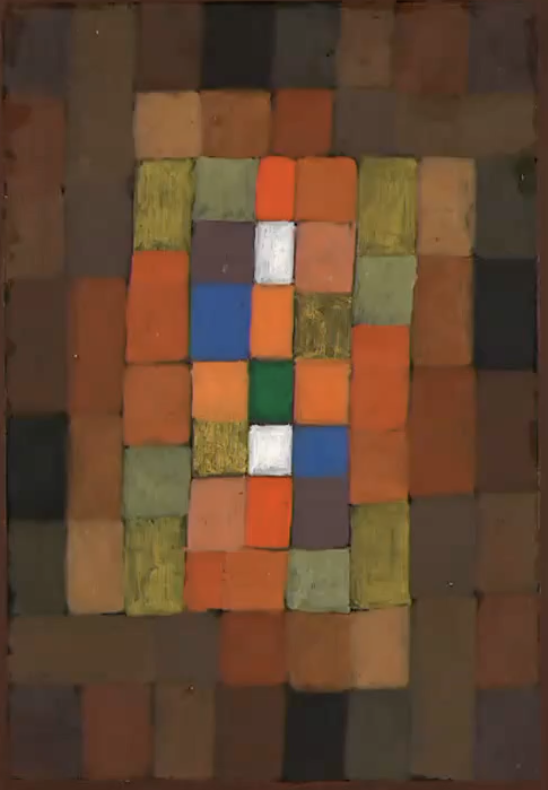
Paul Klee, States Dynamic Gradation
1923, Modernist painter admired by Adorno for creating images that gesture toward unrealized possibilities.
Arnold Schoenberg
Composer admired by Adorno for his experimental twelve-tone music that resisted conventional harmony.
Bertolt Brecht
Playwright associated with alienation effects and experimental theatre admired by Adorno.
Alienation effect
Brechtian technique that disrupts audience immersion to encourage critical reflection.
Samuel Beckett
Playwright associated with minimalist and alienating theatre that Adorno valued.
Fireworks metaphor
Adorno compares the great artworks to fireworks because they briefly appear as radiant, transformative apparitions.
What is Aesthetic theory?
Modern art can be an autonomous force against capitalism. The artwork appears like a vision or revelation that transcends ordinary reality.
‘Art lies, to tell the truth.’
Adorno’s claim that art’s fictional or illusory nature reveals deeper truths about society and possibility.
Shock in aesthetic experience
For Adorno, encountering something radically unfamiliar is essential to genuine art.
Ivory tower defense
Adorno defended difficult, autonomous art against demands that art become directly politically useful.
Hotel Abyss
Georg Lukács’s criticism that the Frankfurt School contemplated social catastrophe from comfortable intellectual isolation.
Georg Lukács
Marxist critic who accused the Frankfurt School of elitism and political passivity.
Student protests of the 1960s
Adorno distrusted many student movements, fearing they reproduced conformity and authoritarian behavior.
Adorno on theory
He argued that independent critical thinking itself is a form of resistance.
‘Whoever thinks, offers resistance.’
Adorno’s claim that critical thought opposes conformity and social domination.
Contrarianism concern today
The lecture notes that strategies of negation and contrarian thinking are now sometimes used by the political right.
Utopian promise
Critical theory preserves ideals such as freedom, equality, autonomy, and kindness as unrealized possibilities.
Mass administered society
A society in which institutions, bureaucracy, and capitalism shape people into passive, conformist subjects.
Why the Frankfurt School remained influential
Its critiques of capitalism, mass media, authority, and culture continue to shape art history, philosophy, and cultural studies.
Minima Moralia
Adorno’s 1951 collection of aphoristic essays analyzing everyday life under capitalism. How small changes affect who we are fundamentally.
Aphorism
A short, provocative statement designed to challenge conventional thinking.
Why Adorno wrote aphoristically
The fragmented form mirrored a fractured modern world and forced readers to think critically.
Adorno’s overall pessimism
He believed modern capitalist society deeply damaged human freedom, relationships, and individuality.
Freedom in Adorno’s theory
Freedom survives through critical thought, negation, non-conformity, and autonomous art.