Topic 5 — Homeostasis & Response
 Call Kai
 Learn
Learn Practice Test
 Spaced Repetition
 Match
Match Flashcards
 Knowt Play
1/279

There's no tags or description
Looks like no tags are added yet.
Name | Mastery | Learn | Test | Matching | Spaced | Call with Kai | Chat |
|---|
No analytics yet
Send a link to your students to track their progress
280 Terms
What is homeostasis?
The regulation of the internal conditions of a cell or organism to maintain optimum conditions for function in response to internal and external changes.
What does homeostasis maintain?
Optimal conditions for enzyme action and all cell functions.
What does homeostasis control in the human body? (3)
Blood glucose concentration
Body temperature
Water levels
Automatic control systems may involve ___________ responses or ___________ responses.
nervous
chemical
What do all control systems include? (3)
Receptors
Coordination centres
Effectors
What do receptors do?
They detect stimuli.
What are stimuli?
Changes in the environment.
What do coordination centres do?
They receive and process information from receptors.
What are 3 examples of coordination centres?
Brain
Spinal cord
Pancreas
What do effectors do?
They bring about responses which restore optimum levels.
What can effectors be? (2)
Muscles
Glands
What does the human nervous system consist of?
Central nervous system (CNS)
Peripheral nervous system
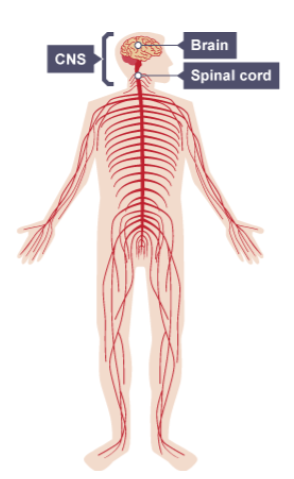
What is the central nervous system (CNS)?
The part of the nervous system made up of the brain and spinal cord.
What is the peripheral nervous system?
Nerve cells that carry information to or from the CNS.
What does the nervous system enable humans to do?
React to their surroundings and coordinate their behaviour.
How the Nervous System Works:
Information from _________ passes along cells (_______) as ________ ________ to the ________ _________ ________ (___).
The ____ coordinates the response of _________ which may be muscles ____________ or glands __________ __________.
receptors
neurones
electrical impulses
central nervous system (CNS)
CNS
effectors
contracting
secreting hormones
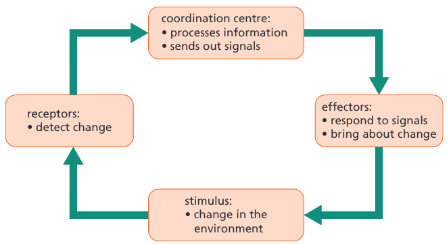
stimulus -> ___________ -> ___________ -> ___________ -> response
receptor
coordinator
effector
What are reflexes?
Automatic responses which take place before you have time to think.
Why are reflexes important?
They prevent the individual from getting hurt.
Reflexes prevent the individual from getting hurt because information travels down a pathway called a ________ ____, allowing vital __________ to take place ___________.
reflex arc
responses
quickly
Reflex actions are ___________ and _______; they do not involve the ___________ part of the brain.
automatic
rapid
conscious
How a Reflex Works:
A ___________ is detected by ___________.
Impulses are sent along a _________ neuron.
In the _____ the impulse passes to a _______ neuron.
Impulses are sent along a _______ neuron.
The impulse reaches an __________ resulting in the appropriate ________.
stimulus
receptors
sensory
CNS
relay
motor
effector
response
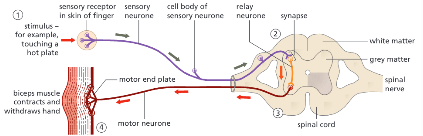
_________ neuron -> ________ neuron -> ________ neuron
sensory
relay
motor
What are 2 examples of reflex arcs?
Pupils getting smaller to avoid damage from bright lights.
Moving your hand from a hot surface to prevent damage.
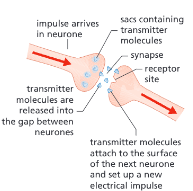
What are synapses?
The gaps between two neurons.
Synapses:
When an impulse reaches the end of the first neuron, a ______________ is released into the synapse.
This ______________ ____________ across the synapse.
When the _____________ reaches the second neuron, it triggers the ___________ to begin again in the next neuron.
neurotransmitter
neurotransmitter diffuses
neurotransmitter
impulse
What is reaction time?
How long it takes to respond to a stimulus.
What are possible independent variables for RP 7 — Reaction Time? (5)
Practice
Hand used
Chemicals (e.g. caffeine)
Background noise
Exercise
What is the dependent variable for RP 7 — Reaction Time?
The distance the ruler drops.
What are the control variables for RP 7 — Reaction Time?
Same starting distance between the thumb and the ruler.
Measuring from the top of the thumb each time.
Keeping room conditions the same (e.g. lighting, temperature)
What effect would practice have on reaction time?
Reaction times usually become shorter the more a person practices the test.
What effect would the hand used have on reaction time?
Your dominant hand would have a shorter reaction time that your non-dominant hand because you use it more often.
What effect would caffeine have on reaction time?
Caffeine speeds up reflex actions which results in a shorter reaction time.
What effect would background noise have on reaction time?
Noise makes it harder to concentrate.
So your reaction time would be slower.
What effect would exercise have on reaction time?
Light exercise could speed up reactions by increasing blood flow.
Heavy fatigue could slow someone down.
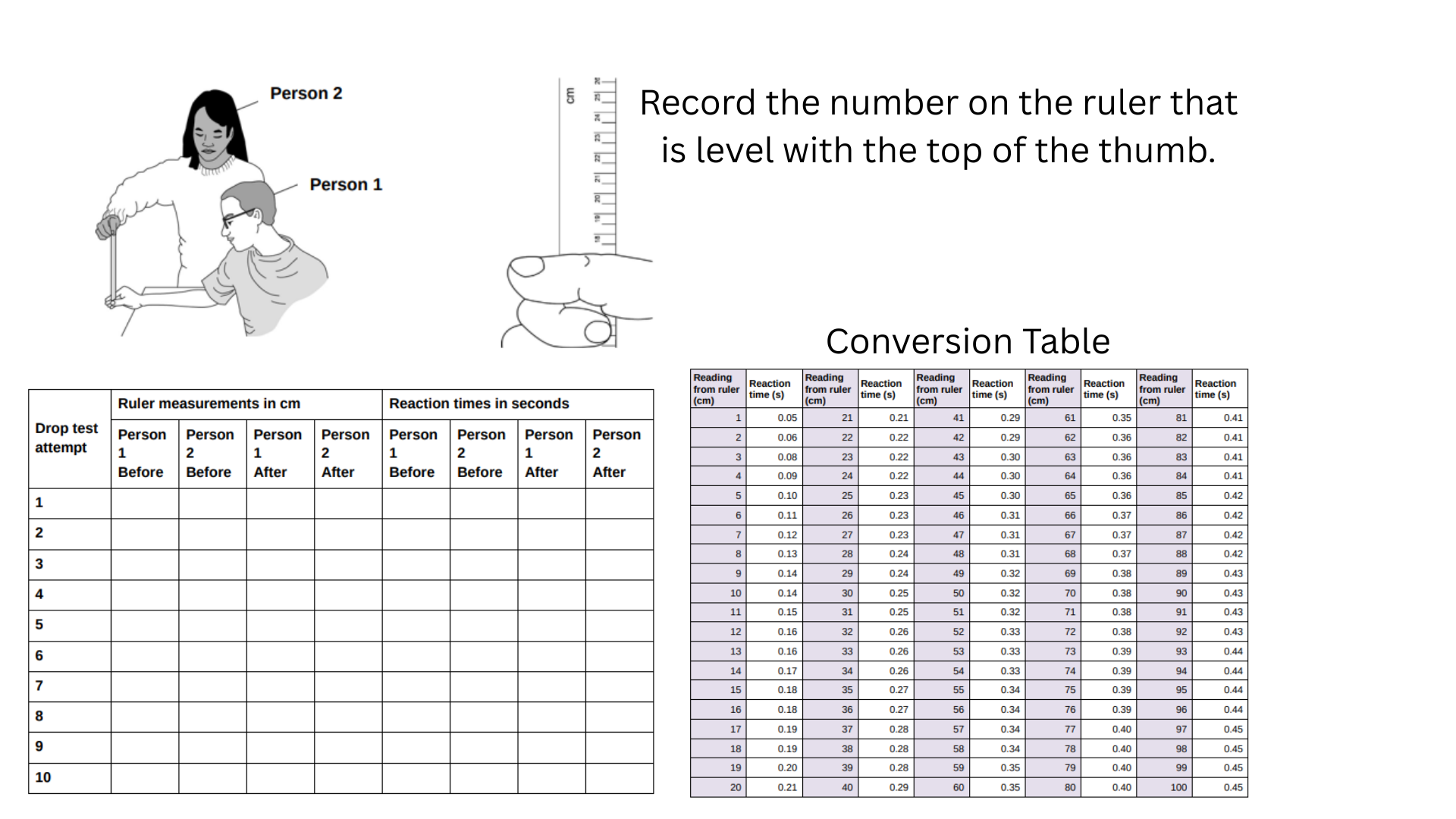
Required Practical 7 — Reaction Time:
Two people need to do this practical, they should both be using their dominant hand.
Person 1 sits down on the chair, with good upright posture and eyes looking across the room.
Person 1 puts the forearm of their ____________ arm across the table with their hand __________________ the edge.
Person 2 holds a ruler _______________ with the ____________ end (the end with the 0 cm mark) in between person 1’s thumb and first finger. They will tell person 1 to prepare to catch the ruler.
Person 1 catches the ruler with their thumb and first finger as quickly as possible when it drops.
Record the number on the ruler that is ________ with the top of person 1’s thumb.
Have a short rest, then repeat the test several times.
Record your results on a table.
Repeat the test with Person 2 catching the ruler and Person 1 dropping it.
Record Person 2’s results on the table.
Use a __________ _______ to convert your ruler measurements into reaction times.
Make the change that you are investigating to change human reaction time.
Repeat steps 1-9 for each person and record the results in your data table.
dominant
overhanging
vertically
bottom
level
conversion table
What does the brain control?
Complex behaviour
The brain is made of billions of interconnected __________ and has different regions that carry out different __________.
neurones
functions
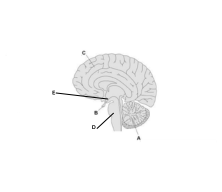
Label each part of the brain.
A — Cerebellum
B — Pituitary gland
C — Cerebral cortex
D — Medulla
E — Hypothalamus
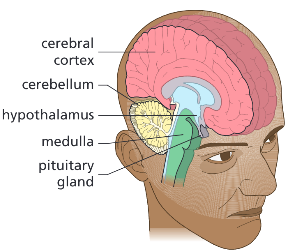
What is the function of the cerebral cortext?
It controls consciousness, intelligence, memory, and language.
What is the function of the cerebellum?
It controls the fine movement of muscles and balance.
What is the function of the medulla?
It controls unconscious actions like breathing and heart rate.
Why is investigating brain function and treating brain damage and disease difficult? (4)
The brain is:
complex and delicate
easily damaged
Drugs given to treat diseases cannot always reach the brain because of the membranes that surround it.
It is not fully understood which part of the brain does what.
What are the ways that neuroscientists can map out regions of the brain? (3)
Studying patients with brain damage
Electrically stimulating different parts of the brain
Using MRI scanning techniques
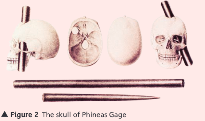
Explain how studying patients with brain damage can be useful for understanding more about the brain.
Observing the changes in an individual following damage on a certain area of the brain can provide information on the role this area has.
What is the advantage of studying patients with brain damage?
It provides evidence of what happens when a function is lost.
What is a disadvantage of studying patients with brain damage?
Damage can affect multiple areas so you might not be able to tell which specific part of the brain had a certain effect.
Explain how electrically stimulating different parts of the brain can be useful for understanding more about the brain.
You push an electrode into the brain — the stimulation may result in a mental or physical change in the individual.
This can provide information on the role this area of the brain has.
What is the advantage of electrically stimulating different parts of the brain?
The patient can give feedback.
What are the disadvantages of electrically stimulating different parts of the brain?
Very invasive
Requires surgery
Carries the risk of infection or damage to the brain tissue
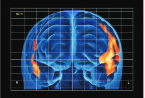
Explain how using MRI scanning techniques can be useful for understanding more about the brain.
A MRI scanner can be used to create an image of the brain.
This can be used to show which part of the brain is affected by a tumour, or which part is active during a specific task.
What are the advantages of using MRI scanning techniques?
Not invasive
Very safe
Provides detailed images of the brain in action
What are the disadvantages of using MRI scanning techniques?
Very expensive equipment
Patient has to stay very still
Not suitable for people with pacemakers
The eye is a _______ organ containing _________ sensitive to _______ ___________ and _________.
sense
receptors
light intensity
colour
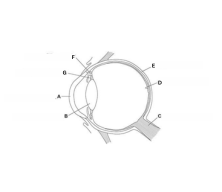
Label each part of the eye.
A — Cornea
B — Lens
C — Optic nerve
D — Retina
E — Sclera
F — Ciliary muscle
G — Suspensory ligament
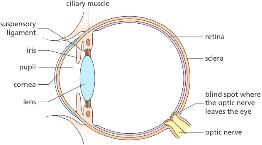
The eye has many different structures within it. They are adapted to allow the eye to change its _______ in order to _________ on near or distant objects (a process called __________________), and to ____ light.
shape
focus
accommodation
dim
What is accommodation?
The process of changing the shape of the lens to focus on near or distant objects.
What does the eye do to focus on a near object?
The ciliary muscles contract
The suspensory ligaments loosen
The lens is then thicker and refracts light rays strongly
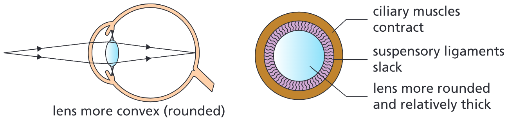
What does the eye do to focus on a distant object?
The ciliary muscles relax
The suspensory ligaments are pulled tight
The lens is then pulled thin and only slightly refracts light rays
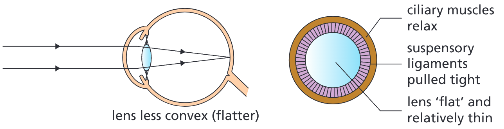
What is the structure and function of the retina?
Layer of light sensitive cells found at the back of the eye.
When light hits the retina, the cells are stimulated — impulses are sent to the brain, which interprets the information to create an image.
What is the structure and function of the optic nerve?
A nerve that leaves the eye and leads to the brain.
It carries the impulses from the retina to the brain to create an image.
What is the structure and function of the sclera?
White outer layer which supports the structures inside the eye.
It is strong to prevent some damage to the eye.
What is the structure and function of the cornea?
The see-through layer at the front of the eye.
It allows light through and the curved surface bends and focuses light onto the retina.
What is the structure and function of the iris?
Muscles that surround the pupil.
They contract or relax to alter the size of the pupil.
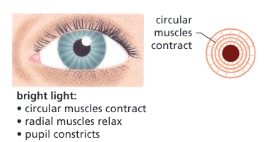
What does the eye do in bright light?
Circular muscles contract
Radial muscles relax
Makes the pupil smaller — avoids damage to the retina
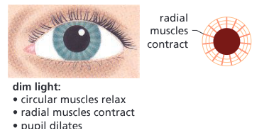
What does the eye do in dim light?
Circular muscles relax
Radial muscles contract
Makes the pupil larger — lets more light enter to create a better image
What do the ciliary muscles and suspensory ligaments do?
Hold the lens in place
They control the lens’ shape
What are two common defects of the eye?
Myopia
Hyperopia
What is myopia also known as?
Short sightedness
What is hyperopia also known as?
Long sightedness
What happens to the light entering your eye if you have myopia or hyperopia?
Rays of light do not focus on the retina:
Myopia — in front
Hyperopia — behind
People with ___________ see close objects in clear focus, but light from distant objects is focused __ _______ __ the retina, so the images on the retina are out of ______ and ________.
myopia
in front of
focus
blurry
What can having myopia be a result of? (2)
Lens that is too curved
Long eyeball
How is myopia commonly treated?
Glasses with a concave lens.
How do concave lenses work for myopia?
They spread out the light from distant objects so it is in perfect focus on the retina.
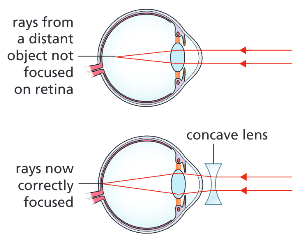
People with ____________ focus clearly on distant objects but close objects appear _________. The lens cannot ________ the rays of light __________ enough. The light is focused _________ the retina, so the images are out of ________.
hyperopia
blurred
refract
strongly
behind
focus
What can having hyperopia be a result of? (2)
Lens is too flat and thin
Short eyeball
How is hyperopia commonly treated?
Glasses with a convex lens.
How do convex lenses work for hyperopia?
They bring the light rays together so that they can be focused on the retina.
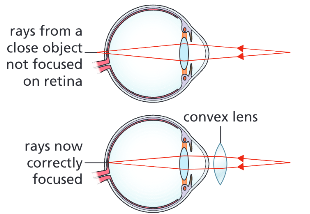
What are the 4 ways to treat hyperopia or myopia?
Glasses
Contact lenses
Laser eye surgery
Replacement lenses
_________ _________ are lenses that are placed on the surface of the eye. They work like conventional glasses, but cannot be _______.
Contact lenses
seen
What are the advantages of hard contact lenses?
Makes it easier to play sports and general activities
Lasts a long time
What are the disadvantages of hard contact lenses?
Risk of eye infections
Can be uncomfortable
What are the advantages of soft contact lenses?
More comfortable to wear
Makes it easier to play sports and general activities
What are the disadvantages of soft contact lenses?
Risk of eye infections
Doesn’t last very long
Some soft lenses last for a __________, but have to be removed and kept in _______ solution overnight. Others are __________ — worn for a day and thrown away.
month
sterile
disposable
How does laser eye surgery treat myopia?
Reducing the thickness of the cornea so it refracts the light less strongly.
This focuses distant light on the retina.
How does laser eye surgery treat hyperopia?
Lasers are used to change the curve of the cornea.
This makes it refract light from close objects more effectively.
What is the main advantage of laser eye surgery?
It is a permanent solution that eliminates the need for glasses.
What are the disadvantages of laser eye surgery?
Expensive
Surgery carries a risk of infection
How do replacement lenses work?
A permanent contact lens is implanted into the eye.
or
The faulty lens is replaced with an artificial one.
What is the main advantage of replacement lenses?
It is a permanent solution that eliminates the need for glasses.
What are the disadvantages of replacement lenses?
Damage to the retina
Cataracts developing if the natural lens remains in place
Infections
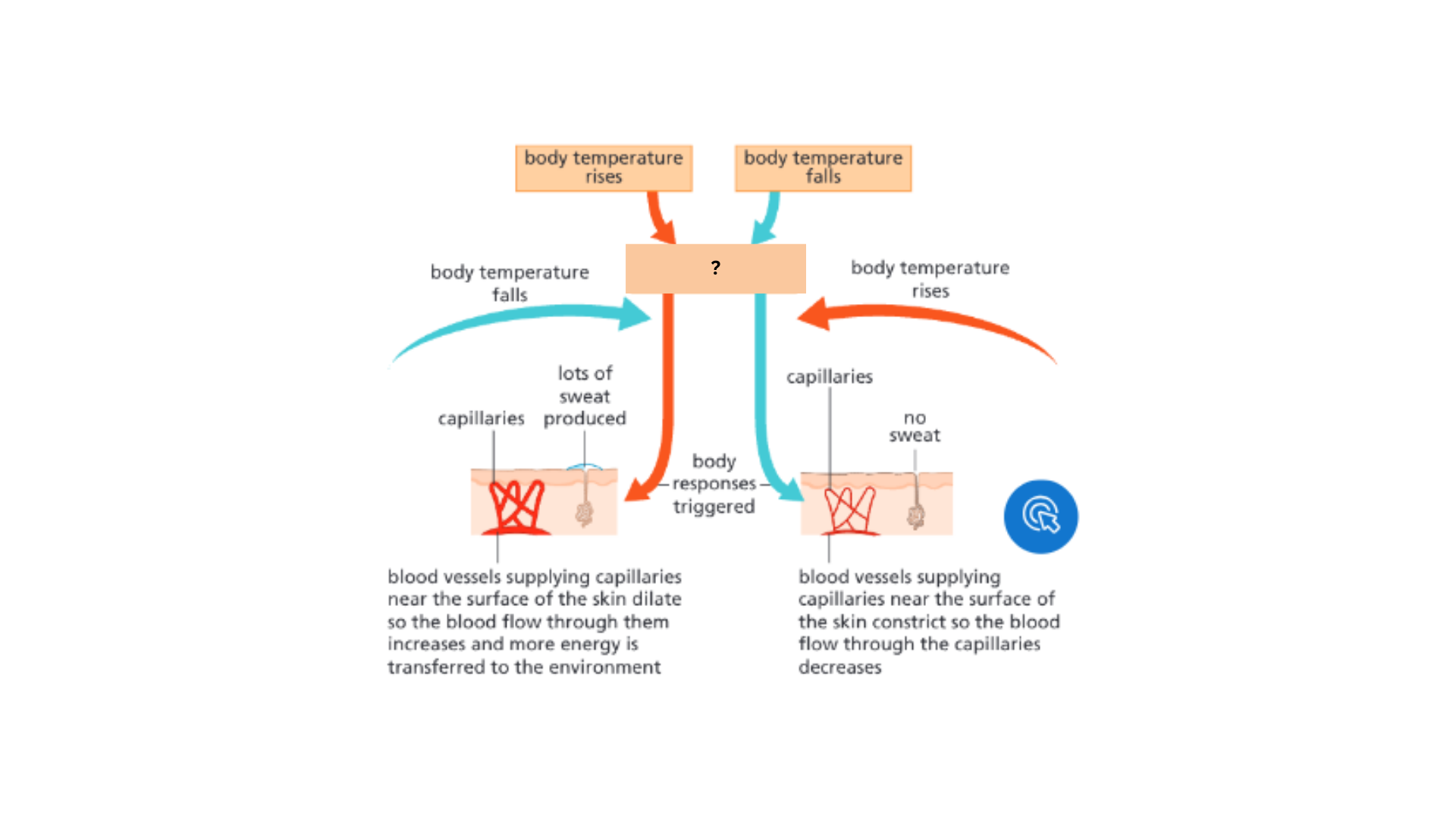
Body temperature is monitored and controlled by the __________________ ________ in the ________.
thermoregulatory centre
brain
What does the thermoregulatory centre have?
Receptors that are sensitive to the temperature of the blood.
The skin contains ______________ ____________ and sends __________ ___________ to the _________________ _________.
temperature receptors
nervous impulses
thermoregulatory centre
What happens when body temperature is too high?
Your enzymes stop working effectively and begin to denature.
The reactions of respiration stop working, causing death.
What does your body do when the core temperature is too high?
Blood vessels dilate (vasodilation).
Sweat is produced from the sweat glands.
Both these mechanisms cause a transfer of energy from the skin to the environment.
How does vasodilation cool you down?
More blood flows closer to the surface of the skin, resulting in increased energy transfer from the body.
How does sweating cool you down?
Sweat evaporates from skin surface resulting in increased energy transfer away from the body.