BIO 2 FINAL IWFDKMN
 Call Kai
 Learn
Learn Practice Test
 Spaced Repetition
 Match
Match Flashcards
 Knowt Play
1/227

There's no tags or description
Looks like no tags are added yet.
Name | Mastery | Learn | Test | Matching | Spaced | Call with Kai |
|---|
No analytics yet
Send a link to your students to track their progress
228 Terms
Allele
Variation of a gene at its locus within a chromosome
Hypothesis
Testable idea regarding the mechanism of an observed pattern
Eukaryote
Cell that contain organelles, linear DNA (Chromosomes), and a nucleus
Species
Reproductively isolated group of individuals (from ancestors)
Genetic drift
Sampling error (usually in small proportions)
Homologous pair
2 chromosomes (1 centromere & 2 chromatids each) that are grouped together during meiosis. Shares traits of both parents when aligned on metaphase plate
Diploid
Containing two sets of chromosomes.
Kinetochore
Protein formed at the centromere during mitosis and meiosis. Latches to microtubules. Kineto = motion. Moving protein
List three of the four mechanisms that act to change allele frequency.
Genetic drift, gene flow, and selection (natural and sexual).
list the basic steps of the scientific method.
Pattern observed
mechanism speculated
hypothesis formed
experiment is formed and tested
results are interpreted
conclusion reached
Distinguish a theory from a hypothesis.
Theory is the closest thing to true/real (tested extensively with same result.) Hypothesis is only speculation until tested.
list three differences between prokaryotes and eukaryotes
Prokaryotes: Circular DNA, flagella locomotion, no organelles, smaller
Eukaryotes: Linear DNA, Undulipodia and amoeboid locomotion, organelles, bigger
Write out the species name for any species using the proper format.
Homo sapiens (Genus = Homo, specific epithet = sapiens)
List two types of locomotion found in eukaryotes and one type of locomotion found in prokaryotes.
Eukaryote: Undulipodia and amoeboid
Prokaryote: Flagella
Briefly describe the endosymbiotic theory for the origin of organelles.
Early eukaryotes engulfed prokaryotes (Chloroplasts and mitochondria) through phagocytosis, which were incorporated into the cell structure. Supported by mitochondria and chloroplasts having double membrane and separate circular DNA
Distinguish between natural selection and sexual selection.
Sexual selection: based on female choice / chances of mating based on traits [Chances of mating]
Natural Selection: differential survival based on heritable traits. [Chances of survival]
Contrast metaphase of mitosis with metaphase I of meiosis.
In metaphase during mitosis, sister chromatids are aligned on the metaphase plate, whereas in metaphase I of meiosis, the homologous pairs are aligned on the metaphase plate.
Distinguish between an autotroph and heterotroph.
Autotroph: “fixes” CO2 into sugar
Heterotroph: Finds sugar in environment
Describe the mechanism by which natural selection acts to change allele frequencies.
If a heritable characteristic increases survivorship, its proportion in a cohort will increase from birth to reproduction.
Endosperm
Triploid material generated during double fertilization. Nourishes the growing embryo inside the seed. Made from the two polar nuclei in the megaspore.
Stomata
Pores/openings on leaves that allow for evapotranspiration and gas exchange
Cotyledon
The first leaves to emerge from a seed embryo. 2 in Dicot, 1 in Monocot.
Auxin
Plant hormone responsible for stem elongation & growth, promotion of lateral bud dormancy, promotion of ethylene production, and the inhibition of abscission. Found in shoot apical meristem.
Ethylene
Gaseous plant hormone responsible for the promotion of ripening and the control of abscission. Found in root & shoot apical meristems, leaf nodes, flowers, and fruits
Gametophyte
Haploid (N) stage in plant life cycles
Stem cells
Undifferentiated cells
Dehiscent fruit
Dry fruit that splits along a seam or has multiple pores.
List 1 non-tracheophyte plant phylum, and 2 tracheophyte plant phyla.
Non-tracheophyte: Bryophyta
Tracheophyte: Coniferophyta, Cycadophyta
For each of the following groups, list a diagnostic character: Angiosperms (phylum Anthophyta), Gymnosperms, and Tracheophytes
Angiosperms (phylum Anthophyta): Flowers, fruits, double fertilization
Gymnosperms: Embryo stored in female sporangium, not in fruit
Tracheophytes: Xylem & phloem, vascular leaves with stomata, and seeds + pollination
Name the primary meristem that gives rise to the following tissue types: Xylem, trichomes and root hairs, and sieve-tube members
Xylem: Procambium
Trichomes and root hairs: Protoderm
Sieve-tube members: Procambium
Indicate whether the following structures are haploid, diploid, or dikaryotic: Gametangium, sporangium, and antipodal cell (Angiosperms)
Gametangium: Haploid
Sporangium: Diploid
Antipodal cell (Angiosperms): Haploid
Indicate whether the following stages are haploid, diploid, or dikaryotic: Megaspore mother cell (Gymnosperms and Angiosperms), pollen (Gymnosperms and Angiosperms), and sporophyte (Land plants)
Megaspore mother cell (Gymnosperms and Angiosperms): Diploid
Pollen (Gymnosperms and Angiosperms): Haploid
Sporophyte (Land plants): Diploid
Name the general structure of fruit that will be produced by the following:
A single flower with many unfused pistils
Many flowers, each with a single pistil, where the carpels fuse
A single flower with a single pistil
Aggregate
Multiple
Simple
In terms of cell fates, how do the cells of the apical meristem differ from those of the lateral meristems of woody plants?
Cells at the apical meristem are totipotent and can become anything. Lateral meristem cells are pluripotent, and can only become xylem or phloem.
List three differences between tracheids and sieve tube members.
Tracheids move water, sieve tube members move sucrose.
Tracheids are dead at maturity, sieve tube members are living.
Sieve tube members utilize companion cells, tracheids do not.
List three characteristics that distinguish monocot Angiosperms from dicot Angiosperms.
Dicot: 2 cotyledons, “Branching” vascular leaves, Petals in sets of 4 or 5
Monocot: 1 cotyledon, Leaf veins parallel to leaf, petals in sets of 3
Bilateral symmetry
1 plane of symmetry
Diploblastic
2 germ layers
Schizocoely
Division of mesentoblast via movement & proliferation into sheets to form a mesoderm-lined coelom
Aseptate hypha
lack septa in hyphae
Macromere
Larger blastomeres typically found at the vegetal pole as a result of holoblastic, unequal cleavage
Gastrulation
Movement of blastula to create layers
Epiboly
Micromeres at the the animal pole migrate to cover macromeres at vegetal pole
Cnidocyte
Stinging cell present in Cnidaria
Dikaryotic
N+N, not 2N
Telolecithal
Yolk concentrated at vegetal pole, which slows/stops cleavage
Indicate whether the following structures are haploid, diploid, or dikaryotic:
Fruiting body of Basidiomycetes
Zygosporangium (Sexual phase of Zygomycetes)
Conidia of Ascomycetes
N+N
N+N
N
List a diagnostic (distinguishing) character for each of the following:
Fungi
Cnidaria
Porifera
Heterotrophic, chitin cell walls, nuclear mitosis, transient diploid stages.
Gelatinous middle layer called Mesoglea, radial symmetry, diffusion across body wall, diploblastic, tissue grade, radial Holoblastic Cleavage
No adult characteristic symmetry, Skeleton made of spongin or spicules, middle layer called mesohyl, cell grade, radial holoblastic cleavage.
Distinguish fruticose lichens from crustose lichens.
Fructicose are larger and bushier than crustose, which are flat.
Why do the fruiting bodies of Ascomycota have sterile hyphae, while those of Basidiomycota do not?
The “female” hyphae absorbs all nuclei from the “male” hyphae in Ascomycota
Name a representative from the following phyla:
Echinodermata
Porifera
Cnidaria
Starfish, sea urchins, sea cucumbers
Sponges
Jellyfish, man o’ war
Name the phyla in which you would find the following organisms:
Jellyfish
Sponges
Capped (gilled) mushrooms
Cnidaria
Porifera
Basidiomycetes
What type of cleavage (holoblastic/meroblastic; equal/unequal) should be expected from the following:
Strongly telolecithal ovum
Isolecithal ovum
Moderately telolecithal ovum
Meroblastic; unequal
Holoblastic; equal
Holoblastic; unequal
Contrast the origin of mesoderm and the development of the coelom in the protostomes and the deuterostomes.
In Protostomes, a 4D cell called a mesentoblast proliferates into sheets and divides through the process of schizocoely to form the mesoderm-lined coelem. In Deuterostomes, the out-pocketing of the archenteron via the process of enterocoely forms a mesoderm-lined pocket called an enterocoel (enterocoely derived coelem)
Contrast the developmental fate (through gastrulation) of a weakly telolecithal ovum that undergoes holoblastic cleavage with that of a strongly telolecithal ovum that undergoes meroblastic cleavage
A blastula as a result of holoblastic, unequal cleaving may appear as a stereoblastula, or a solid ball of blastomeres. The process of epiboly would surround the macromeres to form a blastopore. A blastula resulting from a meroblastic, unequal cleaving may appear as a discoblastula. The disk of micromeres on the uncleaved yolk would fold under themselves through the process of involution.
S-phase
(Synthesis phase) DNA synthesis phase of cell cycle occurring between G1 and G2
Anagenisis
Population genetics
Describe the mechanism of allopatric (vicariance) speciation, and explain how allopatric speciation would produce an evolutionary pattern of cladogenesis.
Allopatric speciation is caused by a vicariance event, which is a physical barrier causing a separation of a population into 2 or more separate populations. These populations would evolve separately from one another, eventually becoming its own species suited to their specific environment.
Explain why Prokaryotes are smaller than Eukaryotes
Prokaryotes lack membrane bound organelles and a nucleus, relying on diffusion for nutrients. Their smaller size ensures a higher SA/V ratio for more efficient absorption and faster growth.
Interphase of Meiosis
Cell copies DNA
Performs functions
Prophase I of Meiosis
Cell prepares for division
Chromatin condenses
Membrane disassociates
Asters anchor at poles
Metaphase I of Meiosis
Homologous pairs align on metaphase plate
Kinetochore proteins attach to microtubules at centromere
Non-kinetochore proteins span cell
Homologous groups share alleles
Anaphase I of Meiosis
Kinetochore proteins shrink
Non-kinetochore proteins elongate
Homologous groups separate
Telophase I of Meiosis
Chromatin unwinds
Membrane reforms
Asters disassociate
Interphase starts again
Prophase II of Meiosis
Same as Prophase I of Meiosis
Metaphase II of Meiosis
Same as Metaphase I of Meiosis, but sister chromatids align rather than homologous pairs (no sharing of alleles)
Anaphase II of Meiosis
Same as Anaphase I of Meiosis, but sister chromatids split not homologous pairs
Telophase II of Meiosis
Same as Telophase I of Meiosis. [Left with 2 gametes containing HALF set of chromosomes EACH]
Pollen
Powdery substance produced by anthers and microsporangiate cones, containing the male gametophytes that produce sperm
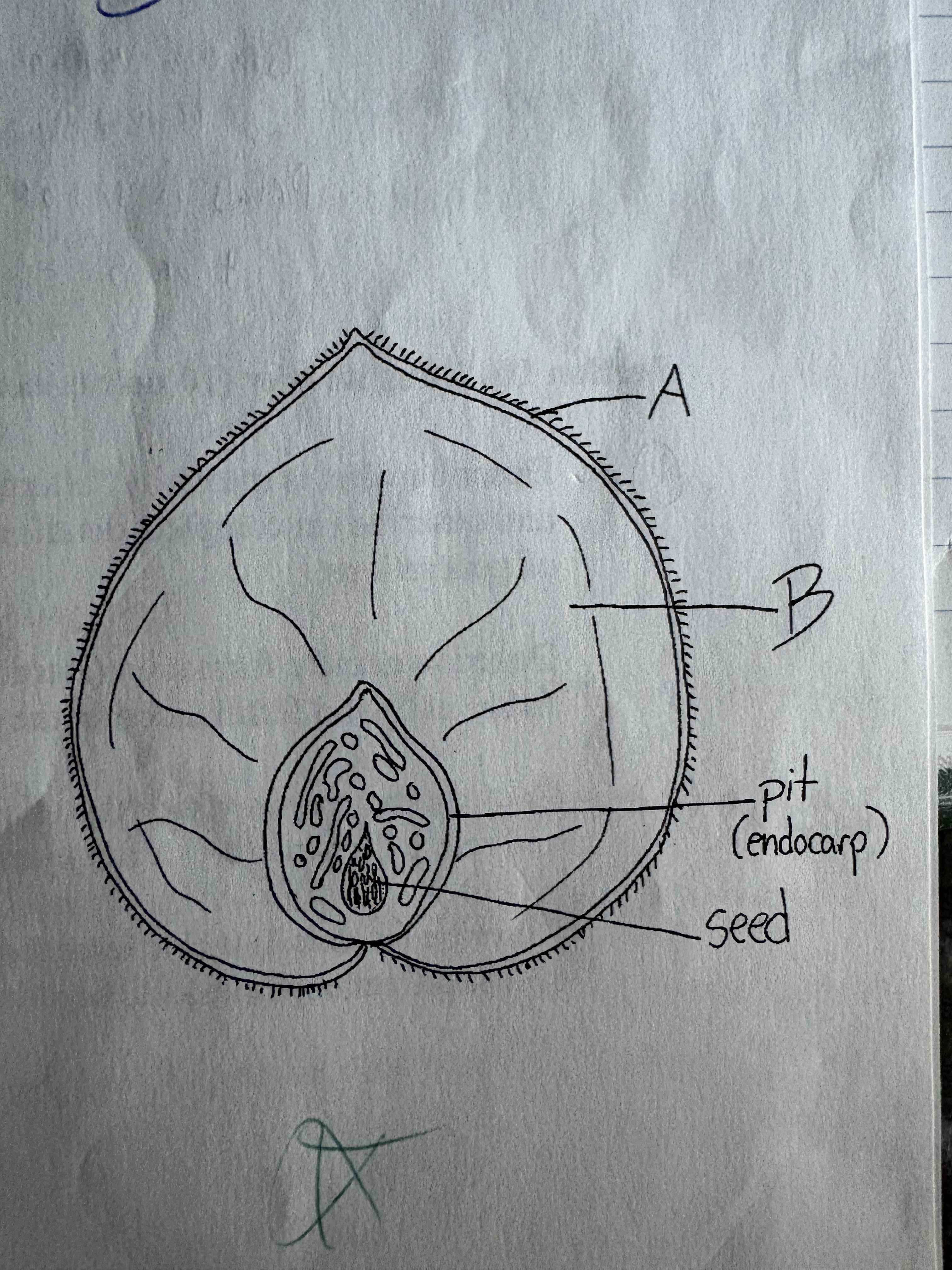
Name the type of fleshy fruit shown in the diagram
Drupe
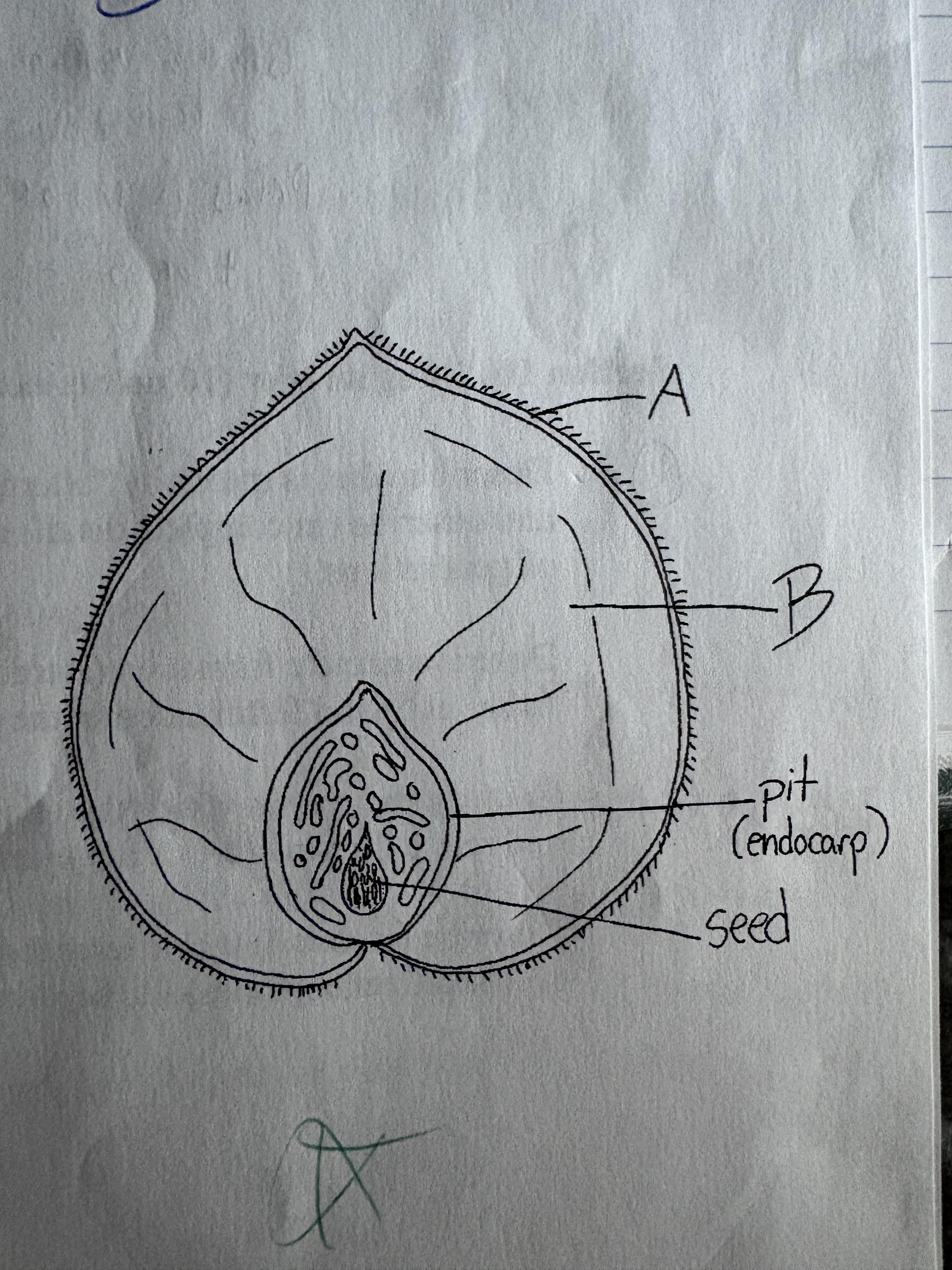
Name the carpel layer indicated by the letter A
Exocarp
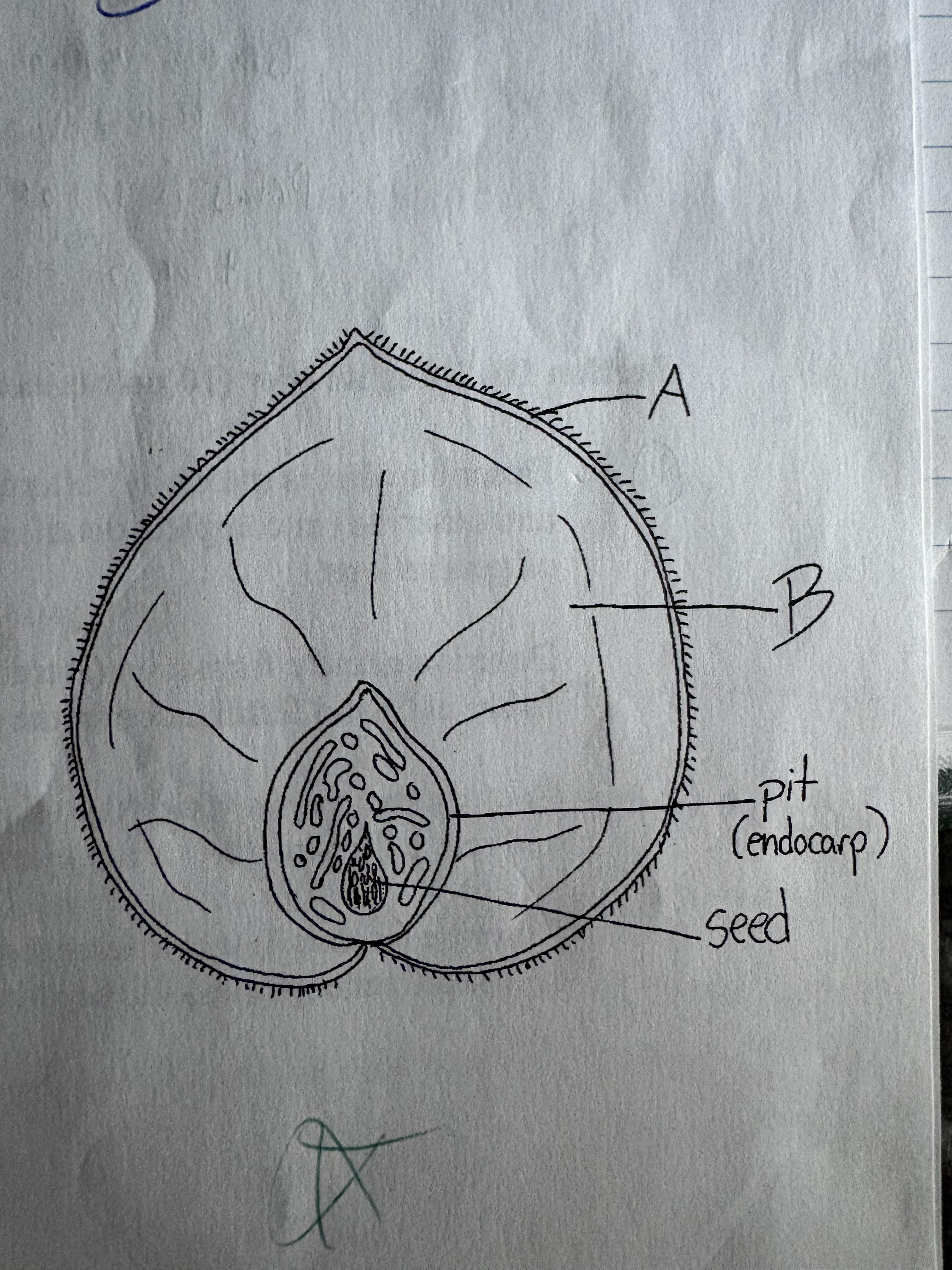
Name the carpel layer indicated by the letter B
Mesocarp
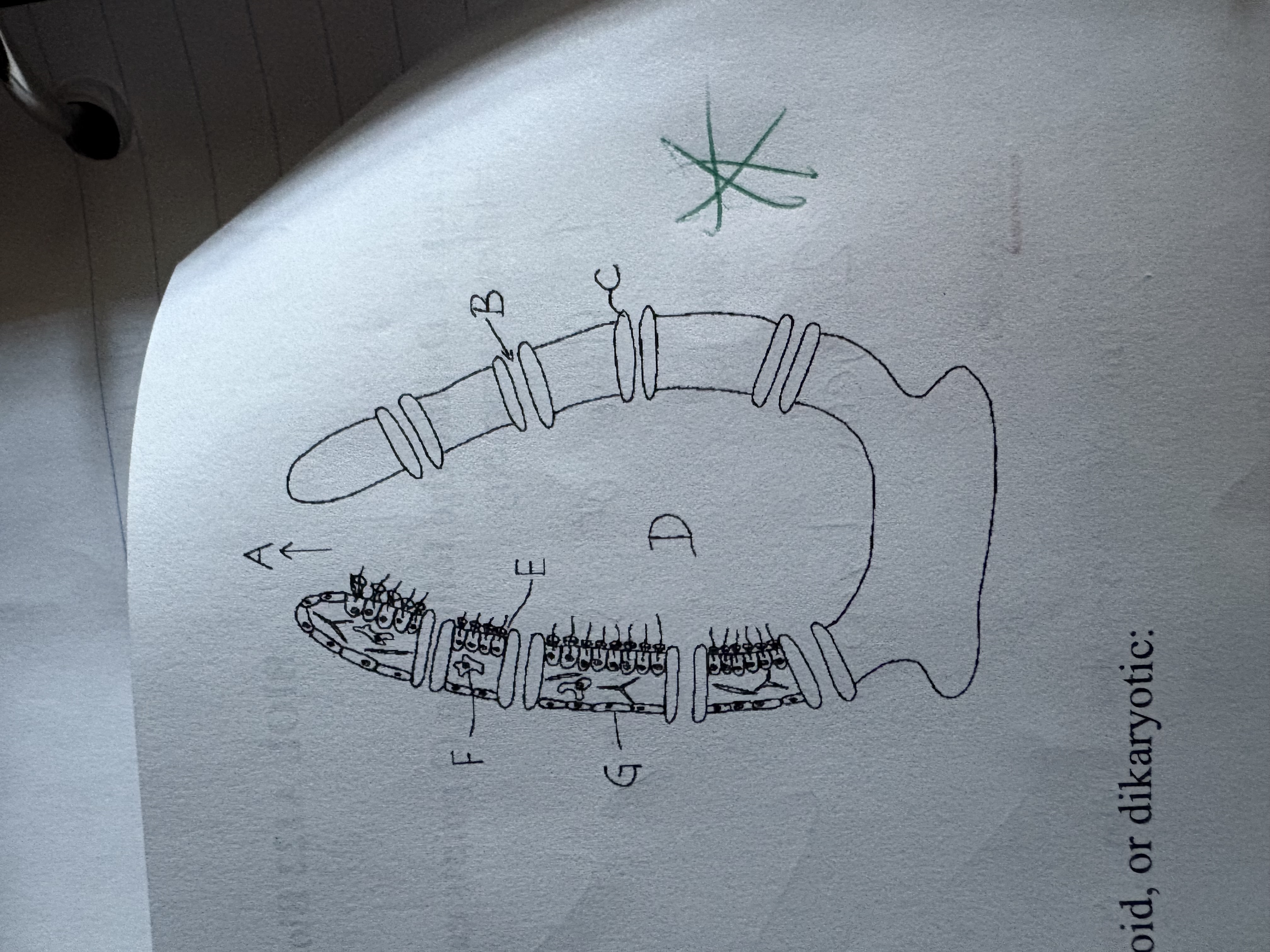
Name the cell type represented by the letter E
Choanicites or Collar cells
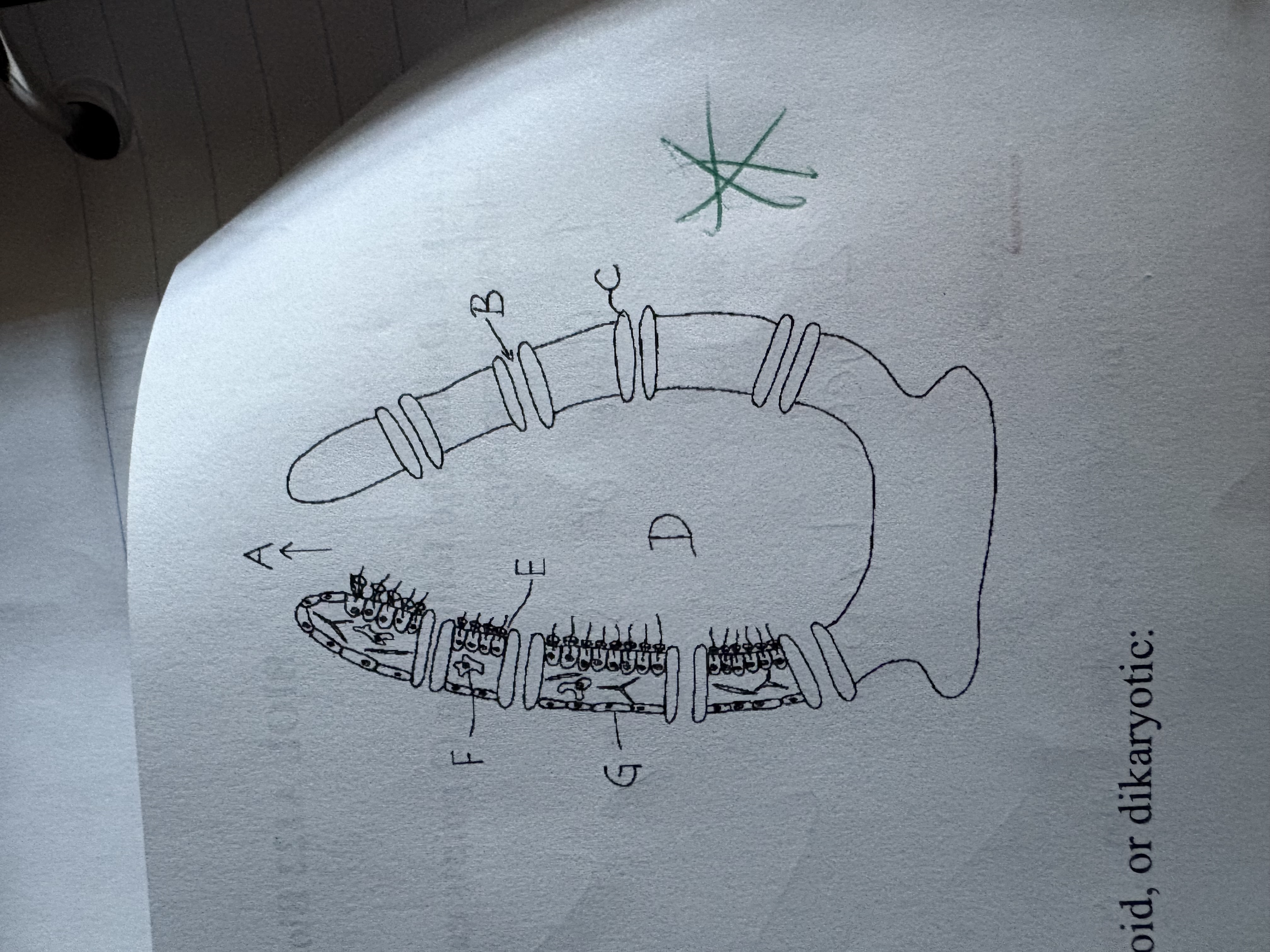
Name the cell type represented by the letter F
Amoebocyte
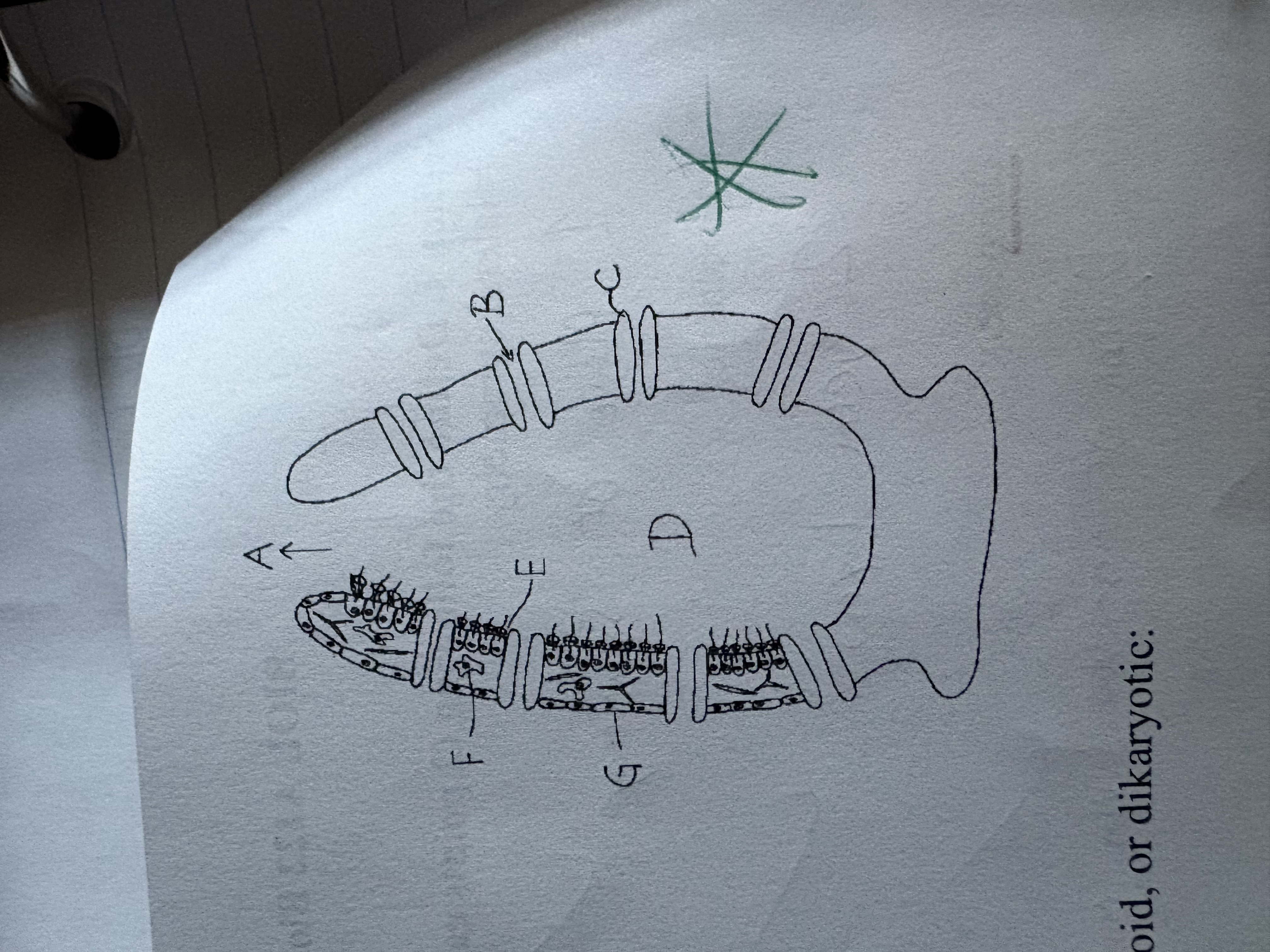
Name the cell type represented by the letter G
Pinacocyte
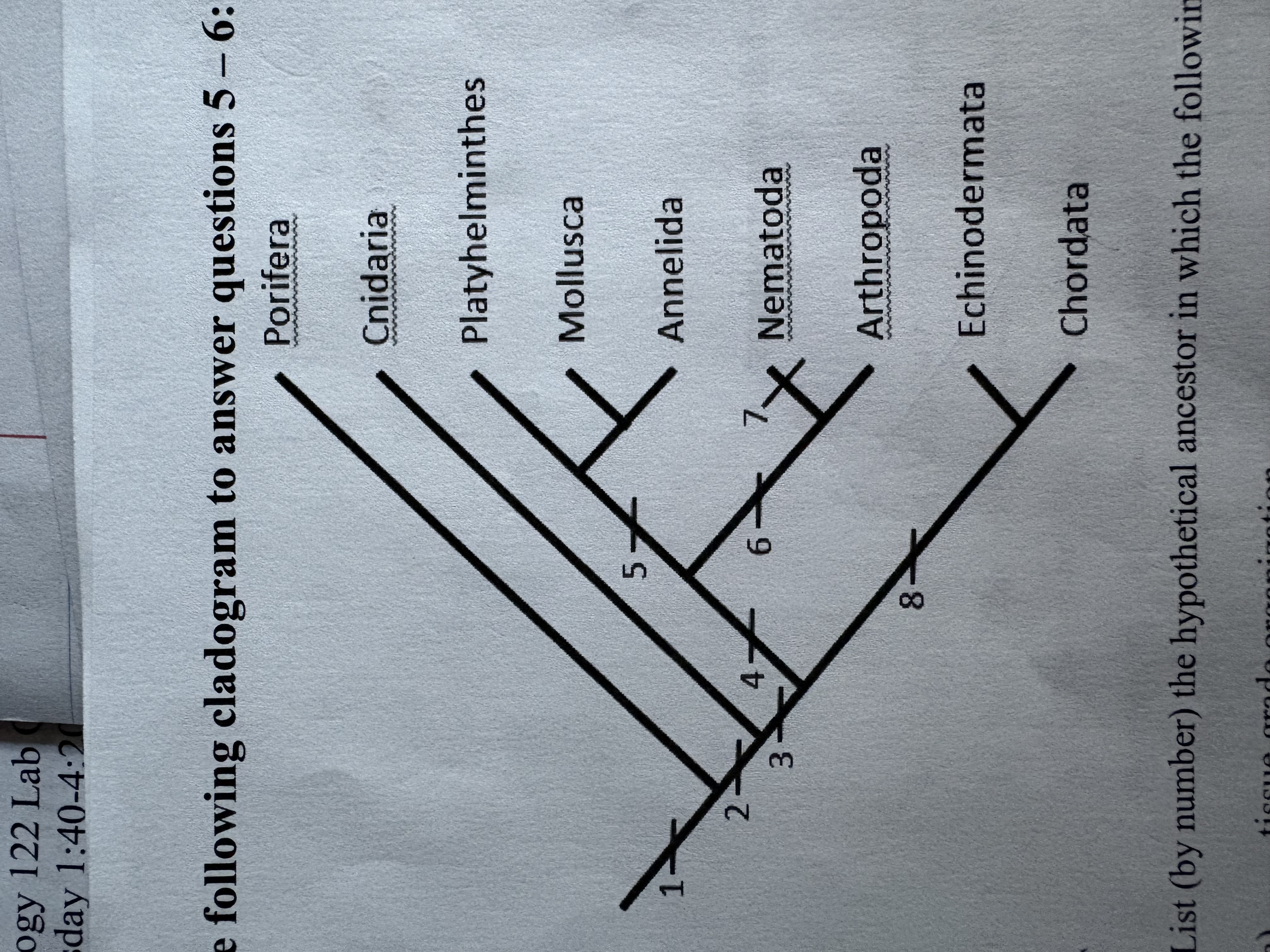
Which number signifies the hypothetical ancestor in which tissue-grade organization arose
2
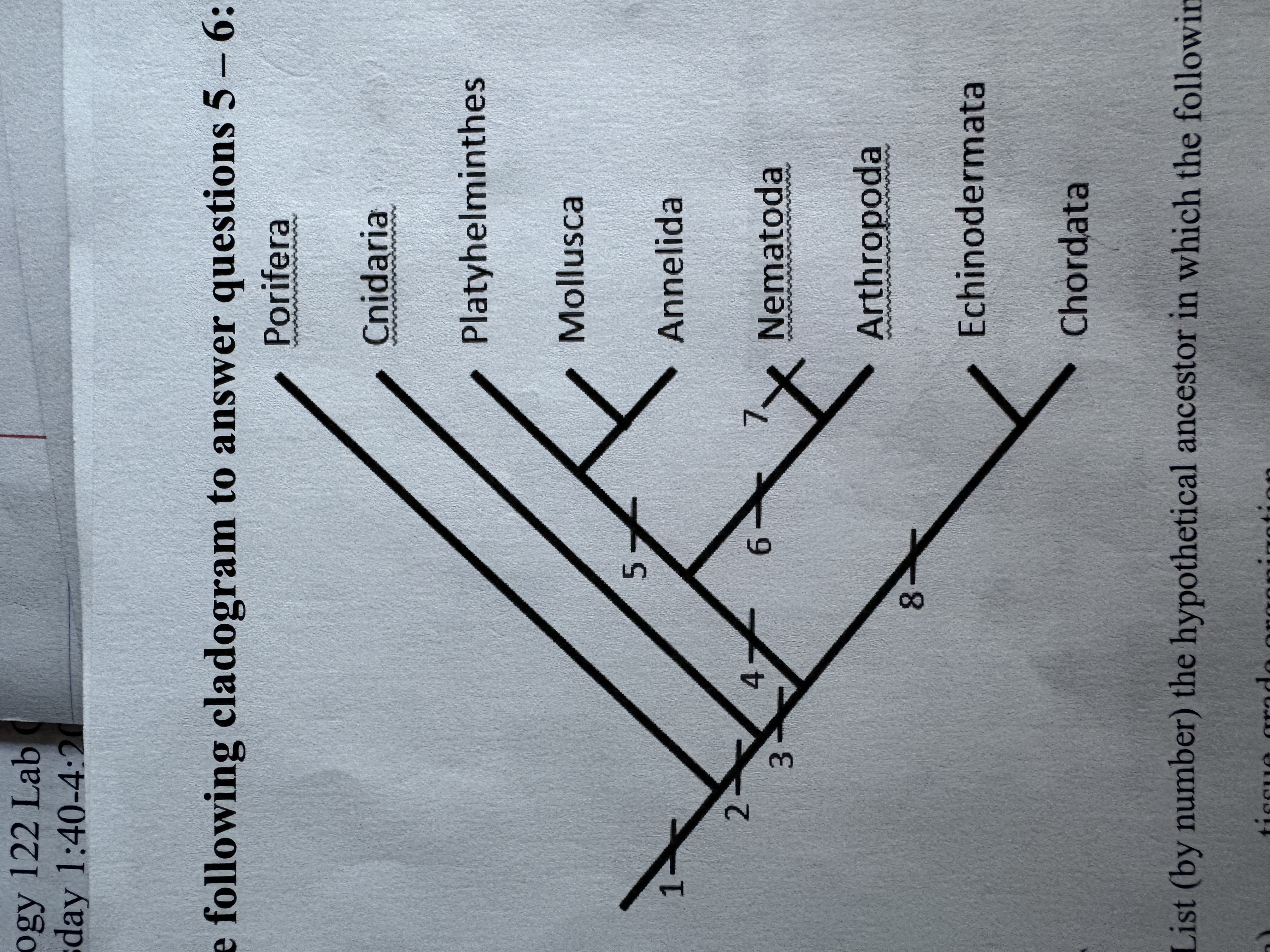
Which number signifies the hypothetical ancestor in which enterocoely arose
8
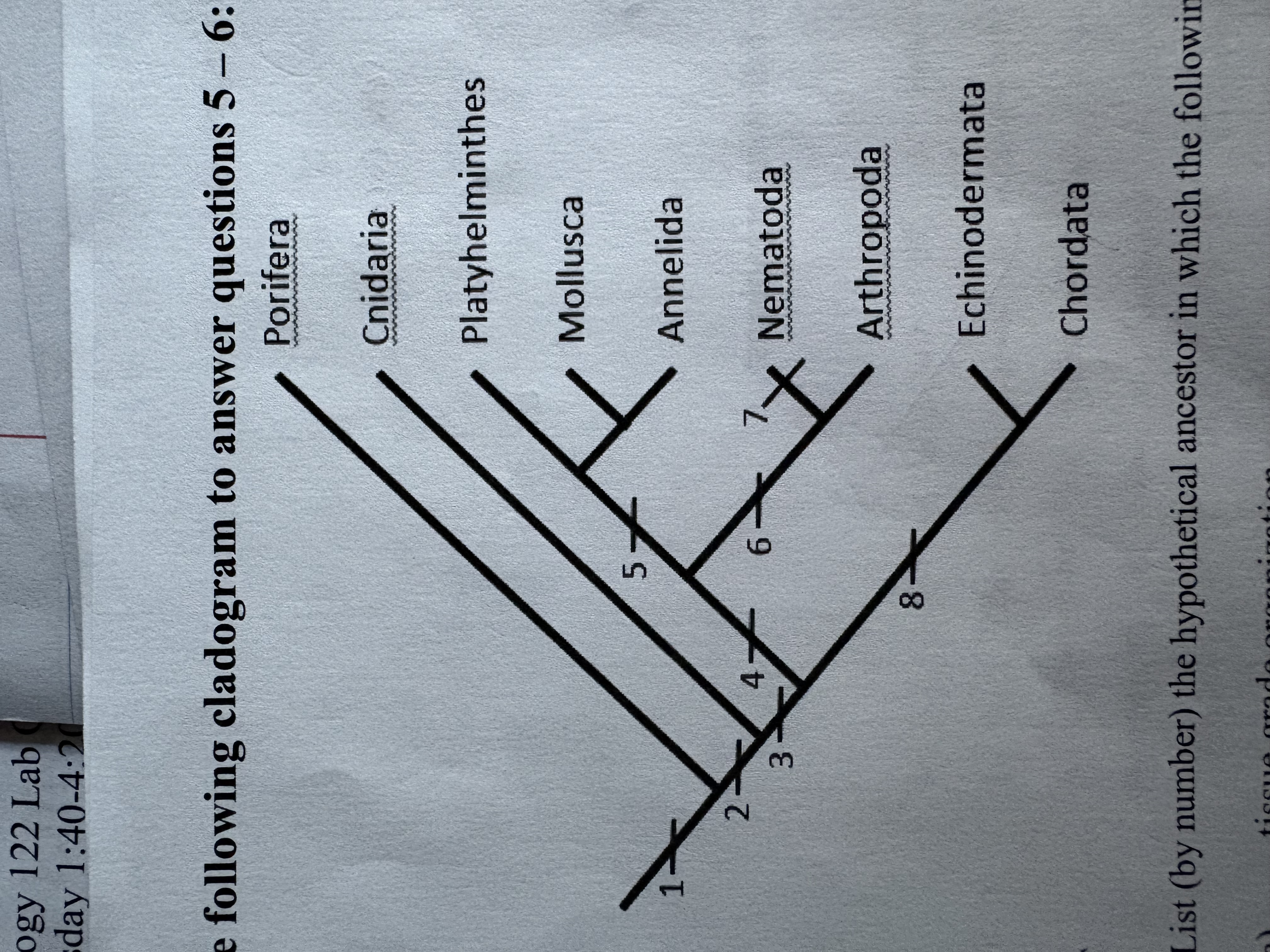
Which number signifies the hypothetical ancestor in which ecdysis arose
6
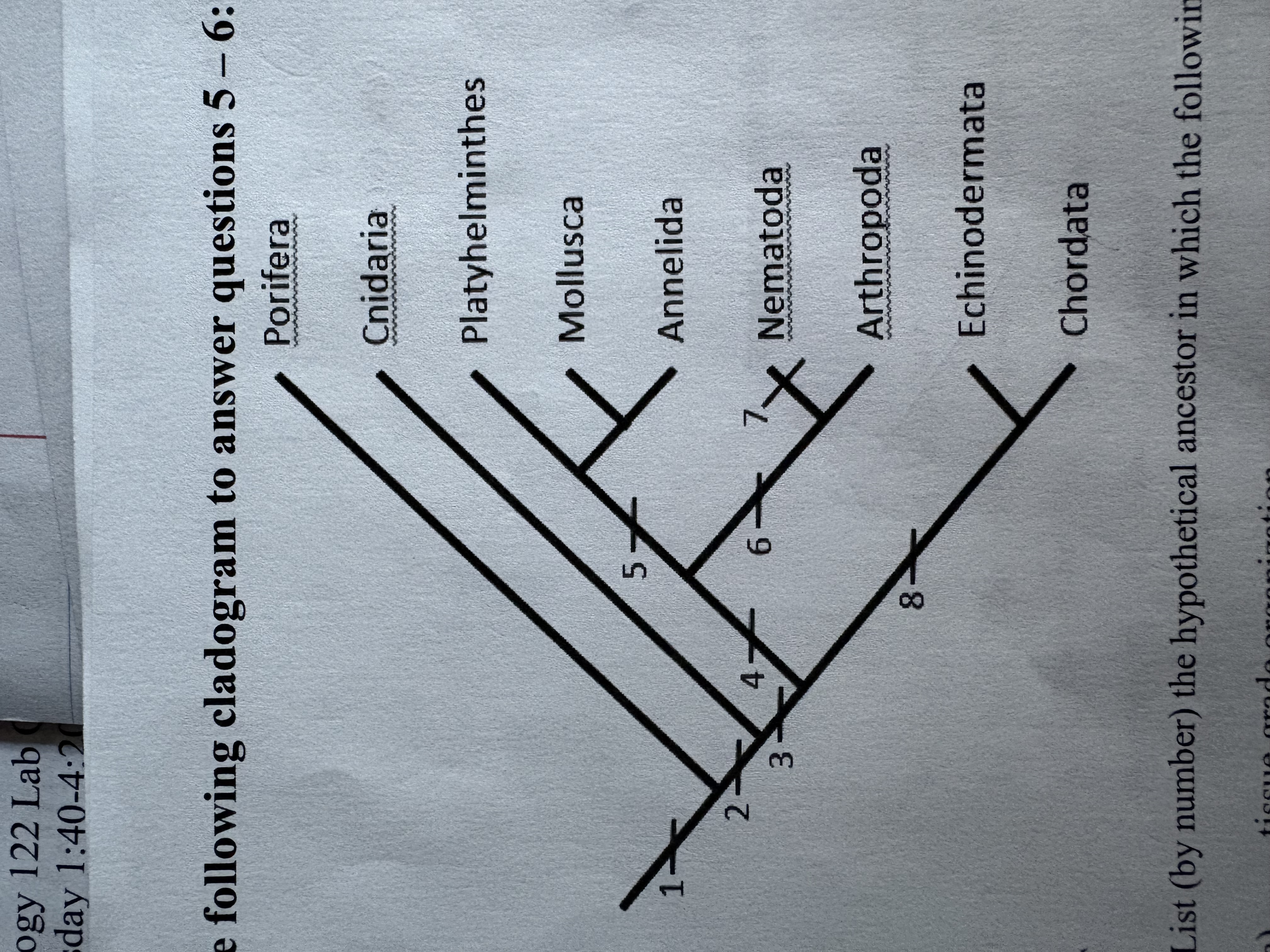
Which number signifies the hypothetical ancestor in which the diploblastic pattern of germ layers arose
2
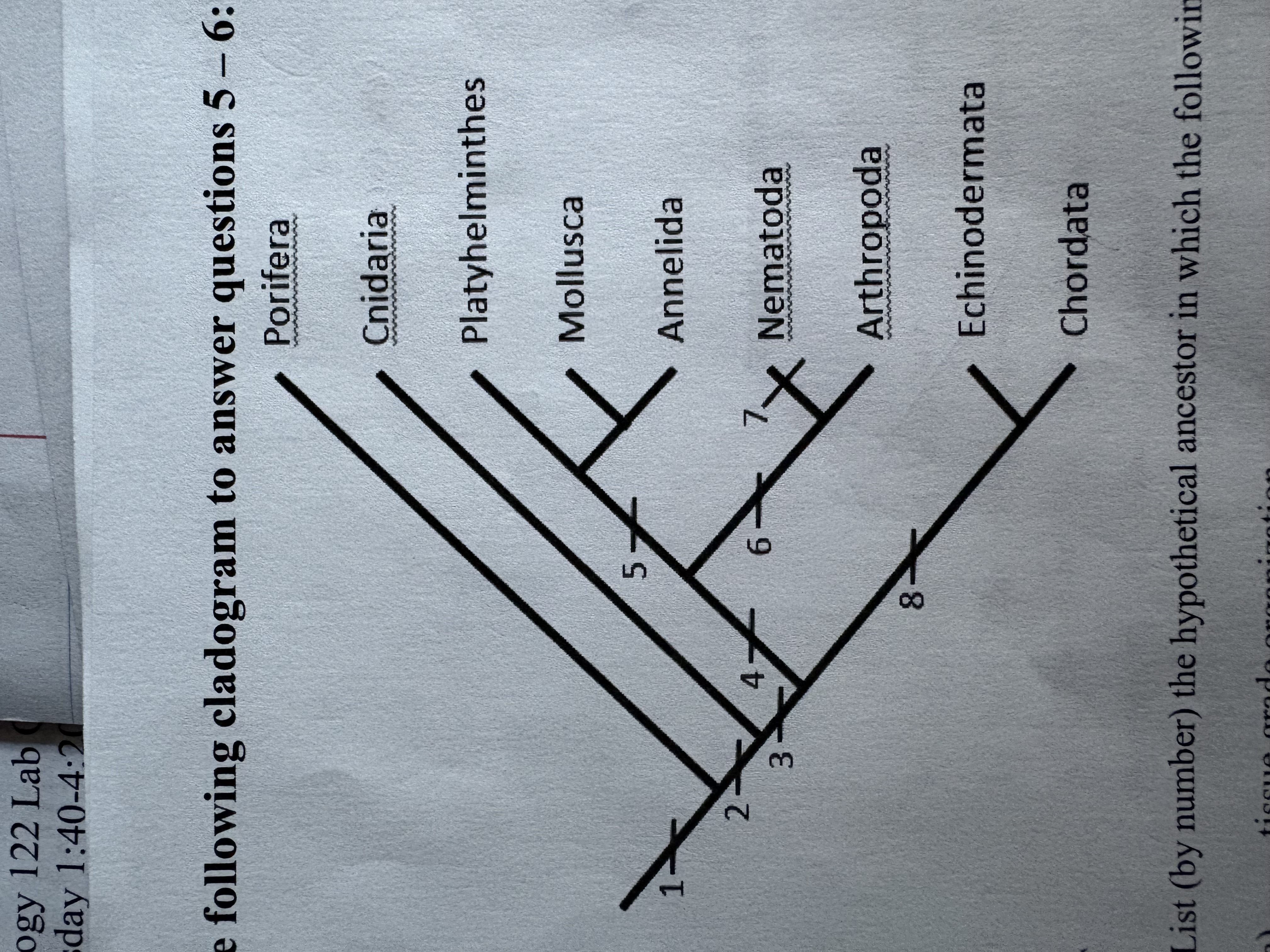
Which number signifies the hypothetical ancestor in which the triploblastic pattern of germ layers arose
3
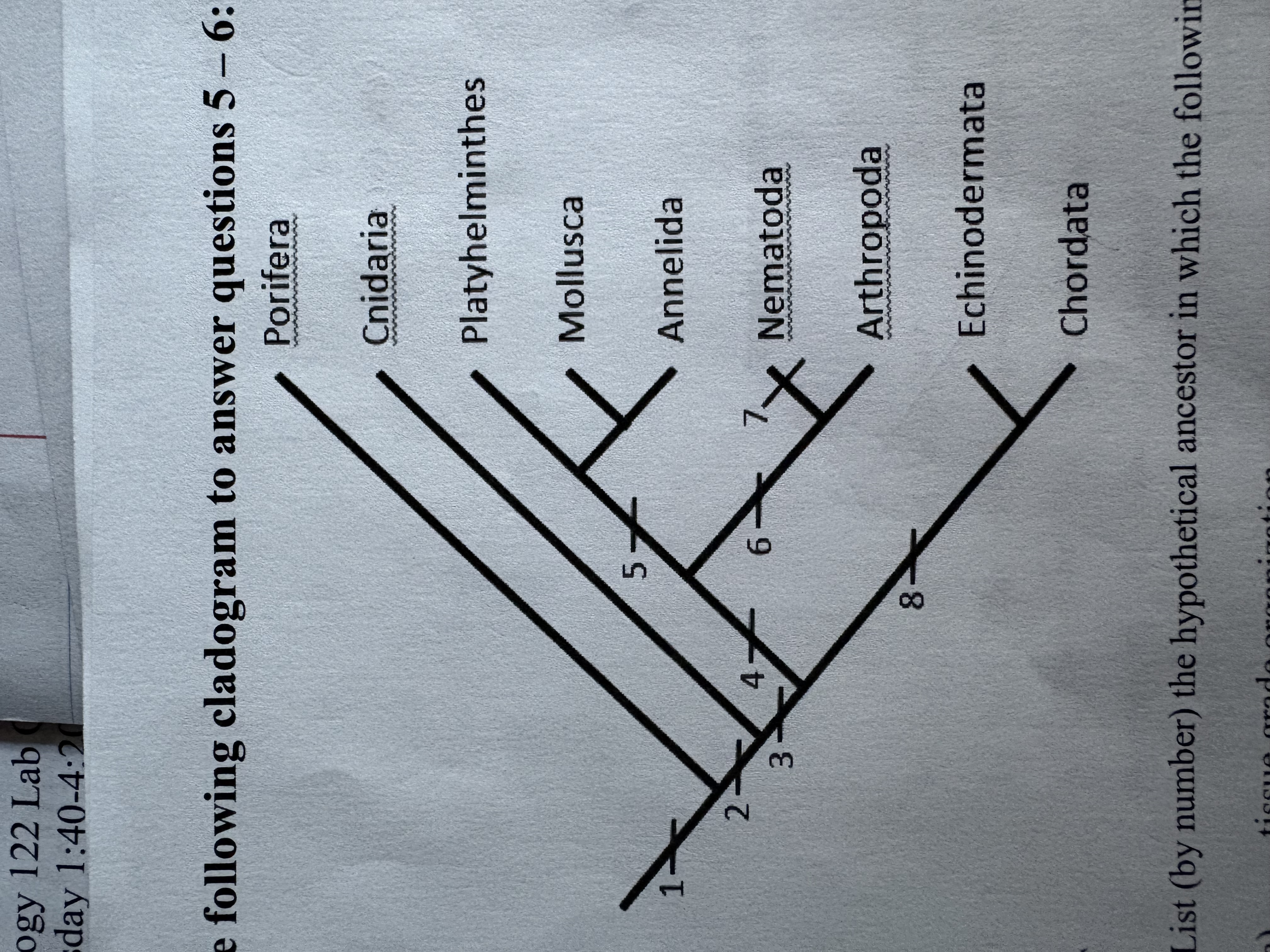
Which number signifies the hypothetical ancestor in which the mesoderm, formed by the outpocketing of the archenteron, arose
8
What is meant by the alternation of generations
Alternation of generations refers to the alternation between the haploid gametophyte stage and diploid sporophyte stage in plants life cycle
Mollusca meaning
Latin: “soft nut”
Characteristics of ancestral mollusc
open circulatory system, heart, and sinuses
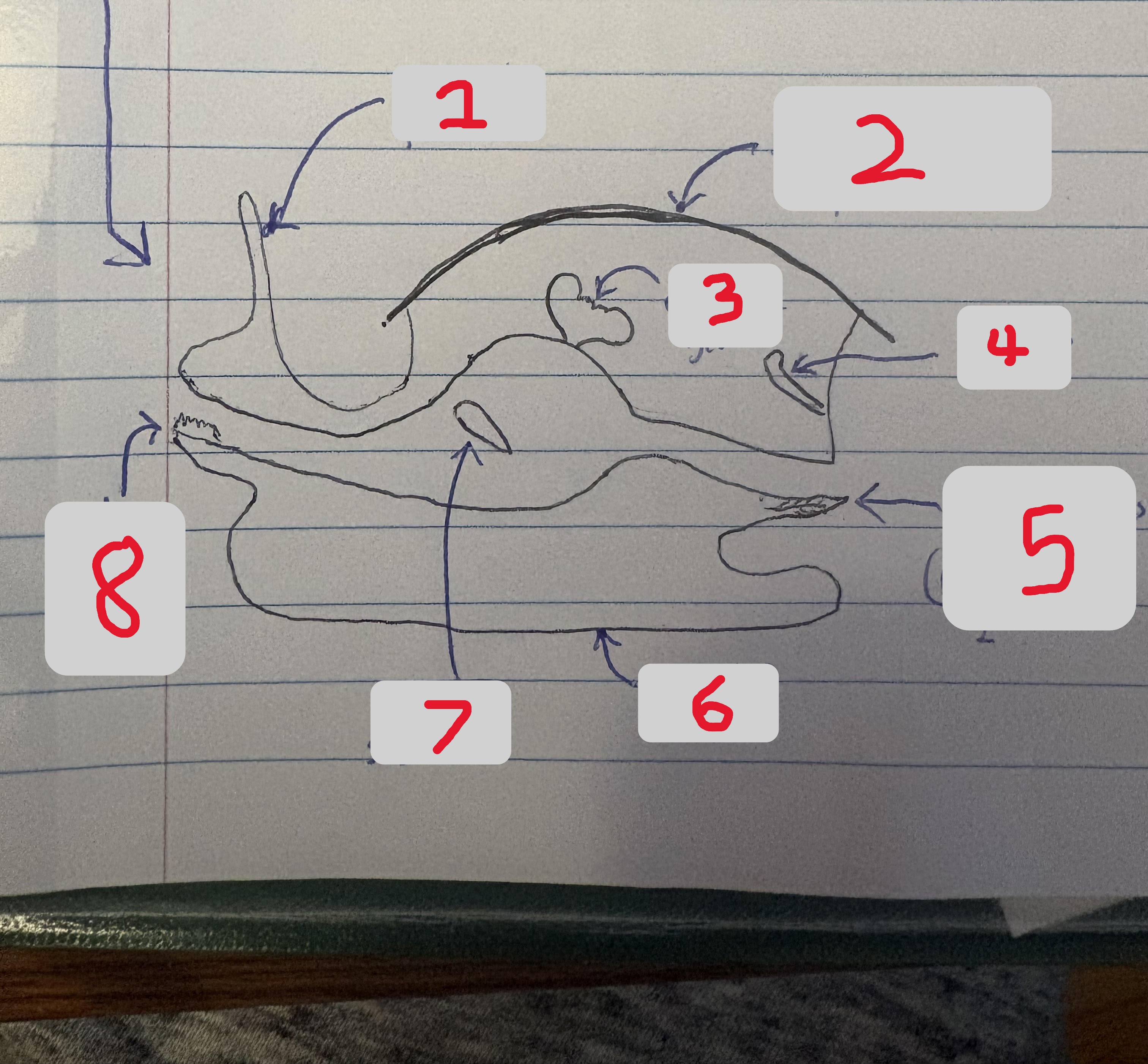
What part of this ancestral mollusk is labeled 1?
Sensory tentacle
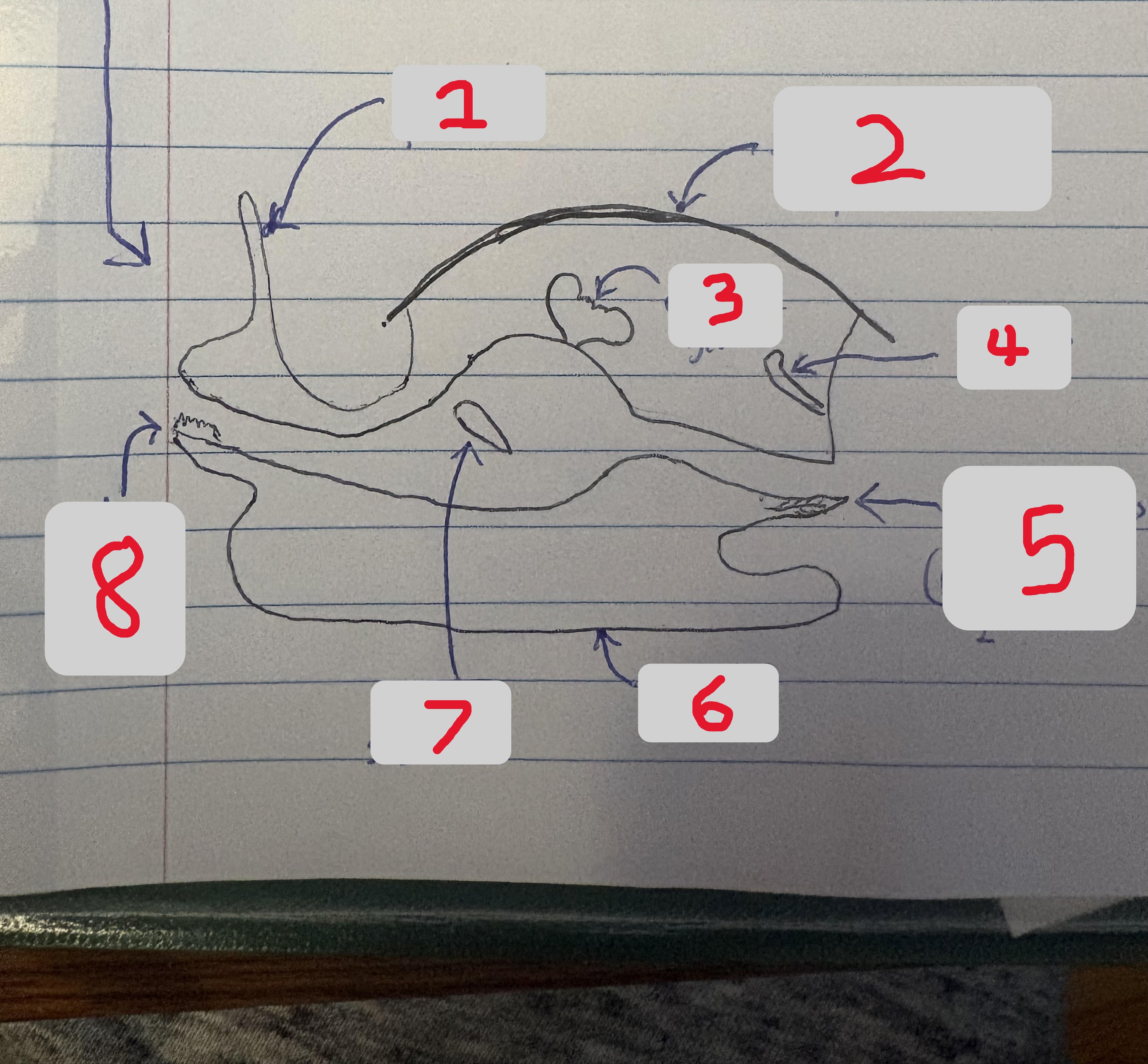
What part of this ancestral mollusk is labeled 2?
Shell secreted by mantle
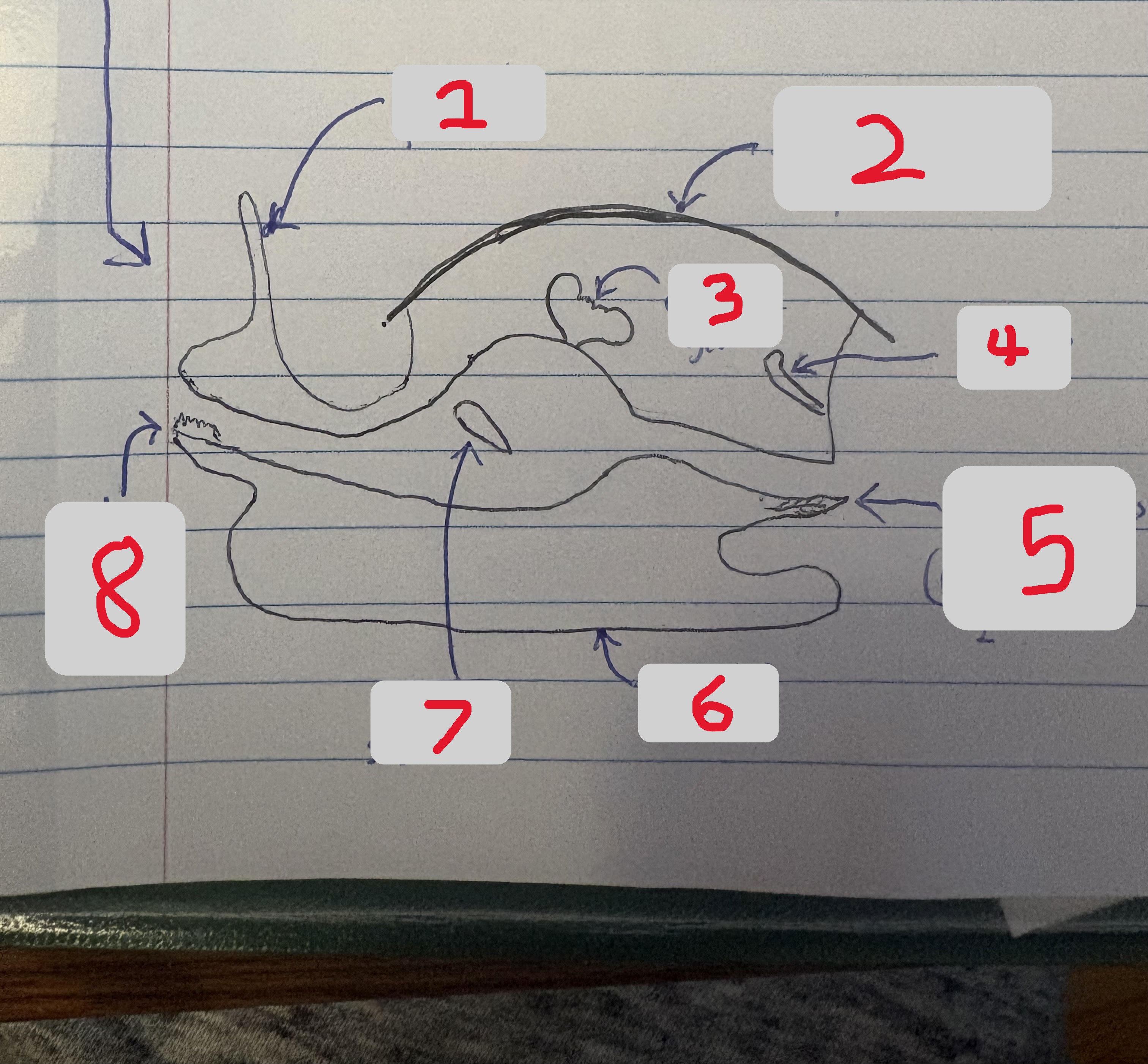
What part of this ancestral mollusk is labeled 3?
Digestive gland
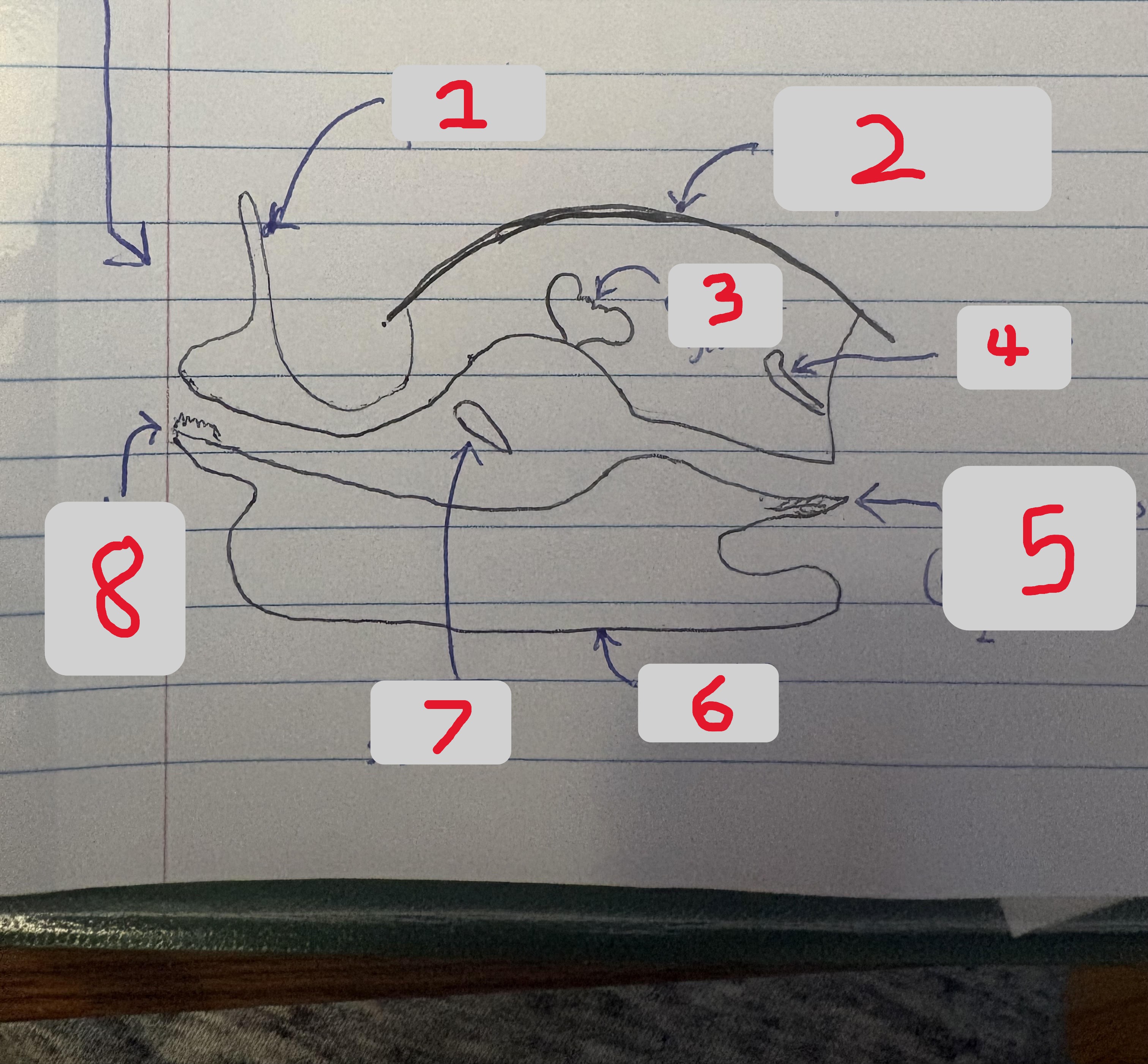
What part of this ancestral mollusk is labeled 4?
Gonads
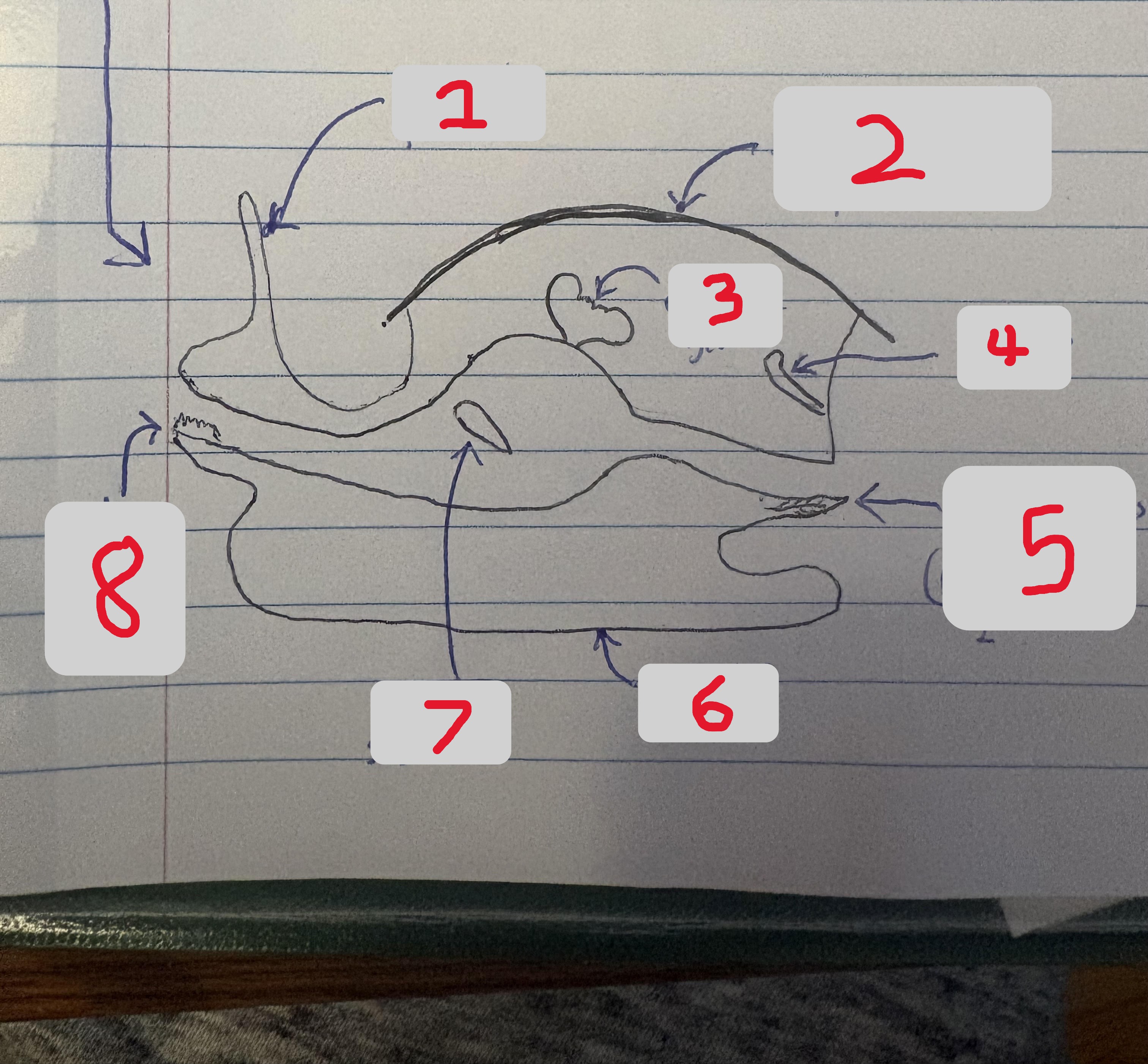
What part of this ancestral mollusk is labeled 5?
Gills
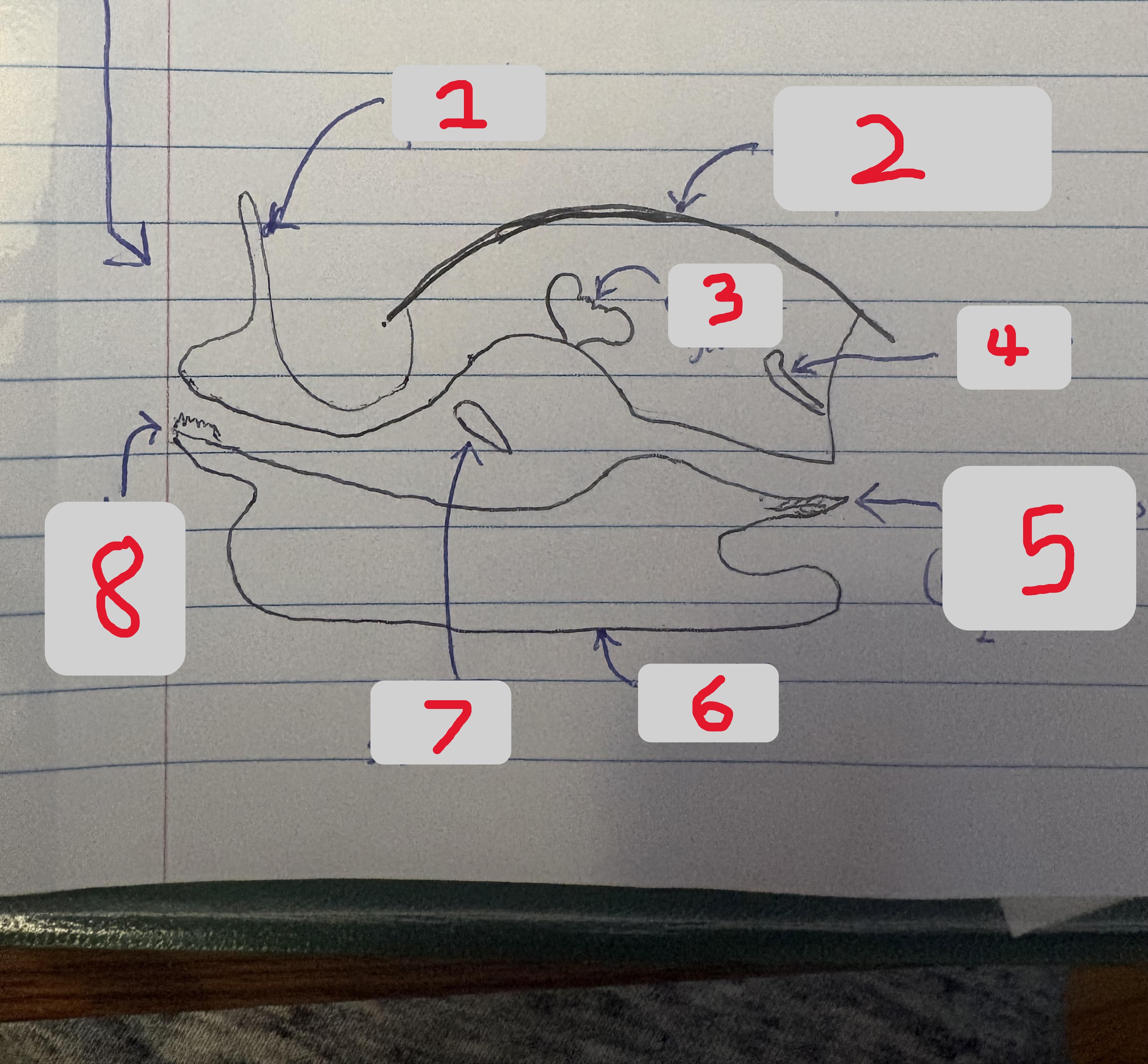
What part of this ancestral mollusk is labeled 6?
Muscular foot
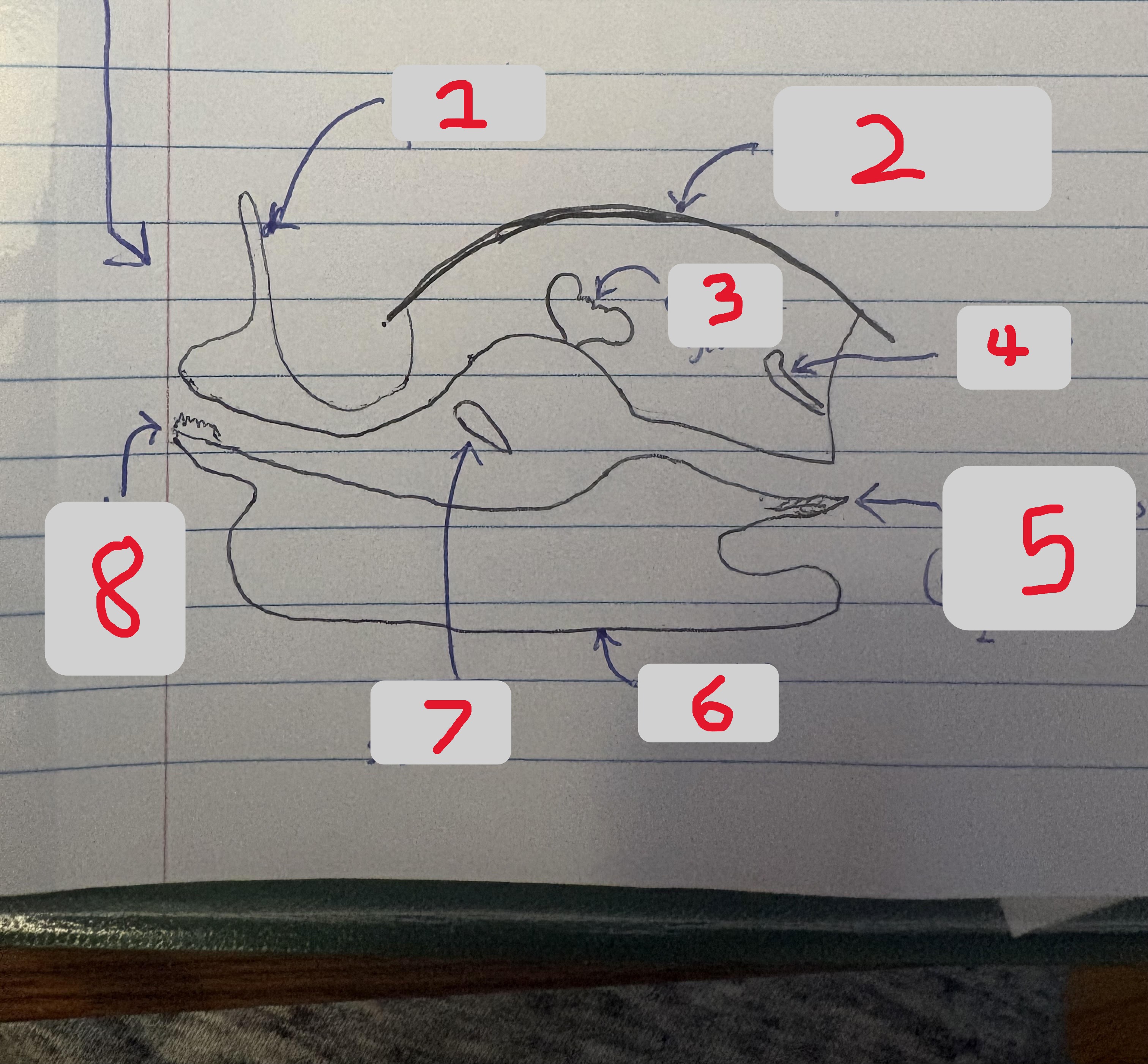
What part of this ancestral mollusk is labeled 7?
Style in sac
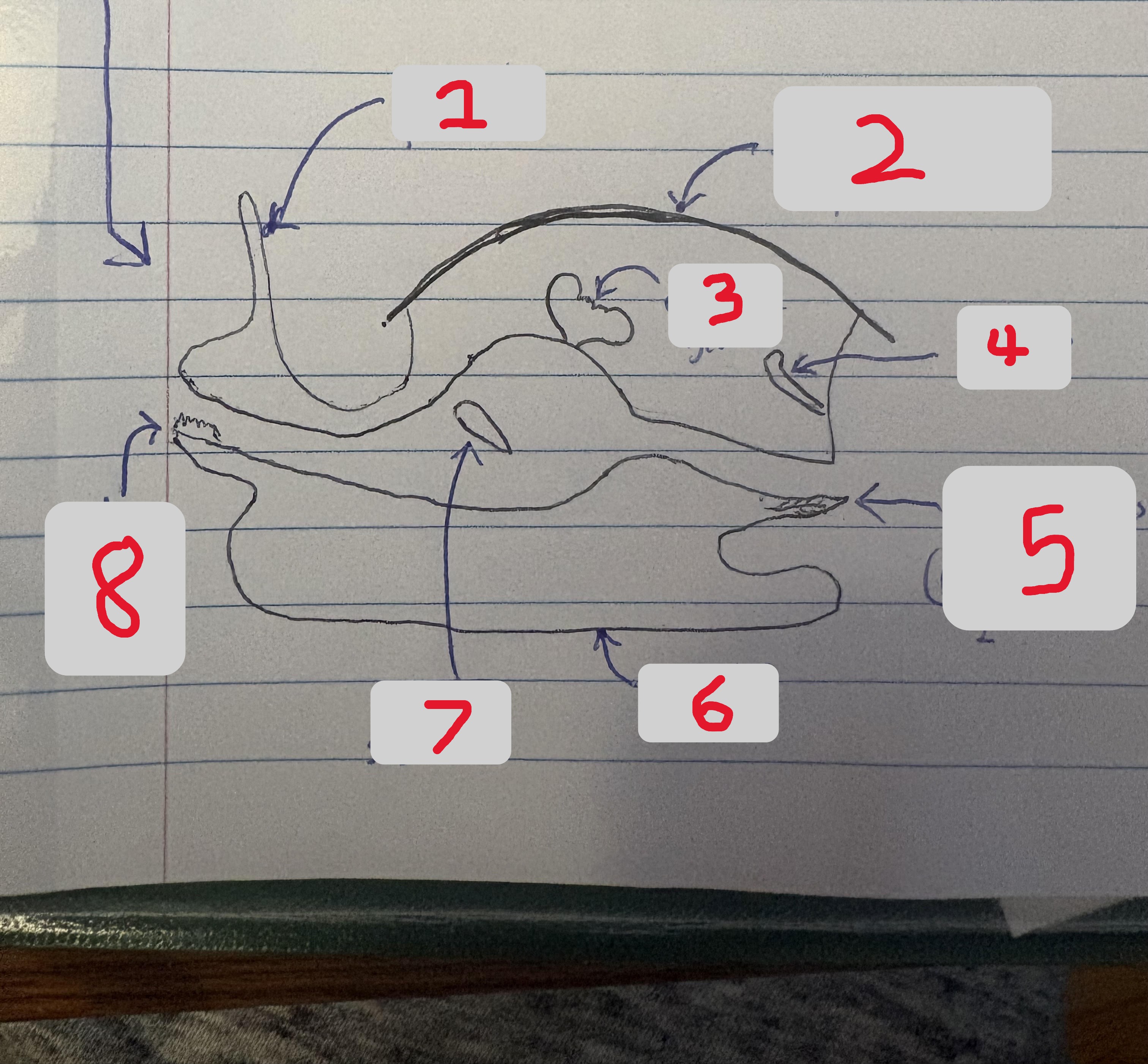
What part of this ancestral mollusk is labeled 8?
Radula, or rasping teeth
Characteristics of gills in ancestral mollusk
Come in pairs, allow for gas exchange, and are ciliated to generate water flow that diverts feces away from the gills
General facts regarding mollusca
Very diverse, and have a very plastic body plan
What is meant by a “plastic” body plan?
Very changeable
What two components of Mollusca are very plastic
Shell and radula
What are the 3 plastic functions of a mollusca shell, and who are they utilized by
Protection: snails and clams
Buoyancy: octopi, nautili, and cuttlefish
Endoskeleton: Squids
4 classes of Mollusca
Polyplacophora, Gastropoda, Bivalvia, and Cephalopoda
Representatives of the class Polyplacophora
Chitons
Polyplacophora
Many plate bearing