LING 114 - Module 1: Indigenous Languages of Canada
 Call Kai
 Learn
Learn Practice Test
 Spaced Repetition
 Match
Match Flashcards
 Knowt Play
1/44

There's no tags or description
Looks like no tags are added yet.
Name | Mastery | Learn | Test | Matching | Spaced | Call with Kai |
|---|
No analytics yet
Send a link to your students to track their progress
45 Terms
What is Indigeneity?
Beyond from being from somewhere, but includes the historical experience in other people arriving in your homeland; not a one-size-fits-all.
Tied to the histories of settlement/colonization, minoritization and struggles over land, rights and cultural/language continuity.
What are some overarching characteristics Indigenous groups share?
Self-identification as Indigenous group
Strong connection to natural resources and surrounding land
Distinct social, kinship, legal, economic and political systems
Distinct culture, language(s) and belief system
Maintain and develop their knowledge systems and practice as distinct people
What is self-identification?
Indigeneity as a designation claimed/defined from within communities rather than imposed externally.
What does First Peoples mean?
Can be used broadly/ interchangeable with Indigenous.
What does First Nations mean?
Refers to a specific Canadian umbrella category.
What is the Canadian definition of Aboriginal?
Encompasses First Nations, Inuit and Metis, not understood globally
Has a negative connotation to it due to its use in government policies like the 1991 Royal Commission on Aboriginal Peoples
Only use it as an adjective, not a noun
Ex. An Aboriginal community, not “The Aboriginals”
Who are the Inuit?
Indigenous peoples of the Arctic, Alaska and Greenland (circumpolar region)
Inuit = word from Inuktitut, signifying "the people"
1 person = inuk
2 people = inuuk (inu-uk)
3+ people = inuit
Not the only language of the Inuit (Inuktitut)
Generalized after the 1rst Inuit Circumpolar Conference for Inuit rights.
Adopted to encompass all Inuit groups in the circumpolar region.
Signed in 1980
Distinguishes singular/dual/plural in terms of grammar
Who are the First Nations?
Includes the most Indigenous communities in Canada
630 First Nations Communities = 50 nations, 50 languages
What they have in common: the legal term "Indian" present in legislation
Ex. The Indian Act, Indian status
Only pertains to communities that is not Inuit or Michif
Not acceptable to use the term "Indian" except in quoting specific contexts like a document
Acceptable when directly referring to community relationships that still use the terms
Ex. Saskatoon Indian and Metis Friendship Centre
Who is Métis/Michif?
Identities tied to the historic Red River Métis/Michif Nation and community recognition; term choice often follows self-identification.
The word Metis comes from French Métis) refers to the mixed ancestry of Métis people.
Indigenous community that rose from generations of inter-marriages between Cree/Ojibwe women and French (and other Euro) men.
What is a language family?
A set of languages descended from a common ancestor.
What are the 8 Indigenous language families of Saskatchewan?
Cree:
nīhithawīwin (Woods Cree)
nēhiyawēwin (Plains Cree)
Michif-Cree/Metis-Cree (Northern Michif)
Nākawēwin (Saulteaux/Plains Ojibwe)
Dënesųłinë
Dakota
Nakota
Michif (mixed Michif/heritage Michif)
Michif-French
What is a genetic unit?
Another way to refer to “family” groupings in historical linguistics.
AKA “language family”
How many genetic units can Indigenous languages in Canada be divided into?
15
What is a language isolate?
A language not known to have any relatives (a “family of one”)
How many language isolates are there in Canada? What are they?
3 language isolates
Beothuk
Haida
Ktunaxa
What is a mixed language and how is it related to Michif?
What are Indigenous sign languages?
Sign languages is unrelated to its supposed language due to the difference in its structure.
How many Indigenous sign languages are there in Canada? What are they?
3 sign languages
Plains Sign Language
Plateau Sign Language
Inuit Sign Language (~80 signers)
More info:
Hand talk -> signed across all the American Plains -> Plains Signed Talk (PST) -> at some point, it was recognized by all -> used simultaneously with a spoken language (ex. signing in PST and speaking Cree) ->
Plateaux Signed Language -> in the Rockies -> also believed to have simultaneously sign with spoken language
How? -> word order is more flexible compared to that of English
Inuit Signed Language -> up North -> seemed to be used more often by deaf communities
What is Language Classification?
Grouping of related languages into the same category
What have linguists learned since John Wesley Powell’s 1891 proposal?
Several of the previously proposed phyla are not accepted anymore
e.g. Amerind hypothesis that said all American languages are related was found to be untenable (not supported with facts)
Languages classified as isolates are in fact related
e.g. the Tlingit language, originally considered an isolate, is within the Na-Dene family
Languages that were considered dialects are in fact separate languages
e.g. Dogrib, Bearlake, Slavey, originally considered dialects of one language, are in fact different languages
What does the distribution of languages looked like at the time of colonisation?
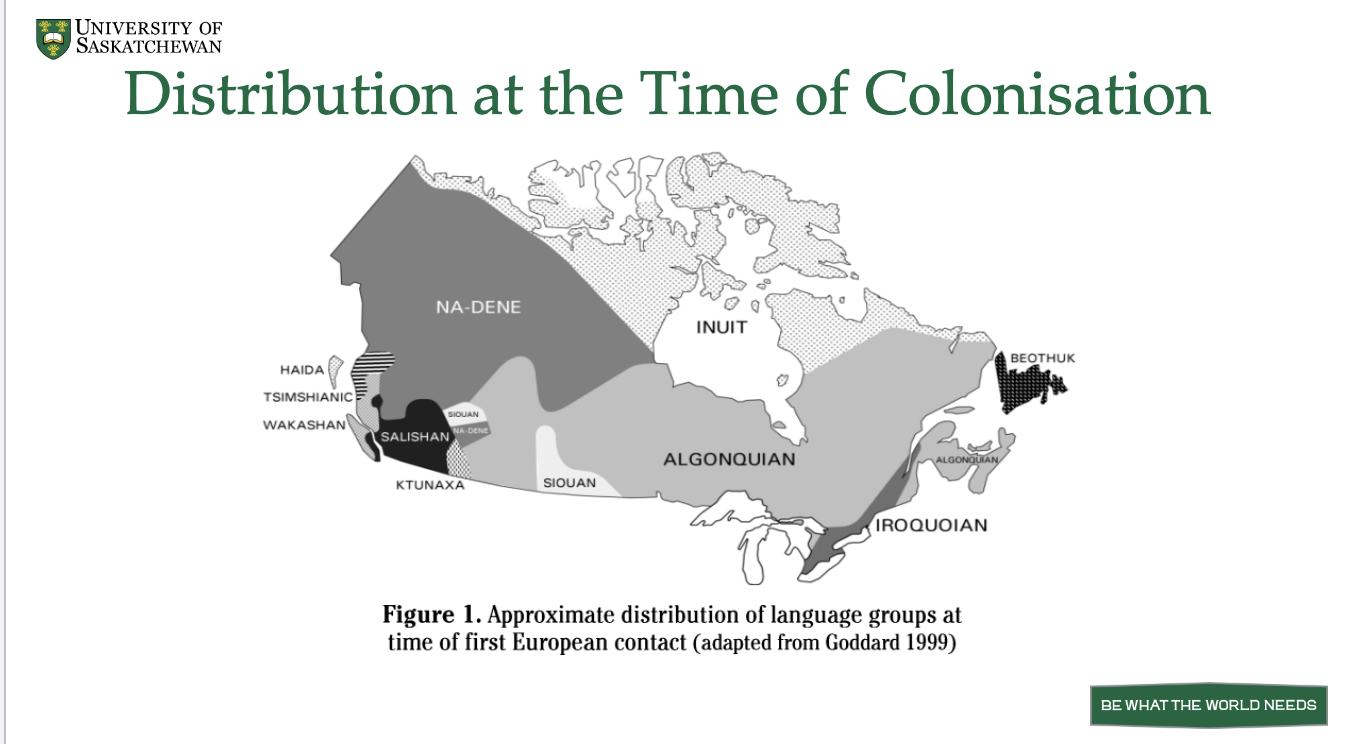
What doe Inuit Languages refer to?
A chain of related dialects (dialect continuum) across Canada, Greenland and Alaska.
What is a dialect continuum?
Series of dialects that change gradually over a geographical area
Speakers of neighboring languages can understand each other
But speakers further apart may not
Explain the Pacific Coast contact area.
Explain the Inuit (-Yupik-Unangan)/ Eskaleut languages.
Tell me about Na-Dene.
Greatest internal diversity
17 distinct languages in Canada alone
Most Na-Dene languages belong to the Athabaskan or Dene subfamily
What is Tlingit?
Classified as a subfamily within Na-Dene
Distantly related to the rest of Na-Dene languages
Does not belong to the Athabaskan subfamily
Why is it so distantly related even though it is so close to the Athabaskan or Dene subfamily languages?
Lots of interaction within the BC Coastal Line -> resulted in inter-marriages
Just an illusion on the map due to the MOUNTAINS -> maps are deceiving lol
What is Dené-Yeniseian Hypothesis?
Hypothesis about how the Dene language may be distantly related to the Yeniseian language in Siberia.
Tell me about the Algonquian language.
Also known as Algic
Some of the most widely spoken Indigenous languages in Canada belong to the Algonquian family:
a) Cree
b) Ojibwe
Dialects of both languages are widely spoken in Alberta, Saskatchewan, Manitoba, Ontario and Quebec.
What are the main Algonquian languages in Canada?
Cree-Innu-Naskapi continuum
a) Western Cree
Th-dialect (Woods Cree)
N-dialect (Swampy Cree)
Y-dialect (Plains Cree)
Northern Plains Cree
Southern Plains Cree
L-dialect (Moose Cree)
R-dialect (Atikamekw)
b) Eastern Cree
c) East Cree
d) Innu
e) Naskapi
Ojibwe
Nishnaabemwin
Anishnaaebemowin
Nakawêwin (Saulteaux/Plains Ojibwe)
Severn Ojibwe (Oji-Cree)
South-western Ojibwe (Chippewa)
Odawa
Algonquin
Potawatomi
Mi’kmaq
Maliseet-Passamaquody
Munsee Delaware
Western Abenaki
Tell me about the Iroquoian language.
Tell me about the Siouan language.
What are the “West Coast” languages families? How are they related to contact and bilingualism/intermarriage as context?
Tell me about Salishan.
Tell me about Wakashan.
Tell me about Tsimshianic.
What is a dormant language?