Neurotransmitters
 Call Kai
 Learn
Learn Practice Test
 Spaced Repetition
 Match
Match Flashcards
 Knowt Play
1/10

There's no tags or description
Looks like no tags are added yet.
Name | Mastery | Learn | Test | Matching | Spaced | Call with Kai |
|---|
No analytics yet
Send a link to your students to track their progress
11 Terms
3 types of Synapses
Neuron + neuron = neuronal
Neuron + muscle = neuromuscular
Neuron + gland = neuroglandular
Ionotropic NT Receptor
Direct
Immediate
Brief
Ion channels (ligand)
At rest —> channel is closed
When NT binds —> opens channel and allows ions to move by facilitated diffusion
Metabotropic NT Receptor
Indirect
Slow
Long-lasting/ prolonged/ greater intensity
Often a G-Protein Coupled Receptor using cAMP as second messenger
Chemical Classification of NTs
Acetylcholine (unique)
Gas
Biological amines (NH2)
Lipid
Amino acid
Purine
Peptide (small protein)
3 Ascending Pathways
Spinocerebellar
no crossing over
body position/ movement awareness
to cerebellum
Dorsal column-medial lemniscal
cross over medulla
touch, joint
to parietal
Spinothalamic
cross over spinal cord
temp, pain
to parietal
Acetylcholine (ACh)
Neurons that release ACh are called: Cholinergic
Functional Classification:
Response: Excitatory (depolarization) / Inhibitory (Hyperpolarization)
Cholinergic Receptors: a) Nicotinic - ionotropic —> open Na+ (excitatory), b) Muscarinic - metabotropic
Chemical Classification: Acetylcholine
CNS: Hippocampus for creating long term memories
PNS:
Somatic motor neurons to stimulate skeletal muscle
Preganglionic autonomic motor neurons to stimulate post ganglionic motor neurons or adrenal medulla
Parasympathetic postganglionic motor neurons to their effectors
Hyposecretion: Alzheimer’s
ACh Receptors (2)
Nicotinic Receptors: Neuromuscular Junction, Autonomic Ganglia (Nicotine is an agonist, prolonging effects of ACh), CNS, Adrenal medulla
Muscarinic Receptors: Others
Alzheimer’s Disease and ACh
Loss of cholinergic neurons (less release of ACh)
Accumulation of abnormal proteins forming plaques
Cholinesterase inhibitors:
- prevent ACh breakdown
- longer in synapse
Norepinephrine (NE)
Neurons that release NE are called: Adrenergic
Functional Classification:
Response: Excitatory (depolarization) / Inhibitory (Hyperpolarization)
Receptors: Adrenergic —> metabotropic
Chemical Classification: Biological amines (NH2)
CNS:
Frontal lobe —> working memory (e.g. decisions, logic, reasoning)
Limbic —> feeling of well being
Reticular activating system (RAS) —> alert, consciousness
PNS: Postganglionic sympathetic motor neurons
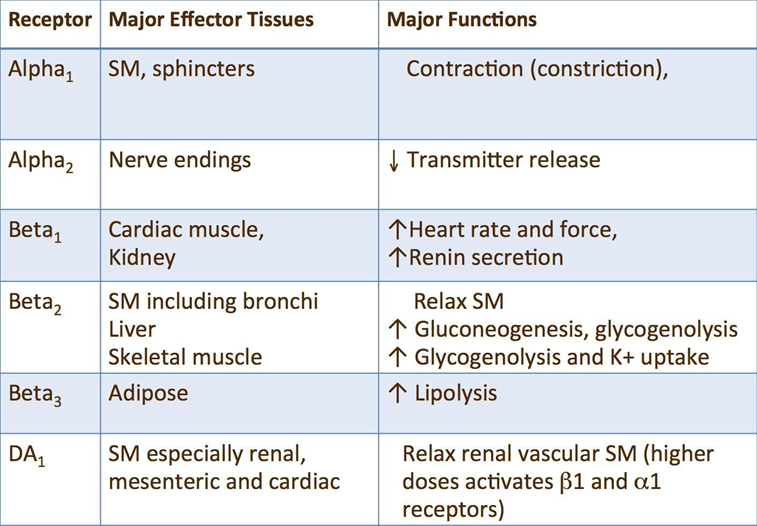
*SM = smooth muscle
Disregard DA1
Glutamate
Neurons that release glutamate are called: Glutaminergic
Functional Classification:
Response: Excitatory
Receptors: Ionotropic (glutaminergic increase)
Chemical Classification: Amino acid
CNS: Main excitatory neuron (important in memory formation)
Impaired reuptake: Alzheimer’s, repeated stimulus overstimulates neuron and causes death
Synaptic Plasticity
Neurons adapt to number/ repetitive stimuli
Long term potentiation: 1) increase repetition, increase stimulus; 2) increase # of NT receptors or increased amount of NT released
Long term depression: 1) few synapses, decrease stimulus or response of post synaptic cell; 2) decrease # of NT receptors or decreased amount of NT released