PHOTOSYNTHESIS and RESPIRATION QUESTIONS
 Call Kai
 Learn
Learn Practice Test
 Spaced Repetition
 Match
Match Flashcards
 Knowt Play
1/10

There's no tags or description
Looks like no tags are added yet.
Name | Mastery | Learn | Test | Matching | Spaced | Call with Kai |
|---|
No analytics yet
Send a link to your students to track their progress
11 Terms
![<p>(SC 20a,b,c) <span data-name="exclamation" data-type="emoji">❗</span></p><p>a) explain how an increase in the rate of the light-dependent reaction affects the rate of the light-independent reaction/ calvin cycle [4]</p><p>b) suggest two ways the student could improve the precision of measuring the time of decolorisation [2]</p><p>c) a student claimed ‘DCPIP is an effective method for measuring the rate of photosynthesis in plants’ evaluate the students conclusion [6] </p>](https://assets.knowt.com/user-attachments/3060b9a8-febd-43cb-b9c4-690f06bee792.jpg)
(SC 20a,b,c) ❗
a) explain how an increase in the rate of the light-dependent reaction affects the rate of the light-independent reaction/ calvin cycle [4]
b) suggest two ways the student could improve the precision of measuring the time of decolorisation [2]
c) a student claimed ‘DCPIP is an effective method for measuring the rate of photosynthesis in plants’ evaluate the students conclusion [6]
a)
Higher light intensity → more ATP produced in LDR
More reduced NADP (NADPH) produced in LDR
ATP provides energy for phosphorylation of GP to TP and RuBP regeneration in Calvin cycle
Reduced NADP provides reducing power to reduce GP to TP
b)
Use colorimeter to measure the absorbance change/ endpoint more objectively
Repeat at each light intensity and find a mean
Standardise chloroplast concentration
c)
Advantages:
Measures LDR specifically
Quantitative (time/rate) → precise comparison
Controlled (isolated chloroplasts) → isolates LDR from LIR
Limitations
DCPIP is an artificial acceptor → not natural pathway → may overestimate/ not reflect real rate
Does not measure ATP production or full photosynthesis (only electron flow)
Light may not be uniform/ heat effects → inaccurate rate
Chloroplasts isolated → not whole plant system
Generalisation for all plants/ only spinach used
No detail of controlled variables (light intensity)
Only detects LDR not photosynthesis overall
No statistical test/ control group to compare to
![<p>(PRK 16a,b,c) <span data-name="exclamation" data-type="emoji">❗</span></p><p>a) state precisely where in the cell this stage of respiration takes place [1]</p><p>b) identify the molecules labelled X, Y and Z in the diagram [3]</p><p>c) state the name of the type of reaction that produces ATP in this stage of respiration [1]</p>](https://assets.knowt.com/user-attachments/d75fa06b-b117-4e7b-83f6-1a0df252eef4.jpg)
(PRK 16a,b,c) ❗
a) state precisely where in the cell this stage of respiration takes place [1]
b) identify the molecules labelled X, Y and Z in the diagram [3]
c) state the name of the type of reaction that produces ATP in this stage of respiration [1]
a) cytoplasm
b) x: triose phosphate, pyruvate, reduced NAD/ NADH
c) (substrate-level) phosphorylation
(PRK 16d,e) ❗
d) in muscle cells, pyruvate is converted to lactate during anaerobic respiration. explain why this allows the muscle cell to maintain activity during periods of low oxygen availability [3]
e) in muscle cells, some of the lactate is converted back into pyruvate when they are well supplied with oxygen. suggest one advantage of this [2]
d)
regenerates NAD/ oxidises reduced NAD (back to NAD)
(so that) glycolysis can continue/ triose phosphate can be converted to pyruvate
(so that) ATP is still produced (to maintain muscle activity)
e)
lactate is toxic/ may cause muscle fatigue → so converting it prevents this
OR
pyruvate can be converted back to glucose/ glycogen → for storage
OR
pyruvate can then enter aerobic respiration → to release energy/ ATP
(PRK 19a,b) ❗
the light-independent stage of photosynthesis occurs in the stroma of chloroplasts and results in the production of organic molecules
a) describe the role of the enzyme RuBisCO in the light-independent reactions [2]
b) outline the process of translation occurring inside the chloroplast to synthesise RuBisCO [3]
a)
catalyses the reaction between carbon dioxide (CO2) and Ribulose Bisphosphate (RuBP)
to form glycerate-3-phosphate (GP)
b)
mRNA binds/ attaches to ribosome
tRNA with specific amino acid binds its anticodon (to codon of mRNA)
(formation of) peptide bonds between amino acids
(PRK 19ci,ii,d) ❗
19c - RuBisCO requires magnesium ions (Mg2+) in order to function effectively
i) state the role of the magnesium ions in this reaction [1]
ii) suggest how magnesium ions increase the catalytic activity of RuBisCO [2]
19d) explain the role of ATP in the light-independent reactions [2]
i) co-factor/ co-enzyme
ii) binds to enzyme → enzyme substrate complex forms more easily/ quickly / (changes structure of active site, helps transport substrate into active site, reduces activation energy required for reaction)
19d)
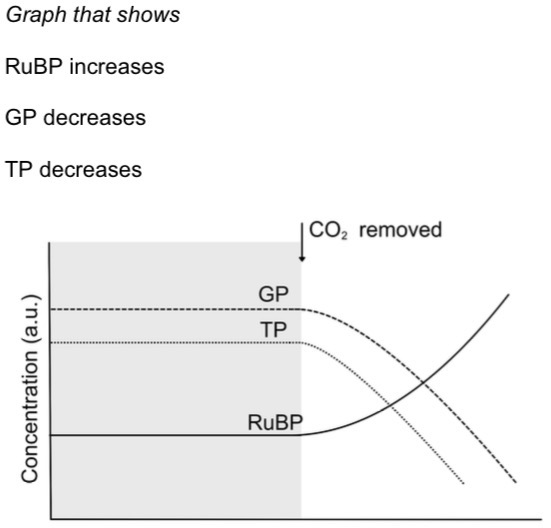
(hydrolysis of ATP) provides energy for the reduction of GP to triose phosphate
provides phosphate/ energy for the regeneration of RuBP (from TP)
(PMT 19a,b) ❗photosynthesis involves two main stages; the light dependent and the light independent stage
a) state precisely where in a plant cell the light independent reaction takes place [1]
the light independent stage relies on the products from the light dependent stage of photosynthesis
b) describe where in the light independent reaction, the products of the light dependent stage are used [3]
a) stroma (in the) chloroplast
b)
→ products are ATP and NADPH/ reduced NADP
→ ATP is used when glycerate-3-phosphate/ GP is converted to triose phosphate/ TP
→ NADPH is used to reduce GP to TP
→ ATP used to convert triose phosphate/ TP to ribulose bisphosphate/ RuBP
![<p>(PMT 19ci,cii,d) <span data-name="exclamation" data-type="emoji">❗</span></p><p>ci) carbon dioxide and light intensity are both limiting factors for photosynthesis, state what is meant by the term limiting factor [1]</p><p>d) heat stress can cause the rate of photosynthesis in a plant to decrease, suggest the impact of high temperature on the light independent reaction [4]</p>](https://assets.knowt.com/user-attachments/a5bb1d87-89d4-4bda-954f-0646ca1774eb.jpg)
(PMT 19ci,cii,d) ❗
ci) carbon dioxide and light intensity are both limiting factors for photosynthesis, state what is meant by the term limiting factor [1]
d) heat stress can cause the rate of photosynthesis in a plant to decrease, suggest the impact of high temperature on the light independent reaction [4]
ci) variables that prevent the reaction from going any faster/ factors that limits the rate of reaction
d)
→ high temperature/ above optimum will denature RuBisCO/ reduced enzyme activity
→ less carbon fixation
→ less RuBP generated
→ less glucose produced
→ (no/ little ADP and Pi and NADP for light dependent reaction) fewer products of light dependent reaction for Calvin cycle
![<p>(MissE 18ai,aii) <span data-name="exclamation" data-type="emoji">❗</span></p><p>18aii) explain the differences between substrate level phosphorylation and oxidative phosphorylation in aerobic respiration [3]</p>](https://assets.knowt.com/user-attachments/96ad7570-d7f6-4617-8ebd-91a4148d5c8c.jpg)
(MissE 18ai,aii) ❗
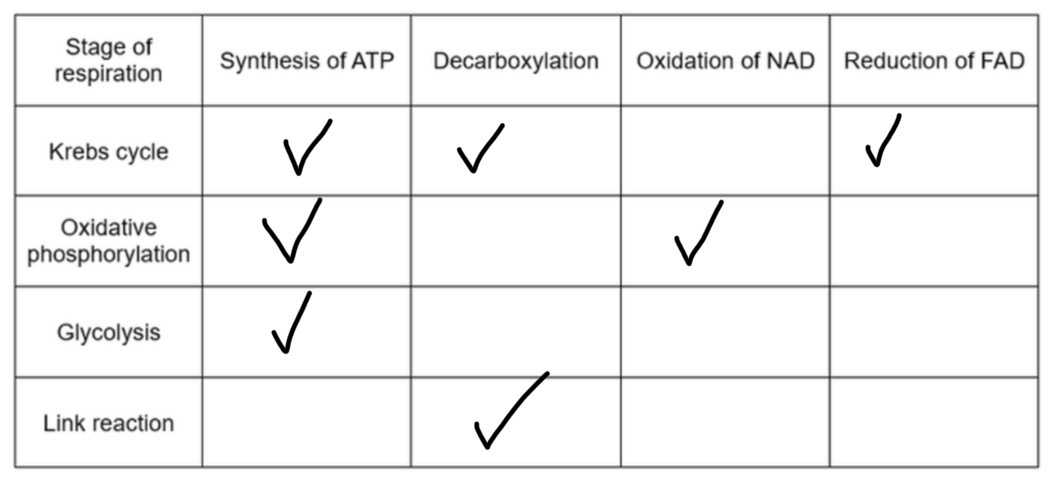
18aii) explain the differences between substrate level phosphorylation and oxidative phosphorylation in aerobic respiration [3]
aii)
→ substrate level phosphorylation occurs in glycolysis and Krebs cycle, whereas oxidative phosphorylation occurs in the final stage/ after the electron transport chain
→ oxidative phosphorylation involves ATP synthase whereas substrate level phosphorylation does not
→ oxidative phosphorylation involves chemiosmosis whereas substrate level phosphorylation does not
→ oxidative phosphorylation involves oxygen as the final electron acceptor whereas substrate level phosphorylation does not
(MissE 18bi,bii,ci,cii) ❗
bi) some species of bacteria are obligate anaerobes, meaning they can only do anaerobic respiration, explain why the yield of ATP in these bacteria is low [1]
bii) other species of bacteria do aerobic respiration, including using electron carriers, electron transport chains and ATP synthase, suggest where ATP synthase would be found in these bacteria [1]
ci) name the practical setup which would allow the rate of respiration in invertebrates to be investigated [1]
cii) suggest why investigations measuring the respiration rates of vertebrates are less commonly carried out [2]
bi)
→ they only do glycolysis/ substrate level phosphorylation to generate ATP
→ they do not do Krebs cycle and/or oxidative phosphorylation
bii) plasma/ cell surface membrane, mesosomes
ci) respirometer
cii)
→ cannot be investigated using a school respirometer due to size
→ more physically/ metabolically active, making respiration rates vary more between individuals
→ more ethical issues/ animal welfare concerns
(MissE 18d) ❗
*design an investigation into the effect of substrate concentration on the rate of respiration in the yeast Saccharomyces cerevisiae
your answer should include references to the variables and how to produce valid results [6]
Variables
Independent variable → substrate concentration
Dependent variable → volume of carbon dioxide produced in a specified time
Control variables → temp, pH, enzyme concentration, species of yeast, volume/mass of yeast, volume of substrate, type of substrate
Method
→ set up a displacement beaker with tap water
→ fill a measuring cylinder with water and invert it into the displacement beaker
→ add yeast and substrate into the conical flask and attach the rubber bung and delivery tube
→ leave for 3 minutes
→ place the end of the delivery tube under the open end of the measuring cylinder under the water, wait for a specified time and record the volume of CO2 produced
→ repeat for other substrate concentrations
Validity of the results
→ at least 3 repeats of each substrate concentration
→ calculate SD
→ calculation of a statistical test eg student’s t-test between two concentrations or Spearmean’s Rank correlation coefficient
→ suitable range of concentrations
→ same volume of substrate
→ same type of substrate
→ same temp/ pH, species of yeast, volume/mass of yeast
![<p>(MissE 20ai,aii,b,c) <span data-name="exclamation" data-type="emoji">❗</span></p><p>ai) explain what conclusions can be made about the different respiratory substrates used at different intensities of exercise [3]</p><p>aii) suggest why the respiratory quotient above 65% is above 1.0 [1]</p><p>b) having studied graph 1, a student concluded that the respiratory quotient increases as the intensity of exercise increases, comment on the students conclusion [3]</p><p>c) <span><span>a scientist decided to calculate the respiratory quotient for small invertebrates, they measured the volume of carbon dioxide produced using a gas syringe to be 48cm, the gas syringe has resolution of 1 cm, calculate the percentage error associated with the scientist’s measurement [3]</span></span></p>](https://assets.knowt.com/user-attachments/a27072ac-f4c7-4efd-ae2d-e9b3adf77ee9.jpg)
(MissE 20ai,aii,b,c) ❗
ai) explain what conclusions can be made about the different respiratory substrates used at different intensities of exercise [3]
aii) suggest why the respiratory quotient above 65% is above 1.0 [1]
b) having studied graph 1, a student concluded that the respiratory quotient increases as the intensity of exercise increases, comment on the students conclusion [3]
c) a scientist decided to calculate the respiratory quotient for small invertebrates, they measured the volume of carbon dioxide produced using a gas syringe to be 48cm, the gas syringe has resolution of 1 cm, calculate the percentage error associated with the scientist’s measurement [3]
ai)
→ RQ of gat/lipids is 0.7
→ at rest, 0% fat is used
→ RQ of carbs is 1, as intensity increases more carbohydrate us used
→ between 20% and 60% intensity, a mixture of fats and carbohydrates are respired
→ above 65% intensity, respiratory substrate cannot be ascertained
aii) a mixture of aerobic and anaerobic respiration so the (volume) of oxygen being used is less than the (volume) or carbon dioxide being produced
b) the student is correct because:
→ the data shows as the intensity of the exercise increases, the RQ increases [data]
the student is incorrect because:
→ data is only from one person/ taken from an athlete
→ no repeats taken and no mean calculated
→ no statistical test calculated
c) 1.0%
% error = uncertainty (half of the smallest scale division)/ quantity x 100