AP Econ Unit 5A quiz
 Call Kai
 Learn
Learn Practice Test
 Spaced Repetition
 Match
Match Flashcards
 Knowt Play
1/76

There's no tags or description
Looks like no tags are added yet.
Name | Mastery | Learn | Test | Matching | Spaced | Call with Kai |
|---|
No analytics yet
Send a link to your students to track their progress
77 Terms
What are the three functions of money
Medium of exchange
Unit of account
Store of value
What is medium of exchange
buying and selling G & S without bartering
Widely accepted as payment
What is unit of account
A standard unit that prices can be stated and value of G & S can be compared. It is a unit of measurement
What is a store of value
an asset that is set aside for future use
What is M1
Most liquid money supply
Includes currency (paper $ + coins), checkable deposits (aka demand deposits
What is M2
M1+ savings accounts + money market deposit accounts + small time deposits (deposits less than $100,000)
What backs the money supply
It is backed by faith in the banking system
What is Fiat Money
Money because the government said so
What is transactions demand (Dt)
People needing money for everyday purchases
When GDP ↑ Dt __
↑
When GDP ↓ Dt ___
↓
What is Demand for money made up of
Dm = Dt + Da
What is Asset Demand (Da)
People needing $ (and holding it outside of banks) to buy assets
Ex: Car, house, appliance
When i ↓, Da ___
↑
When i ↑, Da __
↓
Why is the Dm curve downward sloping
Because of asset demand
Sm is only changed by the…
Fed
They are in charge bc they figure out how much CBS can lend, then the CBS do the lending
Dm is only changed by the…
people
What is the opportunity cost of Asset demand
The interest rate.
When it is in a checking account the interest is very low compared to other assets like bonds or stocks. But, money holds better value and is steady
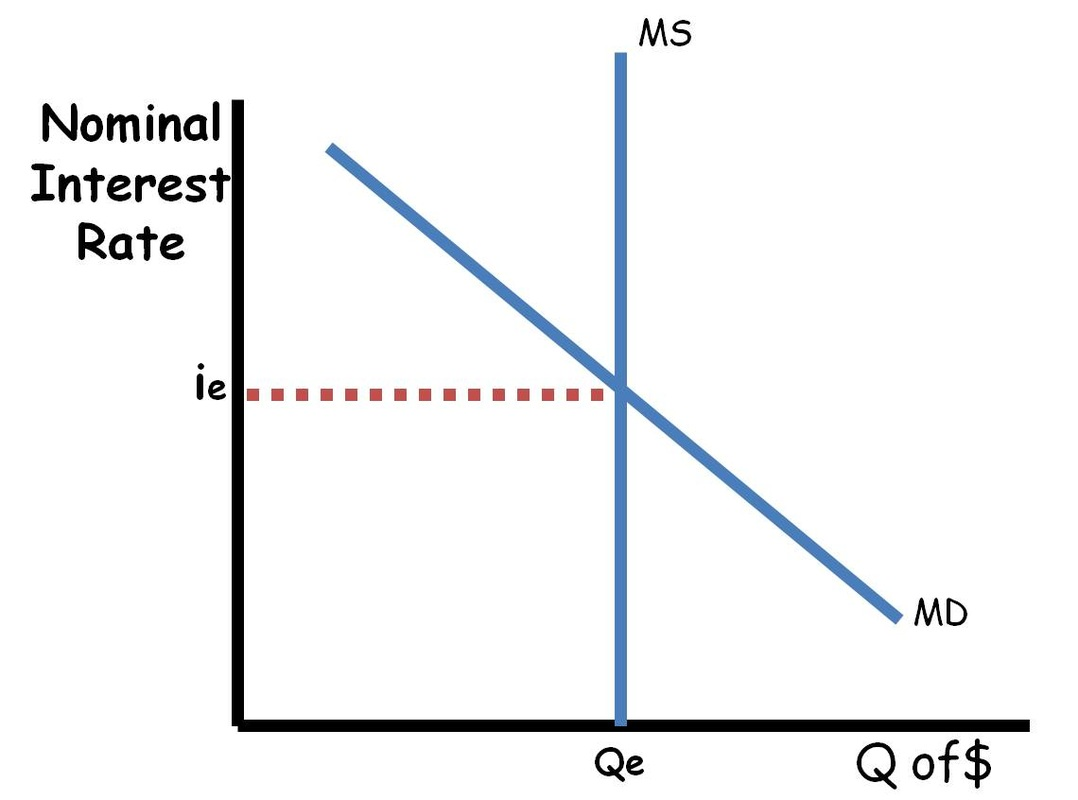
What graph is this
A money Market graph
What is loanable funds
Excess reserves
The money CBS CAN lend
What are the 3 main interest rates
Discount rate
Fed Funds Rate
Prime rate
What are reserves
The money banks hold for people at the Fed
What are demand deposits
Peoples checking accounts
Checkable deposits
M1 is___
Near money. It is very liquid because of checking accounts
What is the discount rate
The interest rate from Fed to CBS
3.75%
What is the Fed Funds Rate
Interest rate between CBS
Aka Short-term lending rate / Overnight lending rate
Target range: 3.5-3.75%
Who sets the target fed funds rate range?
The FOMC
It is the feds responsibility
What is a prime rate
The interest rate from CBS to the public
6.75% to the BEST customer
Who controls the supply of money
The Fed
They are the lender of last resort
Why do banks borrow from each other
The get loanable funds to lend money to the public
What is a reserve requirement
The amount of reserves that the banks cannot lend
What are the three tools of monetary policy
Change the discount rate
Change the reserve requirements
Open Market operations
What is the only way Sm can shift
If CBS lend. If banks don’t lend, monetary policy will not work
What is a monetary base
The cash held by people and the reserves banks have
In a recession the Fed ___ securities
buys
In inflation the Fed ___ securities
sells
Conventional policy works when…
interest rates fall and banks lend/stop lending
The FOMC can ___ securities when the FFR is too high
buy
The FOMC can ___ securities when the FFR is too low
sell
How do CBS make money
By earning interest on securities
Info about the Board of Governors:
Washington DC
They are apolitical
14 year terms
Info about BOG members
7 members.
Members are appointed by president, confirmed by senate
President chooses chairperson and vice president.
pres and VP have 4 year terms
What are the responsibilities of the BOG
Oversee the 12 Fed Banks
Set the Reserve Requirement
Sit on FOMC
Share responsibility of setting discount rate
Info about FOMC
Washington DC
Meet every 6 weeks
12 members (7 are BOG, 1 is NY Fed Pres, 4 others serve 1 year terms)
Why is the NY president vice chair of the FOMC
Because they carry out OMO only at NY
What is the FOMC’s job responsibilities
Set OMO
Set the target fed funds rate
Create economic reports
info on 12 Fed Banks
12 member banks
Supervised by BOG
Each bank has a board of directors
Job responsibilities of 12 fed banks
Issue currency
Hold reserves
Set reserve requirement
Lend money
Control flow of money
What are the job responsibilities of NY fed bank
Store other nation’s gold
Open Market operations
Board of Directors info
9 members
3 yr terms
1 for each bank
Job responsibilities of board of directors
Run day to day operations of bank
Appoint reserve bank pres and vice
Set banks discount rate
Who is the chair of the fed
Jerome Powell
Chair BOG and FOMC
2018-present
Who is John Williams
President of NY bank
Vice chair FOMC
What were the 4 causes of the 2008 financial crisis
Deregulation
Leveraging
Rating agencies
Credit Default Swap
Explain Deregulation
CBS would lend money to subprime borrowers and had no rules (bad credit)
Created mortgage backed securities
Risky loans piled up → housing bubble → collapse
Explain leveraging
Banks used large amounts of borrowed money to buy mortgage assets Banks used huge amounts of borrowed money to buy MBS
Small losses became huge ones
When housing prices fell, banks couldn’t cover debts
Many banks became unstable or failed
Explain the rating agencies problem
Rating agencies: S & P, Moodys, and Fitch rated mortgage securities
Very risky and bad MBS’s were rated AAA because the rating agencies were corrupt
Risk spread across financial system
Explain credit default swaps
CDS= insurance against loan default
Investors bought CDS to protect against mortgage failures
Companies sold huge amounts of CDS
When mortgages failed, the companies couldn’t pay all the insurance back
Big losses and panic
What is easy monetary policy
Fed lowers interest rates (FFR)
Fed buys securities in OMO
This increases bank reserves
Money supply increases → borrowing is cheaper.
Boosts economy
What is tight monetary policy
Fed raises interest rates
Fed sells securities → reduces bank reserves
Money supply decreases → borrowing is more expensive
Slows down economy
Why didn’t banks, realtors and investors care about selling MBS and CDOS to subprime borrowers
Because if they defaulted then they would get the house, and since house prices were increasing so much, it would’ve made even more money
What is shorting
It is betting against something
How did the Fed respond to the financial crisis with QE
Fed bought huge amounts of long-term securities (QE)
This injected money into banks
LF increased
This gave banks more capacity to lend
How did the Fed respond to the financial crisis using conventional monetary policy
FOMC lowered discount rate
FOMC lowered target Fed Funds Rate using OMO
Why did the conventional monetary policy response to the crisis not work
Banks didn’t lend
They were scared people wouldn’t pay back bc people foreclosed mortgages, there was a recession, and high unemployment
Banks started buying treasury bonds instead
People were afraid to borrow
They were scared they would lose their jobs and not be able to pay mortgage
People did not redeposit money
People had no faith in banks
How did the fed respond to the crisis using unconventional mon pol.
Quantitative easing
Impacts long term interest rates (THIS MAKES IT UNCONVENTIONAL)
Forward guidance
Fed publicly communicates its future plans to influence
Fed implemented regulation
Why did the Fed respond to the crisis
To stop a systemic collapse of the banking system
To prevent another great depression
What changes are in the system today after the crisis
Stronger regulation on risk, there is higher excess reserve requirements, and stress tests.
How were balance sheets impacted in the crisis
Assets (loans and MBS) lost value
Liabilities (demand deposits) stayed, banks couldn’t pay debts without Fed support
Loanable Funds increases
Why did recovery from the financial crisis take so long
Massive private debt
Households and banks had to fix balance sheets
Banks were cautious about lending
Housing market lagged: foreclosures and price declines stayed for years
Banks borrowed too much (high leverage) and invested in MBS, CDOS, and CDS, that were hard to sell post crisis
What is leveraging
Borrowing more money than you have to invest
What were some things put in place to stop a collapse from happening again
Banks have to hold more reserves so they can survive losses without collapsing
Fed tests big banks to see if they could survive economic crisis (stress tests)
Banks must have enough liquid assets to cover short-term needs
Stricter rules on subprime loans, MBS, and CD
Fed gives interest on LF to encourage banks to hold reserves
Fed can quickly inject money during a crisis
Dodd-Frank act created the Consumer Financial Protection Bureau to stop predatory lending
What is a reserve
CBS money held at the Fed
What is the main tool of monetary policy is the BOD is responsible for
Discount rate
What is the main tool of monetary policy is the BOG is responsible for
Reserve requirement
What is the main tool of monetary policy is the FOMC is responsible for
OMO