bebier babtches
 Call Kai
 Learn
Learn Practice Test
 Spaced Repetition
 Match
Match Flashcards
 Knowt Play
1/4

Earn XP
Description and Tags
| 14-24: advanced shading stuff | 30-32: mesh and widgets (?) (arcball, mover) | 33-36: bezier curves | 42-45: bezier patches | 55-61: alternative to parametric surfaces
Name | Mastery | Learn | Test | Matching | Spaced | Call with Kai |
|---|
No analytics yet
Send a link to your students to track their progress
5 Terms
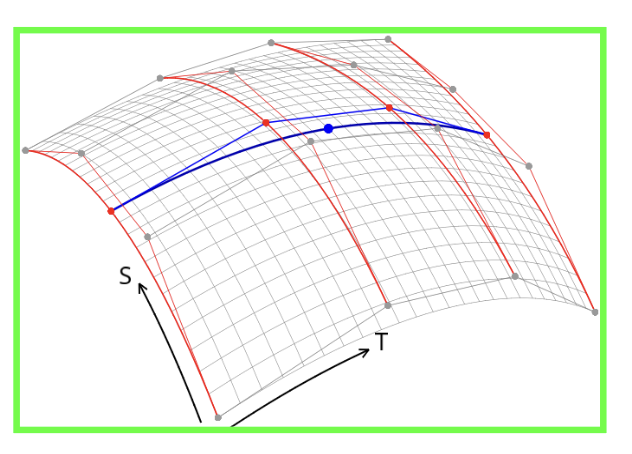
how to make bezier patch?
how many control points
what are the two curve called and what are they made of
how do you find an arbitrary point (u, v) in the patch?
refer to image for #3
16
t curve made of s-points, s-curve made of t-points
to find e.g. a point (u, v) go up each of the s curves (red lines) until you get the point where s = u. Using these four points (red points), create the t-curve. Find where t = v and yay you have the point you want
given a point u, v with parameters s, t on a bezier patch, how can you find the surface normal? (N(s,t) = ?)
how exact is this answer?
find the tangents of the s curve and the t curve and cross product them together
it is super precise!! it is accurate!! NOT an approximation!!
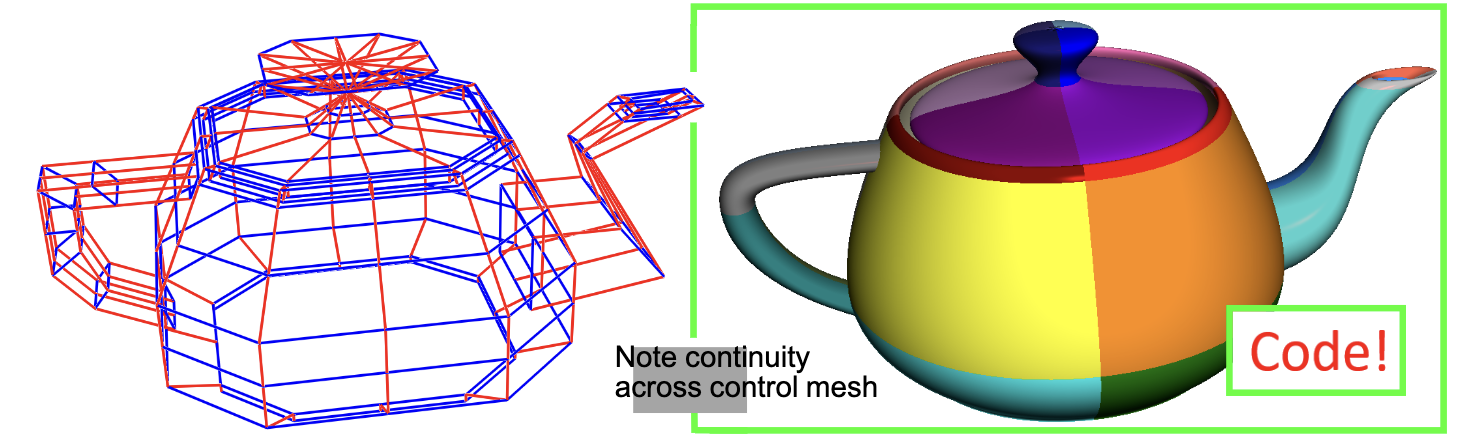
what key concept does the utah teapot demonstrate??
bezier curves/patches!! can see the control mesh is all straight lines, but turns into a curved shape!
how to split a bezier patch? what happens to the control points?
subdivided into two sub-patches along s-direction (top to bottom down the middle), then split those two patches in the t-direction (left to right horizontally). the result is 1 patch has been split into 4 subpatches
old control points thrown out, new control points have to be calculated
continuity in bezier patches?
same as for curves:
bezier patch boundaries lined up → c0 continuity, position only
tangents/slope line up, control points before and after boundary form a stright line with the boundary points → c1 continuity