Study Guide: 7 - Axial Skeleton
 Call Kai
 Learn
Learn Practice Test
 Spaced Repetition
 Match
Match Flashcards
 Knowt Play
1/17

There's no tags or description
Looks like no tags are added yet.
Name | Mastery | Learn | Test | Matching | Spaced | Call with Kai |
|---|
No analytics yet
Send a link to your students to track their progress
18 Terms
Divisions of the skeletal system
The axial skeleton consists of bones arranged along the longitudinal axis of the body.
The parts of the axial skeleton, composed of 80 bones, are the skull, hyoid bone, vertebral column, sternum, and ribs .It consists of 126 bones in the upper and lower extremities (limbs or appendages) and the pectoral (shoulder) and pelvic (hip) girdles, which attach them to the rest of the skeleton.
Bone Surface Markings
Bones show characteristic surface markings which are structural features adapted for specific functions.
Depressions and openings participate in joints or allow the passage of soft tissue.
Processes are projections or outgrowths that either help form joints or serve as attachment points for connective tissue.
The Skull - features
composed of 22 bones - the cranial/cranium and facial/face bones
the skull forms the large cranial cavity and smaller cavities, including the nasal cavity and orbits (eye sockets).
Certain skull bones contain mucous membrane-lined cavities called paranasal sinuses.
The only moveable bone of the skull (other than the ear ossicles within the temporal bones) is the mandible.
Immovable joints called sutures hold the skull bones together.
Functions of cranial bones
They protect the brain.
Their inner surfaces attach to membranes that stabilize the positions of the brain, blood vessels, and nerves.
The outer surfaces of cranial bones provide large areas of attachment for muscles that move the various parts of the head.
Facial bones form the framework of the face and protect and provide support for the nerves and blood vessels in that area
Cranial and facial bones together protect and support the special sense organs.
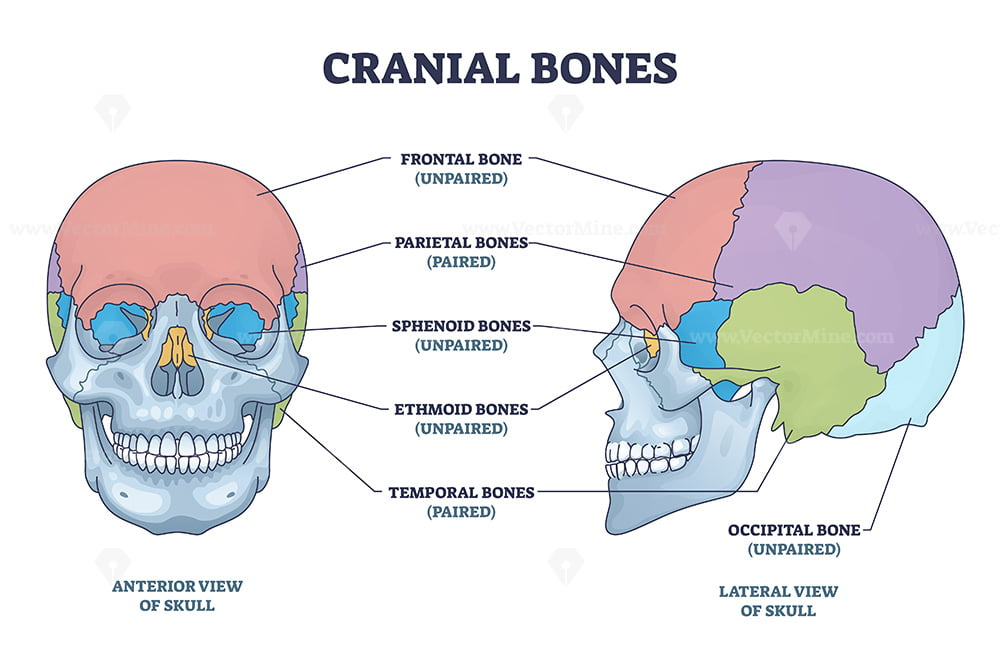
Cranial Bones
The frontal bone forms the forehead, the roofs of the orbits, and most of the anterior part of the cranial floor.
Parietal bones form the greater portion of the sides and roof of the cranial cavity .
Temporal bones form the inferior lateral aspects of the cranium and part of the cranial floor The occipital bone forms the posterior part and most of the base of the cranium.
The sphenoid bone is called the keystone of the cranial floor because it articulates with all the other cranial bones, holding them together.
The ethmoid bone forms part of the anterior portion of the cranial floor, the medial wall of the orbits, the superior portion of the nasal septum, and most of the superior side walls of the nasal cavity. It is a major superior supporting structure of the nasal cavity.
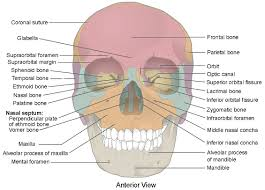
Facial Bones
Nasal bones form part of the bridge of the nose.
The lacrimal bones form a part of the medial wall of each orbit and are the smallest bones of the face.
Palatine bones form the posterior portion of the hard palate, part of the floor and lateral wall of the nasal cavity, and a small portion of the floors of the orbits).
The inferior nasal conchae (turbinates) form a part of the inferior lateral wall of the nasal cavity. Clinical Connection: Cleft palate and cleft lip result from a lack of fusion of portions of the palatine and maxillary bones during fetal development.
The vomer, found on the floor of the nasal cavity, is one of the components of the nasal septum .
The maxillae unite to form the upper jawbone and articulate directly with every bone of the face except for the mandible.
They form part of the floors of the orbits, part of the lateral walls and floor of the nasal cavity, and most of the hard palate.
The zygomatic bones (cheekbones) form the prominences of the cheeks and part of the lateral wall and floor of each orbit. The mandible (jawbone) is the largest, strongest facial bone and the only moveable skull bone (other than the ear ossicles).The mandible articulates with the temporal bone to form the temporomandibular joint
Nasal Septum
the nasal septum is a vertical partition that divides the nasal cavity into right/left sides
clinical connection: a deviated nasal septum is a lateral deflection of the septum from the midline, usually resulting from improper fusion of septal bones and cartilage
The orbits / eye sockets
The orbits contain the eyeballs and associated structures and are formed by seven bones of the skull .Five important foramina are associated with each orbit
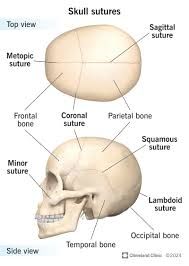
Sutures
Sutures are immovable joints found only between skull bones and hold skull bones together.
Sutures include the coronal, sagittal, lamboidal, and squamous sutures, among others
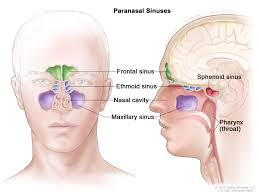
Paranasal sinuses
Paranasal sinuses are cavities in bones of the skull that communicate with the nasal cavity
They are lined by mucous membranes, serve to lighten the skull and serve as resonating chambers for speech.
cranial bones containing sinuses: frontal, sphenoid, ethmoid, and maxillae
clinical connection: sinusitis occurs when membranes of the paranasal sinuses become inflamed due to infection/allergy
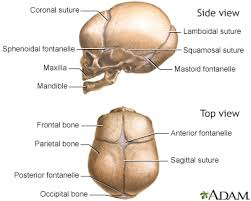
Fontanels
Fontanels are dense connective tissue membrane-filled spaces between the cranial bones of fetuses and infants.
They remain unossified at birth but close early in a child’s life.
The major fontanels are the anterior, posterior, anterolateral, and posterolateral.
Fontanels have two major functions.
They enable the fetal skull to modify its size and shape as it passes through the birth canal.
They permit rapid growth of the brain during infancy.
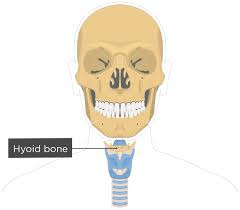
Hyoid Bone
The hyoid bone is a unique component of the axial skeleton because it does not articulate with any other bones.
The hyoid bone consists of a horizontal body and paired projections, the lesser and greater horns.
Vertebral Column - overview
The vertebral column, along with the sternum and ribs, makes up the trunk of the skeleton.
The 26 bones of the vertebral column are arranged into five regions: cervical, thoracic, lumbar, sacral, and coccygeal
Normal Curves of the Vertebral Column
The four normal vertebral curves are the cervical and lumbar (anteriorly convex curves) and thoracic and sacral (anteriorly concave curves)
In the fetus, there is only a single anteriorly concave curve..
The cervical curve develops as the child begins to hold his head erect.
The lumbar curve develops as the child begins to walk.
All curves are fully developed by age 10.
Between adjacent vertebrae, from the first cervical (atlas) to the sacrum, are intervertebral discs that form strong joints, permit various movements of the vertebral column, and absorb vertical shock
Parts of a typical vertebra include : a body, a vertebral arch, and several processes
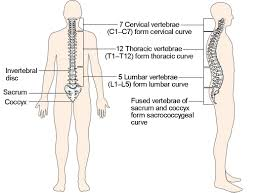
Regions of the Vertebral Column
Cervical Region
• There are 7 cervical vertebrae .
• The first cervical vertebra is the atlas and supports the skull.
• The second cervical vertebra is the axis, which permits side-to-side rotation of the head.
• The third to sixth cervical vertebras correspond to the structural patterns of the typical cervical vertebrae .
The seventh cervical vertebra, called the vertebra prominins, is somewhat different.
Thoracic Region
• There are 12 thoracic vertebrae.
• These vertebrae articulate with the ribs.
Lumbar Region
• There are 5 lumbar vertebrae.
• They are the largest and strongest vertebrae in the column.
Sacrum
The sacrum is formed by the union of 5 sacral vertebrae and serves as a strong foundation for the pelvic girdle.
Coccyx
The coccyx is formed by the fusion of 4 coccygeal vertebrae
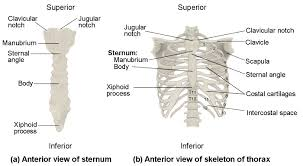
Thorax
The term thorax refers to the entire chest.
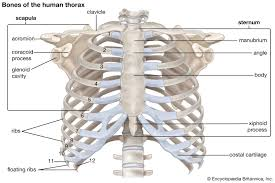
• The skeletal part of the thorax (a bony cage) consists of the sternum, costal cartilages, ribs, and the bodies of the thoracic vertebrae.
• The thoracic cage encloses and protects the organs in the thoracic and superior abdominal cavities. It also provides support for the bones of the shoulder girdle and upper limbs.
Sternum
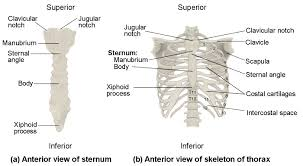
The sternum is located on the anterior midline of the thoracic wall.
• It consists of three parts: manubrium, body, and xiphoid process
Ribs
The 12 pairs of ribs give structural support to the sides of the thoracic cavity. The first 7 pairs of ribs are called true ribs; the remaining five pairs, false ribs (with the last two false ribs called floating ribs).
Disorders - homeostatic imbalances
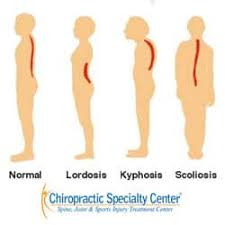
Protrusion of the nucleus pulposus into an adjacent vertebral body is called a herniated (slipped) disc Scoliosis is the most common of abnormal curves
Kyphosis is known as a “hunchback” look.
Lordosis is an increase in the lumbar curve.
Spina bifida is a congenital defect caused by failure of the vertebral laminae to unite at the midline. This may involve only one or several vertebrae; nervous tissue may or may not protrude through the skin.