PSCI 101D Chapter 5 Key Terms
 Call Kai
 Learn
Learn Practice Test
 Spaced Repetition
 Match
Match Flashcards
 Knowt Play
1/16

There's no tags or description
Looks like no tags are added yet.
Name | Mastery | Learn | Test | Matching | Spaced | Call with Kai |
|---|
No analytics yet
Send a link to your students to track their progress
17 Terms
Myelination
The process within the brain that involves neurons becoming insulated with myelin (white, gray fatty sheath) allowing faster neural communication.
At what age is the brain at 90% of adult weight?
Six years old
Executive function
The cognitive ability to organize thoughts in the brain in order to execute and plan certain actions. (problem-solving, working memory)
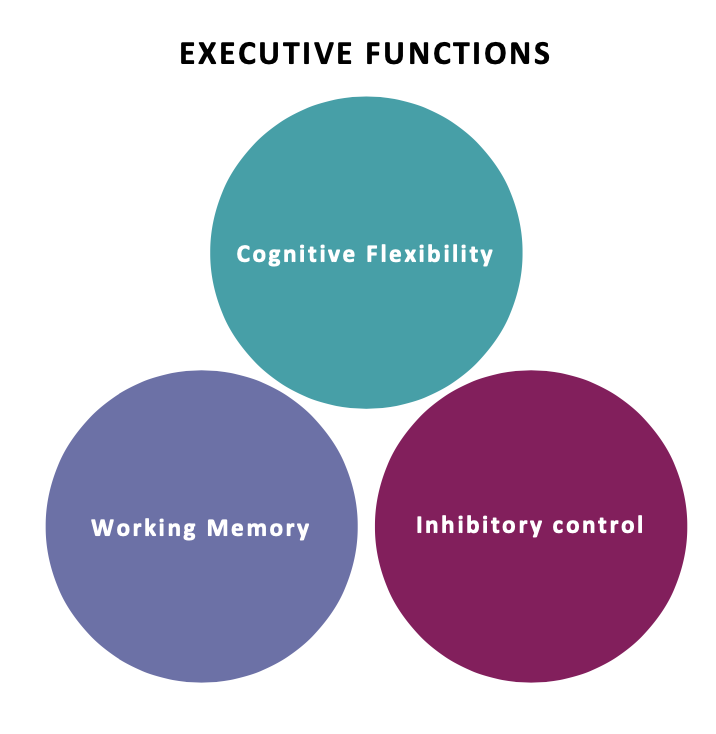
What are the three core executive functions?
Working memory: The ability to retain a small amount of information for immediate access.
Inhibitory control: The ability to control responses.
Cognitive flexibility: The ability to see things from another point of view rather than staying stuck on one idea.
Theory of mind
The cognitive ability to understand what other people are thinking (thoughts, desires, emotions, beliefs).
When does the theory of mind develop during childhood?
Four years old
How is the theory of mind tested?
False-belief problems
Preoperational Stage
The second stage of cognitive development according to Jean Piaget, which includes language and imagination; occurs between ages 2 to 7
Symbolic Representation
The cognitive ability to mentally represent object and experiences through symbols.
Egocentrism
The cognitive ability to think that everything is centered around you.
Appearance-focus
The cognitive ability to excessively place importance on physical looks.
Static Reasoning
The cognitive ability to think that nothing will change and everything will stay the same.
Irreversibility
The cognitive ability to think that nothing can be returned to its original form.
Conservation
The understanding that despite transformation in the physical amount, the amount remains the same.
Ex. counting and rearranging
What mental processes occur during the preoperational stage of development?
Symbolic Representation
Egocentrism
Appearance-focus
Static Reasoning
Irreversibility
Conservation
Scaffolding
A form of temporary support to help a learner master the next task in a given learning process.
What is the zone of proximal development?
The space between what a learner can do without assistance and what a learner can do with adult guidance.