Chemistry 5th Exam Study
 Call Kai
 Learn
Learn Practice Test
 Spaced Repetition
 Match
Match Flashcards
 Knowt Play
1/44

There's no tags or description
Looks like no tags are added yet.
Name | Mastery | Learn | Test | Matching | Spaced | Call with Kai |
|---|
No analytics yet
Send a link to your students to track their progress
45 Terms
What are organic reactions?
They are not always balanced (we care more about what we are making rather than how much)
Sometimes the inorganic byproducts are not written (we mostly care about the organic product)
For each reaction learned, you want to know the organic reactant(substrate), the inorganic reactants (reagents), and the product(s)… if one of those 3 is missing you can fill it in
Sometimes reagents are over the arrow, sometimes they are in front of the arrow with the substrate… it doesn’t matter
What are the techniques to solve organic reaction problems?
Identify what’s given and what is the question asking for
Draw the structure in the format your most comfortable with
Identify abd bane type of substrate (example: alkene, alcohol, or etc.) Hint identify the functional group
Identify which part of the structure is reacting and which is not reacting. Hint: take special note what carbon is bonded ot the portion that is reacting
Identify the type of reactions can occur with your substrate
Identify the reagents to determine the reaction
Identify and name the type of products produced
Number your parent chain
Redraw unreacted portion of your structure iast a product
Number the parent chain on the product making sure the unreacted substituents are correct
Add the correct functional group/atoms to make the correct
What are the four types of organic reactions and their definitions?
Oxidation: in organic chemistry involves carbon’s gain of bonds to oxygen at the alpha carbon (or the loss of hydrogen from the alpha carbon)
Reduction: involves carbon’s loss of bonds to oxygen at the alpha carbon(or the gain of hydrogen from the alpha carbon)
Addition: When you are adding two things to the carbons with a double and or tripled bonds
Substitution: When you are substituting one thing for another
What is a combustion reaction, and its example?
Combustion reaction of an organic molecule that contains only C, H, and/or O with oxygen gas to produce CO2 gas and H2O gas(exothermic)
Organic substrate + O2(g) + CO2(g) + H2O(g) + heat
Equation for the combustion of methane gas
CH4 + O2 → CO2(g) + H2O(g) + heat
or another example:
Propene + O2 → CO2(g) + H2O(g) + heat
What are reactions of alkanes?
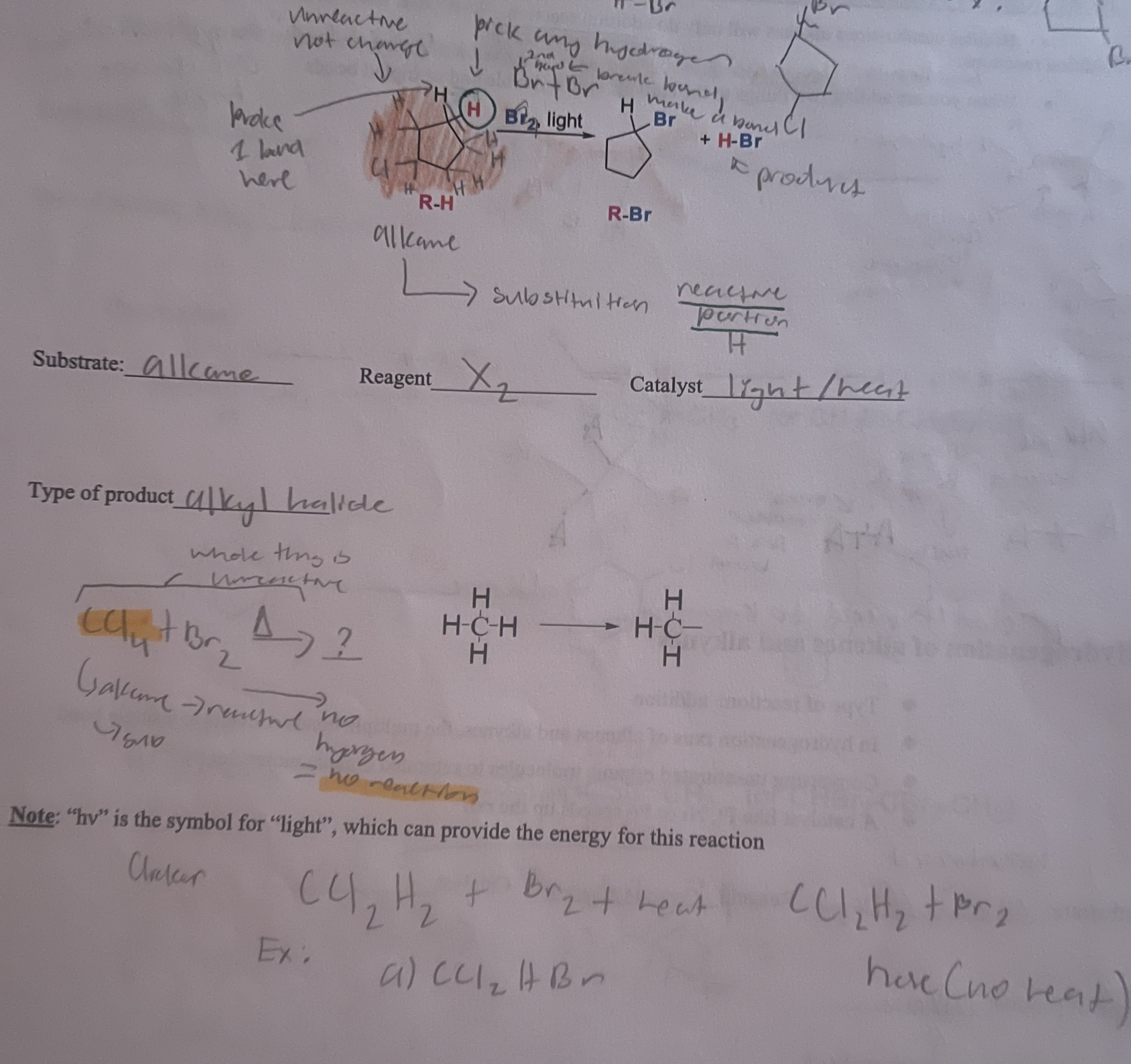
Besides combustions alkanes will only do substitution reactions
For substitution of alkane, a H on the substrate will always be substituted
Reaction between an alkane and a diatomic halogen (Br2 or Cl2)
reagents X2 (halogens)
Type of reaction: substitution
Halogen (X): is substituted in place of a hydrogen on the alkane
Requires light(hv) or heat
The products are alkyl halides(R-X)
STUDY IMAGE WITH THE REST OF THE NOTES
What is the reactions of alkenes and alkynes like?
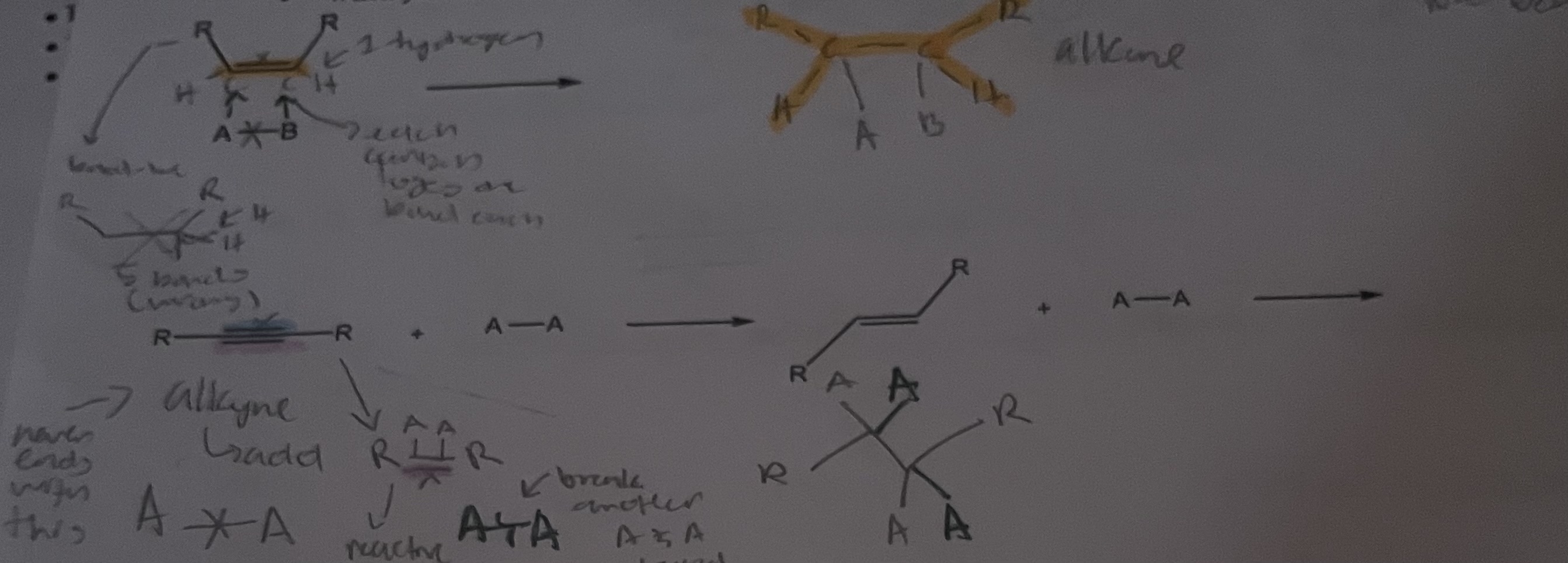
Besides combustions alkenes will only do addition reaction
Addition reactions:
When you are adding two things to the carbons with a double and or tripled bonds
STUDY IMAGE WITH THE REST OF THE NOTES
What is the hydrogenation of alkenes and alkynes?
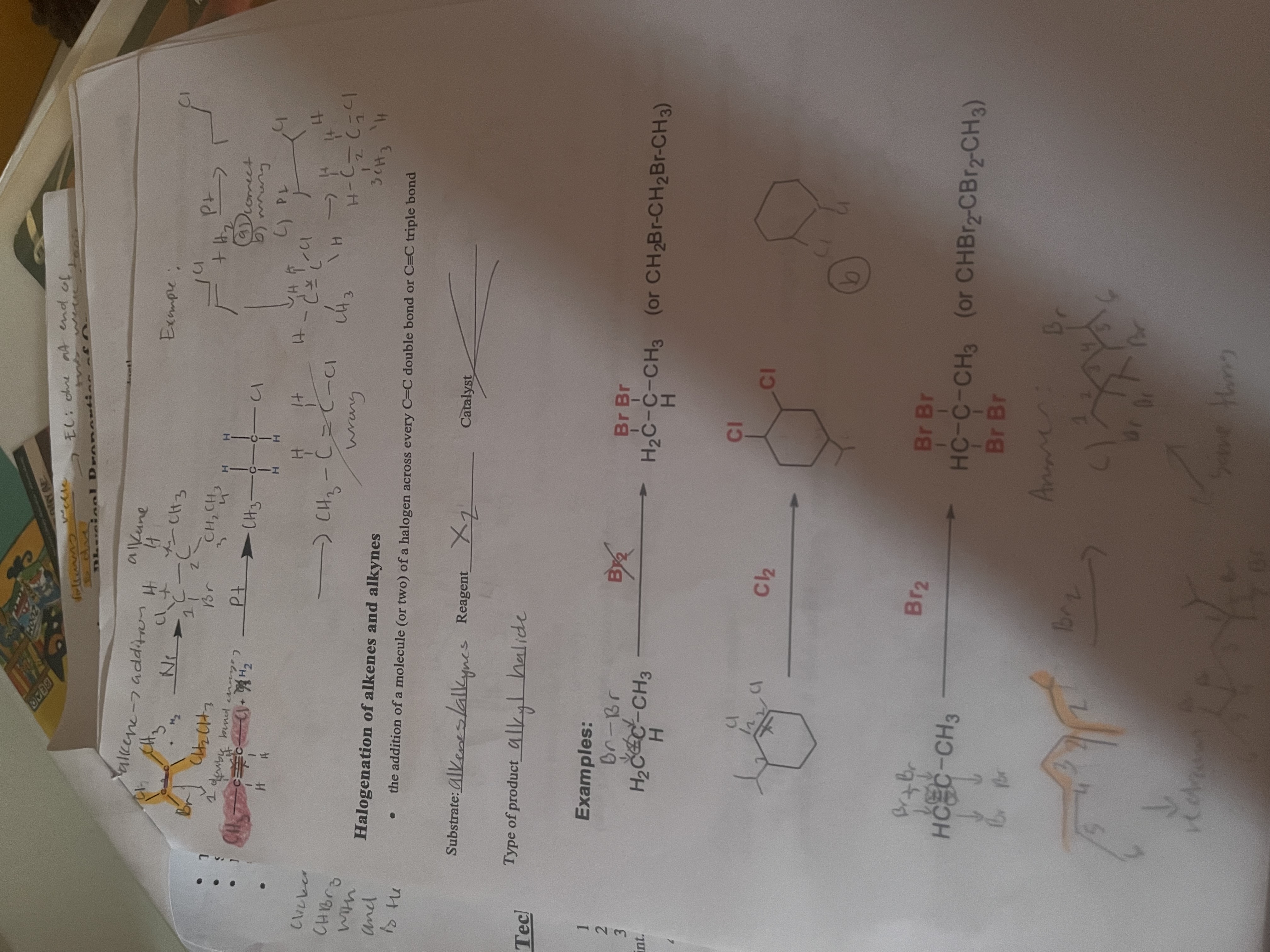
Type of reaction: addition
In hydrogenation reactions alkenes and alkynes, the multiple bonds converts to a single bond
Converting unsaturated organic molecules to saturate organic molecules by
A catalyst like Pt, Ni, or Pd speeds up the reacion
Substrate: alkene/alkyne (unsaturated), Reagent: hydrogen, Catalyst: either Pt, Ni, or Pd
Type of product: alkane(saturated)
STUDY IMAGE WITH THE REST OF THE NOTES
What is the hydration of alkenes?
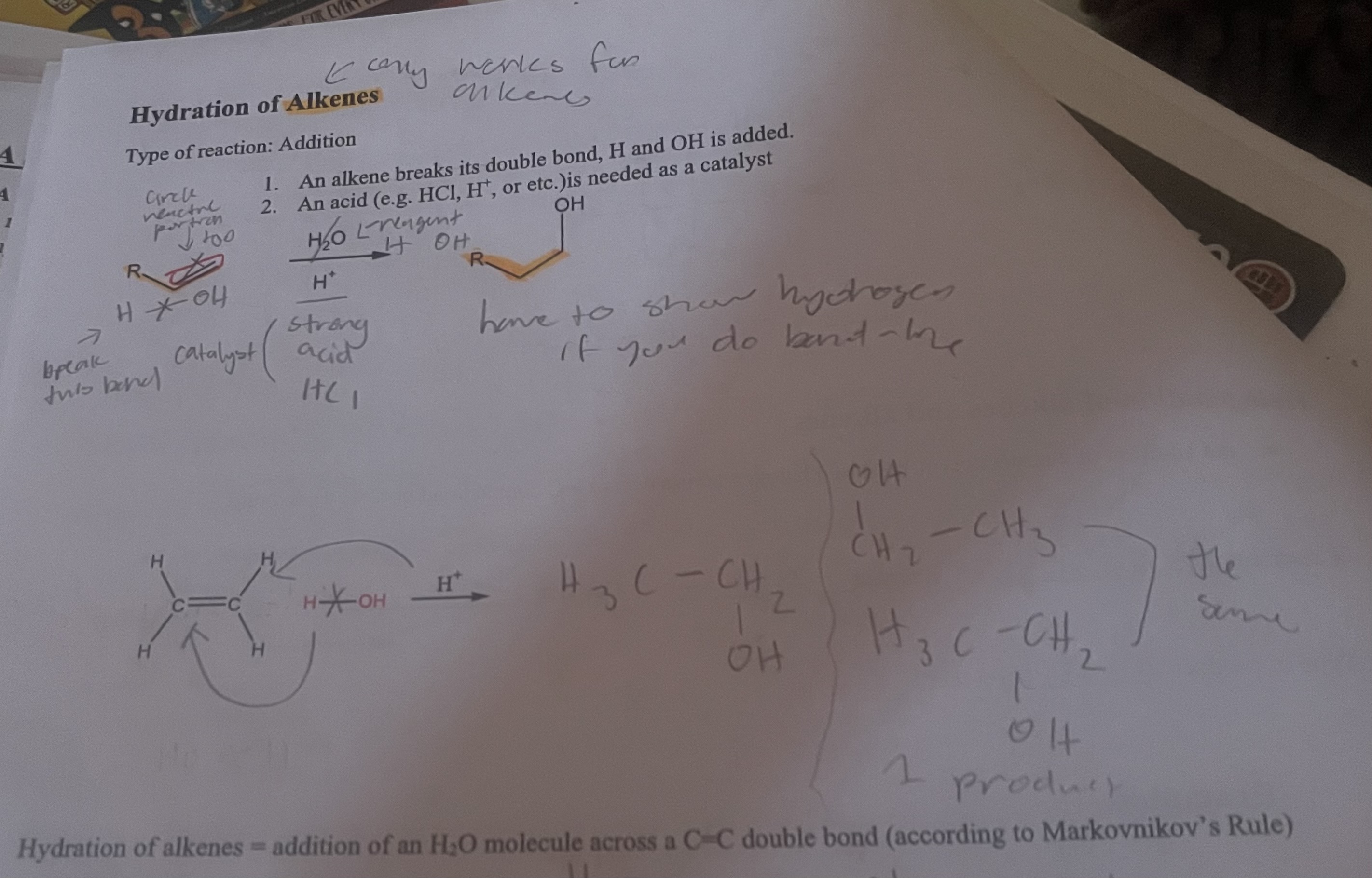
An alkene breaks its double bond, H and OH is added
An acid(example: HCl, H+, or etc.) is needed as a catalyst
Hydration of alkenes = addition of an H2O molecule across a C-C double bond(accoding to Markovnikov’s Rule)
Substrate: alkene, Reagent: H2O, Catalyst: strong acid, Type of product: alcohol
RMB CARBONS MUST HAVE 3 BONDS, BONDS BETWEEN C AND H ARE NOT SHOWN IN BOND LINE STRUCTURE
What are the major and minor products?
If two carbons of the double bond are attached to different groups(asymmetrical alkene), H adds to the carbon of the double bond with more H directly attached to produce the Major product.
Markovnikov’s Rule: hydrogen will add carbon on C=C with more “H”(hydrogen)
STUDY PAGE FROM NOTES
What is the reaction of alcohols?
Alcohols can undergo oxidation reactions.
What are oxidation reactions?
Alcohols can be oxidized with a variety of oxidizing agents to form aldehydes and ketones
Oxidation: in organic chemistry involves alpha carbon’s gain of bonds to oxygen(or loss of hydrogen)
Reagents:
A common oxidizing reagent is K2Cr2O7 or KMnO4
The symbol [O] over the reaction arrow is used to designate any general oxidizing agent.
Also depends on classification of alcohol, you will end up with a different product!
STUDY PAGES FROM NOTES
What are the reactions of aldehydes and ketones?
Aldehydes undergo oxidation or reduction reactions
Ketones will undergo reduction reactions ONLY
What is reduction (hydration of C=O)?
Reagents H2 and Pt/Pd/Ni
Hydrogenation(reduction) of aldehydes and ketones is the addition of an H2 molecule across a carbon-oxygen double bond.
Same reaction as with alkenes, but with a C=O instead of C=C!
Hydrogenation of an aldehyde leads to the formation of a primary alcohol.
Hydrogenation of a ketone leads to the formation of a secondary alcohol
How do we test for aldehydes vs. ketones? (What is the tollens’ test).
An aldehyde is oxidized to a carboxylic acid. Silver also forms. Acetone give a positive or negative result for Tollens test because acetone is a standard ketone.
What are the techniques to solve organic reaction problems?
Identify what’s given and what is the question asking for
Draw the structure in the format your most comfortable with
Identify the name type of substrate (example: alkene, alcohol, or etc,) Hint identify the functional group
Identify which part of the structure is reacting and which is not reacting. Hint Take special note what carbon is bonded to the portion that is reacting.
Identify types of reactions can occur with your substrate
Identify the reagents to determine the reaction
Identify and name the type of products produced
Number your parent chain
Redraw unreacted portion of your structure as a product
Number the parent chain ont he product making sure the unreacted substituents are correct
Add the correct functional group/atoms to make the correct
What is solubility(what are hydrocarbons, what are the non-polar molecules)?
Polar substances are more soluble in polar solvents(water, methanol, ethanol, and etc..)
Non-polar substances are more soluble in non-polar solvents (cyclo-hexane, carbon tetrachloride, and etc.)
Hydrocarbons are very non-polar. Hydrocarbons are more soluble in non-polar solvents.
Alkanes, alkenes, alkynes, and aromatics
*KNOW THAT BENZENE IS NON-POLAR
Are ethers, thiols. 3° amines polar or non-polar, and what is it more soluble in?
Ethers, Thiols, 3° amines are polar. Ethers, Thiols, 3° amines are more soluble in polar solvents.
What are compounds containing carbonyl group(are they polar or non-polar)?
Compounds containing carbonyl group are very polar. Group containing carbonyl are more soluble in polar solvents.
STUDY PICTURE OF THEIR DIFFERENCES
What are compounds that can hydrogen bond with polar solvents like, and where are they most soluble in?
Compounds that can Hydrogen bond with polar solvents are very polar. Compounds that can hydrogen bond with polar solvents are the most soluble in polar solvents.
1° and 2° amines, 1° and 2° amides, alcohols, and carboxylic acids all can hydrogen bond
What are london dispersion forces(what has it, its strength, surface area (STUDY FROM NOTES), and size effects on strength of London forces?
What has it: All matter has this
Strength: very very weak
Size effects on Strength of London forces: larger more electrons (e-), larger your(carbon chain) hydrocarbon more e- therefore stronger LDF
butane vs < decane
What has dipole dipole forces(attraction)?
What has it: polar compounds
Strength: medium weak
Polarity effects on strength of dipole dipole attractions, more polar compound, stronger dipole-dipole
What is the hydrogen bonding attraction(what has it, and strength)?
What has it: polar compounds that has an O-H, N-H, F-H
H-O > H-N
What are the characteristics of carbohydrates?
Source of carbohydrates: PLANTS
Plants by chlorophyll
CO2 and H2O react to give different carbohydrates through a complex series of reactions called photosynthesis.
nCO2 + nH2O → light/chlorophyll → (CH2O)n + nO2
What are the three different types of carbohydrates?
Monosaccharides: 1 sugar or monomer
Disaccharides: 2 sugars
Polysaccharides: many sugars bonded together
STUDY PICTURES IN NOTES
What are characteristics of polymers?
Large, long chain molecules composed of repeating structural units = monomers
Polymers can be composed of several thousand monomers
Found in nature including cellulose in plants, starches in food, proteins, and DNA in the body
There are also synthesis (man-made) polymers like T eflon and nylon
Monomers: small molecules that can link together in some repeating way.
What are the different functional groups?
A monosaccharide with a ketone group is a ketose
An aldose is a monosaccharide that contains and aldehyde group.
STUDY IMAGES FROM NOTES
What are the names of the number of chain lengths?
A three-carbon monosaccharide is a triose
A four-carbon monosaccharide is a tetrose
A five-carbon chain sugar is a pentose
A six carbon chain is a hexose
A seven carbon chain is a heptose
a 8 carbon chain is an octose
REVIEW THE NOTES FOR STRUCTURES
What is stereochemistry(D vs. L) isomers? What is a Fischer projection?
By convention, it is the position of the hydroxyl (-OH) group bonded to the penultimate (next to last) carbono or the last chiral carbon that determines the monosaccharide D or L.
For a properly drawn Fischer projection:
If the -OH group is pointing right = D
If the -OH group is pointing left = L
What are stereoisomers?
Stereoisomers: are pairs of molecules that have the same molecular formula and the same bonding pattern, but different arrangements of the atoms in spsce
cis and trans are one type of stereoisomer
D or L refer to a different type of stereoisomer
What are chiral objects like?
Chiral objects have an image and a mirror image that are not the same ( contain a chiral carbon)
When the chiral objects are sliced in half, the two halves are not the same.
What are achiral objects?
Achiral objects do not have a unique image and mirror image(don’t contain a chiral carbon)
When achiral objects are sliced in half, the two halves are identical (super imposable)
What are chiral carbons?
Chiral carbons are tetrahedral carbons with four different attachments
These two molecules are not superimposable: they are stereoisomers
* KNOW THAT AS LONG AS IT HAS AT LEAST ONE CHIRAL CARBON, THE COMPOUND IS CHIRAL
What are enantiomers?
Two stereoisomers that are nonsuperimposable mirror images of one another are called a pair of enantiomers(a specific type of stereoisomer)
An enantiomer is the mirror image of a chiral compound
What carbohydrates are chiral?
Ex: glyceraldehyde comes in to versions(isomers)
L-glyceraldehyde
D-aldehyde
The first carbon is the carbon on the top(carbonyl has priority over hydroxyl in numbering)
L-version, the OH on the last chiral carbon is on the left
D-version, the OH on the last chiral carbon is on the right
What are the most important monosaccharides?
glucose, fructose, and ribose
STUDY THE STRUCTURES
What are cyclic structures?
Monosaccharides that can be in open-chain form and in a cyclic form(Haworth projections)
What are anomers alpha and beta notation?
In the alpha anomer: the hydroxyl group points down (alpha = “OH down” in a proper Haworth projection)
In the beta anomer: the hydroxyl group points up (beta = “OH up” in a proper Haworth projection)
What are 5-member rings always going to be?
Ketohexose or aldopentose
What are the types of disaccharides?
Carbohydrates composed of 2 monosaccharide units held together by a bond called glycosidic linkage (special name for ester linkage between 2 monosaccharides)
What are alpha and beta linkages?
There are different types of linkages in disaccharides
In alpha-linkages, the bond from the alpha carbon of the first sugar to the oxygen is pointing down (we’re removing H2O(H & OH) )
dehydration reaction link biomolecules
STUDY PICTURES ON NOTES
In beta-linkages, the bond from the alpha carbon of the first sugar to the oxygen is pointing upwards
What are the two most important disaccharides?
glucose + glucose → maltose
glucose + fructose → sucrose
What is hydrolysis of disaccharides?
Water and a strong acid will break the glycosidic linkage
REVIEW PICTURES IN NOTES
What are polysaccharides?
Polysaccharides are high molecular weight polymers of monosaccharides linked together through glycosidic bonds
What is a starch?
Polymer of sugars, how living things stores glucose
What is cellulose?
A structural material for plants