Anatomy Exam 2, Muscles pt 2
 Call Kai
 Learn
Learn Practice Test
 Spaced Repetition
 Match
Match Flashcards
 Knowt Play
1/96

There's no tags or description
Looks like no tags are added yet.
Name | Mastery | Learn | Test | Matching | Spaced | Call with Kai |
|---|
No analytics yet
Send a link to your students to track their progress
97 Terms
What are the 4 types of fascicle organization?
Parallel, Convergent, Pennate, Circular
How are parallel muscles organized?
fibers parallel to the long axis of muscle, same direction as the tendon
Where are parallel muscles found?
biceps or six pack
How are convergent muscles organized?
Broad area converges onto an attachment site (tendon)
Where are convergent muscles found?
Pectoral, chest
How are pennate muscles organized?
Form an angle with the tendon
What are unipennate muscles?
Fibers on one side of tendon
Where are unipennate muscles found?
Extensor digitorum, forearm
How are bipennate muscles organized?
fibers on both sides of tendon
Where are bipennate muscles found?
Rectus femoris, femur
How are multipennate muscles organized?
Tendons branch within the muscle
Where are multipennate muscles located?
deltoid
How are circular muscles arranged?
No tendons, open and close to guard entrances of body
Where are circular muscles located?
orbicularis oris, mouth
What is an articulation / joint?
where bone meets another bone
What is fibrous joints?
connected through dense regular connective tissue
What is cartilaginous joints?
connected through cartilage
What is synchondrosis?
connected through hyaline cartilage
What is symphysis?
connected through fibrocartilage
What does diarthrosis mean?
Highly movable
What are synovial joints?
Movable joints, at the end of long bones
What does synovial fluid do?
Lubricates for movement, shock absorption
What are articular cartilages?
pads articulating surfaces, cushion the joint
What are fat pads?
Superficial to the joint capsule, protect articular cartilages
What are ligaments?
bone to bone connection, support joints
What are tendons?
muscle attachment to bone around joint
What are bursa?
pocket of synovial fluid, cushion areas where tendons or ligaments rub
What are levers?
create the movement, change direction, distance, speed, or strength of a force
What is a First-Class Lever?
fulcrum in the middle, force and load balanced
What is a Second-Class Lever?
load in the middle, small force moves large weight
What is a Third-Class Lever?
applied force in the middle, large force moves small weight, allows for quick and long distance
what is an origin?
A fixed point of attachment
What is an insertion?
a moving point of attachment
What is a flexion?
Reduces angle between elements along the anterior/posterior plane
What is an extension?
increases angle between elements along the anterior/posterior plane
What is an abduction?
Moves away from the body along the frontal plane
What is an adduction?
Moves towards the body along the frontal plane
What is a circumduction?
a circular movement
What is a medial rotation?
moves towards the midline
What is a lateral rotation?
Moves away from the midline
What is pronation?
Rotates forearm, radius over ulna, facing down
What is supination?
Forearm in anatomical position, facing up
What is inversion?
Twists sole of foot medially
What is eversion?
twists sole of foot laterally
What is dorsiflexion
Flexion at ankle, lifting toes
What is plantar flexion?
Extension at ankle, pointing toes down
What is opposition
thumb movement towards fingers or palm
What is reposition?
Thumb at resting position
What is protraction?
Moving anteriorly
What is retraction
Moving posteriorly
What is elevation?
Moving in superior direction (up)
What is depression?
Moving in inferior direction (down)
What is lateral flexion
Bends vertebral column side to side
What kind of joints does Temporomandibular joint have?
hinge, gliding
What type of articulations does intervertebrae have?
amphiarthorsis, diarthrosis
How many articulations does knee joint have?
3 articulations of hinge joint
What kind of movement can Knee Joint do?
Flexion and extension
What kind of movement can hip joint do?
flexion, extension, abduction, adduction
What is an agonist?
The muscle that is contracting and producing movement
What is an antagonist?
The muscle that stretches in response to contraction
What is synergist?
Muscle that assists with larger agonist
What is oris?
Mouth
What is cervicis?
Neck
What is pollicis?
thumb
What is gluteal?
buttocks
What is femoris?
thigh, femur
What is hallucis?
great toe
What is superficialis?
Superficial
What is profundus?
deep
What is rectus?
Straight
What is oblique?
Angled
What is orbicularis?
circular
What is deltoid?
triangular
What is quadratus?
rectangular
What is trapezius?
trapezoidal
what is longus?
long
What is brevis?
short
What happens to muscles when you get older?
Smaller fibers, less elastic, decreased recovery
What is diarthrosis?
Highly movable
What is amphiarthrosis?
Slightly movable
What is synarthrosis?
Immovable
What is the relationship between joint strength and mobility?
If one increases, the other decreases
What is an example of synchondrosis?
costal cartilage, epiphyseal plate
What is an example of symphysis?
the vertebrae
What is gomphosis?
Periodontal membranes hold tooth to bony jaw
What is suture?
Dense regular connective tissue that connects skull bones
What is syndesmosis?
Dense regular connective tissue fibers between bones
What is the meniscus?
fibrocartilage pad
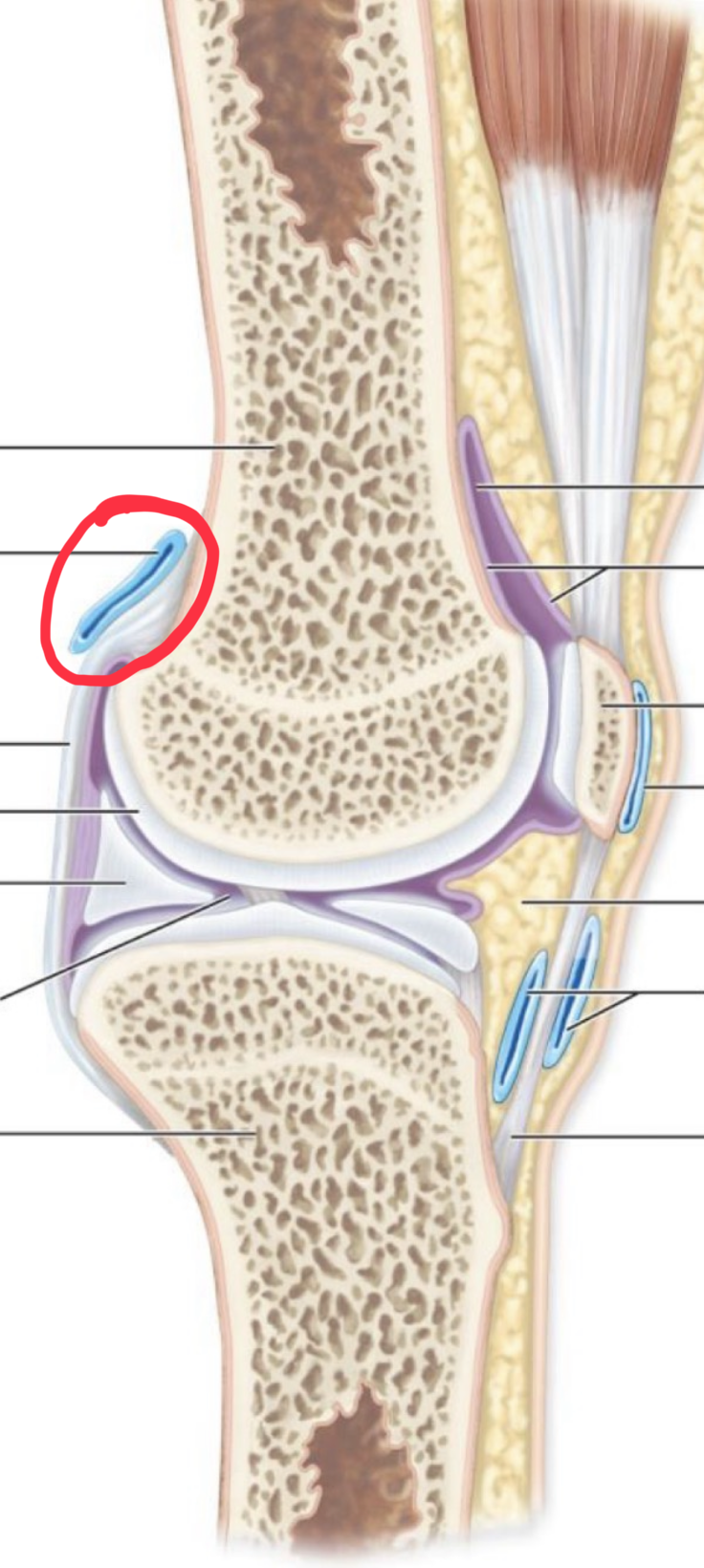
What structure is this?
bursa
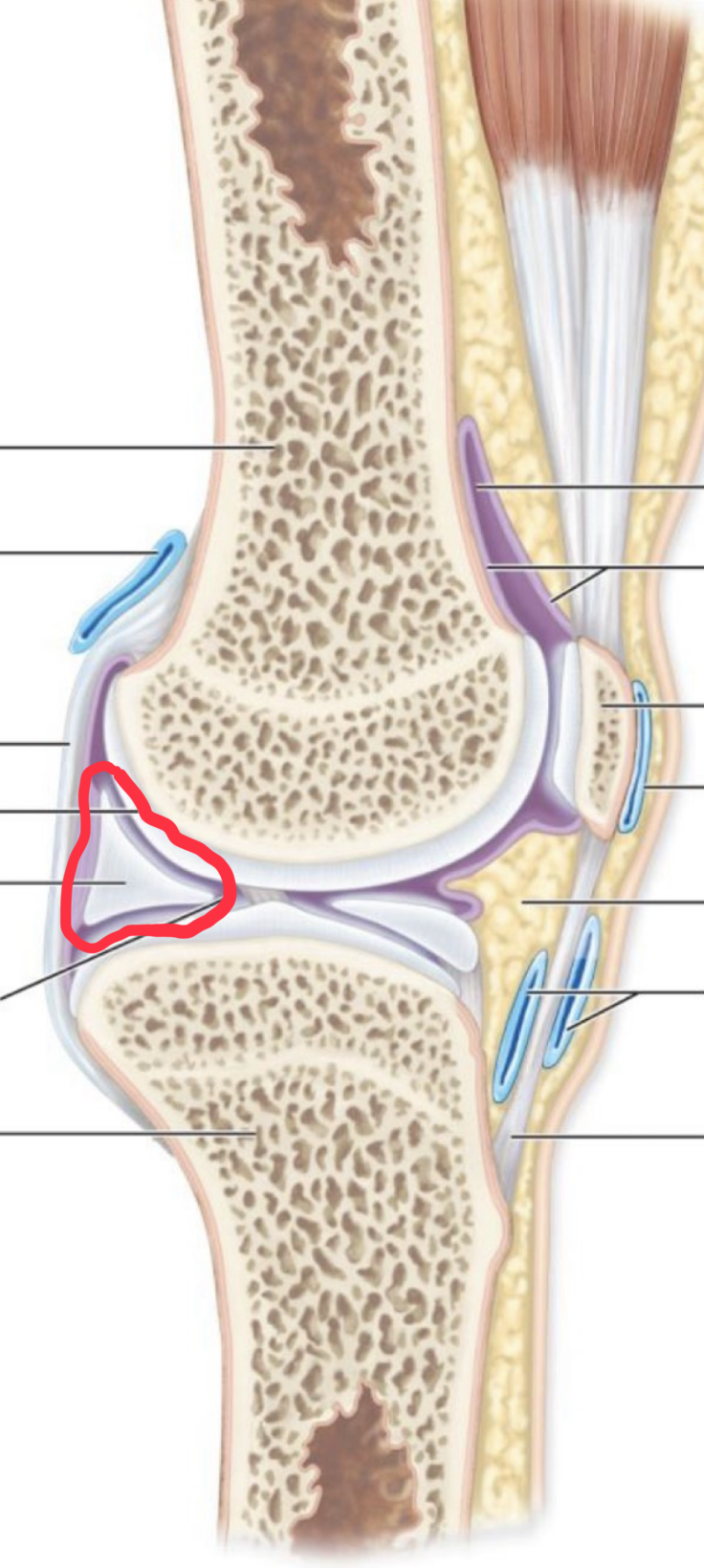
What structure is this?
Meniscus
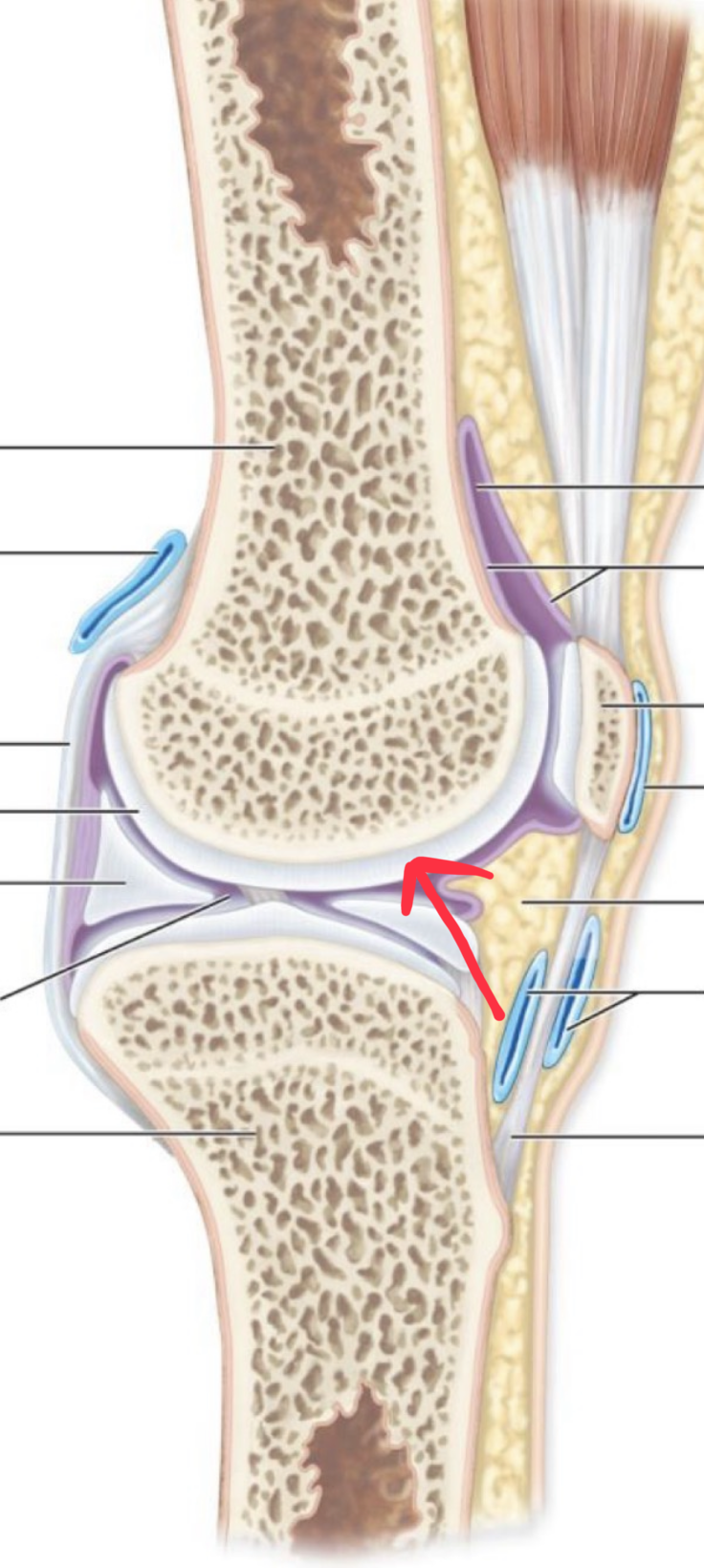
What structure is this?
Articular cartilage
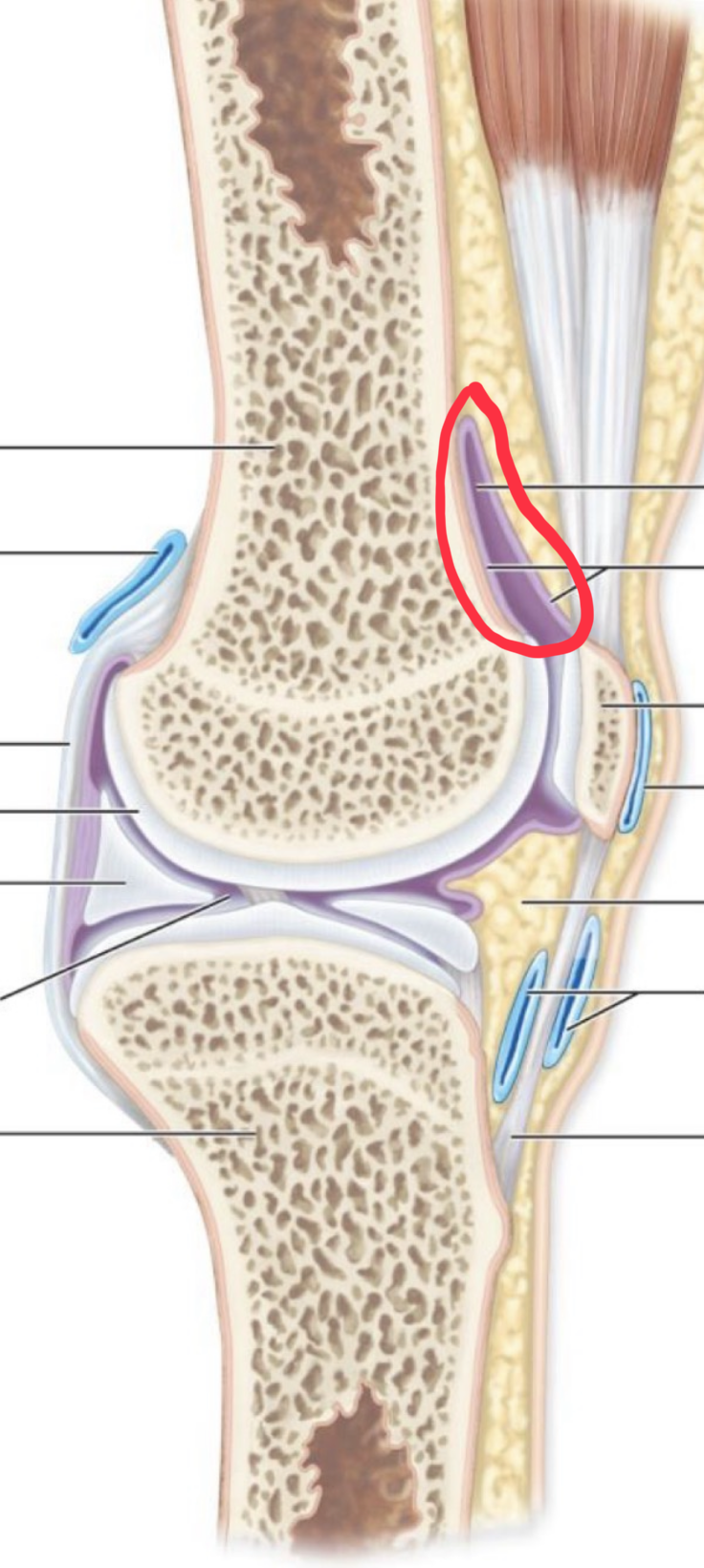
What structure is this?
Synovial membrane
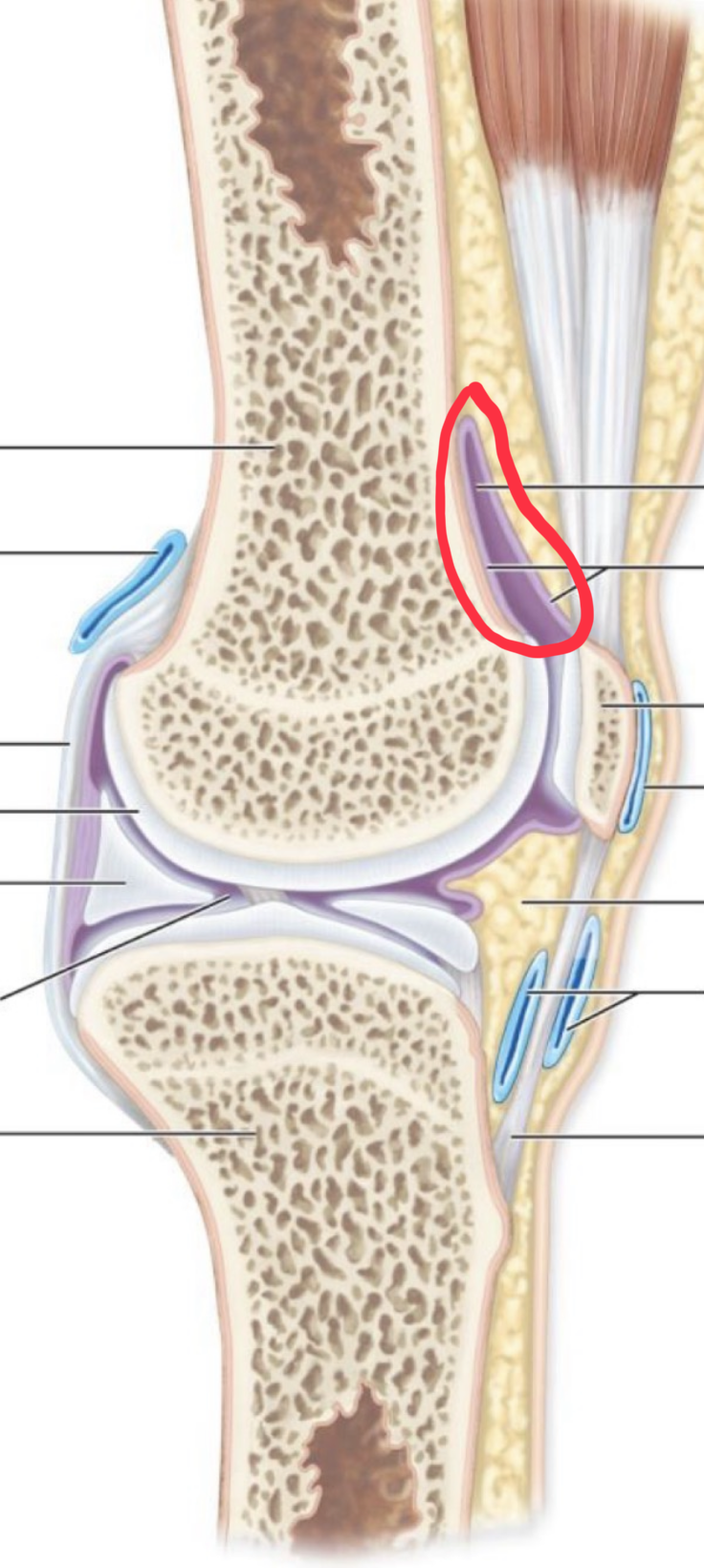
What is inside this structure?
Joint cavity with synovial fluid
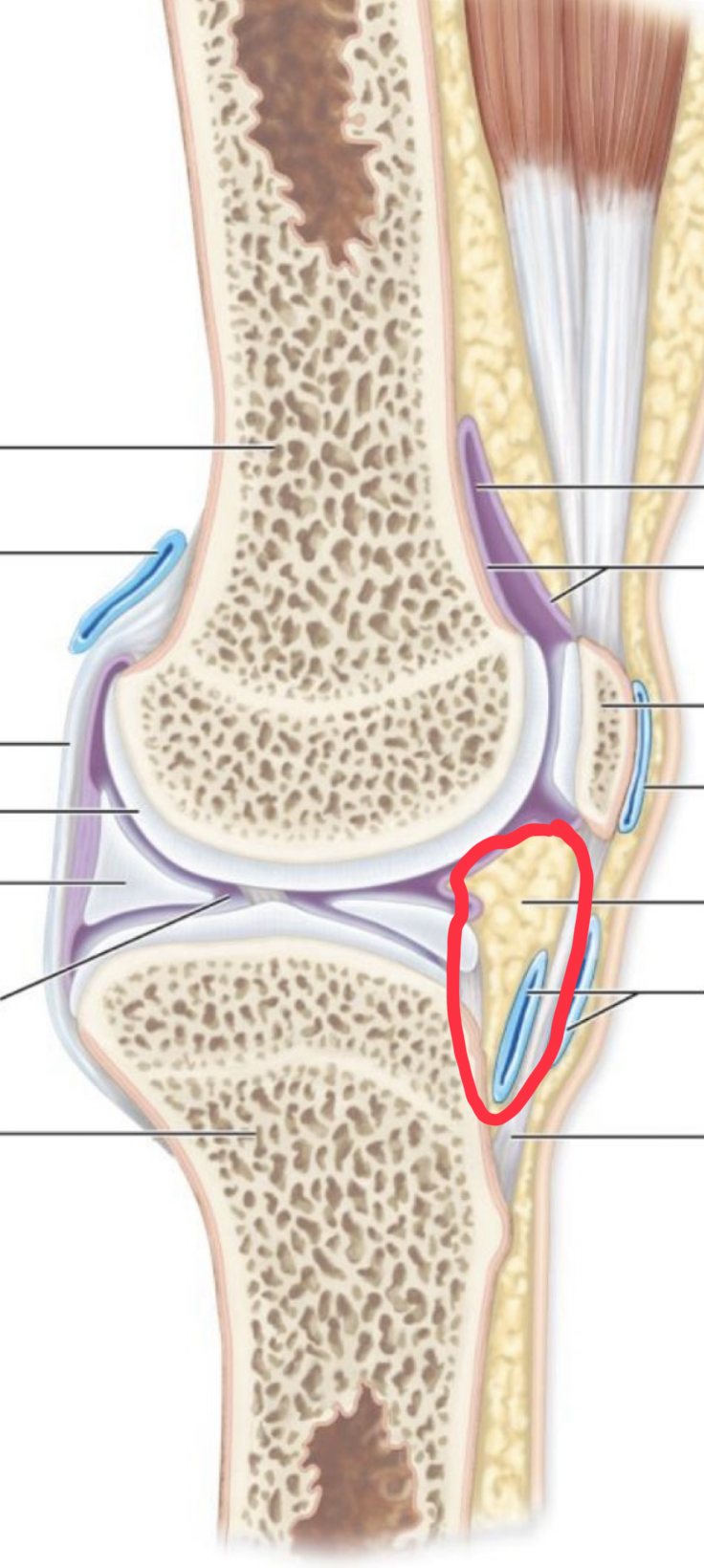
What structure is this?
Fat pad
What is an example of a first class lever?
nodding your head yes
What is an example of a second-class lever?
going on your tippy toes / plantar flexion
Where are the articulations located in the knee joint?
2 between tibia and femur, 1 between patella and femur